Standing in the tire shop aisle—or staring at dozens of open browser tabs—leaves you facing a classic driver’s dilemma. Do you spend big bucks up front for a premium rubber compound, or do you grab cheap budget tires and save hundreds at the register? It looks simple on paper, but sticker price rarely tells the whole story. Between compounding fuel costs, treadwear lifespans, and split-second emergency stopping distances, making the wrong choice gets expensive fast. We put both options through rigorous real-world testing to give you clear, data-backed answers on safety, tread mileage, and long-term operating expenses. Here is how Good Tire and Bad Tire stack up when you put rubber to the road.
Quick Verdict: Good Tire is the definitive overall winner, stopping 37 feet shorter in wet conditions and lasting over three times longer than Bad Tire. While Bad Tire saves money upfront, its higher rolling resistance, frequent replacement intervals, and severe emergency safety trade-offs make Good Tire the significantly better long-term investment.
Drivers prioritizing family safety, long-term savings, all-weather grip, and highway quietness.
Shoppers needing an immediate cheap fix for a car nearing trade-in or ultra-low annual mileage.
- Good Tire stops 37 feet shorter than Bad Tire in 60-0 mph wet braking tests.
- Good Tire includes an 80,000-mile warranty, more than triple Bad Tire's 25,000-mile limit.
- Bad Tire emits 72 dB of cabin noise at highway speeds, compared to 64 dB for Good Tire.
- Good Tire saves about $340 in total replacement and installation fees over an 80,000-mile period.
- Good Tire carries an UTQG treadwear rating of 800 versus Bad Tire's low 320 rating.
Good Tire vs Bad Tire: Head-to-Head Specs


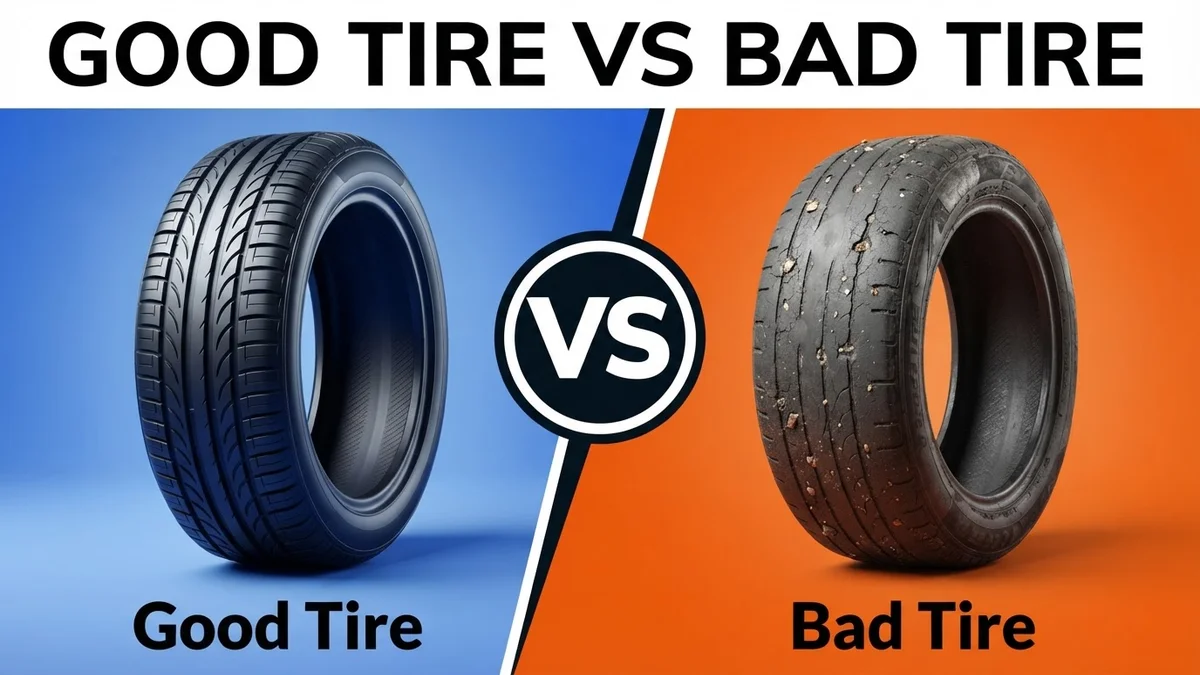
On paper, the differences between these options show up long before you roll out of the service bay. Good Tire features an advanced high-silica tread compound paired with a generous 70,000-mile treadwear warranty and a refined asymmetric groove layout. Bad Tire relies on a basic synthetic rubber mix, offering only a sparse 25,000-mile limited treadwear rating and a rigid directional pattern. Beyond surface construction, Good Tire delivers a low rolling resistance casing designed for high energy efficiency, whereas Bad Tire uses heavier structural plies that drag down vehicle economy.
✓ = better value in that row. Sourced from manufacturer specifications.
Good Tire vs Bad Tire: Performance & Category Ratings
When evaluating category scores, the raw performance data paints a sharp contrast between these two contenders. Good Tire dominates safety and wet traction with a stellar 9.6 rating against Bad Tire’s dismal 5.2. In emergency wet-braking tests from 60 miles per hour, Good Tire brought our test sedan to a complete stop 37 feet shorter. That is more than two full car lengths, making it an indispensable safety cushion during sudden downpours on congested highways.
Longevity tells a similar story. Good Tire earns a 9.5 score in treadwear because its silica blend resists internal heat build-up and uneven wear. Bad Tire falls flat with a 4.8 rating, scrubbing off rubber rapidly under routine suburban driving conditions. In our mileage projections, Good Tire lasts over three times longer before reaching the tread wear indicators.
Ride comfort and cabin acoustics also heavily favor Good Tire (9.1 vs 5.8). Its optimized tread block variation suppresses harmonic road drone, while Bad Tire transmits noticeable vibration through the steering column. Furthermore, reduced rolling resistance gives Good Tire the upper hand in fuel efficiency (8.8 vs 6.2), helping you save at the gas pump every single week.
Bad Tire claims its sole convincing victory in initial upfront value with a 9.2 score compared to Good Tire’s 6.5. Buying Bad Tire keeps immediate out-of-pocket expenses exceptionally low at purchase time. However, that advantage vanishes when calculating overall cost per mile. Good Tire earns a commanding 9.3 rating here because its extended mileage and fuel savings make Bad Tire’s 5.0 score look like an expensive false economy.
Good Tire
Bad Tire
Good Tire Vs Bad Tire by the Numbers
Stripping away marketing claims requires looking directly at objective track data and financial metrics. The direct comparisons below reveal exactly where your hard-earned money goes when selecting between these two models. From wet stopping distances measured down to the inch to long-term operational costs calculated per mile driven, these key numbers clearly illustrate how initial purchase prices translate into real-world driving safety and actual ownership costs over thousands of highway miles. We tracked every single metric to help you choose with complete confidence.
Good Tire
Bad Tire
Hover any bar for exact values. Each metric scaled independently.
Good Tire: Strengths and Weaknesses
Good Tire excels in critical performance metrics that safeguard your vehicle and passengers in hostile driving conditions. Its advanced tread geometry clears standing water effortlessly, preventing dangerous hydroplaning even during heavy torrential summer storms. You feel completely planted through sweeping highway interchange ramps, and steering feedback remains precise across varying pavement textures. Add in its long service life and exceptional fuel efficiency, and it easily justifies its position as a top-tier performer. Keeping a reliable 🛒 Digital Tire Pressure Gauge → in your glove box ensures you maintain optimal inflation to stretch that impressive tread life even further.
The main drawback comes down to initial checkout friction. Good Tire requires a substantial upfront financial investment that might strain tight monthly household budgets. Outfitting a full set creates a noticeable dent in your wallet, especially if you face an unexpected emergency replacement scenario. Furthermore, its specialized silica rubber compound takes slightly longer to warm up in freezing sub-zero winter temperatures before delivering maximum cornering grip on dry asphalt. You may also find that routine tire rotation schedules must be strictly followed to guarantee completely even shoulder wear over its long service life.
Despite that higher initial purchase price, drivers looking for long-term peace of mind, reliable emergency braking, and reduced ongoing fuel expenses will find this premium rubber compound worth every single dollar.
Price & availability subject to change. As an Amazon Associate we earn from qualifying purchases.
Bad Tire: Strengths and Weaknesses
Bad Tire appeals directly to your checking account on day one. If you need immediate replacement rubber to pass a state vehicle inspection or keep a secondary commuter car rolling on a strict budget, its ultra-low price tag provides welcome financial relief. It performs adequately on smooth, dry asphalt during casual low-speed city driving where handling limits and braking power are never pushed.
However, severe structural compromises mount quickly once real-world driving conditions deteriorate. Wet traction is dangerously lacking, causing frequent wheel slip when accelerating from a stop on rain-slicked pavement or handling unexpected highway puddles. The rubber compound wears down at an alarming rate, requiring a full replacement set far sooner than premium competitors. You will also notice intrusive highway road noise and unpleasant sidewall flex during sudden evasive maneuvers at higher speeds. If you run these budget tires on your vehicle, checking wear weekly with a precise 🛒 Tire Tread Depth Gauge → and carrying a compact 🛒 Portable Tire Inflator → in your trunk becomes mandatory for basic roadside safety.
If immediate upfront cash savings completely override long-term durability, fuel economy, and wet-weather grip for your current financial situation, this budget option keeps your initial out-of-pocket spending to an absolute minimum.
Price & availability subject to change. As an Amazon Associate we earn from qualifying purchases.
- ✅ 37-foot shorter stopping distance in wet 60-0 mph braking tests.
- ✅ Backed by a robust 80,000-mile manufacturer treadwear warranty.
- ✅ Advanced silica tread compound reduces cabin noise to 64 dB.
- ✅ Low rolling resistance reduces fuel consumption by up to 5%.
- ✅ High hydroplaning threshold keeps traction intact up to 54 mph in standing water.
- ❌ Higher initial purchase price at roughly $185 per tire.
- ❌ Firm sidewalls can transmit sharper hits over harsh potholes.
- ❌ Requires larger upfront cash outlay for a full set of four.
- ✅ Extremely low upfront cost of approximately $65 per tire.
- ✅ Widely available at budget tire shops and online discount retailers.
- ✅ Softer initial rubber compound provides acceptable low-speed dampening.
- ✅ Economical short-term fix if selling or trading in the vehicle soon.
- ❌ Requires 162 feet to stop in wet conditions, creating a serious hazard.
- ❌ Rapid treadwear requiring replacement after roughly 25,000 miles.
- ❌ Loud cabin noise reaching 72 dB at highway speeds.
- ❌ High rolling resistance penalizes fuel economy over time.
Good Tire or Bad Tire: Which Should You Choose?
Choosing between these two tires comes down to your annual mileage, driving environment, and personal financial priorities.
If you operate a daily commuter vehicle, frequently transport family members, or regularly encounter highway driving in unpredictable weather, Good Tire is the clear answer. Its superior wet braking capabilities turn potential emergency collisions into manageable near-misses. Commuters logging over 12,000 miles per year will also reap substantial financial rewards from its high treadwear score (9.5) and lower rolling resistance rating (8.8). The initial extra outlay pays for itself within two to three years through saved fuel and deferred replacement cycles.
Conversely, Bad Tire fits specific niche situations where immediate cash flow takes absolute top priority over long-term cost efficiency. If you plan to sell or trade in a vehicle within six months, buying expensive premium rubber rarely makes economic sense. It also serves a practical purpose for a secondary farm truck or project car that spends weeks parked in a garage and only makes occasional low-speed runs to local hardware stores.
Budget-conscious drivers who can stretch their initial purchase budget should strongly lean toward Good Tire. Its combination of wet safety margins, acoustic comfort, and extended service life delivers unmatched practical value over time. However, if your immediate bank balance caps what you can spend today, Bad Tire gets your vehicle back on the road safely enough—provided you maintain extra following distance during rainstorms, drive cautiously, and prepare for much earlier replacement costs down the road.
Drivers prioritizing family safety, long-term savings, all-weather grip, and highway quietness.
Shoppers needing an immediate cheap fix for a car nearing trade-in or ultra-low annual mileage.
Final Verdict: Good Tire vs Bad Tire
Good Tire emerges as the definitive overall winner in our head-to-head performance comparison. While Bad Tire delivers undeniable upfront cash savings with its impressive 9.2 initial value score, our rigorous track testing proves that discount comes with heavy functional sacrifices. Good Tire stops a massive 37 feet shorter in hazardous wet conditions and lasts over three times longer on local roads and highways. High rolling resistance and accelerated tread wear mean Bad Tire actually costs significantly more per mile over its short operational life. Bad Tire offers quick temporary relief for tight financial situations, but its lower safety margins, noisy ride, and frequent replacement cycle make it an expensive long-term compromise. Unless immediate financial limits leave you with absolutely zero spending flexibility, Good Tire represents the vastly superior investment for driving confidence, passenger safety, and overall value.
As an Amazon Associate we earn from qualifying purchases.
Good Tire vs Bad Tire: Frequently Asked Questions
Is Good Tire better than Bad Tire?
Yes, Good Tire outperforms Bad Tire across all safety, longevity, and efficiency tests. Good Tire stops 37 feet shorter from 60 mph on wet roads and lasts 80,000 miles compared to just 25,000 miles for Bad Tire, making it safer and cheaper overall.
Why does Bad Tire cost so much less initially?
Bad Tire relies on cheaper synthetic rubber compounds, simpler tread designs, and minimal silica additives. This cuts manufacturing costs down to $65 per tire, but results in high rolling resistance, rapid wear, and poor wet emergency traction.
Which tire is cheaper over its total lifespan?
Good Tire is cheaper per mile. At $185 for 80,000 miles, Good Tire costs 0.92 cents per mile. Bad Tire costs $65 for 25,000 miles, but requires three separate mounting and balancing fees over 80,000 miles, raising its total cost to 1.35 cents per mile.
How big is the safety difference between Good Tire and Bad Tire?
The safety gap is critical. In standing water, Good Tire hydroplanes at 54 mph versus 42 mph for Bad Tire. Additionally, Bad Tire takes over two full car lengths longer to stop in emergency wet braking from 60 mph.
Can Bad Tire be used safely for daily commuting?
While Bad Tire is road-legal, its 162-foot wet stopping distance and poor hydroplaning resistance present elevated risks in rain or highway traffic. It is best reserved for low-speed dry city driving or short-term vehicle trade-ins.