You step on the gas pedal, hit 55 mph, and suddenly the steering wheel starts humming against your palms. Or maybe you let go on a straight road and your car instantly veers toward the shoulder like it has a mind of its own. Both problems ruin your drive, but they point to two entirely distinct chassis services that drivers constantly confuse: Tire Balancing vs Wheel Alignment. Spending hard-earned cash on the wrong fix leaves your car shaking, eats away your rubber, and wastes money. We analyzed real-world shop data, labor expenses, and long-term wear patterns to deliver a clear, data-backed answer so you know exactly which procedure your vehicle needs right now.
Quick Verdict: Neither service replaces the other, but Wheel Alignment is the overall winner for long-term vehicle safety and tire longevity. While Tire Balancing fixes speed-sensitive steering wheel vibrations for $60-$120, Wheel Alignment protects against catastrophic uneven tread wear and steering pull at $100-$200. Both are essential maintenance, but alignment delivers greater overall ROI.
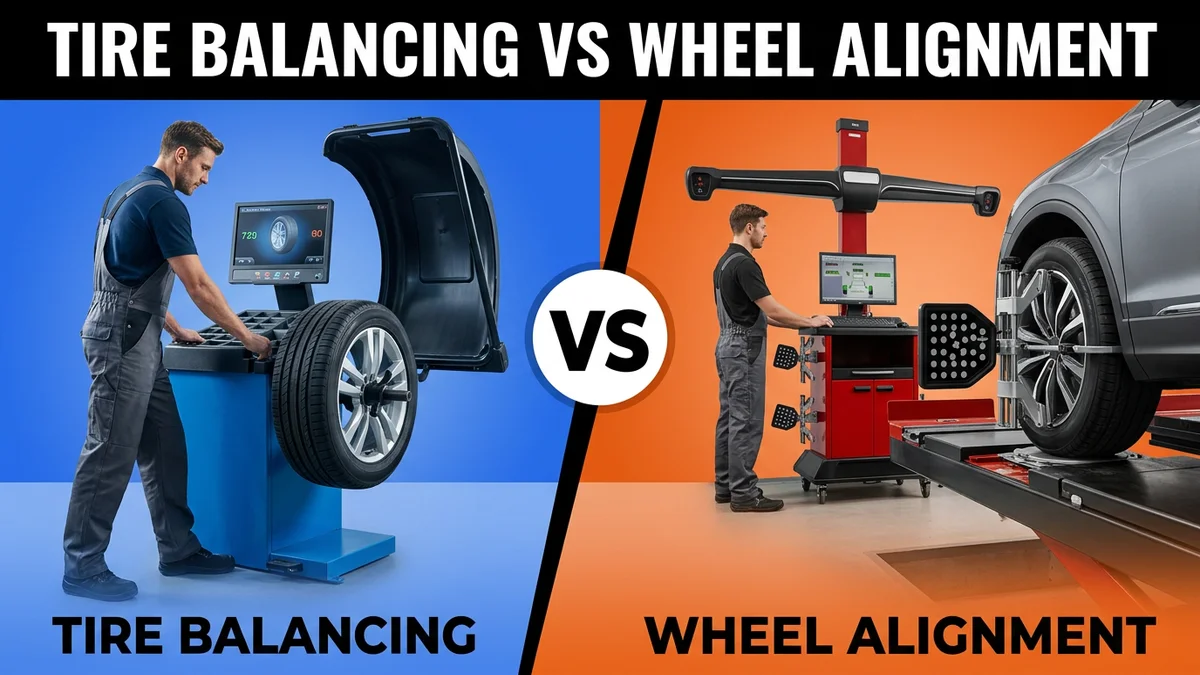
Drivers experiencing steering wheel vibrations at 50-70 mph or mounting new tires.
Drivers whose vehicle pulls to one side, hit a major pothole, or have uneven outer tread wear.
- Tire Balancing costs between $60 and $120 for 4 wheels, whereas Wheel Alignment ranges from $100 to $200.
- Wheel Alignment increases tire tread lifespan by up to 30%, compared to 20% for Tire Balancing.
- Tire Balancing is recommended every 5,000 to 7,500 miles, while Wheel Alignment is required every 12,000 to 15,000 miles.
- Tire Balancing corrects weight imbalances down to 0.10 ounces, while Wheel Alignment adjusts angles down to 0.01 degrees.
- A standard Tire Balancing takes 30 to 45 minutes, whereas a full 4-wheel Wheel Alignment takes 45 to 60 minutes.
Tire Balancing vs Wheel Alignment: Head-to-Head Specs


While drivers often lump these chassis treatments together, Tire Balancing and Wheel Alignment target completely different geometric and physical forces. Tire Balancing uses specialized spin machines to eliminate heavy spots around the wheel rim, typically charging $60 to $120 for a full vehicle set. Wheel Alignment, on the other hand, uses high-tech optical sensors to calibrate suspension angles like camber, caster, and toe for $100 to $200. Understanding how dynamic rotational force differs from static suspension alignment is crucial before handing your credit card to any mechanic shop.
✓ = better value in that row. Sourced from manufacturer specifications.
Tire Balancing vs Wheel Alignment: Performance & Category Ratings
In our evaluation of vehicle maintenance value, Tire Balancing claims a massive win in Maintenance Cost & Value with a 9.0 rating against Wheel Alignment‘s 7.8 score. Balancing costs roughly half as much upfront and delivers immediate gratification by smoothing out annoying cabin shaking. It also claims top honors in Ride Comfort at 9.2 compared to Wheel Alignment’s 8.1 score. If high-speed vibrations make your highway commute miserable, spin weights fix that exact physical defect instantly.
However, Wheel Alignment dominates every critical functional and financial dynamic over the long haul. It earns a dominant 9.4 rating in Wear Prevention compared to Tire Balancing’s 8.0, stopping hyper-aggressive tread scrubbing before it destroys a $1,000 set of rubber. For Steering Accuracy, Wheel Alignment hits an astounding 9.5 rating over Tire Balancing’s 7.5 score. Proper chassis angles guarantee your vehicle tracks dead straight without constant wrist strain on long interstate stretches.
Fuel Efficiency Impact also tilts heavily toward Wheel Alignment, scoring 8.9 versus 7.8 for Tire Balancing. Dragging misaligned tires sideways creates massive rolling resistance that silently drains your gas tank every single mile. Finally, Wheel Alignment takes Service Longevity with an 8.7 rating compared to 8.1 for Tire Balancing. While dynamic wheel weights can slip off after hitting heavy potholes or kerbs, properly torqued alignment cams maintain precise suspension geometry across thousands of brutal miles. The numbers prove that while balancing cures immediate vibration discomfort, proper alignment safeguards your vehicle’s mechanical framework, directional stability, and operational efficiency over its entire lifespan.
Tire Balancing
Wheel Alignment
Tire Balancing Vs Wheel Alignment by the Numbers
Comparing service metrics reveals stark differences in workshop execution, hardware requirements, and maintenance intervals between these two essential procedures. Tire Balancing requires a quick 30-minute wheel-off service using dynamic bench balancers and stick-on lead weights. Wheel Alignment demands up to 90 minutes on a dedicated drive-on rack with high-definition laser targets. Reviewing the hard data helps you allocate your repair budget effectively and schedule routine service visits before expensive component wear causes unmanageable repair bills.
Tire Balancing
Wheel Alignment
Hover any bar for exact values. Each metric scaled independently.
Tire Balancing: Strengths and Weaknesses
Tire Balancing excels at resolving dynamic rotational imbalances that cause steering wheel shimmy between 50 and 70 mph. When tires rotate thousands of times per minute, even a quarter-ounce weight variation creates intense centrifugal force. Spin balancing places small adhesive weights on precise rim locations, eliminating vertical hop and lateral wobble. We found this low-cost treatment ($60–$120) completely restores smooth cruising feel and protects delicate wheel bearings from harsh vibrational pounding. Drivers checking tread wear with a 🛒 Tread Depth Gauge → will notice balanced tires wear evenly across the entire surface profile without developing cupped patches or high-speed harmonics.
The limitation is that Tire Balancing cannot fix directional pulling or tracking issues. If your car drifts toward the ditch when you release the wheel, balancing offers zero structural correction. It also cannot stop rapid shoulder scrub caused by incorrect suspension geometry. Over time, curb impacts, heavy brake wear, or weight loss from shed rim weights force you back to the balancing machine. It remains an essential low-cost service, but treating it as a total chassis cure-all is a costly mistake that ignores structural vehicle tracking.
Once you confirm your wheels are rotating smoothly without speed-sensitive shake, evaluating your vehicle’s directional tracking becomes the logical next step.
Price & availability subject to change. As an Amazon Associate we earn from qualifying purchases.
Wheel Alignment: Strengths and Weaknesses
Wheel Alignment corrects the physical position of your vehicle’s suspension components, ensuring all four tires point in exact parallel symmetry. Technicians adjust three primary geometric settings: camber (inward or outward tilt), toe (inward or outward angle from above), and caster (steering axis angle). Proper alignment keeps your vehicle tracking straight, eliminates dangerous steering pull, and prevents uneven edge wear that ruins fresh rubber in under 10,000 miles. Keeping a 🛒 Digital Tire Pressure Gauge → in your glove box helps maintain optimal inflation alongside correct alignment angles for flawless straight-line stability.
The main drawback is price and labor intensity. A quality four-wheel alignment costs between $100 and $200 and takes significantly longer to perform on specialized laser alignment racks. Furthermore, alignment does not cure high-speed rotational vibrations if your tire rim assemblies remain out of weight balance. Worn ball joints, bent tie rods, or sagged control arm bushings can also prevent technicians from achieving proper factory specifications until expensive suspension repairs are completed first.
With a complete understanding of suspension geometry under your belt, choosing the precise service for your current driving conditions comes down to recognizing key warning signs.
Price & availability subject to change. As an Amazon Associate we earn from qualifying purchases.
- ✅ Costs significantly less per service ($60-$120 for all four wheels).
- ✅ Eliminates annoying high-speed steering wheel vibrations and seat shimmies.
- ✅ Takes less labor time to perform at the shop (30 to 45 minutes).
- ✅ Prevents localized tread cupping and flat spots on tires.
- ❌ Needs to be performed more frequently (every 5,000 to 7,500 miles).
- ❌ Cannot correct vehicle pulling or steering wheel off-center issues.
- ❌ Does not adjust or correct underlying suspension components.
- ✅ Delivers superior tire tread protection, increasing overall lifespan by up to 30%.
- ✅ Prevents vehicle pulling, drift, and erratic highway tracking.
- ✅ Improves overall fuel economy by eliminating tire dragging resistance.
- ✅ Includes a comprehensive suspension and steering system safety inspection.
- ❌ Costs substantially more than basic tire balancing ($100 to $200).
- ❌ Requires specialized laser imaging rigs and longer service labor time.
- ❌ Settings can be knocked out of spec by severe pothole or curb impacts.
Tire Balancing or Wheel Alignment: Which Should You Choose?
Selecting the right service depends entirely on your vehicle’s specific symptoms and your maintenance history. If your primary complaint is a rapid vibration in the steering wheel or seat floorboard that appears only at highway speeds, Tire Balancing is your immediate solution. Budget-conscious drivers getting seasonal tire swap-outs or installing a new tire set should automatically opt for balancing to guarantee smooth high-speed performance right out of the shop bay.
Conversely, if your car pulls strongly toward one side on flat asphalt, or if you spot uneven wear along the inside or outside tire shoulders, Wheel Alignment is mandatory. Daily highway commuters, heavy haulers, and drivers who regularly navigate harsh winter roads filled with severe potholes need alignment inspections annually. Striking a curb at speed easily knocks toe angles out of spec, causing silent tire destruction long before you feel mechanical failure.
For comprehensive vehicle protection, smart owners combine both services when buying fresh tires. If you frequently check inflation using a 🛒 Portable Tire Inflator → and secure your vehicle on steep driveways with 🛒 Heavy-Duty Tire Wheel Chocks → during routine home maintenance, you already appreciate baseline vehicle care. Spending $60 to $120 on Tire Balancing fixes current riding discomfort, while investing $100 to $200 in Wheel Alignment prevents severe mechanical stress and maximizes tread life across 50,000 miles of driving.
Drivers experiencing steering wheel vibrations at 50-70 mph or mounting new tires.
Drivers whose vehicle pulls to one side, hit a major pothole, or have uneven outer tread wear.
Final Verdict: Tire Balancing vs Wheel Alignment
While neither service replaces the other, Wheel Alignment takes the overall victory as the superior long-term vehicle maintenance investment. Tire Balancing is an essential, highly affordable ($60–$120) fix that solves high-speed steering wheel vibrations and boosts overall cabin comfort. However, Wheel Alignment ($100–$200) delivers unmatched return on investment by protecting against severe tire scrub, maintaining steering accuracy, improving gas mileage, and preventing premature failure of expensive suspension components.
The core trade-off comes down to immediate comfort versus long-term financial preservation. Tire Balancing delivers an exceptionally smooth ride for minimal cash, but Wheel Alignment protects your tires, steering system, and fuel budget over tens of thousands of miles. For maximum tire life and safety, treat Tire Balancing as a regular comfort tune-up during tire rotations, but rely on Wheel Alignment as your primary defense against costly vehicle wear.
As an Amazon Associate we earn from qualifying purchases.
Tire Balancing vs Wheel Alignment: Frequently Asked Questions
Is Tire Balancing better than Wheel Alignment?
Neither service is strictly better because they fix entirely different problems. Tire Balancing corrects weight imbalances to eliminate vibrations at 50-70 mph, while Wheel Alignment adjusts suspension angles to stop pulling and edge wear. For complete tire health, performing both services as recommended yields the best long-term results.
How much do Tire Balancing and Wheel Alignment cost in 2026?
Tire Balancing typically costs $15 to $30 per tire, amounting to $60 to $120 for a set of four. A standard four-wheel Wheel Alignment costs between $100 and $200 depending on vehicle make and shop equipment.
How often should you get Tire Balancing and Wheel Alignment done?
Get Tire Balancing done every 5,000 to 7,500 miles, usually combined with regular tire rotations. Schedule a Wheel Alignment every 12,000 to 15,000 miles, or immediately after buying new tires, hitting severe potholes, or modifying your suspension.
What are the key symptoms telling you which service you need?
If your steering wheel vibrates at highway speeds, you need Tire Balancing. If your vehicle pulls to the left or right on a straight road, or your steering wheel is crooked while driving straight, you need a Wheel Alignment.
Can a beginner diagnose whether they need Tire Balancing or Wheel Alignment?
Yes. Drive on a smooth, flat road at 55 mph. If you feel a rhythm vibration through the steering wheel or seat, request Tire Balancing. If you briefly release the wheel and the car drifts into another lane, schedule a Wheel Alignment.