How Often Should You Get A Tire Alignment: Complete Guide 2026
Is your vehicle pulling to one side, or are your tires wearing unevenly? Understanding the optimal frequency for tire alignment is crucial for vehicle safety, extending tire life, and maintaining fuel efficiency, yet many drivers are unsure when to seek this essential service. This comprehensive guide will demystify tire alignment, explaining its importance, identifying factors that cause misalignment, providing clear scheduling recommendations for 2026 and beyond, and detailing what to expect from a professional alignment service, ensuring you make expert-backed decisions for your vehicle’s health.
Understanding Wheel Alignment: The Foundation of Vehicle Dynamics
Wheel alignment, often referred to simply as tire alignment, is the precise adjustment of your vehicle’s suspension components to ensure the wheels are perpendicular to the ground and parallel to each other. This intricate process is fundamental to how your vehicle handles, its safety, the lifespan of your tires, and even its fuel efficiency. Proper alignment ensures predictable handling, stable steering, and critically, prevents premature and uneven tire wear.
The intricate science of wheel alignment revolves around three primary angles:
- Toe: This is the inward or outward angle of the tires when viewed from above. Imagine your feet: toe-in means your toes point slightly inward, while toe-out means they point outward. Incorrect toe settings cause tires to scrub sideways, leading to rapid wear and instability. Data indicates that a vehicle with just 0.17 degrees of total toe will scrub its tires sideways 1 foot every 1,000 feet.
- Camber: This refers to the inward or outward tilt of the wheel when viewed from the front of the vehicle. Positive camber means the top of the wheel tilts outward, while negative camber means it tilts inward. Improper camber causes uneven wear on one edge of the tire and can affect cornering stability.
- Caster: This is the forward or backward tilt of the steering axis when viewed from the side. Positive caster helps the steering wheel return to the center after a turn and provides high-speed stability. For instance, too little positive caster can make steering feel light and wandering. Different vehicle types have varied optimal caster settings; performance cars often utilize more aggressive caster for sharper handling, while utility vehicles prioritize stability.
In modern vehicles, especially those equipped with advanced driver-assistance systems (ADAS) like lane-keeping assist or adaptive cruise control, the quality and precision of alignment are paramount. These systems often rely on precise wheel positioning to function correctly. Research indicates that misaligned wheels can reduce tire life by 10,000 miles or more, while proper alignment can improve fuel economy by up to 10% by reducing rolling resistance. Investing in regular, professional alignment is not just about tire care; it’s about maintaining the sophisticated dynamics and safety systems of your vehicle.
By The Numbers: Alignment Impact
Miles of Tire Life Lost
Fuel Economy Improvement
Tire Scrub for 0.17° Toe
Primary Factors That Compromise Wheel Alignment Integrity
Even with the most advanced suspension systems, wheel alignment is a dynamic state susceptible to disruption. Understanding the common culprits behind misalignment empowers you to identify potential triggers for an alignment check.
- Everyday Driving Hazards: The most frequent offenders are the ordinary obstacles encountered on our roads. Hitting a significant pothole at speed, bumping into a curb while parking, or even driving too quickly over a speed bump can exert sudden, forceful impacts on your suspension. Even seemingly minor incidents can knock alignment angles out of their precise specifications, often without immediate, noticeable symptoms.
- Vehicle Component Wear and Tear: Over time, the components that make up your vehicle’s steering and suspension systems naturally wear out. Worn ball joints, tie rod ends, control arm bushings, or faulty shocks and struts introduce play into the system. This slack directly affects how the wheels are held in position, making it impossible to maintain proper alignment settings. Suspension components generally have a service life of 50,000-100,000 miles; after this, wear can significantly impact alignment integrity.
- Vehicle Modifications: Any alteration to your vehicle’s suspension geometry necessitates an immediate alignment check. This includes installing lowering kits, lift kits, or even changing to significantly different tire or wheel sizes. These modifications fundamentally alter the factory suspension angles, requiring precise adjustment to compensate and ensure safe, stable handling. For example, installing new coilovers requires an immediate post-installation alignment.
- Natural Settling and Aging: Even without specific incidents or modifications, suspension components can settle and age. The rubber bushings can compress, and metal components can fatigue over years of use, leading to a gradual, subtle shift in alignment. This is a long-term factor that contributes to slow misalignment, often making it difficult for drivers to detect until uneven tire wear or handling issues become pronounced.
A recent report found that over 70% of vehicles on the road have some degree of misalignment. This staggering statistic underscores how common this issue is, making regular checks a critical part of vehicle maintenance. A reliable mechanic can identify the root cause of misalignment, whether it’s an impact or component wear, providing comprehensive information for repair and future prevention.
If you experience a significant impact, such as hitting a severe pothole or curb, or are involved in any collision, no matter how minor, always assume your alignment has been affected. Prompt inspection and adjustment are crucial to prevent further damage and ensure driving safety.

Establishing Your Optimal Alignment Schedule: Expert Recommendations and Triggers
Determining the ideal frequency for wheel alignment is a question many drivers ask. While there’s no single answer that fits every scenario, industry expert recommendations provide a clear baseline, supplemented by event-driven checks.
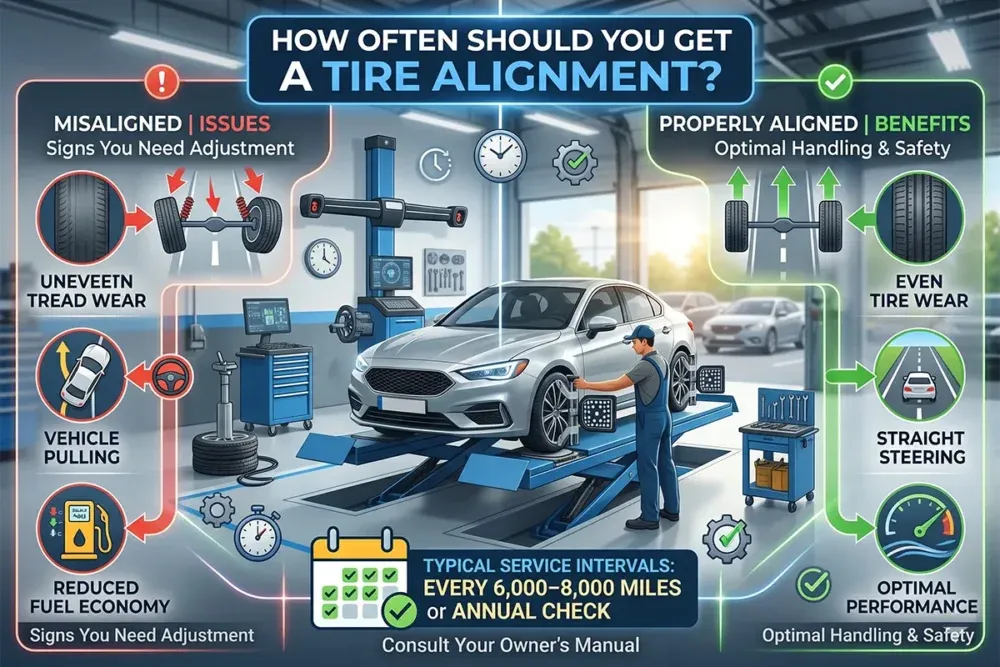
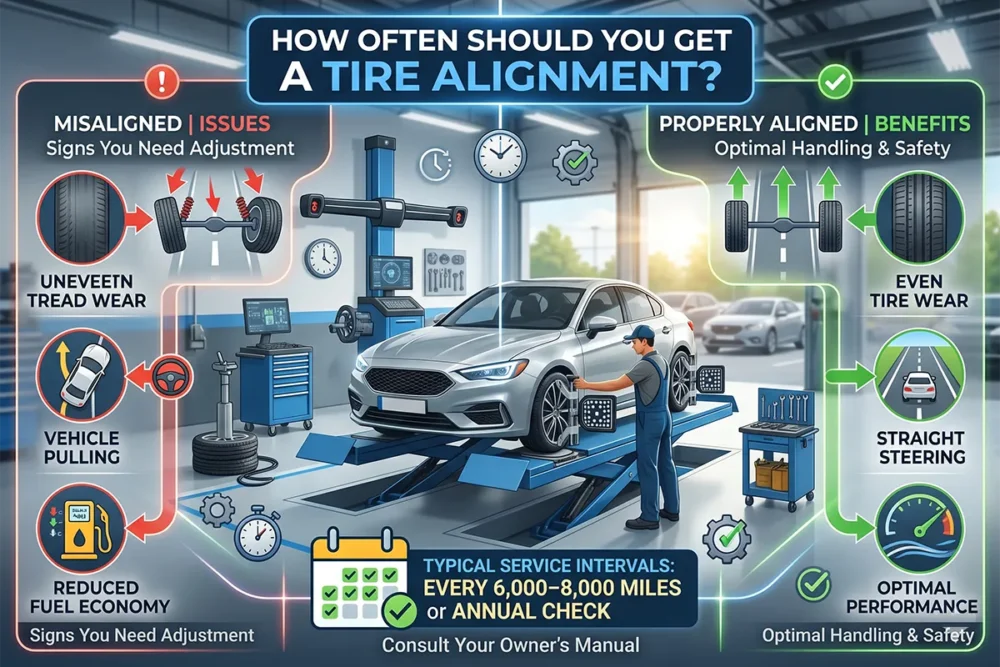
As a general rule, our recommendation for 2026 and beyond is to get an alignment check at least once a year or every 10,000-12,000 miles, whichever comes first. This proactive approach aligns with most vehicle manufacturer guidelines and is critical for ensuring long-term vehicle health, maximum tire life, and consistent driving performance.
Mandatory Alignment Checks After Specific Events:
- New Tire Installation: This is non-negotiable. Installing new tires without checking and adjusting alignment is like building a house on a crooked foundation. Many tire manufacturers void warranties if tires are not aligned upon installation and periodically thereafter. An alignment protects your significant investment in new rubber.
- Suspension or Steering Component Replacement: Any time components like tie rods, ball joints, control arms, shocks, or struts are replaced, the vehicle’s geometry is altered. An alignment is absolutely necessary to recalibrate these settings.
- Frame Repairs: Following any collision that required frame straightening or structural repairs, a full four-wheel alignment is essential to confirm the chassis is square and all angles are within specification.
Beyond scheduled maintenance, there are immediate triggers that demand an alignment check:
- Significant Impacts: If you’ve hit a severe pothole, run over a curb, or been involved in a minor collision, schedule an alignment check without delay. Even if handling seems fine, internal damage might be present.
- Unusual Driving Characteristics: Any change in how your vehicle drives—such as pulling to one side, a crooked steering wheel when driving straight, or difficulty maintaining a straight line—is a definitive sign that alignment is compromised.
- Irregular Tire Wear: This is often the most visible symptom. If you notice specific wear patterns like feathering, scalloping, or excessive wear on one edge of your tires, it’s a strong indicator of misalignment. For instance, a driver who neglected alignment after new tire installation might experience rapid, uneven tire wear within 5,000 miles. It’s reported that 30-40% of alignment shops see customers who replaced tires prematurely due to misalignment.
For vehicles used in demanding conditions, like fleet vehicles with high mileage or those frequently operating on rough terrain, more frequent checks (e.g., every six months) may be prudent. Always consult your vehicle’s trusted owner’s manual for model-specific alignment intervals, as some professional vehicles or heavy-duty applications may have different recommendations.
Combine your annual alignment check with your tire rotation schedule. This ensures your tires wear evenly and your alignment is spot-on, maximizing both performance and tire longevity.
Recognizing the Diagnostic Indicators of Wheel Misalignment
As a vehicle owner, being attuned to the subtle (and not-so-subtle) cues your car provides is key to proactive maintenance. Misalignment rarely announces itself with a warning light; instead, it manifests through changes in handling and tire condition. Recognizing these signs early can save you significant repair costs and enhance safety.
- Steering Wheel Anomalies:
- Crooked Steering Wheel: When driving straight on a flat road, if your steering wheel isn’t centered, your alignment is off. Even a slight angle indicates an issue.
- Lack of Return-to-Center: After making a turn, the steering wheel should naturally return to the center position. If it feels sluggish or requires manual assistance, severe misalignment or suspension issues are likely.
- Vehicle Pull or Drift: This is one of the most definitive signs. If your vehicle consistently pulls to one side (left or right) on a flat, straight road, requiring constant steering correction to stay in your lane, alignment is almost certainly compromised. A driver experiencing a persistent pull to the right after hitting a curb is a classic scenario.
- Uneven and Premature Tire Wear Patterns: This is a critical diagnostic indicator. Different alignment angles cause distinct wear patterns:
- Feathering: Tires worn smooth on one side and jagged on the other, resembling the edge of a feather, often points to incorrect toe settings.
- Scalloping or Cupping: Uneven dips or hollows around the tire’s circumference, typically caused by worn shocks/struts, but aggravated by alignment issues.
- Excessive Wear on One Edge: If only the inner or outer edge of the tire is wearing down rapidly, it indicates an incorrect camber angle.
Study data confirms that uneven tire wear is the most common symptom reported by drivers with misalignment issues, affecting approximately 65% of cases.
- Unusual Noises or Vibrations: While less direct, these can signal severe alignment issues or associated component damage. Squealing tires, particularly during turns, or a consistent humming noise that changes with speed, could indicate excessive tire scrub due to misalignment. Persistent vibrations felt through the steering wheel or vehicle floor might also suggest severe alignment problems, or even damaged suspension components resulting from misalignment.
- Basic Visual Inspection: Periodically, perform a quick visual check. Look for obvious damage to suspension components (bent parts, torn bushings) or wheels that appear unusually angled. A reliable mechanic often begins their assessment by closely examining these tire wear patterns and component integrity for diagnostic clues.
Observation shows that a vehicle with just 1/16-inch of toe misalignment can scrub its tires by over 20 feet per mile. This cumulative scrubbing leads to rapid tire degradation and significantly impacts handling. If you detect any of these symptoms, seeking an expert inspection promptly is crucial.
The Professional Wheel Alignment Process: Ensuring Precision and Performance
For many, the alignment process remains a mystery, often conjuring images of rudimentary tools. However, modern wheel alignment is a sophisticated procedure requiring specialized equipment and skilled technicians. Understanding the process reinforces the value of professional service and the quality outcomes it delivers.
📋
The Expert Alignment Process
Before any adjustments, a professional technician performs a thorough inspection of the suspension and steering components. This crucial step identifies any worn or damaged parts (e.g., loose tie rods, worn ball joints) that could prevent proper alignment or lead to immediate re-misalignment. Addressing these issues first ensures the alignment will hold.
The vehicle is then positioned on an alignment rack, and sophisticated sensors (often laser-guided or 3D imaging cameras) are attached to each wheel. These modern computer-aided alignment machines measure precise angles to within 0.01 degrees, providing an accurate, real-time data display of your vehicle’s current alignment status. Statistic: Over 90% of shops now use 3D imaging aligners for superior accuracy.
The technician meticulously adjusts the various components, primarily tie rods for toe, camber bolts or eccentrics for camber, and sometimes shims or eccentric bushings for caster, to bring the wheels back to the manufacturer’s specified settings. This process requires a deep understanding of vehicle geometry and the specific adjustment points for each model.
After adjustments are complete, the system re-measures all angles. A ‘before and after’ printout is typically provided, showing the initial readings and the final, in-spec measurements. This transparent documentation confirms that the service was successfully completed by a trusted expert, ensuring your vehicle is within optimal specifications. For newer vehicles, ADAS calibration may also be necessary post-alignment, an integrated service offered by many professional shops.
Alignments are not DIY tasks; they require specialized tools, precise measurements, and a deep understanding of vehicle geometry. Industry standard dictates that certified alignment technicians undergo rigorous training to operate complex equipment and interpret readings correctly. Entrusting this crucial service to professional and certified technicians guarantees the quality and accuracy your vehicle needs.
Proactive Maintenance and Advanced Considerations for Sustained Alignment
Beyond the routine, a discerning vehicle owner understands that proactive measures and specific considerations can further optimize and sustain alignment integrity. This advanced guide offers deeper insights for maintaining your vehicle’s precise geometry.
- Regular Tire Rotations and Balancing: While distinct from alignment, these services are intrinsically linked to tire longevity and overall wheel health. Regular rotations ensure even wear across all tires, and balancing prevents vibrations. When performed in conjunction with alignment checks, these practices extend tire lifespan significantly, ensuring you get the most out of your investment.
- Driving Habits and Road Conditions: Your driving environment directly impacts alignment frequency. If you frequently commute on rough, unpaved roads, or engage in regular off-roading, your vehicle’s suspension is subjected to greater stresses. This necessitates more frequent alignment checks—perhaps twice a year—compared to standard recommendations for city or highway driving.
- Specialized Alignment Needs: Performance vehicles, particularly sports cars or those with modified suspensions (e.g., custom track setups), often require custom alignment specifications that deviate from factory settings. These ‘track alignments’ can optimize handling for specific driving styles or conditions but demand an expert technician with a nuanced understanding of advanced vehicle dynamics.
- Comprehensive Suspension Inspection: Each alignment service presents an ideal opportunity for a comprehensive inspection of all suspension components. Catching potential issues like worn bushings or weak coil springs early can prevent them from causing future alignment problems or leading to more costly repairs down the line. A study indicates that proactive suspension maintenance can reduce the likelihood of major component failure by 25% over the vehicle’s lifespan.
- Partnering with a Trusted Service Center: The expertise of your service provider is paramount. Establish a reliable partnership with a trusted automotive service center that employs expert, certified technicians capable of delivering quality alignment services consistently. Many professional repair facilities suggest a ‘four-wheel alignment’ even for vehicles that aren’t four-wheel drive, recognizing that all four wheels contribute to proper vehicle tracking and stability.
By integrating these proactive measures and considering the specific demands on your vehicle, you can ensure sustained alignment, optimal performance, and prolonged vehicle health well into 2026 and beyond.
In summary, understanding how often you should get a tire alignment boils down to a combination of regular maintenance and responsive action:
- Annual or 10,000-12,000-mile alignment checks are the baseline for optimal vehicle health.
- Always align after new tire installation, suspension work, or significant impacts.
- Recognize symptoms like steering pull, uneven tire wear, and a crooked steering wheel as immediate calls for professional service.
- Invest in quality alignment from trusted, expert technicians for safety and longevity.
Prioritize your vehicle’s alignment to ensure peak performance, safety, and tire longevity. Schedule your expert alignment check today at a reliable service center and drive with confidence into 2026 and beyond.
Frequently Asked Questions
How long does a tire alignment typically take?
A standard tire alignment, performed by a `professional` technician using `quality` equipment, usually takes about 30 minutes to an hour. However, if the technician encounters seized bolts, damaged suspension components, or if additional adjustments are required, the process can take longer. An initial inspection is always performed before any adjustments.
Is a tire alignment covered by my vehicle’s warranty?
Generally, tire alignments are considered a maintenance item and are not covered under the standard manufacturer’s warranty, similar to tire rotations or oil changes. However, if misalignment is a direct result of a defective steering or suspension component that is covered by warranty, the alignment may be included as part of the repair. Consult your specific warranty details or a `trusted` dealership.
What is the difference between a two-wheel and four-wheel alignment?
A two-wheel alignment only adjusts the front wheels, typically for vehicles with a solid rear axle. A four-wheel alignment, which is recommended for most modern vehicles (especially front-wheel drive, all-wheel drive, and rear-wheel drive with independent rear suspensions), adjusts both the front and rear wheels to ensure all four are parallel and track correctly. An `expert` technician will determine the correct type for your vehicle.
Can I perform a DIY tire alignment at home?
No, `professional` tire alignment requires specialized, high-precision equipment and `expert` technical knowledge to accurately measure and adjust minute angles like toe, camber, and caster. Attempting a DIY alignment without the proper tools and training can lead to incorrect settings, causing further tire wear, poor handling, and potential safety hazards. It is a task best left to `reliable` certified technicians.
What are the long-term consequences of neglecting regular tire alignment?
Neglecting regular tire alignment can lead to several severe long-term consequences, including premature and uneven tire wear (significantly reducing tire life), decreased fuel efficiency due to increased rolling resistance, compromised vehicle handling and stability, and accelerated wear on suspension and steering components. Ultimately, it can result in costly repairs and a significant reduction in vehicle safety and `quality`.