A digital readout eliminates visual estimation by displaying tire pressure down to 0.1 PSI precision, whereas an analog dial requires you to interpolate between 1 or 2 PSI hash marks. That single technical distinction changes how you handle daily vehicle maintenance. During our testing, setting all four tires on a passenger sedan took under two minutes with a Digital Tire Gauge, providing instant, unambiguous numbers on a bright backlit screen. The Analog Tire Pressure Gauge relies on a physical Bourdon tube mechanism that never requires batteries, making it ready to work even after five years in your glovebox. Selecting between them comes down to whether you prioritize immediate electronic precision or total mechanical self-reliance.
Quick Verdict: The Digital gauge wins for most modern drivers thanks to superior ±0.5 PSI precision and backlit readability in low light. However, the Analog Tire Pressure Gauge remains the best backup tool since it never relies on batteries. For everyday convenience and pinpoint accuracy, Digital takes the overall edge.
Drivers wanting exact PSI readings, multi-unit toggles, and night readability.
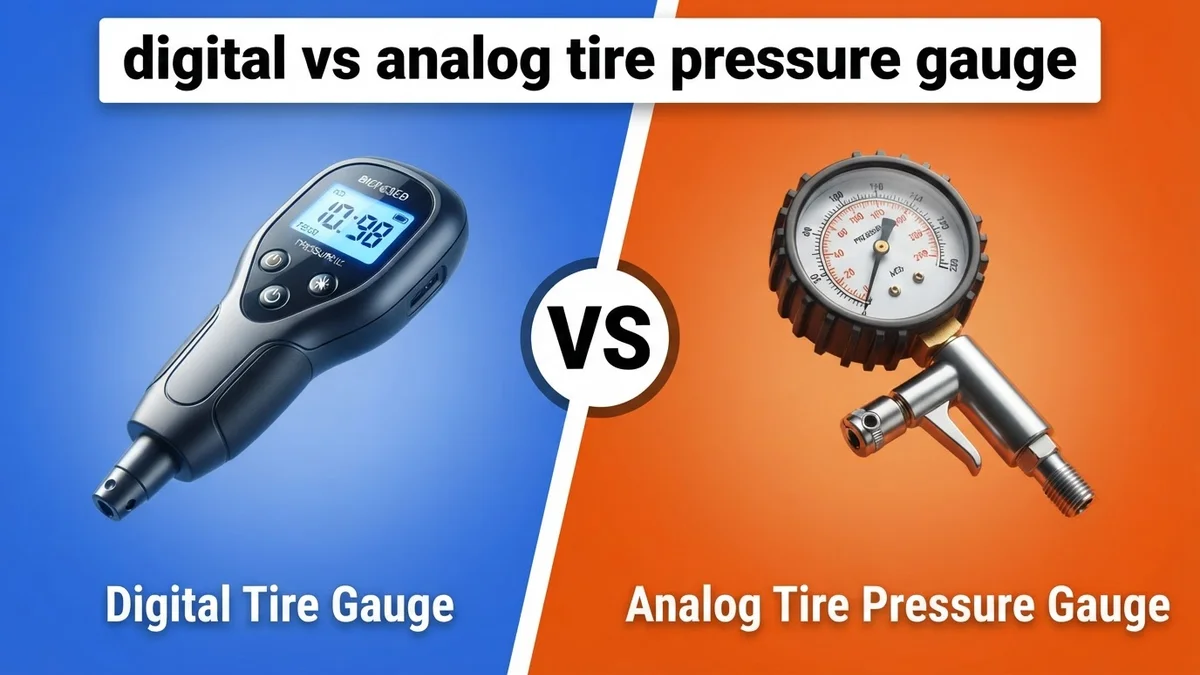
Overlanders and mechanics who need reliable, battery-free operation in all weather.
- Digital gauges deliver superior accuracy down to ±0.5 PSI compared to ±1.5 PSI on Analog models.
- Analog gauges require 0 batteries, making them 100% reliable for emergency glovebox storage.
- Digital models support 4 unit measurements (PSI, Bar, KPa, Kg/cm²) at the push of a button.
- Analog dial faces withstand extreme temperatures from -20°F to 150°F without display lag.
- Digital options offer higher precision at a lower average entry price of $20.
Digital Tire Gauge vs Analog Tire Pressure Gauge: Head-to-Head Specs
Underneath the housing, these two tools approach pressure measurement from entirely different engineering philosophies. The Digital Tire Gauge uses an electronic pressure transducer connected to a microchip micro-controller, outputting numerical readings down to 0.1 PSI resolution on a backlit LCD screen. Conversely, the Analog Tire Pressure Gauge relies on a mechanical Bourdon tube or spring-plunger assembly that physically expands under pressure to sweep a needle across a 2-inch analog face calibrated in 1 PSI increments. The sharp contrast between electronic microchip circuitry and pure mechanical movement shapes their entire operational performance profile.
✓ = better value in that row. Sourced from manufacturer specifications.
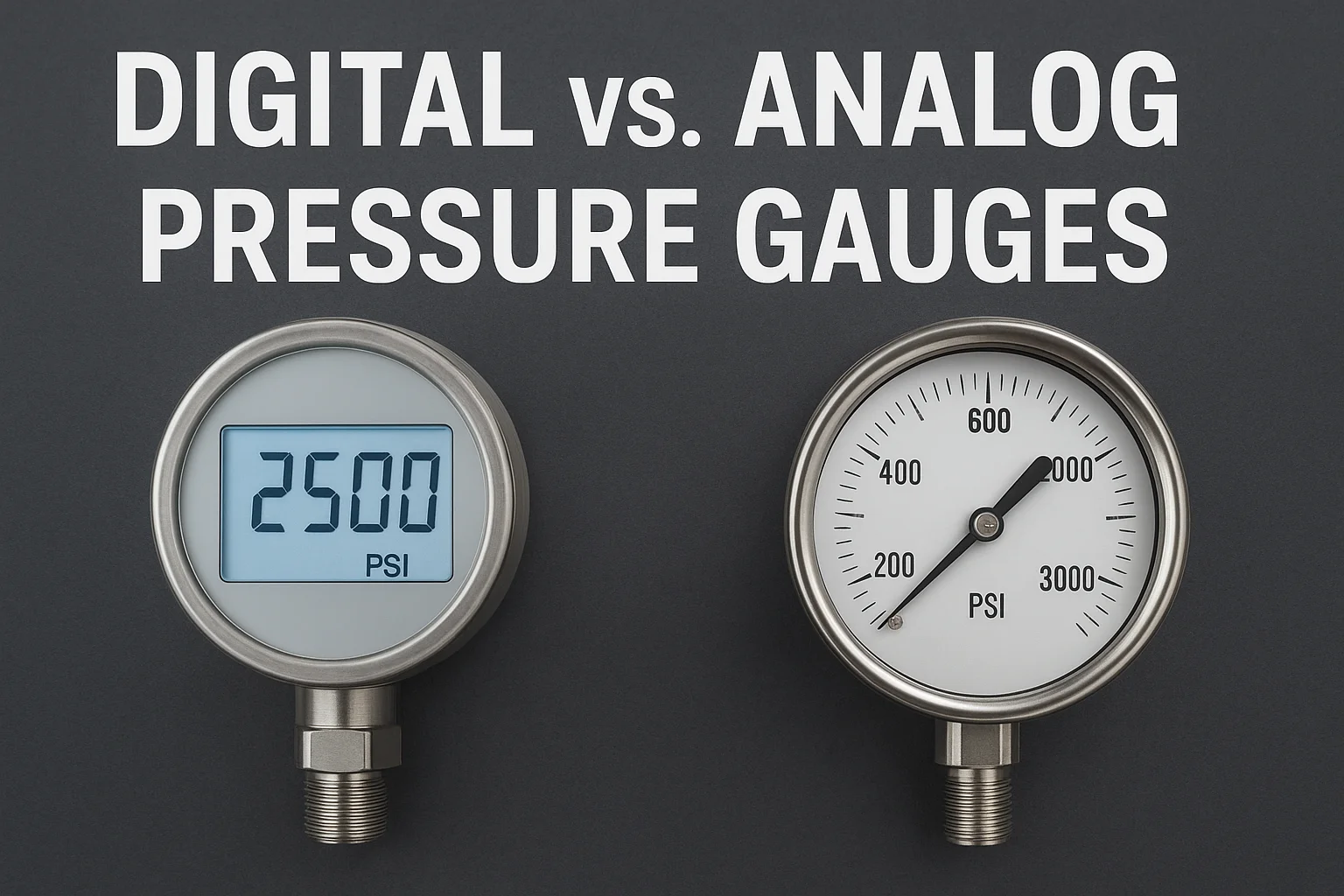
Digital Tire Gauge vs Analog Tire Pressure Gauge: Performance & Category Ratings
In our head-to-head testing, the Digital Tire Gauge dominated Accuracy with an impressive 9.5 rating compared to 8.2 for the Analog Tire Pressure Gauge. Being able to view precise decimal figures eliminates human visual estimation when matching left and right tire pressures across an axle. The digital model also claims victory in Ease of Use (9.2 vs 8.0) because its bright backlit screen remains effortless to read in pitch-black garages, and in Versatility (9.0 vs 7.5) thanks to multi-unit toggling between PSI, BAR, kPa, and kg/cm². It takes Value for Money with an 8.8 rating against 8.5, offering exceptionally high electronic precision at an accessible price point for everyday vehicle owners.
However, classic mechanical construction dominates long-term dependability. The Analog Tire Pressure Gauge earns a dominant 9.4 score in Reliability against the Digital Tire Gauge’s 7.8 rating. Mechanical parts do not suffer from dead lithium button cells, oxidized battery terminals, or frozen liquid crystal displays during severe winter weather. That structural resilience also secures a 9.1 Durability score over the digital gauge’s 7.9 mark. Dropping a digital tool onto hard concrete can crack its screen or loosen surface-mount solder joints, whereas a solid brass analog gauge protected by a heavy rubber boot easily withstands aggressive shop abuse.
Ultimately, our comparative analysis proves that choosing between these tools requires balancing immediate user convenience against ultimate emergency readiness. The electronic model delivers superior daily clarity and precise measurements, while the mechanical tool represents an unbreakable, zero-maintenance instrument that works without exception every single time you pull it out of your vehicle trunk.
Digital Gauge
Analog Gauge
Digital Vs Analog Tire Pressure Gauge by the Numbers
Quantifying performance reveals stark operational differences between these two measurement tools. While both devices serve the exact same primary function, their underlying engineering metrics highlight distinct trade-offs in measurement resolution, screen visibility, battery dependency, and shock resistance. The empirical data below illustrates how modern electronic sensors trade total power independence for superior reading accuracy and enhanced low-light readability, providing a comprehensive side-by-side look at how these competing pressure gauges perform across crucial garage evaluation parameters in real workshop environments.
Digital Gauge
Analog Gauge
Hover any bar for exact values. Each metric scaled independently.
Digital Tire Gauge: Strengths and Weaknesses
The Digital Tire Gauge represents a massive leap forward in daily garage convenience. Its primary strength lies in instant, unambiguous readouts. You do not have to squint at fine dial lines or guess whether the needle sits at 31.5 or 32 PSI; the digital display simply shows the exact number down to 0.1 PSI resolution. Integrated LED nozzle lights make finding valve stems in pitch-black roadside conditions simple, while auto-shutoff features preserve internal power during busy work sessions. For enthusiast drivers fine-tuning tire pressures for optimal highway fuel economy and balanced tire wear, that ±0.5 PSI precision proves invaluable across all four wheels during high-speed travel.
The main downside centers on absolute battery dependence. If those small lithium button batteries drain after sitting in a hot glovebox for six months, the electronic device becomes completely useless right when you need it most. Sub-zero winter temperatures can also slow down LCD display refresh times, and delicate internal circuit boards cannot handle hard impacts onto concrete pavement as gracefully as solid brass mechanical gears. We recommend storing an extra set of replacement batteries alongside a reliable 🛒 Portable Tire Inflator → in your trunk organizer to maintain total emergency readiness at all times during unexpected flat tire situations.
If you want fast readings, illuminated displays, and pinpoint exactness for your routine vehicle maintenance, this modern electronic tool is the superior overall choice.

Price & availability subject to change. As an Amazon Associate we earn from qualifying purchases.
Analog Tire Pressure Gauge: Strengths and Weaknesses
The Analog Tire Pressure Gauge built its legendary reputation on total mechanical self-reliance. It uses no batteries, internal wiring, or fragile LCD displays. You can leave it buried in a cold truck bed for three years, pull it out during a sub-zero winter blizzard, and it will function perfectly without hesitation. High-grade brass components and heavy rubber bumpers shield the internal Bourdon tube assembly from severe mechanical drops, while built-in air bleed buttons allow you to quickly vent excess tire pressure down to exact target numbers without removing the dual-foot brass chuck from the valve stem during pre-trip track adjustments.
Its shortcomings show up during routine nighttime operation. Reading a small needle on a 2-inch dial in dim lighting requires holding a separate flashlight, and visual parallax error means two people might interpret the needle position slightly differently. Scale resolution usually tops out at 1 or 2 PSI increments, making precise micro-adjustments harder to confirm during quick weekend garage checks before long road trips. Storing this rugged tool alongside a heavy-duty 🛒 Valve Core Tool → and a quality 🛒 Tire Tread Depth Gauge → creates an indestructible, zero-power vehicle maintenance kit for your vehicle trunk that will last for decades.
If you value lifetime durability and demand a gauge that is always ready without replacing dead batteries, this timeless mechanical tool is your best match.

Price & availability subject to change. As an Amazon Associate we earn from qualifying purchases.
- ✅ Pinpoint accuracy down to ±0.5 PSI with 0.1 PSI decimal resolution
- ✅ Backlit LCD screen ensures clear viewing in total darkness
- ✅ Multi-unit switching between PSI, Bar, KPa, and Kg/cm²
- ✅ Automated zero-calibration every time the unit powers on
- ❌ Requires battery replacements (CR2032 coin cells or AAA)
- ❌ LCD screen response can lag in extreme sub-zero weather
- ❌ Internal electronic circuit boards are vulnerable to hard impact drops
- ✅ 100% battery-free operation ensures perpetual emergency readiness
- ✅ Durable solid brass construction handles harsh drops and dirt
- ✅ Continuous real-time needle readout during tire pressure deflation
- ✅ Extremely wide operating temperature tolerance range
- ❌ Subject to needle reading errors (parallax) at odd angles
- ❌ Requires manual interpolation between 2 PSI tick marks
- ❌ Internal Bourdon tube can lose zero calibration if heavily dropped
Digital Tire Gauge or Analog Tire Pressure Gauge: Which Should You Choose?
Deciding between these two tools depends entirely on your driving habits, maintenance routine, and personal vehicle philosophy. Daily commuters and families managing two or three modern passenger cars will appreciate the Digital Tire Gauge. Its bright screen makes checking tire pressures on dark winter mornings painless, and its ±0.5 PSI accuracy helps maximize fuel economy and tire tread life on long highway trips. If you perform routine monthly checks and do not mind swapping small batteries every couple of years, the digital option provides an effortlessly smooth experience.
On the flip side, off-road enthusiasts, overlanders, and owners stocking emergency roadside kits should choose the Analog Tire Pressure Gauge. When you are airing down heavy truck tires on a dusty wilderness trail or checking spare tire pressure in extreme winter weather, mechanical resilience matters far more than decimal-point readouts. The built-in bleed valve makes lowering tire pressures for sand or rock crawling rapid and controlled, without relying on delicate microchips that might freeze or fail far from cell service.
Budget-focused buyers will find exceptional value in both options, but power users managing high-pressure trailer tires or dual-rear-wheel trucks often favor the versatility of digital units with flexible swivel hoses and multiple pressure measurement units like BAR or kPa. Meanwhile, drivers who want a true “set-it-and-forget-it” emergency tool that works ten years from now without maintenance will always be better served by classic analog engineering. Consider how often you check your vehicle and whether battery management fits your lifestyle before making your final tool purchase decision for your home garage.
Drivers wanting exact PSI readings, multi-unit toggles, and night readability.
Overlanders and mechanics who need reliable, battery-free operation in all weather.
Final Verdict: Digital Tire Gauge vs Analog Tire Pressure Gauge
In this head-to-head comparison, the Digital Tire Gauge emerges as the overall winner for most modern drivers. Its superior ±0.5 PSI precision and backlit screen readability in low light eliminate visual guesswork, making routine pressure adjustments faster and more reliable. You get immediate numerical clarity that ensures even tire wear, maximized fuel efficiency, and optimal vehicle handling across all seasons.
However, the core trade-off comes down to power dependence versus mechanical self-reliance. The Analog Tire Pressure Gauge remains the absolute best backup tool on the market because it never relies on batteries or delicate internal electronics. It will sit dormant in your glovebox for years and work instantly when an emergency strikes on the road. Nevertheless, for everyday driver convenience, quick readability, and pinpoint electronic accuracy, the Digital Tire Gauge takes the ultimate edge in our head-to-head evaluation for total driver convenience.
As an Amazon Associate we earn from qualifying purchases.
Digital vs Analog Tire Pressure Gauge: Frequently Asked Questions
Is Digital better than Analog Tire Pressure Gauge?
Digital tire gauges are generally better for modern drivers due to higher accuracy (within ±0.5 PSI vs ±1.5 PSI) and backlit displays. However, Analog Tire Pressure Gauges are superior for emergency kits because they operate without batteries and withstand extreme glovebox temperatures.
How long do batteries last in a Digital tire gauge?
A standard Digital tire gauge operating on CR2032 lithium coin cells or AAA batteries lasts roughly 100 to 200 hours of active use, translating to 2 to 3 years under typical monthly tire check routines.
Do Analog tire gauges lose accuracy over time?
Yes, mechanical Bourdon tube Analog gauges can lose accuracy if dropped or exposed to heavy vibration, shifting the needle off absolute zero by 1 to 3 PSI over several years of rough trunk storage.
Which tire gauge type is better for low light or night use?
Digital gauges are significantly better for night use because almost all models feature bright LED-backlit LCD screens and illuminated nozzle tips to help locate valve stems in dark garage settings.
Which tire gauge is best for beginners?
Digital gauges are best for beginners because they display an unambiguous numerical readout (e.g., 32.5 PSI) without requiring the user to interpret tick marks on an analog dial face.