Discovering a flat tire is never ideal, but finding a puncture near the sidewall introduces a unique set of safety concerns and repair complexities. Drivers frequently question the viability and safety of plugging a tire when the damage is close to its flexible side, often seeking a quick fix without understanding the critical structural differences of a tire. This comprehensive guide will precisely define the ‘no-plug zone’ near the tire’s sidewall, detail the inherent risks of improper repairs, and outline the expert-recommended safe solutions, empowering you to make informed decisions for your vehicle’s integrity and your safety.
Understanding Tire Construction and Sidewall Vulnerability to Punctures
To truly grasp why the location of a tire puncture is paramount, one must first understand the intricate engineering behind modern tire construction. Tires are not monolithic rubber blocks; they are sophisticated composites designed to perform distinct functions across different areas. This nuanced understanding is fundamental for any professional or enthusiast seeking reliable information on tire repair.
Detailed Explanation of Tire Layers
A typical radial tire, the standard for passenger vehicles, comprises several critical layers, each serving a specific purpose:
- Tread: The outermost layer, designed for traction, wear resistance, and dissipating water. It’s thick, dense, and patterned.
- Belts: Located directly beneath the tread, these are typically made of high-strength steel cords (sometimes nylon or other materials) laid at angles. They provide rigidity to the tread, resist punctures, and stabilize the contact patch for optimal handling.
- Plies (Carcass): These are the foundational layers, usually made of polyester or rayon cords, running from bead to bead. They provide the tire’s strength and shape, allowing it to withstand internal air pressure and external forces.
- Inner Liner: A thin, airtight layer of synthetic rubber that seals in the air, preventing leakage.
- Bead: High-strength steel wires encased in rubber, anchoring the tire to the wheel rim.
The structural integrity required for a repair is primarily found within the multi-layered, reinforced tread area.
Analysis of Sidewall Composition and Dynamic Forces
The sidewall, in stark contrast to the tread, is inherently designed for flexibility and shock absorption, not rigid reinforcement. It features much thinner rubber and, crucially, a complete absence of steel belts. Its primary function is to absorb road shock, support the vehicle’s weight, and allow the tire to flex under load while maintaining its shape against internal pressure, typically ranging from 28-35 PSI for passenger vehicles. This continuous flexing, compression, and tension during vehicle operation make the sidewall a high-stress area, undergoing constant deflection. For instance, when a tire rotates, the section of the sidewall on the road is compressed, momentarily changing the tire’s shape, while other sections are under tension. This dynamic behavior is precisely why a rigid repair cannot hold.
Comparison of Repair Capabilities
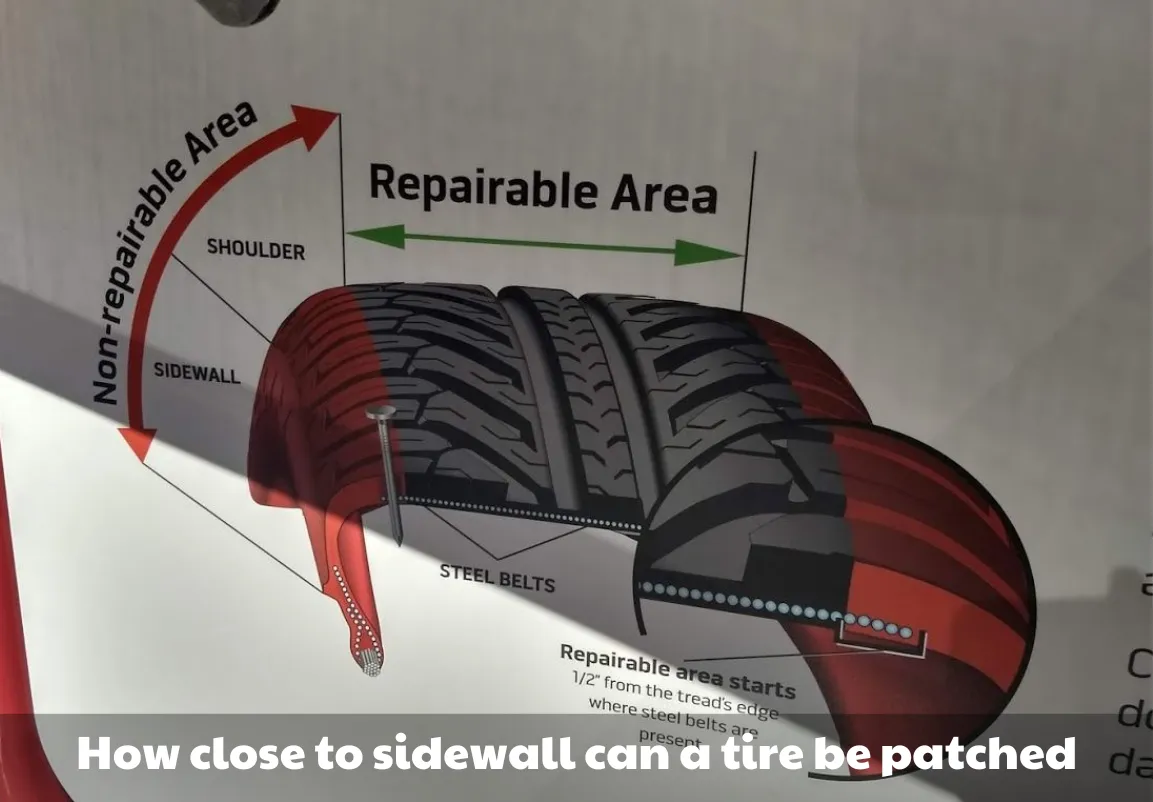
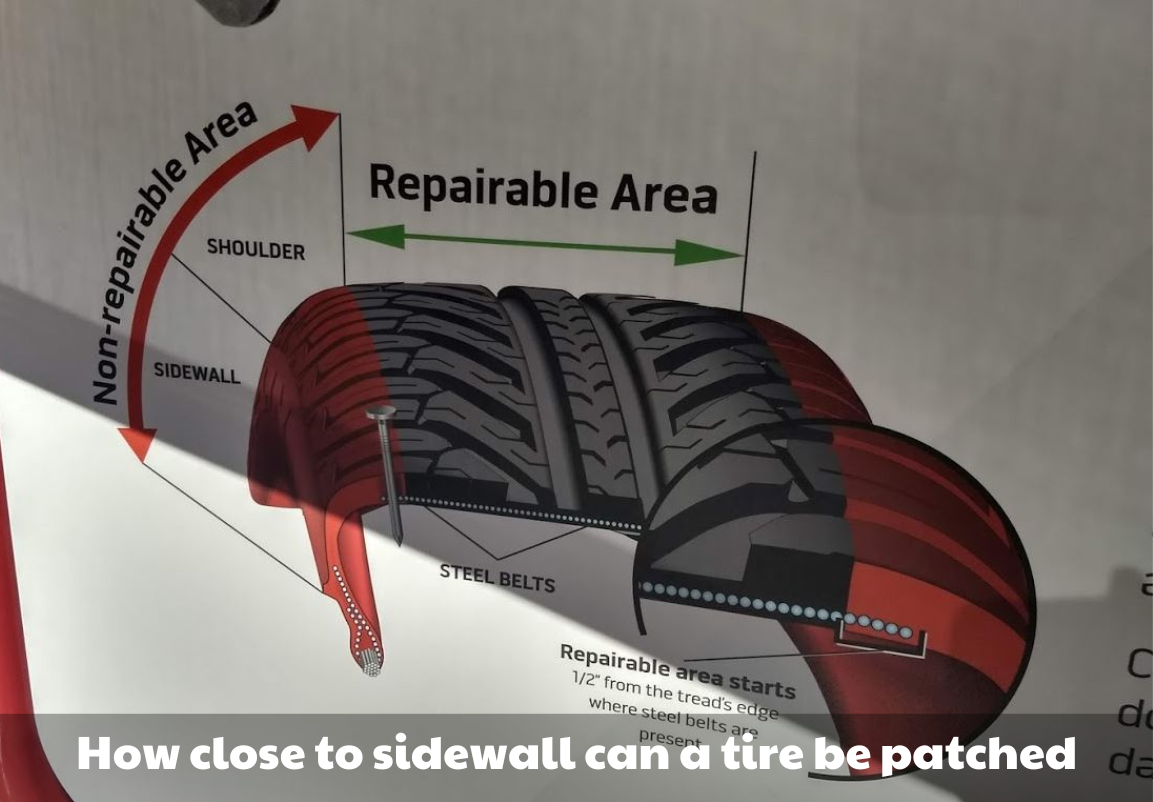
The distinction in construction dictates repair suitability. The tread’s robust, multi-ply, and steel-belted structure can accommodate a proper patch and plug repair, where the plug seals the puncture path and the patch reinforces the internal structure. The sidewall, however, lacks this internal reinforcement. A repair in this area would be subjected to intense, continuous bending and stretching, inevitably leading to its failure. This critical difference is illustrated by a tire cross-section: the thick, reinforced crown suitable for repairs versus the pliable, thinner sidewall designed for flex, not rigid sealing.
Defining the ‘No-Plug Zone’: How Close To The Sidewall Is Too Close For Tire Repair?
For over two decades, the tire industry has maintained clear, unequivocal standards regarding the repairable area of a tire. These guidelines are not arbitrary; they are based on extensive engineering, testing, and safety considerations. Adhering to them is paramount for vehicle safety and long-term tire performance.
Establishing the Industry Standard ‘No-Plug Zone’
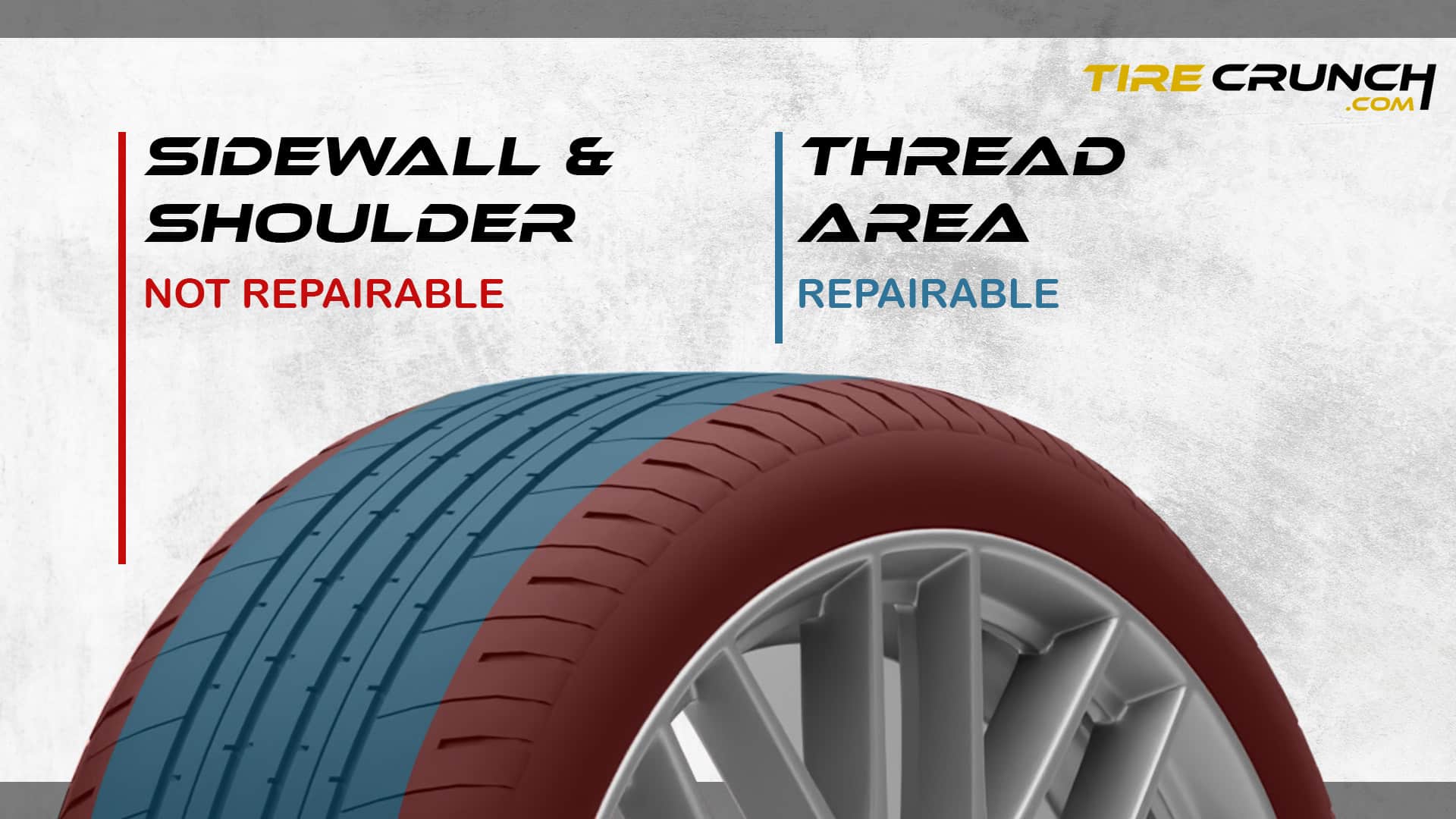
The universally accepted industry standard ‘no-plug zone’ dictates that any puncture located within one inch (25mm) of the tire’s sidewall is deemed irreparable. This measurement is typically taken from the edge of the outermost tread groove towards the sidewall. If any part of the puncture wound enters this one-inch buffer, the tire should not be repaired.
TIA Guidelines for Tire Repair
The Tire Industry Association (TIA), the leading authority on tire service and repair in North America, explicitly states that repairs are strictly prohibited outside the tread crown area. The repairable area is specifically defined as the portion of the tire that meets the road, bounded by the shoulder and extending inward, but not including the shoulder itself if the damage is too close to the sidewall. This encompasses punctures up to 1/4 inch (6mm) in diameter within the approved repair zone, always requiring a combination plug-and-patch repair, never a standalone plug.
When evaluating a puncture, a simple visual aid can be a ruler or tape measure. Place it against the tire’s tread, aligned with the outermost tread groove. If the center of the puncture is 1.5 inches from the sidewall, it might be repairable. If it’s 0.5 inches from the sidewall, it is unequivocally not repairable and requires replacement. This measurement is taken from the edge of the actual contact patch, not the visual edge of the tire.
Legal and Safety Implications of Improper Repair
Attempting to repair a tire within the ‘no-plug zone’ or with a plug-only method carries significant repercussions:
- Invalidated Warranties: Most tire manufacturers explicitly void warranties if a tire is repaired contrary to industry standards, especially near the sidewall.
- Legal Liabilities: If a tire fails due to an improperly performed repair, leading to an accident, the repairer (and potentially the vehicle owner) could face serious legal liabilities.
- Compromised Vehicle Safety: Most critically, an improper repair jeopardizes the safety of vehicle occupants and others on the road. The tire is a primary safety component; its integrity cannot be compromised. Research indicates that improper tire maintenance and repair are significant contributing factors in tire-related accidents, though specific statistics on sidewall plug failures are difficult to isolate due to the immediate catastrophic nature of such events.
The distinction between a ‘puncture repair’ (which requires both a plug and an internal patch, sealing the injury and reinforcing the tire’s structure) and a ‘plug-only’ repair (a temporary, external fix often found in DIY kits) is crucial. TIA guidelines explicitly state that a plug-only repair is insufficient and unsafe for any part of the tire, let alone the sidewall.
By The Numbers
Minimum Distance from Sidewall for Repair
Maximum Puncture Diameter for Repair
Sidewall Repair Success Rate
Typical Passenger Car Tire Pressure
The Inherent Risks and Dangers of Plugging a Sidewall Puncture
Attempting to repair a tire’s sidewall with a plug is not merely ineffective; it is an incredibly dangerous practice that directly compromises vehicle safety. The unique stresses and construction of the sidewall render any such repair effort futile and hazardous.
Failure of the Repair Due to Constant Flexing
As established, the tire sidewall is engineered for constant, dynamic flexing. A plug, designed to fill a static hole, cannot withstand these continuous bending and stretching forces. The bond between the plug material and the tire’s rubber will inevitably break down. This leads to two primary failure modes:
- Air Leaks: The most common outcome is a slow or rapid air leak as the plug works loose or the surrounding rubber separates.
- Expulsion: In more severe cases, the plug can be violently expelled from the tire, leaving an open hole and instant loss of pressure.
Catastrophic Tire Failure
The most alarming danger is a sudden, catastrophic tire failure or blowout, particularly at highway speeds. When a sidewall plug fails, it doesn’t just leak; it can rip the already compromised sidewall structure, leading to an immediate and complete loss of air pressure. Imagine traveling at 65 mph (a common operating speed) when a sidewall plug gives way; the sudden instability can cause a loss of vehicle control, potentially resulting in severe accidents, posing extreme danger to vehicle occupants and others sharing the road. While specific statistics linking sidewall plug failures to accidents are not publicly itemized, general data from the National Highway Traffic Safety Administration (NHTSA) consistently highlights tire blowouts as a factor in thousands of crashes annually, with improper repairs undoubtedly contributing to this statistic.
Integrity Compromise and Heat Buildup
Even if a sidewall plug appears to hold air initially, it has already weakened the tire’s structural integrity. The puncture itself damages the crucial carcass plies in the sidewall. A plug cannot repair these layers; it merely fills the hole. This compromised area becomes a weak point prone to:
- Delamination: Layers of the tire’s structure separating.
- Rapid Decompression: A sudden burst under load.
- Heat Buildup: The constant flexing around a weakened, improperly repaired area generates excessive internal friction and heat. This thermal stress accelerates the breakdown of rubber compounds and structural materials, further increasing the risk of a blowout. This is why a tire with an improper repair might pass a static visual inspection but fail catastrophically under dynamic road conditions.
Never drive on a tire with a known sidewall puncture, even if it appears to be holding air. The risk of catastrophic failure, especially at highway speeds, is too great. Prioritize safety over a temporary, unreliable fix.

Professional Assessment vs. DIY Repair: When to Seek Expert Tire Services
While DIY tire repair kits are readily available, their application is severely limited, particularly when dealing with damage near the sidewall. For any questionable tire damage, especially in critical areas, professional intervention is not just recommended; it’s mandatory for safety and ensuring reliable performance.
Emphasizing Professional Evaluation
A certified tire technician possesses the expertise and equipment to conduct a thorough evaluation of tire damage. Crucially, they can assess internal tire damage that is not visible externally. A small puncture on the outside might hide significant structural damage to the inner plies, which a DIY plug kit cannot address. Professionals will dismount the tire from the wheel, carefully inspect the inside for scuffing, discoloration, or delamination, and determine if a safe repair is genuinely possible according to TIA guidelines. This expert assessment is key to preventing a situation where a seemingly ‘repaired’ tire fails unexpectedly weeks later.
Limitations of DIY Plug Kits
DIY plug kits are strictly designed for emergency, temporary use in the tread area only, and only for small, direct punctures. They are explicitly not intended for:
- Sidewall punctures.
- Punctures larger than 1/4 inch (6mm).
- Cuts or gashes.
- Damage to the tire bead or shoulder.
These kits provide only an external seal and no internal structural reinforcement, which is critical for long-term safety. Relying on a DIY plug for anything beyond a short, low-speed trip to a tire shop is a dangerous gamble. An example: attempting a DIY plug on a sidewall puncture might initially hold air, but after a week of normal driving, the plug could fail, leaving you stranded or, worse, causing a blowout.
Equipment and Expertise of Professional Tire Shops
Professional tire shops are equipped with specialized tools and staffed by TIA-certified technicians who adhere to rigorous safety protocols. They use:
- Specialized Patches: These are applied from the inside of the tire, chemically bonded, and cured to provide lasting structural reinforcement, alongside a plug that fills the injury channel.
- Internal Inspection: Essential for identifying non-visible damage.
- Proper Sealing: Ensuring the repair area is prepped, cleaned, and sealed correctly to prevent moisture ingress and bond failure.
- Balancing: Re-balancing the wheel assembly after repair to maintain smooth operation.
While a new tire is often the safest choice for sidewall damage, professional repair of a tread puncture can offer significant cost savings, often 75-85% less than the price of a new tire, when genuinely possible. This value is only realized if the repair is performed correctly and safely by a professional.
Factors Professionals Consider
Beyond just location, technicians consider a multitude of factors:
- Puncture Size and Angle: Large or angled punctures may be irreparable even in the tread.
- Type of Damage: Cuts, gashes, or damage from impacts are generally not repairable.
- Overall Tire Condition: Age (tires older than 6-10 years may be too brittle), tread wear (insufficient tread depth), and previous repairs all influence the decision.
Alternatives to Plugging a Sidewall Puncture: Safe Solutions for Tire Damage
When a tire is compromised too close to the sidewall, there is generally only one truly safe and professional solution: replacement. Understanding the alternatives to a permanent repair can help you manage the situation effectively and safely until a new tire can be installed.
Immediate and Safe Tire Replacement
For punctures located within the non-repairable zone of the sidewall, the primary and safest recommendation is immediate tire replacement. No plug, patch, or combination thereof can restore the structural integrity of a compromised sidewall to a safe and reliable standard. This ensures the full safety, performance, and reliability that your vehicle manufacturer intended. For example, if you discover a nail exactly 0.8 inches from your tire’s sidewall, your decision is clear: replace the tire, not attempt a repair. This prevents the significant risks discussed previously.
Understanding Temporary Spare Tires (Donuts) and Their Limitations
In the event of a sidewall puncture, your temporary spare tire (often called a “donut”) serves as a crucial interim solution. However, it comes with strict limitations:
- Speed Restrictions: Most temporary spares are rated for a maximum speed of 50 mph (80 km/h). Exceeding this can lead to overheating and failure.
- Distance Restrictions: They are typically designed for short distances, often 50-70 miles (80-110 km), to get you to the nearest tire service center.
- Handling Compromise: Due to their smaller size and different construction, temporary spares significantly alter vehicle handling, braking, and stability.
Use a temporary spare only to travel directly to a professional tire shop for proper replacement of your damaged tire.
Consideration of Full-Size Spare Tires
If your vehicle is equipped with a full-size spare tire, this is the ideal solution. A full-size spare allows you to maintain normal vehicle performance and safety without speed or distance limitations until you can replace the damaged tire. Always ensure your full-size spare is properly inflated and maintained, just like your other four tires.
When to Replace Two Tires (Axle Pair)
In certain situations, especially for All-Wheel Drive (AWD) vehicles, replacing just one tire after a sidewall puncture may not be sufficient. If the new tire’s tread depth significantly differs from the opposite tire on the same axle (typically more than 2/32″ or 4/32″ depending on the vehicle manufacturer), it can cause stress on the drivetrain components. The different rotational speeds can confuse the AWD system, leading to premature wear or damage to the differential and transmission. For this reason, many manufacturers recommend replacing tires in axle pairs, or even all four tires, if one tire is irreparable and its remaining tread depth is considerably greater than the replacement. Consult your vehicle’s owner’s manual or a trusted professional for specific recommendations for your make and model.
Choosing the right course of action for a sidewall puncture is a critical decision that directly impacts your safety and the longevity of your vehicle. Always opt for the professional and reliable solution of tire replacement.
Conclusion
The intricate design of a tire dictates its repairability. Tire sidewalls are high-stress, flexible zones inherently unsuitable for plug repairs. Industry standards, prominently from the TIA, prohibit repairs within one inch (25mm) of the sidewall into the tread. Attempting to plug near the sidewall risks catastrophic tire failure and severe safety hazards due to the constant flexing, absence of structural reinforcement, and potential for rapid decompression. For punctures in this critical area, professional assessment and often, tire replacement, are the safest, most reliable solutions. Prioritize your safety and consult a certified tire technician immediately for any punctures near the tire’s sidewall. Do not attempt DIY repairs in this critical area; replacement is almost always the safest course of action, ensuring both your safety and the optimal performance of your vehicle for years to come.
Frequently Asked Questions
Can a tire with sidewall damage ever be repaired?
No, generally a tire with true sidewall damage cannot be safely repaired. The sidewall’s flexible structure and constant dynamic stress make it impossible for standard repair materials to maintain a secure, long-lasting seal. Any attempt at repair risks tire failure, making replacement the only safe and reliable option recommended by professionals and manufacturers.
What is the ‘no-repair’ zone on a tire?
The ‘no-repair’ zone typically refers to any puncture located outside the tire’s tread crown area. This includes punctures within one inch (25mm) of the sidewall, on the shoulder, or directly on the sidewall itself. These areas experience too much flex and stress to reliably hold a patch or plug, per Tire Industry Association (TIA) standards.
Why can’t sidewall punctures be patched like tread punctures?
Sidewall punctures cannot be patched like tread punctures because the sidewall lacks the internal reinforcement (steel belts) and static stability of the tread. It constantly flexes under load, causing standard patches and plugs to delaminate, tear, or lose their seal, leading to air loss or catastrophic failure. Tread repairs benefit from structural rigidity.
Is it safe to drive on a tire with a plugged sidewall temporarily?
No, it is not safe to drive on a tire with a plugged sidewall, even temporarily. A sidewall plug is highly prone to sudden failure due to the immense flexing and stress in that area. This can lead to a rapid blowout, posing severe safety risks at any speed. Immediate replacement or professional assessment is critical.
What should I do if my tire has a puncture near the sidewall?
If your tire has a puncture near the sidewall, you should immediately and safely pull over, replace the damaged tire with your spare (if available and safe to do so), and proceed directly to a professional tire service center. Do not attempt a DIY plug repair. A certified technician will confirm if replacement is necessary, which is almost always the case for sidewall damage.