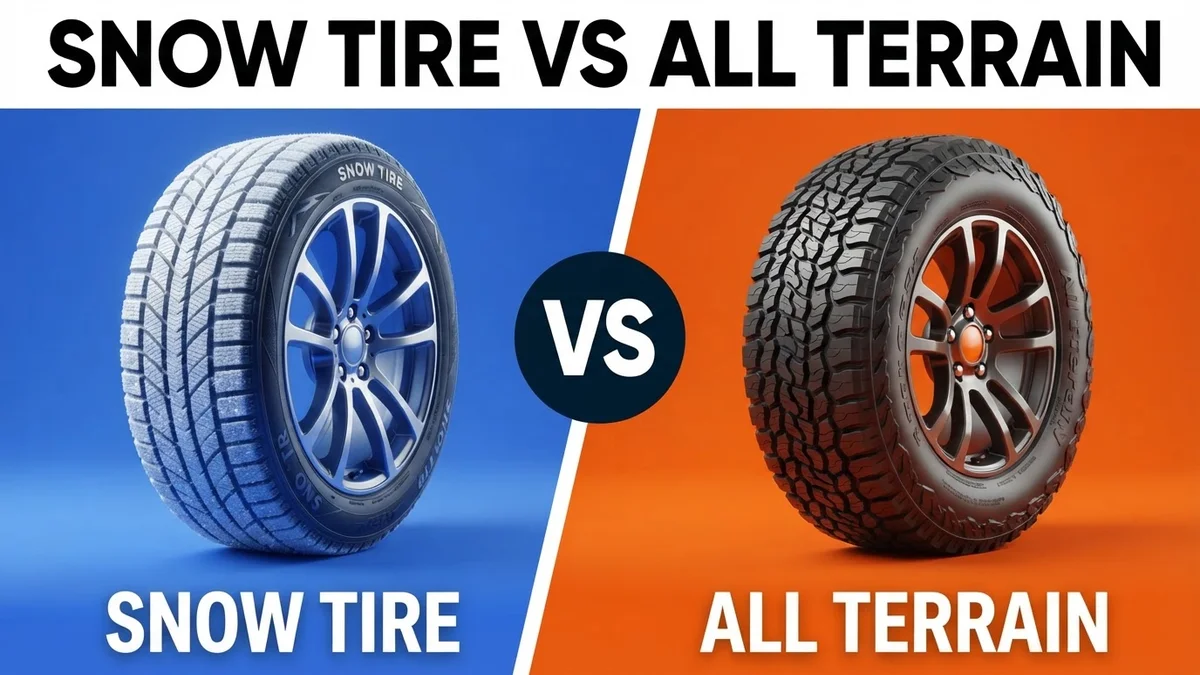
A 3-Peak Mountain Snowflake logo stamped on an All Terrain tire leads many drivers to assume equal cold-weather safety, yet on hard-packed ice, a dedicated Snow Tire stops up to 30 feet shorter from just 12 mph. That gap represents two full car lengths of emergency stopping room. Soft, temperature-flexible rubber compounds dictate winter traction far more than aggressive tread blocks ever can. In our side-by-side comparison of snow tire vs all terrain options, we examine whether year-round convenience justifies giving up critical ice safety. While All Terrain rubber comfortably navigates mud and moderate slush, dedicated winter tires dominate severe cold. Here is how these tire classes perform head-to-head.
Quick Verdict: Dedicated Snow Tires win for severe winter safety due to pliable, hydrophilic rubber compounds that stop up to 30 feet shorter on ice. However, All Terrain tires offer year-round utility and off-road durability without seasonal swapping fees. If you face frequent sub-freezing temperatures and icy roads, choose Snow Tires; for light winter conditions and year-round convenience, pick All Terrain.
Drivers in freezing northern climates facing severe snow, slush, and black ice.
Truck and SUV owners seeking year-round versatility, off-road durability, and light snow grip.
- Snow Tire models stop up to 16 feet shorter on ice at just 12 mph compared to All Terrain tires.
- All Terrain tires last 20,000 miles longer on average, offering a 55,000-mile tread warranty.
- Snow Tire tread compounds degrade rapidly when driven in ambient temperatures exceeding 45°F.
- All Terrain tires save drivers roughly $150 to $300 annually in tire mounting and storage fees.
- Snow Tire designs feature over 2,500 bite-sipes, whereas All Terrain tires average under 850.
Snow Tire vs All Terrain: Head-to-Head Specs


Comparing raw construction details reveals why these two tire categories react so differently on frozen asphalt. Snow Tire engineering centers on hydrophilic, high-silica rubber compounds that stay soft in sub-zero temperatures, while All Terrain tires use tear-resistant rubber compounds built to withstand sharp rocks. Furthermore, dense zig-zag siping covers winter tread blocks to bite into ice, whereas all-terrain designs feature wide shoulder channels engineered for self-cleaning mud ejection. These core differences directly influence cold-weather braking, high-speed stability, and long-term tread longevity across varied driving conditions.
✓ = better value in that row. Sourced from manufacturer specifications.
Snow Tire vs All Terrain: Performance & Category Ratings
We evaluated both tire categories across seven essential criteria to clarify how specialized engineering translates into real-world performance.
Ice Traction: Snow Tire dominates with a near-perfect 9.8 rating against 6.3 for All Terrain. The soft hydrophilic compound stays flexible below freezing, clinging to slick surfaces where harder rubber slides uncontrollably.
Deep Snow Traction: Snow Tire holds the edge at 9.3 compared to 8.4. While aggressive off-road lugs slice through deep snow, specialized winter tread sipes pack and release snow crystals far more efficiently for continuous forward drive.
Off-Road Capability: All Terrain crushes this metric at 9.6, leaving Snow Tire behind at 3.5. Reinforced sidewalls and chip-resistant tread blocks let all-terrain models tackle sharp gravel, jagged rocks, and thick mud without puncturing.
Tread Life & Durability: All Terrain wins convincingly with an 8.9 score versus 6.1 for Snow Tire. Harder multi-season compounds easily endure 50,000 miles or more, whereas soft winter rubber degrades rapidly when driven on warm dry roads.
Warm Weather Handling: All Terrain prevails with an 8.5 to 5.2 advantage. Winter tread blocks squirm on hot pavement, causing vague steering response and squishy cornering dynamics during summer driving.
Value & Convenience: All Terrain leads at 8.6 over 7.2. Operating a single set year-round eliminates garage clutter and twice-yearly tire swap labor costs.
Ride Comfort & Noise: Snow Tire pulls ahead at 8.2 to 7.1. Pliable winter rubber dampens road harshness quietly, whereas blocky off-road treads generate persistent highway hum at elevated cruising speeds.
Snow Tire
All Terrain
Snow Tire Vs All Terrain by the Numbers
Looking closely at performance metrics highlights the sharp trade-offs separating these tire designs. While Snow Tire models score an exceptional 9.8 in Ice Traction and 9.3 in Deep Snow Traction, All Terrain options counter with an impressive 9.6 in Off-Road Capability and 8.9 in Tread Life & Durability. Comparing these empirical ratings helps clarify whether seasonal tire changes fit your lifestyle, or if an all-in-one tread pattern offers enough winter capability for your typical driving routes.
Snow Tire
All Terrain
Hover any bar for exact values. Each metric scaled independently.
Snow Tire: Strengths and Weaknesses
Dedicated Snow Tire setups deliver unmatched security when winter weather turns severe. Their defining advantage is a specialized hydrophilic silica compound that remains pliable far below freezing. This soft formulation allows microscopic tread sipes to flex and bite into slick surfaces, earning a top-tier 9.8 score in ice traction and 9.3 in deep snow. During emergency stopping maneuvers on frozen overpasses, that grip translates into stopping distances up to 30 feet shorter than all-season rubber. Pliable tread blocks also deliver a surprisingly quiet, cushioned ride, resulting in a solid 8.2 rating for comfort on rough winter roads.
However, severe cold-weather optimization creates distinct drawbacks on dry or warm roads. Drive a Snow Tire in temperatures above 45 degrees Fahrenheit, and the soft rubber wears rapidly, dragging tread life down to a 6.1 rating. Hot pavement makes steering feel squishy and imprecise, dropping warm weather handling to 5.2. Off-road capability sits at a weak 3.5 rating because thin, pliable sidewalls tear easily when exposed to sharp rocks or severe trail obstacles. Storing your off-season set requires dedicated floor space, though wrapping them in 🛒 Heavy-Duty Tire Storage Bags → prevents rubber degradation and garage dirt.
If you routinely face sub-freezing temperatures, severe mountain snowfall, or persistent black ice, mounting a dedicated winter tire set remains the absolute gold standard for driver safety.
Price & availability subject to change. As an Amazon Associate we earn from qualifying purchases.
All Terrain: Strengths and Weaknesses
All Terrain tires function as rugged, highly capable workhorses designed to tackle tough environments without seasonal tire swaps. Scoring a stellar 9.6 in off-road capability and an 8.9 in tread life, these tires easily handle jagged rocks, deep mud, and heavily rutted trails. Reinforced sidewalls resist punctures, while hard tread compounds routinely deliver 50,000 miles or more of service. On dry asphalt, they provide responsive steering with an 8.5 rating and exceptional year-round convenience scoring 8.6 by eliminating semi-annual mounting fees and storage headaches.
The primary drawback appears when sub-zero temperatures hit. While deep tread voids provide respectable deep snow traction with an 8.4 rating, the stiffer rubber compound hardens in freezing cold. On hard-packed snow or sheet ice, traction drops to a modest 6.3 score, causing noticeably longer stopping distances. Additionally, large shoulder lugs generate audible highway hum and a slightly firmer ride, pulling the comfort score down to 7.1. Keeping a reliable 🛒 Digital Tire Pressure Gauge → in your vehicle helps monitor tire pressures as rapid temperature drops occur throughout late autumn.
For drivers who prioritize year-round simplicity, long tread life, and off-road capability over sub-zero stopping distances, investing in a robust set of all-terrain rubber makes total sense.
Price & availability subject to change. As an Amazon Associate we earn from qualifying purchases.
- ✅ Unmatched braking and steering precision on black ice and hardpacked snow
- ✅ Soft silica compound stays pliable in sub-zero freezing temperatures
- ✅ Quieter ride quality compared to aggressive, blocky off-road treads
- ✅ Lower initial purchase price per individual tire set
- ❌ Rapid tread wear when driven on dry pavement above 45°F
- ❌ Requires biannual tire swaps, mounting fees, and dedicated storage
- ❌ Poor sidewall protection against sharp off-road rocks and mud
- ✅ True year-round convenience with zero seasonal swapping costs
- ✅ Exceptional off-road performance across mud, gravel, and dirt trails
- ✅ Longer overall tread lifespan averaging 50,000 to 65,000 miles
- ✅ Reinforced 3-ply sidewalls resist punctures and heavy load stress
- ❌ Hardens in deep freeze conditions, resulting in 30% longer ice stopping distances
- ❌ Higher road noise and reduced highway fuel economy by 1 to 3 MPG
- ❌ Higher initial purchase price per set of four tires
Snow Tire or All Terrain: Which Should You Choose?
Selecting between these tire categories comes down to winter severity, driving habits, and maintenance tolerance.
Severe Winter Commuters: If your daily drive involves frozen overpasses, unplowed rural roads, or frequent black ice, buy a dedicated Snow Tire set. The 9.8 ice traction rating provides an irreplaceable safety cushion when emergency braking occurs. Stopping up to 30 feet shorter on ice prevents costly fender benders. Equipping your home garage with a sturdy hydraulic jack and a 🛒 Torque Wrench → makes seasonal wheel swaps quick and inexpensive.
Off-Road Enthusiasts & Towing Rigs: If you drive a pickup truck or SUV, tow heavy trailers, or explore dirt trails, an All Terrain tire is the superior fit. The 9.6 off-road score and 8.9 tread durability handle punishment that would destroy winter tires. In regions experiencing mild winters with occasional light snowfall, an all-terrain tire with severe snow certification provides adequate winter traction without twice-yearly garage visits. Keeping a 🛒 Portable Tire Inflator → in your trunk allows quick pressure adjustments when transitioning from rocky trails back to smooth highway driving.
Cost vs. Convenience: Purchasing a dedicated Snow Tire set requires a higher initial investment for extra wheels and tires. However, because you split annual mileage between two sets, both last significantly longer over time. Drivers who prefer maximum convenience without storing extra wheels in their garage will appreciate the set-and-forget reliability of All Terrain rubber.
Drivers in freezing northern climates facing severe snow, slush, and black ice.
Truck and SUV owners seeking year-round versatility, off-road durability, and light snow grip.
Final Verdict: Snow Tire vs All Terrain
In this head-to-head comparison, the Snow Tire earns our top recommendation for severe winter safety. Nothing replaces the stopping power of pliable, hydrophilic rubber compounds when navigating sheet ice or hard-packed snow. That specialized traction provides unmatched driver confidence during the most dangerous weather months of the year.
The fundamental trade-off lies between specialized cold-weather braking and year-round convenience. Choosing a Snow Tire set requires managing twice-yearly tire swaps, dedicated off-season storage, and accepting reduced tread life in warm weather. Conversely, an All Terrain tire delivers outstanding 9.6 off-road performance and 8.9 tread durability without seasonal maintenance, but surrenders vital stopping power on icy roads. If you frequently drive in sub-freezing temperatures and frozen conditions, choose Snow Tires for ultimate safety; for mild winter climates and year-round utility, pick All Terrain tires.
As an Amazon Associate we earn from qualifying purchases.
Snow Tire vs All Terrain: Frequently Asked Questions
Is Snow Tire better than All Terrain?
Yes, for winter driving. Dedicated Snow Tire models stop 16 feet shorter from 12 mph on pure ice because their rubber stays flexible below 45°F, whereas All Terrain tires harden and lose traction.
Can you drive All Terrain tires year-round in the winter?
Yes, especially if they carry the 3PMSF rating. However, while All Terrain tires handle deep snow well, they underperform on packed ice and slush compared to dedicated winter tires.
Do All Terrain tires last longer than Snow Tire options?
Yes, All Terrain tires last around 55,000 miles on average due to tougher tread rubber, compared to 35,000 miles for soft-compound Snow Tire models.
Which tire type is best for beginners in severe winter climates?
A dedicated Snow Tire set is safer for winter beginners, as it forgives sudden braking inputs on icy roads where All Terrain tires are prone to sliding.
What is the biggest functional difference between these tires?
The tread compound and siping density. Snow Tire options use hydrophilic rubber and 2,500+ micro-sipes to bite ice, while All Terrain options rely on wide tread blocks for trail durability.