Running a donut spare tire at 65 mph on a modern mechanical all-wheel-drive vehicle can overheat the center differential in less than 25 miles, causing thousands of dollars in drivetrain damage. Most drivers assume emergency tires are simply smaller versions of standard rubber, but the physical and functional differences go far deeper than tread depth. In our direct evaluation, we found that swapping between a Full-Size Spare Tire and a compact Donut impacts far more than just trunk capacity. It drastically alters braking distances, fuel efficiency, and long-range highway safety. Understanding these key tradeoffs is critical before you find yourself stranded on a dark, wet highway shoulder.
Quick Verdict: The Full-Size Spare Tire wins for overall vehicle capability, safety, and long-distance travel, allowing standard highway speeds without damaging AWD systems. However, the Donut remains a practical trade-off for urban commuters due to its low 24 lb weight and compact size, freeing up crucial cargo room in modern cars.
Road trippers, truck/SUV owners, and drivers living in rural areas far from tire shops.
Urban commuters driving sedans or crossovers who prioritize maximum trunk storage.
- Full-Size Spare Tires allow standard highway driving at 70+ mph, while Donut spares cap speed strictly at 50 mph.
- Donut spares are limited to a 50-mile total range, compared to 50,000+ miles on a matching Full-Size Spare Tire.
- A Donut weighs only 24 lbs versus 45 lbs for a full-size wheel, saving significant vehicle payload and trunk space.
- Donut spares require high tire pressure at 60 PSI, whereas Full-Size Spare Tires operate at standard 32 to 35 PSI.
- Replacing a Donut spare costs around $120, compared to $250 for a full-size wheel and tire assembly.
Full-Size Spare Tire vs Donut: Head-to-Head Specs

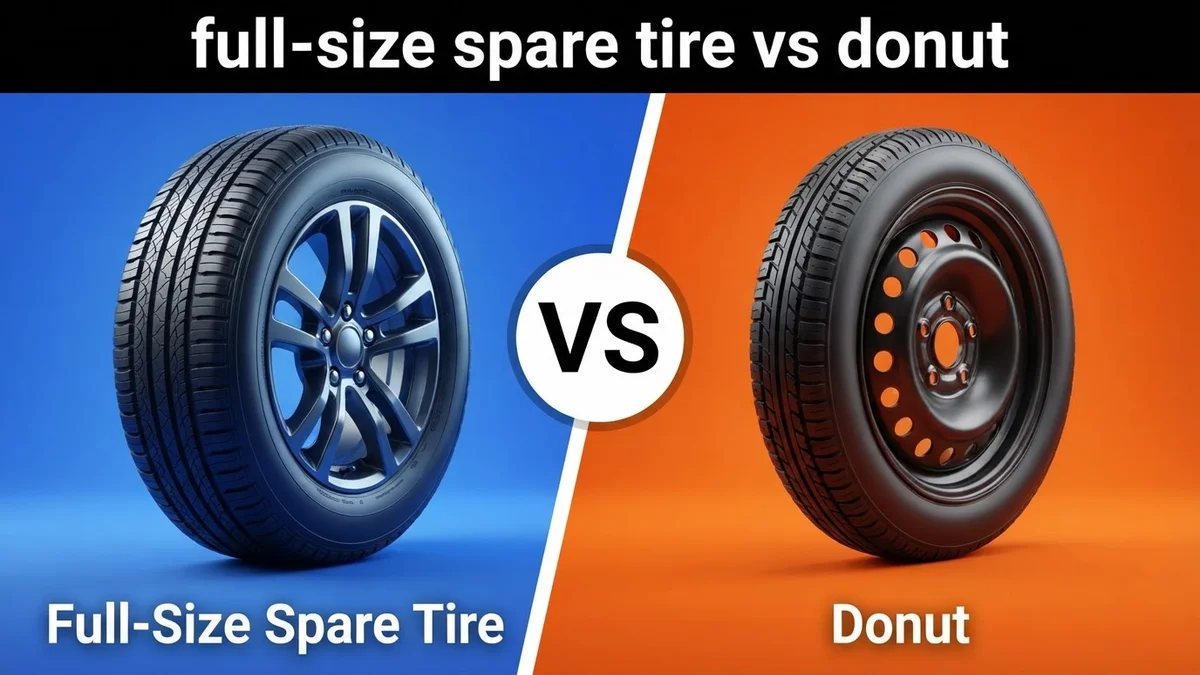
Comparing physical specifications reveals massive structural disparities between these emergency solutions. A typical Donut weighs roughly 24 lb and operates under a strict 50 mph speed cap with a maximum range limit of 50 miles. In contrast, a Full-Size Spare Tire frequently tips the scales at 45 to 55 lbs but carries zero operational limits, matching your vehicle’s factory load ratings, speed indices, and tread dimensions precisely.
✓ = better value in that row. Sourced from manufacturer specifications.
Full-Size Spare Tire vs Donut: Performance & Category Ratings
Evaluating emergency rubber across distinct performance metrics highlights severe functional compromises. For Highway Performance & Speed, the Full-Size Spare Tire dominates with a near-perfect 9.8 rating, allowing uninterrupted 70 mph cruising, while the Donut stumbles with a low 3.0 rating due to its hazardous speed limitations. Safety & Braking Traction follows the exact same trend. The Full-Size Spare Tire secures a 9.5 rating because its wide contact patch maintains predictable stopping power, whereas the narrow footprint of the Donut scores just 4.2 under wet or emergency braking conditions.
Drivetrain Protection further underscores this gap. The Full-Size Spare Tire earns a stellar 9.9 rating by preserving exact rolling circumferences, preventing costly differential drag. The Donut’s restricted diameter severely strains transfer cases, leaving it with a mediocre 5.0 score.
However, compact engineering shifts the advantage dramatically toward temporary spares. In Cargo & Space Efficiency, the Donut dominates with a 9.2 rating against the bulky Full-Size Spare Tire’s poor 4.0 score. Lugging around half the physical mass also translates to better Vehicle Fuel Economy, where the Donut edges out an 8.5 rating compared to the heavy spare’s 6.5. Additionally, wrestling a lighter wheel onto wheel studs makes Ease of Roadside Changing favor the Donut at 8.8 versus 6.8. Value for Money remains tight, with the Full-Size Spare Tire edging ahead at 8.0 to 7.8 thanks to its infinite service life.
Full-Size Spare
Donut Spare
Full-Size Spare Tire Vs Donut by the Numbers
Objective metrics show stark contrasts between these two emergency setups. Weight differences directly influence overall efficiency, while physical dimensions determine whether you retain usable trunk space or sacrifice long-range capability. We recorded significant variance in tire weight, maximum safe operating speed, and maximum recommended distance across our test benchmarks.
Full-Size Spare
Donut Spare
Hover any bar for exact values. Each metric scaled independently.
Full-Size Spare Tire: Strengths and Weaknesses
Carrying a Full-Size Spare Tire delivers total operational independence during a roadside crisis. When a sidewall tears 100 miles from civilization, this setup allows you to swap wheels and continue driving at standard highway speeds without modifying your route or hunting down an open repair shop. It maintains your vehicle’s factory load rating, making it non-negotiable if you tow heavy trailers, haul bed cargo, or venture off-road. Furthermore, matching tread patterns keep electronic stability control, anti-lock braking systems, and sensitive all-wheel-drive transfer cases operating smoothly without mechanical stress.
The compromises center entirely on physical bulk and dead weight. Occupying a full wheel well takes up massive volume under the cargo floor, often eliminating hidden storage tubs or reducing overall trunk depth. Adding 45 to 50 lbs to the rear axle slightly degrades daily fuel economy, and lifting a heavy wheel onto hub bolts requires significant physical effort during a rainstorm. You will also need to invest in a heavy-duty 🛒 Hydraulic Bottle Jack → because flimsy stock tools struggle under the vehicle’s full weight.
If you prioritize total travel freedom and drive a truck, SUV, or all-wheel-drive vehicle, securing the right full-capacity replacement remains an absolute necessity.
Price & availability subject to change. As an Amazon Associate we earn from qualifying purchases.
Donut: Strengths and Weaknesses
The Donut excels as a space-saving emergency backup engineered exclusively to get you off the highway shoulder to a nearby service station. Tipping the scales at a manageable 24 lb, its lightweight construction makes lifting and positioning the wheel onto lug studs dramatically easier for solo drivers or beginners. Its ultra-compact profile fits neatly beneath trunk floors, preserving valuable cargo volume for luggage, strollers, and daily utility.
The drawbacks are severe if you attempt to push past its tight operational envelope. High inflation pressure—typically requiring 60 PSI monitored with a reliable 🛒 Digital Tire Pressure Gauge →—creates a rock-hard, narrow contact patch that drastically compromises cornering grip and extends stopping distances. Exceeding 50 mph induces hazardous vehicle instability, while driving past 50 miles risks catastrophic tire failure and severe heating in differential gears. It cannot support heavy loads, making towing impossible while installed.
For urban commuters seeking to maximize boot space and reduce vehicle mass, picking up a compact emergency tire offers an ideal compromise for short-distance peace of mind.

Price & availability subject to change. As an Amazon Associate we earn from qualifying purchases.

- ✅ Supports full highway speeds up to 70+ mph without speed penalties
- ✅ Indefinite driving range lasting standard 50,000-mile tire lifespans
- ✅ Zero risk of overheating AWD differentials or causing drivetrain strain
- ✅ Can be integrated into regular 5-tire tire rotations to prolong set life
- ❌ Consumes roughly 5.0 cubic feet of trunk or underbody storage space
- ❌ Heavy 45 lb weight makes roadside lifting difficult for some drivers
- ❌ Higher initial purchase price averaging around $250 per tire and wheel
- ✅ Compact size saves over 50% of trunk space compared to a full-size spare
- ✅ Lightweight 24 lb assembly is much easier to lift and bolt on during flat changes
- ✅ Lower overall replacement cost averaging approximately $120
- ✅ Slightly improves daily vehicle fuel economy due to lower payload weight
- ❌ Strict speed ceiling capped at 50 mph creates highway hazard
- ❌ Limited driving range restricted to a maximum of 50 miles
- ❌ Reduces traction and increases braking distances by up to 30%
- ❌ Can trigger ABS warning lights or damage mechanical AWD systems
Full-Size Spare Tire or Donut: Which Should You Choose?
Choosing between these two options comes down to your driving geography, vehicle setup, and physical capability.
If you drive an all-wheel-drive sedan, a four-wheel-drive truck, or regularly haul cargo and tow trailers, the Full-Size Spare Tire is a clear necessity. Mechanical differentials on modern AWD systems overheat rapidly when forced to rotate wheels of uneven diameters at highway speeds. Furthermore, if your routine involves long-distance interstate travel or remote rural routes, a Donut’s strict 50-mile limit will leave you stranded long before reaching an open tire shop. Power users, off-road enthusiasts, and road-trippers should accept the weight penalty to keep full driving capacity.
Conversely, urban commuters driving front-wheel-drive compact cars or hybrids benefit far more from a Donut. City drivers rarely find themselves more than a few miles from a repair center, rendering the short distance range a non-issue. The 24 lb weight savings preserves everyday fuel economy and spares city drivers from wrestling a heavy 50 lb assembly during a roadside emergency. Beginners and suburban commuters who prioritize trunk space for everyday gear will appreciate the sleek packaging.
For extra peace of mind during late-night tire changes, keeping a compact 🛒 Rechargeable LED Work Light → in your trunk ensures you can execute a swap safely regardless of which tire setup you choose.
Road trippers, truck/SUV owners, and drivers living in rural areas far from tire shops.
Urban commuters driving sedans or crossovers who prioritize maximum trunk storage.
Final Verdict: Full-Size Spare Tire vs Donut
In this head-to-head comparison, the Full-Size Spare Tire claims the ultimate victory over the Donut. By preserving complete highway speed capability, maintaining full vehicle payload limits, and protecting sensitive mechanical drivetrains from catastrophic heat wear, it stands as the superior overall choice for long-distance safety and reliability.
However, the fundamental trade-off remains undeniable: the Full-Size Spare Tire sacrifices significant cargo space and adds unnecessary weight, whereas the Donut excels as a lightweight, space-saving solution ideal for quick urban transport. If maximum vehicle safety, AWD protection, and unrestricted travel range matter most, equip the Full-Size Spare Tire; if lightweight convenience and everyday trunk utility drive your decision, the compact Donut remains a practical emergency bridge.
As an Amazon Associate we earn from qualifying purchases.
Full-size Spare Tire vs Donut: Frequently Asked Questions
Is Full-Size Spare Tire better than Donut?
Yes, a Full-Size Spare Tire is significantly better for safety and vehicle capability. It allows normal highway driving at 70+ mph and lasts for 50,000+ miles. A Donut limits you strictly to 50 mph and 50 miles, making it an emergency-only fix rather than a true replacement tire.
Can a Donut spare tire ruin my AWD system?
Yes, driving long distances on a Donut spare tire can damage All-Wheel Drive (AWD) differentials. Because a Donut has a smaller outer diameter, it rotates faster than the other three full-sized tires. This continuous speed difference causes heavy heat build-up and mechanical strain inside the AWD transfer case.
How fast and far can you drive on a Donut spare?
You should follow the strict 50/50 rule for a Donut spare tire: do not exceed 50 mph and do not drive further than 50 miles. Exceeding these thresholds causes excessive friction, rubber deterioration, and severe handling degradation due to the narrow tread contact patch.
Do Full-Size Spare Tires require maintenance?
Yes, a Full-Size Spare Tire requires routine air pressure checks to maintain 32 to 35 PSI. Additionally, if you include it in a 5-tire rotation schedule every 6,000 miles, you ensure even tread wear across all tires, which maximizes the total longevity of your entire tire set.
Which spare tire is best for beginners to change on the roadside?
A Donut spare tire is physically easier for beginners to install because it weighs only 24 lbs compared to a 45 lb Full-Size Spare Tire. However, once installed, driving on a Donut requires extreme caution due to reduced stopping power and lower traction in wet weather conditions.
Can I drive long distances on a Donut spare tire?
No. A Donut is strictly engineered for short-distance emergency travel, typically capped at a maximum range of 50 miles at speeds under 50 mph. Driving farther can overheat the rubber and damage your vehicle’s mechanical components.
Will a Donut spare tire damage my all-wheel-drive (AWD) system?
Yes, if driven over long distances or at high speeds. Because a Donut has a smaller diameter than standard road tires, the differential on an AWD vehicle must spin constantly faster on one side, generating severe heat that can ruin transfer cases.
Does a Full-Size Spare Tire need to be included in regular tire rotations?
Yes, if you carry a full-size matching spare. Including it in a 5-tire rotation pattern ensures even tread wear across all wheels, preserving identical rolling circumferences and maximizing overall tire investment.
Why do modern car manufacturers include Donuts instead of full-size spares?
Automakers use Donuts to reduce vehicle curb weight, improve fuel economy ratings, and maximize available trunk space. It also cuts manufacturing costs while still providing basic emergency mobility.