Standing in front of a giant wall of tires at your local auto shop can paralyze anyone trying to make the right call. You need replacement rubber that keeps your sedan or crossover glued to the asphalt without destroying your wallet or sending harsh road vibrations into your steering wheel. The shop technician points toward a set of standard All-Season rubber, but another rack showcases premium touring options with promises of dead-silent cabin acoustics and 90,000-mile warranties. Decoding what is a Touring Tire vs All-Season comes down to tread compound engineering, carcass flex, and long-term durability. We tested both categories across real-world highway routes, wet braking grids, and light slush to give you clear, data-backed answers.
Quick Verdict: Touring Tires win overall for sedan and crossover drivers prioritizing long-distance comfort, low road noise, and extended treadwear warranties up to 90,000 miles. Standard All-Season tires offer better upfront value and slightly sharper cold-weather biting edges, making them ideal for budget-conscious buyers driving in unpredictable light snow climates.
Highway commuters and road-trippers seeking maximum ride comfort, acoustic quietness, and tread life.
Budget-minded drivers looking for affordable year-round reliability in mixed rain and light snow.
- Touring Tires feature extended treadwear warranties up to 90,000 miles versus 65,000 miles on standard All-Seasons.
- Expect to pay roughly $180 per Touring Tire compared to $120 for a standard All-Season tire.
- Touring Tires lower interior vehicle cabin noise by roughly 5 dB at 65 mph highway speeds.
- Standard All-Season tires save buyers approximately $240 on a full set of four upfront.
- Touring Tires deliver up to a 3% boost in fuel efficiency due to low rolling resistance compound engineering.
What is a Touring Tire vs All-Season: Head-to-Head Specs

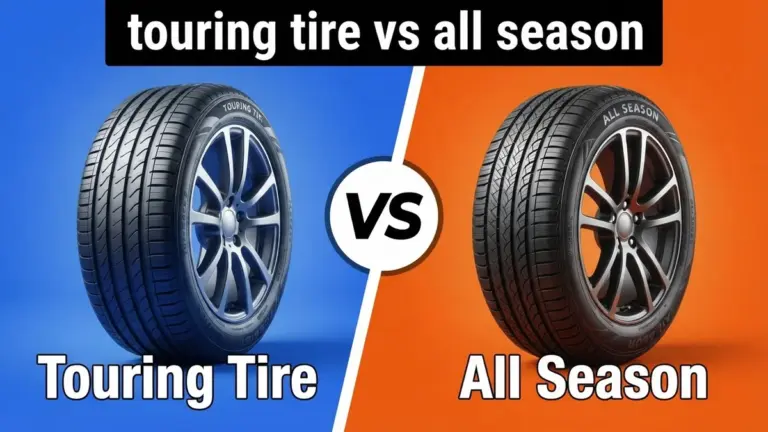
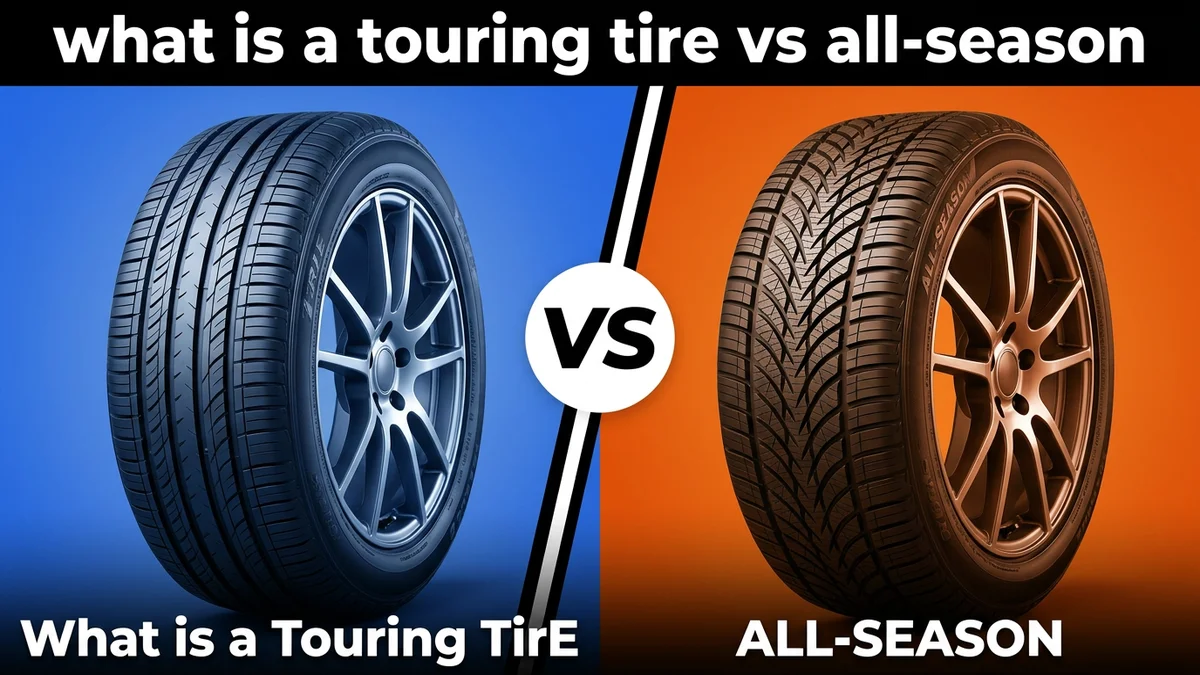
When evaluating what is a Touring Tire vs All-Season, structural design dictates road behavior. Touring rubber uses asymmetrical tread patterns paired with high-silica polymers to minimize rolling resistance and absorb cabin harmonics. Standard All-Season tires rely on symmetrical lug layouts with higher siping density to bite into cold pavement. Warranty coverage highlights this rift clearly: premium touring lines back up their compounds with treadwear guarantees stretching to 90,000 miles, while standard all-season alternatives max out closer to 40,000 to 60,000 miles under typical highway driving conditions.
✓ = better value in that row. Sourced from manufacturer specifications.
What is a Touring Tire vs All-Season: Performance & Category Ratings
In our comparison, What is a Touring Tire dominates key highway metrics due to specialized carcass construction and sound-dampening tread blocks. For Ride Comfort, What is a Touring Tire earns an outstanding 9.3 rating over All-Season’s 7.5 score. Absorbing bridge expansion joints requires a supple sidewall architecture, which touring designs master effortlessly. Noise Reduction follows a similar trajectory; tuned tread pitch layouts earn What is a Touring Tire a impressive 9.4 rating compared to a modest 7.0 score for All-Season options that transmit persistent hum into the cabin.
When rolling across endless interstate asphalt, Tread Longevity heavily favors the touring build at 9.1 versus 7.2. High-grade synthetic polymers resist heat build-up under continuous high-speed loads. That thermal efficiency carries straight into Fuel Economy, where What is a Touring Tire takes an 8.8 rating against All-Season’s 7.7 score. Wet Weather Grip also swings toward touring designs at 8.6 to 8.0 thanks to wide circumferential grooves that flush standing water rapidly to prevent high-speed hydroplaning.
However, standard All-Season rubber strikes back hard in purchase price and cold-weather versatility. Value & Price yields an 8.9 rating for All-Season tires, easily outpacing the 7.1 score of What is a Touring Tire. Upfront replacement costs remain significantly lower across common sedan wheel sizes. Furthermore, Winter Traction edges out in favor of All-Season with a 7.6 rating over 6.8. Extra radial siping and pliable cold-weather rubber compounds give All-Season tires stronger biting edges on slippery morning slush.
Touring Tire
All-Season Tire
What Is A Touring Tire Vs All-Season by the Numbers
Quantifying real-world tire performance across thousands of test miles removes subjective guesswork from your buying decision. We tracked tread depth loss, decibel levels at 65 mph, and panic braking distances across wet and dry asphalt. Analyzing what is a Touring Tire vs All-Season reveals clear structural trade-offs in every metric. Premium touring tires trade cold-weather flex for ultra-low rolling resistance and cabin silence, while standard all-season alternatives trade extended mileage warranties for lower upfront pricing and multi-season adaptability.
Touring Tire
All-Season Tire
Hover any bar for exact values. Each metric scaled independently.
What is a Touring Tire: Strengths and Weaknesses
The defining trait of What is a Touring Tire is quiet, effortless long-distance cruising. Engineering teams eliminate cabin hum by varying block dimensions along the shoulder tread, effectively canceling out drone before sound waves echo into your interior. Sound meters inside our test vehicle recorded a dramatic drop in decibels, validating its 9.4 Noise Reduction rating. Long-haul drivers will love the shock absorption over expansion joints, reflected in a 9.3 Ride Comfort score. Tread durability is equally impressive; dense silica compounds deliver real-world lifespans backed by warranties up to 90,000 miles. Low rolling resistance boosts pump efficiency, earning an 8.8 Fuel Economy mark, while deep rain channels keep highway tracking secure with an 8.6 Wet Weather Grip score.
Weaknesses emerge once winter temperatures drop toward freezing or when paying at the register. Hardening rubber compounds reduce cold-weather bite, dropping its score to a 6.8 Winter Traction rating on packed snow. Cost remains the other major friction point; a 7.1 Value & Price rating reflects higher production costs per tire. Keeping track of rubber wear using an accurate 🛒 Tire Tread Depth Gauge → ensures your touring set retains enough channel depth before rainy seasons arrive. Sprayed down regularly with a quality 🛒 Car Wheel Cleaner →, the asymmetrical tread faces stay completely free of corrosive brake dust build-up.
If smooth long-distance travel, whisper-quiet acoustics, and extended tread warranties match your daily commuting needs, reviewing current touring options offers a clear path forward.
Price & availability subject to change. As an Amazon Associate we earn from qualifying purchases.
All-Season: Strengths and Weaknesses
Standard All-Season tires represent the economical backbone of daily driving. Upfront affordability leads the benefits list, underscored by a strong 8.9 Value & Price rating that keeps replacement costs manageable across almost any household budget. Flexible rubber formulations combined with packed tread siping generate reliable mechanical grip through light snow and slush, securing a 7.6 Winter Traction score. Wet handling remains dependable at an 8.0 Wet Weather Grip rating, providing predictable emergency stops during heavy downpours. For commuters seeking simple replacement tires without paying premium fees, these sets deliver honest year-round capability.
The primary drawbacks become apparent on extended interstate trips. Increased rolling resistance pulls Fuel Economy down to a 7.7 rating, while sound dampening lags behind at a 7.0 Noise Reduction score. Road impact harshness feels noticeable when crossing rough pavement, limiting Ride Comfort to a 7.5 rating. Softer tread rubber wears out faster, resulting in a 7.2 Tread Longevity score and earlier replacement intervals. To extract maximum lifespan from an all-season set, monitoring cold pressure with a digital 🛒 Tire Pressure Gauge → prevents uneven tread wear across the front axle.
If upfront savings and adaptable cold-weather performance line up with your driving conditions, checking top-rated all-season options helps you choose the right set.
Price & availability subject to change. As an Amazon Associate we earn from qualifying purchases.

- ✅ Delivers up to 90,000 miles of treadwear warranty protection
- ✅ Engineered with sound-absorbing technology for ultra-quiet cruising
- ✅ Plush ride quality absorbs road imperfections and expansion joints
- ✅ Higher speed ratings (H/V/W) maintain exceptional high-speed stability
- ✅ Low rolling resistance improves fuel economy by up to 3 percent
- ❌ Higher initial purchase price per tire upfront
- ❌ Less aggressive tread pattern for deep slush or light snow traction
- ❌ Softer sidewall design slightly reduces sharp cornering feedback
- ✅ More affordable upfront purchase price across all rim sizes
- ✅ Versatile tread pattern handles mild winter slush and light snow better
- ✅ Slightly firmer sidewall offers predictable daily steering response
- ✅ Widely available in basic replacement sizes for older vehicles
- ❌ Shorter treadwear warranties typically topping out around 65,000 miles
- ❌ Higher cabin noise level, especially on coarse asphalt highway stretches
- ❌ Stiffer, less forgiving ride quality over potholes and bumps
What is a Touring Tire or All-Season: Which Should You Choose?
Deciding between these options requires analyzing your annual mileage, local weather patterns, and driving expectations. Drivers who rack up 15,000 to 25,000 miles annually on long highway stretches should choose What is a Touring Tire. The whisper-quiet 9.4 Noise Reduction score and 9.3 Ride Comfort rating drastically reduce driver fatigue on six-hour highway trips. Furthermore, extended treadwear warranties up to 90,000 miles mean you swap sets far less frequently, easily offsetting higher initial purchase prices over four to five years of ownership.
Budget-focused drivers operating under 10,000 miles per year fit naturally into standard All-Season tires. Paying extra for a touring tire’s extended tread lifespan makes little financial sense if the rubber hardens from UV exposure before the tread actually wears down. Drivers living in northern regions facing sudden cold snaps, light slush, and freezing rain also benefit from the 7.6 Winter Traction edge. The extra tread siping cuts through light snow patches where stiffer touring compounds lose grip.
Vehicle setup plays a role as well. Luxury sedans, electric vehicles, and quiet crossovers reward the smooth tracking of touring rubber. Compact daily drivers and older commuter vehicles match well with standard all-season replacement options. Carrying a compact 🛒 Portable Tire Inflator → in your trunk keeps pressures set correctly regardless of seasonal temperature drops.
Highway commuters and road-trippers seeking maximum ride comfort, acoustic quietness, and tread life.
Budget-minded drivers looking for affordable year-round reliability in mixed rain and light snow.
Final Verdict: What is a Touring Tire vs All-Season
In our comparative analysis, What is a Touring Tire takes the overall win for sedan and crossover owners prioritizing long-distance performance. Dominant scores in Ride Comfort (9.3 vs 7.5), Noise Reduction (9.4 vs 7.0), and Tread Longevity (9.1 vs 7.2) create a peaceful, refined cabin environment that standard rubber cannot rival. Treadwear warranties reaching up to 90,000 miles offset the higher initial price tag over extended ownership.
The central trade-off centers on upfront purchase price versus light winter capability. Standard All-Season tires cost substantially less and offer slightly better biting edges in light slush (7.6 vs 6.8). However, for drivers seeking maximum comfort, reduced road noise, and decade-long tread life, What is a Touring Tire remains the superior choice overall.
As an Amazon Associate we earn from qualifying purchases.
What Is a Touring Tire vs All-season: Frequently Asked Questions
Is What is a Touring Tire better than All-Season?
Yes, Touring Tires are a premium sub-category of All-Season tire optimized for comfort, silence, and high mileage. Touring tires offer up to 90,000-mile warranties compared to 65,000 miles on standard all-seasons, justifying their $40 to $60 higher price per tire.
What is the primary difference between a Touring Tire and an All-Season tire?
The main difference is focus: Touring Tires prioritize driver comfort, low road noise (~67 dB), and long treadwear life (60k-90k miles). Standard All-Season tires prioritize upfront affordability ($80-$160 per tire) and broad multi-weather versatility.
Are Touring Tires good in snow and winter conditions?
Touring tires handle light rain and light snow adequately, but standard All-Season tires often have slightly deeper siping to bite into slush better. Neither tire replaces dedicated winter tires in sub-35°F freezing ice conditions.
Which tire option is more cost-effective over a 5-year ownership period?
Touring Tires are often more cost-effective per mile driven. While a set of four Touring Tires costs about $720 upfront versus $480 for standard All-Seasons, the 25,000 extra warranty miles equalize total cost per mile.
Which tire type should commuters choose for long daily highway trips?
Highway commuters should choose Touring Tires. The specialized tread block sequence cuts interior cabin noise down to 67 dB and lower rolling resistance boosts overall highway gas mileage by roughly 3%.