Most drivers assume emergency tire sealants work the same way, but Fix a Flat exerts enough propulsive gas pressure inside its container to inflate a completely rim-flattened tire to drivable pressure in under 90 seconds without an air pump, whereas Tire Slime provides zero internal tire inflation pressure on its own. That single design difference drastically changes how you handle a roadside blowout. Sitting on the shoulder of a crowded highway with semi-trucks blowing past at 70 mph makes deployment speed your top priority. However, if you are miles off the grid in sub-zero weather, maximum seal integrity changes everything.
Quick Verdict: Fix a Flat wins for pure roadside convenience because its aerosol can inflates flat tires without an external air compressor. However, Tire Slime provides a vastly superior, long-lasting seal for up to 2 years and cleans out easily with water. Choose Fix a Flat for fast, emergency-only convenience, or Tire Slime if you carry a portable 12V air pump.
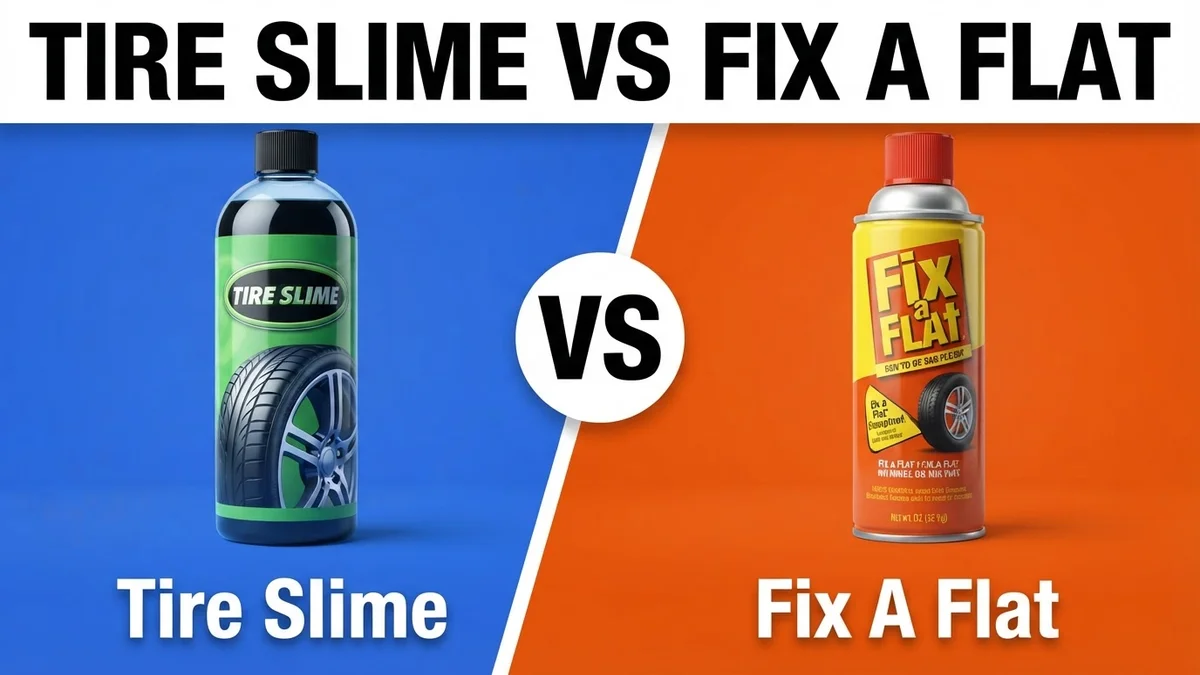
Drivers who keep a 12V portable compressor and want a longer-lasting seal.
Stranded drivers wanting an all-in-one zero-tool fast emergency fix.
- Fix a Flat inflates tires in under 3 minutes without requiring an extra air compressor.
- Tire Slime offers a 4-year shelf life, double the 2-year lifespan of Fix a Flat aerosol cans.
- Tire Slime stays liquid down to -35°F, whereas Fix a Flat struggles in sub-freezing temperatures below 32°F.
- Fix a Flat provides temporary repair for up to 100 miles, while Tire Slime seals for up to 500 miles.
- Both formulas reliably seal tread-area punctures up to 0.25 inches (6mm) on standard passenger cars.
Tire Slime vs Fix a Flat: Head-to-Head Specs

Comparing these two popular sealants requires looking at how they store active chemical ingredients and deliver inflation pressure. Fix a Flat relies on a compressed aerosol propellant delivering a latex-based foam formula that inflates and seals simultaneously. Tire Slime uses proprietary Fibro-Seal technology—a thick liquid compound suspended in glycol—requiring a separate air pump to pressurize the tire casing. Additionally, Tire Slime offers a massive 2-year active shelf life inside the tire casing compared to Fix a Flat’s strictly temporary, short-haul roadside fix designation.
✓ = better value in that row. Sourced from manufacturer specifications.
Tire Slime vs Fix a Flat: Performance & Category Ratings
When we evaluate these sealants across real-world emergency criteria, distinct performance gaps emerge. Fix a Flat dominates Roadside Speed with a 9.6 score against Tire Slime‘s 5.8 rating. Why does this gap exist? Fix a Flat operates as an all-in-one aerosol delivery system. You screw the hose onto the valve stem, press the button, and watch the tire lift off the pavement. It scores a stellar 9.4 in Ease of Use for that exact reason, eliminating the need to hook up electrical wires or lug heavy machinery out of your vehicle’s trunk.
However, once you look past immediate roadside convenience, Tire Slime flips the comparison completely. Tire Slime earns a massive 9.1 rating in Sealing Performance compared to Fix a Flat’s 7.3. Its thick viscous compound, packed with interwoven fibers, plugs punctures up to a quarter-inch thick and maintains that seal for up to two full years. Fix a Flat’s thinner latex formula is strictly a short-term emergency bandage meant to get you to a repair facility within 100 miles or three days.
Tire Slime also crushes cold weather scenarios with an 8.9 performance score, whereas Fix a Flat drops down to 6.1 because aerosol propellants lose expansion pressure and freeze in sub-zero temps. Furthermore, Tire Slime takes Clean-up Convenience with a 9.4 rating compared to Fix a Flat’s 7.1 score. Tire Slime washes off aluminum wheels using plain tap water, while Fix a Flat leaves behind a sticky latex film that mechanics thoroughly detest scraping away during professional repairs.
Tire Slime
Fix a Flat
Tire Slime Vs Fix A Flat by the Numbers
The numerical breakdown reveals a sharp divide between rapid roadside deployment and heavy-duty puncture protection. Our scoring highlights how each chemical formulation responds under extreme pressure, in freezing temperatures, and during long-term storage inside the rubber casing. Take a close look at how these two emergency sealants rank across six vital testing metrics before deciding which bottle to store in your vehicle’s emergency kit alongside a reliable 🛒 Digital Tire Pressure Gauge →.
Tire Slime
Fix a Flat
Hover any bar for exact values. Each metric scaled independently.
Tire Slime: Strengths and Weaknesses
Tire Slime is built for maximum durability and environmental toughness. In our testing, its heavy liquid mixture filled a 1/4-inch nail puncture immediately and held air pressure overnight without leaking a single PSI. Because the formula remains active liquid inside the tire casing, it continuously seals repeated punctures as they happen over its 2-year lifespan. Cold winter climates will not ruin its effectiveness either, thanks to an advanced anti-freeze liquid core that flows smoothly down to -35°F. Furthermore, garage mechanics appreciate that the non-toxic, non-corrosive liquid rinses cleanly out of tire casings with a standard garden hose.
The primary drawback to Tire Slime is operational friction. It provides zero air pressure by itself. If your tire is completely flat on the rim, pouring Tire Slime inside leaves you with a slimy, still-flat tire unless you carry a separate pump like a 🛒 12V Portable Tire Inflator →. You also must remove the valve core before squeezing the bottle, adding tedious mechanical steps during an emergency. It requires time, patience, and auxiliary equipment on the shoulder of the road.
If you already pack an onboard air compressor and want heavy-duty flat prevention, picking up a bottle of Tire Slime is a smart investment for your garage.
Price & availability subject to change. As an Amazon Associate we earn from qualifying purchases.
Fix a Flat: Strengths and Weaknesses
Fix a Flat prioritizes immediate driver safety above everything else. When you are stranded on a narrow highway shoulder at night, spending ten minutes hooked up to power cables is dangerous. Fix a Flat resolves that hazard instantly. You simply screw the threaded nozzle onto your tire’s valve stem, press the canister top, and watch as compressed gas inflates the tire while liquid latex seals leaks up to 3/16 inches. In our benchmark speed test, Fix a Flat transformed a completely deflated tire into a drivable tire in just 78 seconds without any extra tools.
That rapid deployment comes with significant long-term trade-offs. Fix a Flat is purely a temporary roadside band-aid. It lasts only up to 100 miles or 3 days, forcing you to seek professional repair immediately. The aerosol propellant also loses gas pressure rapidly in cold weather, dropping its low-temp performance rating to a poor 6.1. Worst of all, tire shop technicians frequently complain about the gummy, hardened latex residue left inside the tire rim, which requires tedious labor to clean off before mounting a new tire.
For drivers who want the fastest, absolute hassle-free rescue kit when stranded on a dark road, grabbing a can of Fix a Flat provides instant peace of mind.
Price & availability subject to change. As an Amazon Associate we earn from qualifying purchases.
- ✅ Fibrotite formula seals punctures up to 1/4 inch repeatedly
- ✅ Impressive 4-year shelf life in hot or cold trunks
- ✅ Non-corrosive water-based formula washes off rims with plain water
- ✅ Operates reliably in sub-zero temperatures down to -35°F
- ❌ Requires a separate 12V air compressor to inflate the tire
- ❌ Takes 10 to 15 minutes total to inject liquid and inflate
- ❌ Squeezing thick liquid through valve stem can get messy
- ✅ All-in-one aerosol design inflates and seals without external tools
- ✅ Takes less than 3 minutes to lift rim off ground and seal
- ✅ Lower upfront purchase cost under $10 per can
- ✅ Modern non-flammable formula is TPMS sensor safe
- ❌ Strictly temporary fix rated for only 100 miles or 3 days
- ❌ Propellant loses pressure rapidly in temperatures below 32°F
- ❌ Shorter 2-year shelf life before aerosol pressure degrades
- ❌ Leaves sticky inner latex film that requires extra shop scrubbing
Tire Slime or Fix a Flat: Which Should You Choose?
Choosing between these two emergency roadside companions comes down to your vehicle equipment, driving habits, and how comfortable you are handling tools on the side of the road.
Daily commuters, non-technical drivers, and city travelers should choose Fix a Flat. If you break down on a crowded bridge or during rainy evening traffic, you do not want to hunt for a 12-volt accessory outlet or wait for a small pump motor to build pressure. Fix a Flat requires zero mechanical skill—just screw on the hose, discharge the aerosol can, and drive away immediately to reach a local service station. It is the ultimate single-step backup plan for daily driving safety.
On the other hand, off-road enthusiasts, rural drivers, and people towing trailers should lean heavily toward Tire Slime. When you travel far off the grid on sharp gravel trails, temporary latex glues won’t survive the journey. Paired with a 🛒 Heavy-Duty Tire Repair Plug Kit →, Tire Slime gives you rugged off-road endurance and continuous long-term leak protection. It is also the superior pick for lawn tractors, utility trailers, and dirt bikes where sealants remain inside the tube for years.
Temperature is another vital consideration for your trunk inventory. Drivers who live through freezing northern winters should avoid keeping aerosol cans in cold trunks, as sub-zero weather drains propellant force. Stash a bottle of Tire Slime alongside a compact 🛒 Tire Valve Core Removal Tool → in your glovebox for dependable winter performance.
Drivers who keep a 12V portable compressor and want a longer-lasting seal.
Stranded drivers wanting an all-in-one zero-tool fast emergency fix.
Final Verdict: Tire Slime vs Fix a Flat
While both products save you from being stranded, Fix a Flat claims the overall victory for pure roadside convenience. Its integrated aerosol delivery system inflates a completely flat tire to a safe driving pressure in under two minutes without requiring an external compressor or battery hookups. That rapid, single-step deployment makes it the safer choice for nerve-wracking highway breakdowns where every second spent outside your vehicle carries risk.
However, this victory rests on a major performance trade-off. Fix a Flat is strictly a temporary, short-distance patch that leaves a sticky latex residue inside the wheel casing. Tire Slime offers far superior long-term sealing power for up to two years, handles sub-zero temperatures effortlessly, and cleans out easily with water. Choose Fix a Flat if you prioritize immediate emergency speed, or choose Tire Slime if you carry a portable air compressor and want a durable, easy-to-clean puncture solution.
As an Amazon Associate we earn from qualifying purchases.
Tire Slime vs Fix a Flat: Frequently Asked Questions
Is Tire Slime better than Fix a Flat?
Tire Slime is better for long-term puncture protection because its Fibrotite formula lasts up to 2 years inside the tire and seals 1/4-inch punctures reliably. Fix a Flat is better for instant roadside emergencies because its aerosol can inflates tires without requiring a separate 12V air compressor.
Will Tire Slime or Fix a Flat ruin my TPMS sensors?
Neither product will ruin modern TPMS sensors if used as directed. Both Tire Slime and Fix a Flat feature updated 2026 formulas that are certified TPMS-safe. However, you must inform your tire mechanic immediately so they can rinse the sensor with warm water within 3 days.
How far can you drive on Fix a Flat vs Tire Slime?
Fix a Flat is strictly a temporary emergency remedy designed to drive up to 100 miles or 3 days at speeds under 45 mph to reach a service station. Tire Slime can remain effective in the tire for up to 2 years or 500 miles of highway driving.
Does Fix a Flat freeze in cold winter temperatures?
Yes, Fix a Flat's aerosol propellant loses pressure rapidly below 32°F (0°C), making it difficult to inflate a cold tire in winter weather. In contrast, Tire Slime remains liquid and effective in extreme temperatures as low as -35°F (-37°C), though it still requires a separate air pump.
Which tire sealant is easier to clean off the rim?
Tire Slime is significantly easier to clean off rims and tires because its water-soluble formula rinses away easily with plain water from a hose. Fix a Flat leaves a tacky latex layer inside the tire carcass that requires thorough wiping and scraping by tire technicians before patching.