Millions of drivers throw away perfectly fine tires every year because they believe a simple puncture ruins structural integrity forever. In reality, a proper plug-and-patch repair restores up to 100% of a tire’s original structural capability when the puncture diameter sits under 0.25 inches. Scrapping a standard $200 tire over a $30 repairable nail hole creates massive landfill waste and burns through hard-earned cash unnecessarily. While tire retail chains profit when pushing brand-new rubber, opting to repair simple punctures delivers massive financial savings without compromising daily highway safety. In this detailed comparison, we evaluate Patching a Tire versus Replacing across cost, safety, longevity, and sustainability.
Quick Verdict: When dealing with simple tread punctures under 0.25 inches, Patching a Tire is the clear winner for cost-conscious drivers, saving over $170 per wheel while safely preserving remaining tread life. However, Replacing is essential if damage affects the sidewall or shoulder, or if tread depth is below 4/32 inches, ensuring complete structural integrity and maximum highway safety.
Drivers with minor tread punctures under 0.25 inches and healthy tread depth.
Drivers with sidewall damage, worn tread below 4/32 inches, or severe blowouts.
- Patching a Tire saves drivers an average of $170 per wheel compared to full replacement.
- Tire patches are strictly limited to tread punctures smaller than 0.25 inches (6 mm).
- Sidewall damage cannot be patched under USTMA standards and requires 100% replacement.
- A proper interior patch-plug combo restores safety for up to 30,000 miles of remaining tread.
- New tire replacements deliver 10/32 inches of fresh tread and factory mileage warranties.
Patching a Tire vs Replacing: Head-to-Head Specs
Choosing between these two automotive service methods comes down to physical limits and repair geometry. The core specification gap rests on allowable puncture location and tread depth thresholds. Patching a Tire requires damage restricted strictly to the central tread area with punctures measuring less than 0.25 inches (6mm) in diameter. Replacing removes all repair boundaries, offering an uncompromised structural baseline regardless of whether you suffered sidewall slashes or reached the critical 2/32-inch tread depth limit.
✓ = better value in that row. Sourced from manufacturer specifications.

Patching a Tire vs Replacing: Performance & Category Ratings
When we calculated raw financial return, Patching a Tire crushed the competition with a near-perfect 9.8 score in Cost Efficiency & Value versus Replacing’s 5.2. Repairing a puncture costs roughly $20 to $40, while a new tire easily demands $180 to $250 once mounting and balancing fees enter the equation.
However, Replacing dominated Safety & Structural Integrity with a 9.9 score compared to Patching a Tire at 7.8. Fresh factory rubber contains zero internal belt damage, providing factory-rated speed ratings and full structural resilience. In contrast, even a professionally executed radial patch leaves a minor scar in the carcass fabric.
In Convenience & Speed, Patching a Tire scores 9.1 against 6.5 for Replacing. Using a simple plug kit takes under 20 minutes in your driveway. Buying new rubber means waiting hours at a busy tire shop or arranging alternative transportation.
For Longevity & Tread Life, Replacing takes the win at 9.7 versus Patching a Tire’s 7.0. A new tire gives you 50,000 to 70,000 miles of highway driving, whereas a patch only preserves the remaining miles left on your existing, worn tread.
Patching a Tire leads Environmental Sustainability with a massive 9.4 rating compared to Replacing’s 4.8. Keeping usable rubber on the road reduces scrap landfill volume by up to 20 pounds per wheel. Finally, DIY Potential clearly favors Patching a Tire with an 8.6 rating, as standard driveway tools handle the job easily. Replacing earns a low 2.1 rating because mounting heavy bead wire requires expensive commercial shop machinery.
Tire Patch
New Tire
Patching A Tire Vs Replacing by the Numbers
Analyzing real-world service metrics highlights the massive statistical divergence between these two maintenance options. Our research aggregates field data covering financial cost, labor duration, environmental impact, and highway safety metrics. The numbers clearly reveal why drivers often overspend when faced with unexpected tread punctures. Before scheduling your next shop appointment, consider these key operational data points comparing standard tire repair against total wheel replacement.
Tire Patch
New Tire
Hover any bar for exact values. Each metric scaled independently.

Patching a Tire: Strengths and Weaknesses
The main advantage of Patching a Tire lies in its unmatched value proposition. Saving over $170 on a single maintenance event frees up funds for necessary mechanical repairs elsewhere. Furthermore, a proper internal combination patch—a stem plug paired with an interior vulcanized patch—effectively seals water out of the internal steel belts, preventing rust and preserving structural safety. The process is exceptionally fast, allowing you to get back on the road in roughly 20 minutes without shop delays.
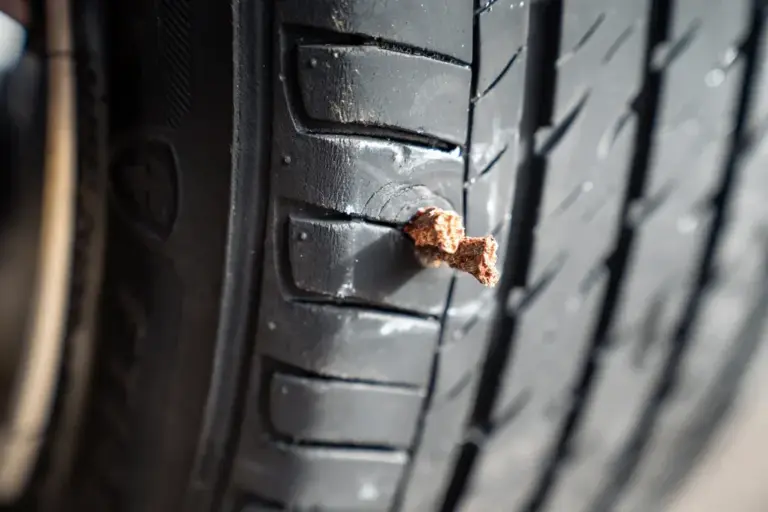
Downsides do exist. You cannot patch punctures located within 0.5 inches of the tire shoulder or directly inside the sidewall flex zone. Punctures larger than 0.25 inches exceed safe patch parameters. Attempting to repair tread with depth below 4/32 inches is also foolish, as you are simply delaying an inevitable replacement. Additionally, poorly executed external rope plugs without interior vulcanization can leak air slowly over time, requiring you to monitor inflation with a 🛒 Heavy-Duty Tire Pressure Gauge →.
Despite these limitations, repair remains the most efficient choice for central tread punctures on healthy tires. If you want to keep costs minimal and handle small repairs yourself right in your garage, getting a complete kit is the smartest move.

Price & availability subject to change. As an Amazon Associate we earn from qualifying purchases.
Replacing: Strengths and Weaknesses
Opting for Replacing provides absolute peace of mind and maximum safety. Fresh rubber guarantees factory-fresh structural integrity, full wet-weather hydroplaning resistance, and uncompromised high-speed stability. Replacing completely removes the risk of sudden air loss caused by compromised tire belts or creeping patch leaks. If your existing tread measures near the legal minimum or your mileage exceeds 50,000 miles, purchasing a new tire resets your vehicle’s foundation and maximizes stopping power in emergency maneuvers.
The primary downside is severe financial cost. Beyond the base tire price, installation fees, valve stem replacements, disposal surcharges, and alignment checks quickly escalate the total bill. On all-wheel-drive vehicles, replacing a single unrepairable tire often forces you to buy four matching tires to prevent drivetrain damage, multiplying your expenditure drastically. Replacing also generates substantial rubber waste, sending functional material to recycling facilities prematurely.
While high costs and shop wait times are inconvenient, fresh rubber is non-negotiable when dealing with sidewall cuts or worn treads. Checking your tread depth regularly using an accurate 🛒 Tire Tread Depth Gauge → ensures you replace tires at the safest operational threshold. If your damage sits outside safe repair zones, investing in a fresh set of rubber remains the ultimate safety upgrade.

Price & availability subject to change. As an Amazon Associate we earn from qualifying purchases.
- ✅ Saves $150 to $300 compared to buying a replacement tire
- ✅ Fast turnaround time, often under 30 minutes at most shops
- ✅ Environmentally friendly by keeping usable rubber out of landfills
- ✅ Preserves original factory wheel balance if performed correctly
- ✅ Inexpensive DIY options available for temporary emergency fixes
- ❌ Cannot fix sidewall, shoulder, or large tread tears over 0.25 inches
- ❌ Does not restore worn tread depth or improve wet weather traction
- ❌ Improper internal repairs can lead to slow leaks or structural failure
- ✅ Restores 100% full tread depth and maximum rain/snow traction
- ✅ Comes backed by long-term manufacturer treadwear warranties
- ✅ Eliminates all structural safety risks associated with severe tire damage
- ✅ Mandatory solution for sidewall punctures, cracks, or wheel rim gouges
- ✅ Improves overall ride comfort, handling precision, and road noise reduction
- ❌ High upfront cost ranging from $150 to over $350 per tire
- ❌ Often requires replacing tires in pairs or sets of four on AWD vehicles
- ❌ Takes longer to dismount, mount, balance, and re-align wheels
Patching a Tire or Replacing: Which Should You Choose?
Deciding between Patching a Tire and Replacing comes down to damage geometry, tread health, driving demands, and budget flexibility.
For daily commuters operating on tight monthly budgets, Patching a Tire is the undisputed champion when dealing with standard nail punctures in the crown area. If your tire has 6/32 inches of tread remaining and the puncture sits squarely between the outer tread grooves, spending $30 on a professional repair makes perfect practical sense. DIY mechanics equipped with a portable 🛒 12V Air Compressor → can handle minor inflation management and quick repairs in minutes without burning an entire afternoon at a service facility.
Conversely, long-distance highway drivers, heavy towers, and performance enthusiasts should lean heavily toward Replacing when tire integrity is even slightly questionable. Towing heavy trailers places immense heat and shear stress on tire carcasses; a previously compromised tire carcass increases puncture failure risk under load. Furthermore, if your tire tread measures below 4/32 inches, patching only delays the inevitable by a few weeks. In that scenario, replacing the tire is the wiser safety investment.
Budget-conscious drivers facing simple central punctures should choose Patching a Tire every single time. Premium vehicle owners, winter drivers, and those with shoulder or sidewall damage must choose Replacing to ensure total road safety. Is saving $170 worth risking a high-speed blowout on damaged sidewalls? Absolutely not—match the service to the exact damage location.
Drivers with minor tread punctures under 0.25 inches and healthy tread depth.
Drivers with sidewall damage, worn tread below 4/32 inches, or severe blowouts.
Final Verdict: Patching a Tire vs Replacing
When evaluating Patching a Tire versus Replacing, Patching a Tire emerges as our overall winner for cost-conscious drivers handling routine daily driving. When dealing with simple tread punctures under 0.25 inches, Patching a Tire saves over $170 per wheel while safely preserving remaining tread life. It offers unbeatable financial efficiency, quick execution, and excellent environmental sustainability.
However, the single key trade-off comes down to safety headroom vs initial cost. Replacing remains non-negotiable whenever damage strikes the sidewall, when puncture diameter exceeds 0.25 inches, or when tread depth falls below 4/32 inches. While Replacing costs significantly more money and takes longer to perform, it restores 100% of factory structural integrity and eliminates all highway blowouts linked to hidden cord damage. Check your puncture location carefully before spending hundreds on new rubber.
As an Amazon Associate we earn from qualifying purchases.
Patching a Tire vs Replacing: Frequently Asked Questions
Is Patching a Tire better than Replacing?
For straight tread punctures under 0.25 inches with plenty of remaining tread depth, Patching a Tire is significantly better because it costs around $30 versus $200 for a replacement. However, if damage occurs on the sidewall or tire shoulder, Replacing is mandatory to maintain structural safety and vehicle control.
How much money do you save by Patching a Tire vs Replacing?
Patching a Tire costs between $20 and $40 at standard repair shops, whereas a quality replacement tire averages $150 to $300. This means drivers save approximately $130 to $270 per puncture, provided the damage is within safe repair guidelines set by the Rubber Manufacturers Association.
Can you patch a tire with sidewall damage?
No, you should never patch or plug a tire sidewall. Sidewalls endure extreme flexing and pressure while driving; repairs in this area will fail and lead to catastrophic blowouts. Any tire with sidewall damage, cracks, or bulges requires immediate Replacing to ensure safe driving conditions.
How long does a patched tire last compared to a new tire?
A properly installed plug-and-patch repair from the inside of the tire lasts for the remaining usable lifespan of the tread—often up to 30,000 miles. By contrast, Replacing a tire gives you a completely new casing with 50,000 to 80,000 miles of expected tread life.
Which option is best for DIY mechanics?
Patching a Tire is far better for DIYers. Roadside plug kits cost under $15 and take 15 minutes to install. Conversely, Replacing a tire requires commercial bead-breakers, mounting equipment, and high-speed balancing machinery that cannot be easily done in a typical home garage.