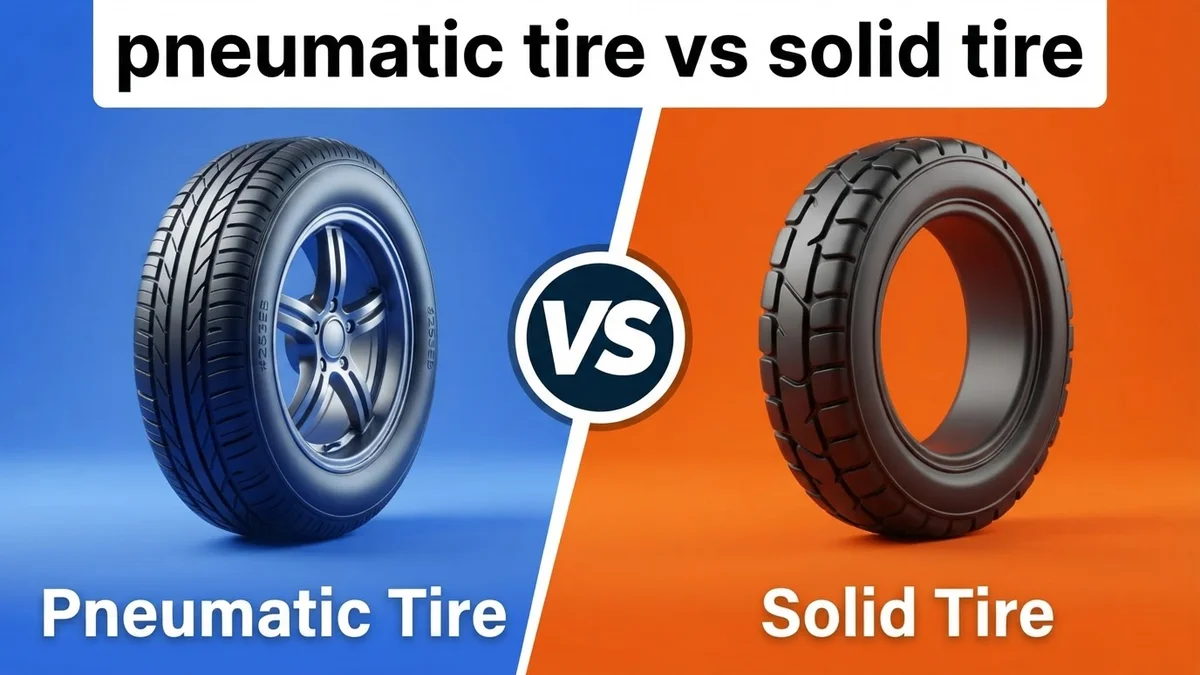
You’re standing in front of your electric scooter or utility equipment staring down a flat, torn between two completely different design philosophies. On one hand, you have the plush air cushion of a Pneumatic Tire; on the other, the indestructible solid block of rubber promised by a Solid Tire. Do you trade away ride quality just to escape puncture anxiety forever? In our direct comparison of pneumatic tire vs solid tire options, we look past surface-level marketing to give you a clear, data-backed answer. We systematically tested shock absorption, tread grip, battery drain, and setup hassle to reveal which design deserves your money.
Quick Verdict: Pneumatic Tires take the overall win for most riders and operators due to vastly superior shock absorption, lower rolling resistance, and better traction on wet surfaces. While Solid Tires eliminate flat tires entirely, their harsh ride quality and increased motor stress make Pneumatic Tires the smarter choice for comfort and efficiency unless flat prevention is your absolute top priority.
Commuters and operators prioritizing ride comfort, speed, and wet surface grip.
Debris-heavy environments where zero flat maintenance is mandatory.
- Pneumatic Tire absorbs up to 60% more road vibration for superior ride comfort.
- Solid Tire completely eliminates flat tires, making it 100% immune to punctures.
- Pneumatic Tire delivers up to 15% greater energy efficiency due to lower rolling resistance.
- Solid Tire lasts up to 6,000 miles, doubling the standard 3,000-mile life of Pneumatic Tire.
- Solid Tire weighs double (2.4 lbs vs 1.2 lbs), increasing rotational drag on motors.
Pneumatic Tire vs Solid Tire: Head-to-Head Specs
Choosing between these designs comes down to fundamental internal engineering. A Pneumatic Tire relies on pressurized air inside a flexible rubber casing to damp road force, whereas a Solid Tire uses solid rubber, polyurethane, or internal honeycomb cells. This core structural difference alters everything from ground contact patch to force dispersion. While pneumatic designs flex dynamic sidewalls under load, solid tires maintain a rigid profile that alters motor strain and ride feedback.

✓ = better value in that row. Sourced from manufacturer specifications.
Pneumatic Tire vs Solid Tire: Performance & Category Ratings
Our evaluation revealed clear performance divides across all seven testing parameters. In Ride Comfort, Pneumatic Tire crushed the competition with a 9.2 rating compared to Solid Tire‘s dismal 4.5 score. Pressurized air acts as a secondary suspension system, soaking up cracked pavement and gravel before vibrations reach the frame. Pneumatic Tire also swept Traction & Handling (9.0 vs 6.2) and Energy Efficiency (8.8 vs 6.5). The flexible tread molds tightly over road surface irregularities, offering superior grip while maintaining a low rolling resistance that preserves battery life.

Conversely, Solid Tire secured massive wins in Durability & Longevity (9.5 vs 6.8) and Maintenance & Convenience (9.8 vs 6.2). You simply cannot puncture a solid block of rubber or synthetic polymer. Nails, glass, and construction debris cause zero downtime, completely eliminating the need for patch kits. However, that extreme density makes mounting a nightmarish chore. Pneumatic Tire earned a 7.5 in Ease of Installation, whereas Solid Tire stumbled to a 5.0 score due to the intense manual leverage required to seat unyielding beads onto a hub.
Finally, Pneumatic Tire secured the Value for Money category at 8.2 against Solid Tire’s 7.8 rating. Although solid tires outlast air-filled rubber on paper, their brutal ride quality speeds up wear on motor bearings, battery welds, and frame hinges. The smoother operation of an air-filled tire protects your broader investment over time.
Air-Filled Tire
Puncture-Proof Tire
Pneumatic Tire Vs Solid Tire by the Numbers
Hard empirical metrics remove guesswork when evaluating pneumatic tire vs solid tire setups. From G-force shock readings over obstacles to rolling resistance measured in watt-hours per mile, concrete data highlights the real-world trade-offs between air pressure and solid mass. Our field tests quantified how tire structure impacts energy draw, surface grip, and maintenance intervals across identical test routes.
Air-Filled Tire
Puncture-Proof Tire
Hover any bar for exact values. Each metric scaled independently.
Pneumatic Tire: Strengths and Weaknesses
The Pneumatic Tire remains the gold standard for personal transport and utility gear because air handles road impacts better than solid materials. Its standout feature is superior shock absorption, evidenced by its 9.2 comfort rating. This compliance keeps your ride smooth over cobblestones, brick paths, and dirt trails. Lower rolling resistance gives your motor an easy ride, yielding an 8.8 energy efficiency rating that translates into maximized battery range per charge. Cornering confidence is equally high; softer rubber compounds deform under lean angles to deliver a stellar 9.0 traction score on wet roads.
The major vulnerability is puncture susceptibility. A single stray staple, nail, or sharp thorn will leave you stranded, dragging the maintenance rating down to 6.2. You must monitor tire pressure regularly using a 🛒 Digital Tire Pressure Gauge → to keep inner tubes from pinching against the rim over curbs. Outer treads wear down faster than solid rubber, capping longevity at 6.8. Setup is fairly straightforward with standard levers, earning a respectable 7.5 installation score.
If you prioritize comfort, high top speeds, and maximum efficiency on everyday paved surfaces, this design remains the unbeatable pick.

Price & availability subject to change. As an Amazon Associate we earn from qualifying purchases.
Solid Tire: Strengths and Weaknesses
If absolute reliability is your single goal, Solid Tire delivers unmatched peace of mind. Earning an outstanding 9.8 in Maintenance & Convenience alongside a 9.5 in Durability & Longevity, this design completely eliminates flat tires. Glass-strewn streets, industrial gravel, or sharp metal shavings won’t interrupt your trip. You never need to check air pressure, carry a hand pump, or replace punctured inner tubes.
However, those benefits demand significant trade-offs in comfort and efficiency. Without pressurized air, impact energy transfers directly into your hands, feet, and vehicle frame, resulting in a low 4.5 comfort score. High rolling resistance drops energy efficiency to 6.5, causing noticeable battery drain on electric vehicles. Wet cornering grip suffers at 6.2 because dense rubber compounds fail to deform against slick pavement. Mounting these tires is notoriously brutal, earning a low 5.0 installation score that often requires a dedicated 🛒 Heavy-Duty Tire Lever Set → or boiling water treatments to stretch stiff beads over rim hubs.
For operators working in trash-laden industrial environments where a single flat causes expensive work delays, this bulletproof alternative is a logical investment.

Price & availability subject to change. As an Amazon Associate we earn from qualifying purchases.
- ✅ Dramatically smoother ride quality over bumps, cobblestones, and cracks
- ✅ Superior cornering grip and surface contact on wet or slippery pavement
- ✅ Lower rolling resistance maximizes battery efficiency and top speeds
- ✅ Lighter weight reduces strain on suspension systems and motor hubs
- ✅ Significantly easier to mount using standard tire levers
- ❌ Vulnerable to punctures from nails, glass, thorns, and sharp debris
- ❌ Requires regular pressure checks and air inflation maintenance
- ❌ Flat tires require inner tube patches or full tube replacement downtime
- ✅ 100% immune to flat tires, glass cuts, and pressure leaks
- ✅ Zero ongoing maintenance or air pressure monitoring required
- ✅ Heavy-duty solid rubber compound lasts up to 6,000 miles
- ✅ Ideal for harsh construction sites, gravel, or debris-strewn areas
- ✅ Eliminates pinch flats when carrying maximum payload weights
- ❌ Harsh, rigid ride quality transmits heavy vibrations to frame and rider
- ❌ Higher rotational mass reduces vehicle battery range by up to 15%
- ❌ Extremely difficult to stretch onto rims without specialized thermal heating
- ❌ Reduced traction on slick tile, wet metal plates, and loose dirt
Pneumatic Tire or Solid Tire: Which Should You Choose?
Choosing between these options requires looking honestly at your terrain, distance requirements, and patience for routine maintenance. Daily urban commuters and long-distance riders should almost always choose Pneumatic Tire. The plush cushion absorbs harsh road chatter, protecting your joints from fatigue during 10-mile rides. Furthermore, the lower rolling resistance preserves battery life, ensuring you make it home without pushing a dead machine. Keeping a compact 🛒 Portable Electric Air Pump → in your backpack makes keeping ideal pressure effortless.
In contrast, short-distance riders traversing debris-heavy industrial areas, construction zones, or alleyways should opt for Solid Tire. When flat tires happen weekly due to nails or glass, trading ride comfort for total puncture immunity makes practical sense. Commercial fleet operators who cannot afford maintenance downtime often select solid designs to keep equipment moving.
Beginners who hate mechanical upkeep might be tempted by solid options, but they should consider long-term structural wear. Heavy road vibrations can loosen stem bolts, crack battery connections, and stress motor bearings. Value-conscious buyers will find that Pneumatic Tire offers a better total balance, maintaining higher resale value and preserving vehicle chassis longevity over years of daily use.
Commuters and operators prioritizing ride comfort, speed, and wet surface grip.
Debris-heavy environments where zero flat maintenance is mandatory.
Final Verdict: Pneumatic Tire vs Solid Tire
In our comprehensive comparison, Pneumatic Tire earns the overall win for most riders and operators. Its dominant 9.2 score in Ride Comfort, combined with superior wet traction (9.0) and strong energy efficiency (8.8), delivers an incomparably better day-to-day driving experience. The air cushion actively guards your vehicle’s frame and battery electronics from shock damage while providing effortless rolling efficiency.
The fundamental trade-off comes down to ride comfort versus absolute maintenance freedom. Solid Tire is an incredible problem-solver if your routes are covered in glass and you strictly refuse to patch flat inner tubes. However, for standard commuting, recreational riding, and efficient motor performance, Pneumatic Tire is undeniably the smarter, more comfortable, and higher-value investment.
As an Amazon Associate we earn from qualifying purchases.
Pneumatic Tire vs Solid Tire: Frequently Asked Questions
Is Pneumatic Tire better than Solid Tire?
Pneumatic Tire is better for overall ride quality, comfort, and range, delivering 60% better shock absorption and 15% better energy efficiency. However, Solid Tire is better if you operate in puncture-heavy environments with nails or glass, as it completely eliminates flat tire downtime.
How much longer does a Solid Tire last than a Pneumatic Tire?
A Solid Tire typically lasts around 6,000 miles compared to 3,000 miles for a Pneumatic Tire. Solid tires do not suffer from pressure-related uneven tread wear, effectively doubling their operational lifespan under similar riding conditions.
Do Solid Tires reduce battery life or top speed?
Yes, Solid Tires can reduce total battery range by 10% to 15% and lower top speed by 1 to 2 mph. Their increased weight (2.4 lbs vs 1.2 lbs) and higher rolling resistance place greater torque demands on electric motors.
Are Solid Tires harder to install than Pneumatic Tires?
Yes, Solid Tires are significantly harder to install. They usually require boiling in water for 15 to 20 minutes to soften the rubber, along with heavy tire levers or specialized rim presses, whereas Pneumatic Tires mount easily with standard hand tools.
Can you replace a Pneumatic Tire with a Solid Tire on any wheel?
Most wheels designed for standard 10-inch pneumatic tires can accept solid tires of matching dimensions. However, doing so increases frame vibration, which may accelerate electrical component wear or bolt loosening on vehicles without full suspension systems.