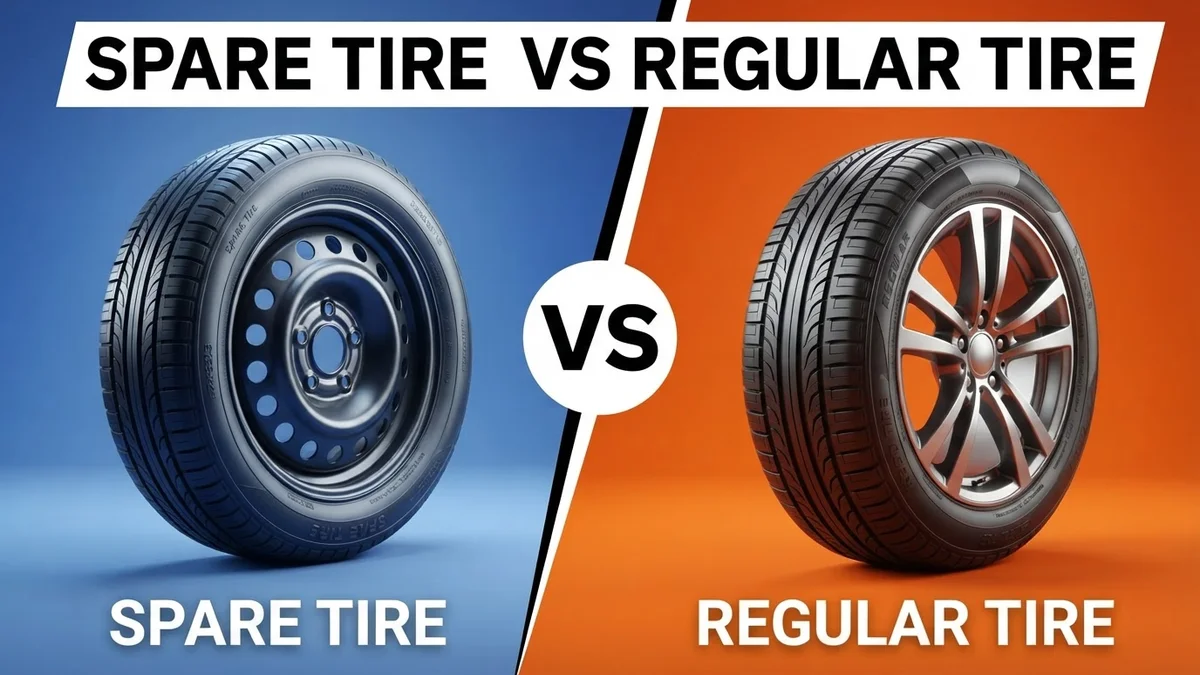
A compact Spare Tire weighs under 30 pounds and occupies less than two cubic feet, yet driving on it for more than 50 miles can completely destroy your vehicle’s differential. Many drivers assume a Spare Tire is simply a smaller version of their standard rubber that can handle normal road duties in a pinch. That assumption is dangerously wrong. A compact Spare Tire operates under severe structural limits—capped strictly at 50 mph and a maximum total lifespan of just 50 miles before friction and heat compromise structural integrity. Meanwhile, a standard Regular Tire can log up to 80,000 miles of continuous service across high-speed highways, winter slush, and heavy payloads. In our comparison of the spare tire vs regular tire, we break down why these components serve completely different roles.
Quick Verdict: Regular Tires win overall for daily driving, safety, and longevity, offering up to 80,000 miles of service. Spare Tires (compact donuts) are built strictly for emergency use to reach a repair shop, capped at 50 mph and 50 miles of total range. Invest in high-quality Regular Tires for primary use and keep a functioning Spare Tire for road emergencies.
Drivers seeking lightweight, space-saving roadside emergency backup protection.
Everyday vehicle operation requiring high speed, durability, traction, and longevity.
- Regular Tires last up to 80,000 miles, whereas compact Spare Tires are capped at 50 total miles.
- Compact Spare Tires require 60 psi inflation pressure compared to 32-35 psi for Regular Tires.
- Driving on a Spare Tire is capped at 50 mph maximum speed to prevent tire overheating and blowout.
- Regular Tires offer 10/32 to 11/32 inches of tread depth, while Spare Tires start with only 3/32 to 4/32 inches.
- A standard full-sized tire costs between $110 and $260, compared to $60 to $140 for a donut Spare Tire.
Spare Tire vs Regular Tire: Head-to-Head Specs


Comparing these automotive components reveals dramatic engineering trade-offs designed for vastly different scenarios. The compact Spare Tire features a shallow 3/32-inch tread depth and a minimalist rubber compound optimized to shrink trunk storage space. In contrast, a full-sized Regular Tire starts with 10/32 inches of tread depth, using steel belt layers and advanced heat-dissipating compounds to sustain continuous speeds above 100 mph. These physical specifications define how each tire handles weight, heat, and road friction.
✓ = better value in that row. Sourced from manufacturer specifications.
Spare Tire vs Regular Tire: Performance & Category Ratings
In our comprehensive comparison, the Regular Tire dominates every operational driving category. Scoring a top-tier 9.5 out of 10 in Daily Performance and a 9.5 in Traction & Safety, a standard tire features intricate tread patterns, lateral siping, and rigid sidewalls designed to channel water and maintain grip during sudden evasive maneuvers. The Spare Tire fails to deliver here, scoring a dismal 2.0 in Daily Performance and 3.0 in Traction & Safety. Its narrow rubber patch severely reduces braking force and disrupts modern electronic stability control systems.
The durability gap is equally vast. The Regular Tire earns a 9.0 in Lifespan & Durability because its reinforced ply layers endure tens of thousands of miles of abrasive pavement friction. The Spare Tire settles for a 1.5 rating, reflecting its fragile construction intended only for short emergency journeys. However, the temporary donut flips the script when evaluated for convenience. It earns a dominant 9.5 in Emergency Utility and a 9.0 in Space & Weight Efficiency. Weighing roughly half as much as a mounted standard wheel assembly, a donut tire fits easily under the cargo floor without tanking your vehicle’s fuel economy. Finally, the Regular Tire takes Value for Money with a 9.0 rating against the Spare Tire’s 7.0, as its multi-year lifespan delivers far better long-term cost efficiency per mile driven.
Spare Tire
Regular Tire
Spare Tire Vs Regular Tire by the Numbers
The empirical metrics clearly highlight the performance gap between these two rubber options. When you examine speed caps, mileage thresholds, tread depth, and inflation pressure specifications, the data shows why automobile manufacturers engineer one tire for daily highway driving and hide the other in the trunk solely for roadside emergencies. In our analytical breakdown, these specific numbers illustrate how physical dimensions directly dictate overall road safety.
Spare Tire
Regular Tire
Hover any bar for exact values. Each metric scaled independently.
Spare Tire: Strengths and Weaknesses
The compact Spare Tire serves one vital purpose: rescuing you from a stranded roadside emergency when an unexpected blowout strikes. Its slim profile and light weight allow automobile designers to maximize passenger legroom and cargo volume inside modern vehicles. Weighing significantly less than a standard wheel assembly, it reduces overall curb weight, helping vehicles maintain optimal fuel economy during daily driving. When a sharp nail ruins your morning commute, having this compact wheel waiting under the trunk carpet is an incredible asset.
However, its operational liabilities are undeniable. The shallow tread pattern provides minimal grip on wet roads and virtually no traction on icy pavement. Exceeding the strict 50 mph speed limit causes rapid heat accumulation that can compromise the tire’s structural layers. Furthermore, because its rolling diameter is smaller than a standard wheel, traveling beyond the recommended 50-mile range places extreme strain on your vehicle’s transmission gears and differential unit. In our comparison, relying on a donut for extended driving is a dangerous risk. Checking your trunk setup with a 🛒 Digital Tire Pressure Gauge → ensures your spare stays properly pressurized to 60 PSI before an emergency occurs. If you need to replace a missing or damaged temporary wheel, securing a proper emergency spare is vital for road peace of mind.
Price & availability subject to change. As an Amazon Associate we earn from qualifying purchases.
Regular Tire: Strengths and Weaknesses
A standard Regular Tire is an engineering powerhouse built for multi-year durability and uncompromised road performance. Constructed with high-silica tread compounds, heavy steel belt plies, and rigid shoulder blocks, a quality Regular Tire delivers smooth highway cruising, crisp cornering control, and predictable stopping distances in dry, wet, or freezing conditions. Whether you carry heavy cargo in a truck or commute long highway miles, these tires maintain a broad contact patch that actively pumps water away to prevent dangerous hydroplaning.
The drawbacks stem primarily from size, weight, and financial investment. A full-sized wheel assembly is bulky, heavy, and costly to purchase or replace. Storing a full-sized spare inside a vehicle trunk consumes significant cargo space while adding extra payload mass that slightly reduces fuel efficiency. Additionally, regular tires require routine maintenance; driving on underinflated rubber causes uneven tread wear and leads to premature replacement expenses. Using a portable 🛒 Tire Inflator → at home helps maintain ideal air pressure, while keeping a reliable 🛒 Tire Repair Plug Kit → in your glove compartment lets you quickly fix simple tread punctures on the go. Investing in a premium set of road-ready tires guarantees the safety and durability your daily vehicle demands.
Price & availability subject to change. As an Amazon Associate we earn from qualifying purchases.
- ✅ Lightweight construction reduces fuel consumption when stored
- ✅ Compact size leaves maximum cargo space in trunk well
- ✅ Lower initial replacement cost for basic emergency backup
- ✅ Easier to lift and align during roadside tire changes
- ❌ Strictly limited to a maximum speed of 50 mph
- ❌ Maximum safe driving range is restricted to 50 miles
- ❌ Shallow tread provides minimal traction on wet or icy roads
- ✅ Built to last between 45,000 and 80,000 driving miles
- ✅ Supports full vehicle towing capacities and gross weight ratings
- ✅ Delivers superior braking, cornering, and wet weather grip
- ✅ Fully rated for sustained high-speed highway driving
- ✅ Includes manufacturer mileage wear warranty coverage
- ❌ Higher initial purchase price per unit
- ❌ Heavy weight reduces available trunk storage capacity when carried as spare
- ❌ Requires routine air inflation checks and tire rotations
Spare Tire or Regular Tire: Which Should You Choose?
Deciding between a Spare Tire and a Regular Tire is not a matter of selecting one over the other for daily driving, but rather understanding how to integrate both into your vehicle management strategy. Daily commuters, highway drivers, and families hauling cargo must prioritize high-quality Regular Tires on all four wheel positions. If you operate an all-wheel-drive vehicle or tow trailers regularly, keeping matched Regular Tires with equal tread wear is critical to prevent dangerous drivetrain binding and costly transmission repair bills.
However, your spare strategy depends on your vehicle type, trunk capacity, and driving habits. For city commuters, sedan owners, and hybrid drivers with limited trunk space, keeping a compact Spare Tire is the smartest choice. It sacrifices high-speed performance for compact storage, ensuring you stay mobile after a flat tire without taking up valuable luggage space. On the other hand, truck owners, off-road enthusiasts, and long-distance overlanders should ditch the temporary donut entirely and mount a full-sized Regular Tire as a spare. A full-sized replacement allows you to continue driving at normal highway speeds without worrying about distance caps or drivetrain strain. To make roadside tire swaps quick and effortless, we recommend keeping a high-torque 🛒 Telescoping Lug Wrench → stored beside your vehicle’s jack assembly.
Drivers seeking lightweight, space-saving roadside emergency backup protection.
Everyday vehicle operation requiring high speed, durability, traction, and longevity.
Final Verdict: Spare Tire vs Regular Tire
In this comparison, the Regular Tire emerges as the absolute winner. It delivers the essential traction, load-bearing capacity, dynamic stability, and 80,000-mile longevity required to navigate daily roads safely. The Spare Tire performs its supportive role brilliantly, but it remains strictly a short-term emergency tool meant to limp your vehicle to the nearest service station.
The fundamental trade-off comes down to daily driving safety versus emergency space efficiency. A temporary donut tire cannot replace a regular highway tire, and running one as a permanent wheel severely threatens your safety and mechanical components. We recommend investing in high-grade Regular Tires for your vehicle’s primary wheels while keeping a fully inflated Spare Tire in your trunk so a sudden blowout never leaves you stranded on the highway.
As an Amazon Associate we earn from qualifying purchases.
Spare Tire vs Regular Tire: Frequently Asked Questions
Is Spare Tire better than Regular Tire?
No, a Regular Tire is superior in durability, speed rating, and safety performance. Regular Tires last up to 80,000 miles at high speeds, whereas a Spare Tire (compact donut) is designed only for emergency travel below 50 mph for up to 50 miles to reach a mechanic.
How far can you drive on a Spare Tire compared to a Regular Tire?
You should only drive a compact Spare Tire for up to 50 miles total distance. In contrast, a new Regular Tire can cover between 45,000 and 80,000 miles depending on compound and driving habits before replacement, maintaining standard handling and braking specs.
What is the biggest difference between a Spare Tire and a Regular Tire?
The main difference lies in construction and purpose. Spare Tires are compact, high-pressure (60 psi) emergency temporary fixes with shallow tread depth, while Regular Tires are full-sized, low-pressure (32-35 psi) units engineered for long distance, full speed capability, and maximum cornering grip.
Why are Spare Tires inflated to 60 psi while Regular Tires are 32 psi?
Compact Spare Tires have a much smaller air volume and reinforced, smaller sidewalls. To safely carry the vehicle corner weight without collapsing or causing rim damage, they require higher pneumatic pressure, usually around 60 psi, compared to 32 to 35 psi for standard Regular Tires.
Can I replace a Spare Tire with a Regular Tire?
Yes, if your trunk wheel well has enough physical clearance. Storing a full-size Regular Tire on a matching wheel as your spare allows you to resume normal driving immediately after a flat, though it increases trunk weight by 10 to 15 lbs.