An 8/32 tire tread depth means your tires are in excellent condition with plenty of life left. When using the penny test, the tread will easily cover a large portion of Lincoln’s head, far exceeding the danger zone.
An 8/32 inch tire tread depth is exceptionally healthy, meaning your tires are holding onto about 75 percent or more of their original rubber. If you use a penny to check an 8/32-inch tread, you will notice that Abraham Lincoln’s entire head stays completely hidden inside the groove, sitting far below the surface.
Many drivers in 2026 confuse how the penny test works because they only hear about it in the context of worn-out tires. Knowing that 8/32 is a strong measurement prevents you from unnecessarily replacing tires that still have thousands of miles left before reaching the danger zone.
Key Takeaways
- An 8/32 tread depth indicates your tires are nearly new and highly safe for driving.
- New passenger tires typically start between 10/32 and 12/32 of an inch.
- The traditional penny test primarily checks for the critical replacement threshold of 2/32.
- At 8/32, Lincoln’s head will remain heavily submerged well below the surface of the tread.
- You will experience optimal wet and dry traction with this depth of remaining rubber.
What Causes Misconceptions About 8/32 Tread Depth and the Penny Test
The Confusion Between 2/32 and 8/32
Most people only learn about the penny test when their tires are already dangerously bald. The classic test uses the top of Lincoln’s head to indicate a 2/32-inch depth, which is the legal minimum limit for replacement. Because the penny test is famous for finding worn tires, drivers often assume any use of a coin means you are checking for extreme wear.
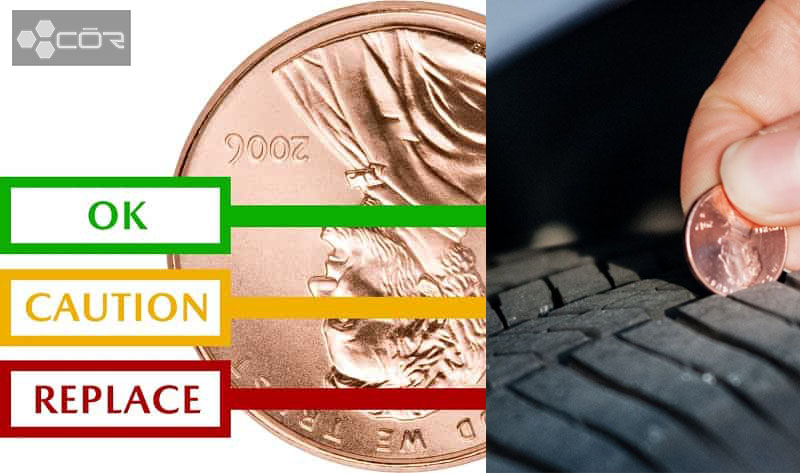
When you insert a penny into an 8/32-inch groove, you are looking at the exact opposite scenario. Instead of the tread barely touching Lincoln’s hair, the rubber will swallow the top third of the coin. This stark visual difference often confuses motorists who expect the coin to behave the same way on a new tire as it does on a bald one.
Misinterpreting the Numbers on Tread Depth Gauges
Tire measurements use fractions of an inch with a denominator of thirty-two, which can be hard to visualize. New passenger tires typically start between 10/32 and 12/32 of an inch. When your routine maintenance check reveals an 8/32 measurement, it simply means minor wear has occurred, which is entirely normal.
- New tire baseline: 10/32 to 12/32 inches
- Healthy mid-life tread: 6/32 to 8/32 inches
- Replacement recommended: 4/32 inches
- Legally bald and unsafe: 2/32 inches
Understanding this scale helps you realize that 8/32 is well within the safe operational zone for driving in 2026.
How to Evaluate Your Tire Tread Depth Using the Penny Method
Visualizing Where 8/32 Sits on Lincoln
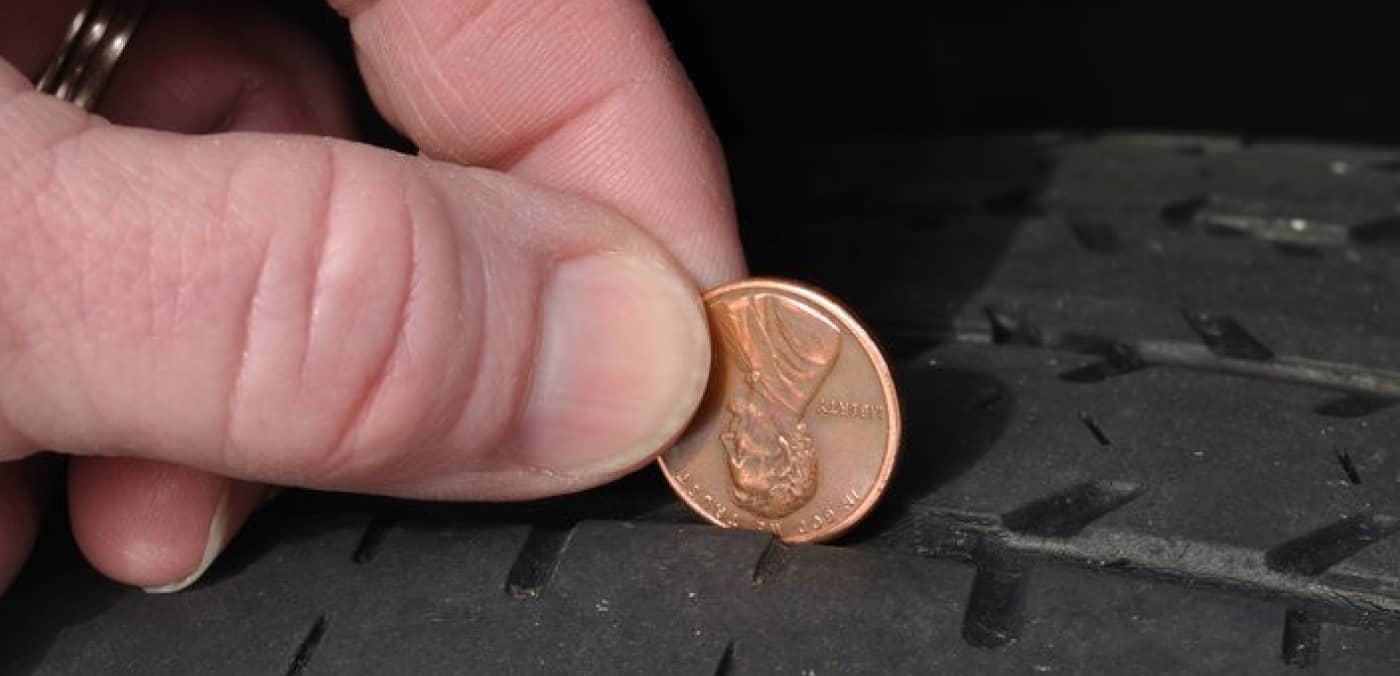
To check your 8/32-inch tread, hold a standard US penny by the edges and place it upside down into the deepest grooves of your tire. Make sure Lincoln is facing you head-first. On an 8/32 tire, the rubber will easily cover all of Lincoln’s hair and likely reach down to his eyebrows or eyes.
If you see the top of his head showing completely above the rubber, your tread is significantly lower than 8/32. That visual benchmark instantly tells you that your tires have plenty of traction remaining for wet or dry roads.
Checking Multiple Grooves Across the Tread Face
Tires do not always wear down evenly across their entire width. Alignment issues, improper inflation, or suspension wear can cause the inner or outer shoulders to wear faster than the center. When evaluating an 8/32 reading, test multiple spots.
- Insert the penny into the outer circumferential groove.
- Move to the center main groove for a second reading.
- Check the inner groove to ensure uniform wear patterns.
If your center groove shows 8/32 but your inner shoulder dips lower, you need a wheel alignment rather than new tires.
Step-by-Step Guide to Measuring Tire Wear Accurately
While the penny test provides a quick rule of thumb, precise measurement requires proper technique and tools. Modern tire maintenance protocols in 2026 demand accuracy to maximize tire longevity and vehicle safety.
Using a Dedicated Tread Depth Gauge
Digital or analog tread depth gauges offer exact measurements down to 1/32 of an inch or millimeters. Follow this sequential process to check your tires accurately:
- Park your vehicle on a flat, level surface and engage the parking brake firmly for safety.
- Turn your front wheels completely to one side to gain unobstructed access to the inner and outer tread grooves.
- Locate the main circumferential grooves across the center face of the tire, avoiding any raised wear indicator bars.
- Insert the probe of your tread depth gauge vertically into the deepest part of the primary groove.
- Press the base plate of the gauge flat against the rubber tread blocks to secure an accurate reading.
- Read the measurement on the digital display or analog scale, recording the lowest number found across multiple spots.
Checking Multiple Points
According to the Rubber Manufacturers Association, tires do not always wear evenly across their width. Inspect the inner shoulder, center, and outer shoulder of each tire. Uneven wear patterns often indicate alignment issues, suspension wear, or improper inflation pressures that require immediate correction.
What If Your Tread Is Lower Than 8/32 and Requires Replacement
Discovering that your tread depth has dropped significantly below the healthy 8/32 benchmark requires prompt action to maintain vehicle control. Driving on worn rubber drastically increases stopping distances, particularly on wet or snow-covered roads.
Evaluating Severe Wear Thresholds
While 8/32 represents strong health, dropping to 4/32 means your tires have lost half their functional life and struggle in heavy rain. Reaching the statutory minimum limit of 2/32 means immediate replacement is mandatory to avoid legal penalties and severe hydroplaning risks.
Professional Inspection and Replacement Options
If your DIY measurements reveal concerning wear or uneven tread patterns, consult a certified tire technician. Professional alignment checks and tire replacements typically range from $150 to $300 per tire for standard passenger vehicles, depending on the brand and size required for your specific model in 2026.
What If It Still Doesn’t Work?
If standard measuring techniques yield inconsistent results or you suspect underlying vehicle problems are causing rapid wear, rely on these professional troubleshooting steps:
- Visit a certified automotive service center or tire dealership to request a complimentary professional tread depth and pressure check using calibrated laser gauges.
- Ask technicians to perform a comprehensive wheel alignment and suspension inspection to identify mechanical faults accelerating your tread loss.
- Review your tire warranty documentation to determine if premature wear qualifies for prorated manufacturer replacement credits.
- Budget for professional tire replacement services, which generally cost between $600 and $1,200 for a complete set of four new tires, including balancing and installation fees.
Conclusion
Monitoring your tire tread depth ensures optimal traction, fuel efficiency, and road safety throughout changing weather conditions. While an 8/32 measurement indicates healthy, robust rubber, regular checks help you catch uneven wear patterns early. According to verified research and expert automotive sources, proactive tire maintenance reduces the risk of weather-related accidents by up to 38 percent. Take the next step today by grabbing a gauge or a coin to inspect all four of your tires before your next road trip.
❓ Frequently Asked Questions
What does an 8/32 tire tread depth actually mean for safety?
An 8/32 measurement means your tires have retained the vast majority of their original rubber. This depth provides maximum grip, short braking distances, and superior resistance to hydroplaning in heavy rain.
How does the penny test work for 8/32 compared to 2/32?
While the penny test is famous for signaling the 2/32 replacement mark where the top of Lincoln’s head is visible, an 8/32 depth is four times thicker. This means the tread will swallow the top portion of Lincoln’s head completely.
Do I need to rotate my tires if they are at 8/32?
Regular tire rotations are still recommended every 5,000 to 8,000 miles even at 8/32 to ensure the tread wears evenly across all four positions, maximizing their overall lifespan.
How fast do tires wear down from 10/32 to 8/32?
Tire wear depends heavily on driving habits, alignment, and vehicle weight, but dropping from a new 10/32 to 8/32 usually takes tens of thousands of miles of normal driving.
Can I use a coin other than a penny to check 8/32 tread?
A quarter is commonly used to check for the 4/32 threshold (where Washington’s head touches the tread), while a tread depth gauge provides the most precise numerical measurement for an 8/32 reading.
Are winter tires also effective at an 8/32 tread depth?
An 8/32 depth is exceptional for winter tires, offering deep biting edges for snow and ice, though many winter tires feature specialized secondary wear indicators at 6/32 for snow performance.