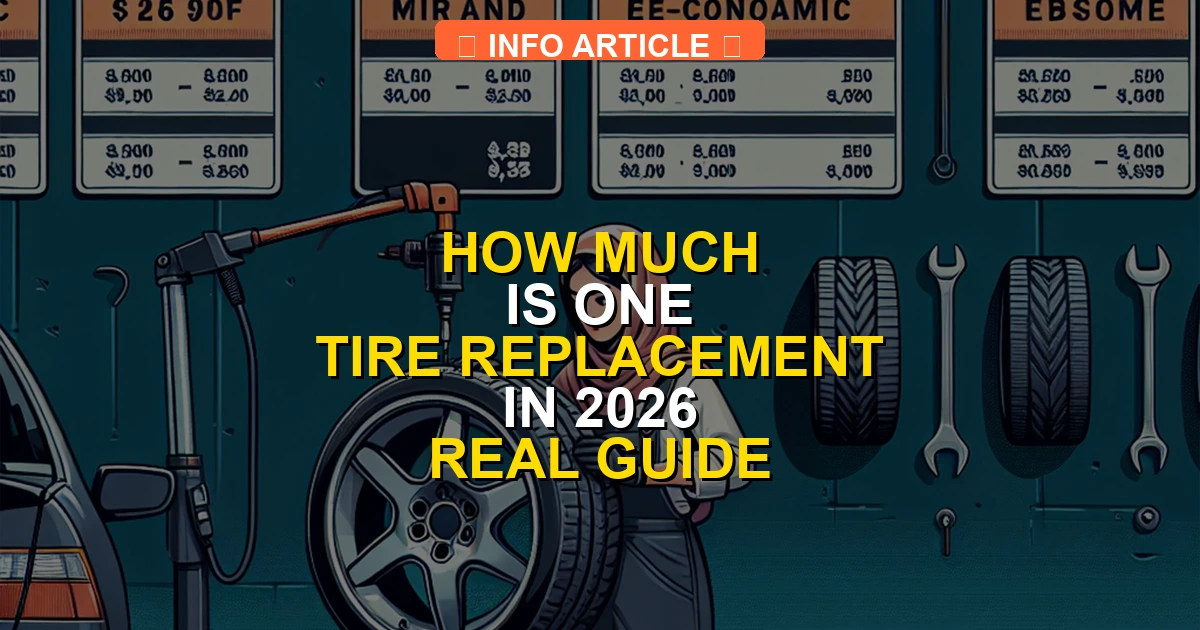
Replacing a single tire typically costs between $100 and $300 total, depending heavily on your vehicle type and tire quality. This price combines the cost of the physical tire plus essential installation fees like mounting, balancing, and disposal.
Replacing just one tire generally costs between $100 and $300 total for standard passenger vehicles in 2026. This price combines the actual cost of the rubber with standard shop labor fees. A budget tire for a compact car might run you $70 plus $25 for mounting and balancing. On the other hand, a performance tire for a luxury sedan can easily push past $250 before installation fees. Replacing a single tire happens more often than you think, usually due to a sudden pothole blowout or an unrepairable nail in the sidewall.
Understanding these costs helps you avoid surprise bills at the repair shop. When you only need one new tire, you must also match the tread depth and brand to your existing tires to maintain safe handling. Skipping this step can strain your drivetrain, especially on all-wheel-drive vehicles. Let us break down the exact costs you will face at the counter in 2026.
Key Takeaways
- Economy tires for compact cars generally range from $50 to $100 per tire.
- Standard sedan tires cost between $100 and $200 before installation.
- Performance and light truck tires often exceed $250 to $400 each.
- Labor and shop fees usually add an extra $25 to $50 per tire.
- Always factor in disposal fees, valve stem replacements, and local taxes.
What Causes High Tire Replacement Costs and Price Variations
Tire prices vary wildly depending on manufacturing materials, engineering, and supply chain factors. Knowing what drives these costs helps you choose the right replacement for your driving habits without overpaying.

Vehicle Type and Wheel Size
The size of your wheel dictates the base price of the rubber. Larger wheels require more material and specialized manufacturing.
- Compact cars and standard sedans (15 to 16-inch wheels): Base tire costs range from $70 to $130.
- Crossovers and mid-size SUVs (17 to 19-inch wheels): Base tire costs range from $130 to $220.
- Full-size trucks and large SUVs (20-inch plus wheels): Base tire costs range from $200 to $350 or more.
Tire Quality and Specialized Tread
The intended performance of the tire changes the price tag significantly. Economy all-season tires keep costs low for daily commuters. Touring tires cost moderately more because they offer longer tread life and quieter rides. Performance and heavy-duty truck tires use specialized rubber compounds and reinforced sidewalls, driving the price up substantially.
2026 Tire Replacement Expert Practical Guide
Figuring out how much one tire replacement actually costs can feel like navigating a maze of hidden fees, bewildering sizing codes, and unexpected labor charges. Whether you picked up a pesky nail on your morning commute or experienced a sudden blowout on the highway, understanding the true financial breakdown of purchasing and installing a single tire saves you from overpaying at the mechanic. This comprehensive guide walks you through every financial variable, from tire tiers to balancing fees, ensuring you pay a fair price and get back on the road safely.
Step 1: Identify Your Exact Tire Size and Specifications
What you need: Your current vehicle, a flashlight, and a notepad or smartphone.
Instructions: Before you can even estimate the cost of a replacement tire, you must know the exact specifications required for your vehicle. Walk out to your car and inspect the sidewall of your existing tires. Look for a alphanumeric code that typically starts with the letter P or LT, followed by numbers like 205/55R16. Write down this entire sequence, along with the load index and speed rating usually found right after the dimensions (such as 91H). Match these numbers precisely when searching online retailers or calling local shops, because substituting the wrong size can severely impact your vehicle handling, fuel economy, and speedometer accuracy.
Pro Tip: Never rely on guesswork or general vehicle make and model alone; manufacturers often change tire sizes between different trim levels of the exact same model year.
Step 2: Choose Your Tire Quality Tier
What you need: Access to online tire retailers like Tire Rack, Discount Tire, or your local dealership catalog.
Instructions: Tire pricing varies dramatically based on quality, brand, and intended use. Economy-tier tires generally cost between $50 and $100 each and are best for budget-conscious drivers or older vehicles with low mileage demands. Mid-tier tires, ranging from $100 to $200 per tire, represent the sweet spot for everyday commuters, offering a solid balance of longevity, wet-weather traction, and warranty coverage. Premium tires, costing anywhere from $200 to $400+ each, are designed for luxury vehicles, high-performance sports cars, or heavy-duty trucks. When replacing just one tire, you should ideally match the brand, tread pattern, and wear level of your existing tires as closely as possible to maintain balanced traction.
Pro Tip: If your remaining three tires are heavily worn (less than 4/32-inch tread depth), replacing just one brand-new tire can strain your drivetrain or cause handling imbalances, making a pair replacement necessary.
Step 3: Factor in Installation and Mounting Labor Fees
What you need: Price quotes from at least two local mechanics, tire specialty shops, or national chains.
Instructions: Rarely is the sticker price of a tire the final amount you will pay. Most shops charge a separate mounting and balancing fee, which typically ranges from $20 to $40 per tire. Mounting involves safely removing the old tire from the metal wheel rim using specialized machinery and pressing the new tire onto it. Balancing ensures that the weight of the new tire and wheel assembly is distributed evenly, preventing annoying steering wheel vibrations at highway speeds. Always ask for an out-the-door quote that itemizes these service charges so you are not hit with surprise labor costs when you go to pick up your vehicle.
Pro Tip: Many online tire retailers partner with local installers who offer discounted installation rates if you purchase the tire directly through their network.
Step 4: Account for Ancillary Shop Fees and Taxes
What you need: Your local sales tax rate and an awareness of standard environmental regulations.
Instructions: When calculating your final total, remember to include mandatory state or municipal fees. Most jurisdictions charge a state tire recycling fee (usually $1.50 to $5.00 per tire) to properly dispose of your old, worn-out rubber. Additionally, shops typically charge a small fee for new valve stems (around $3 to $5) and shop supplies or hazardous waste disposal. Finally, add your local sales tax to the subtotal of the tire and labor. While these individual fees seem minor, adding $15 to $30 in ancillary charges is completely normal and should be factored into your upfront budgeting.
Pro Tip: Keep your old tire if you want to verify that you were actually charged a recycling fee, though most shops automatically recycle it according to local environmental laws.
Step 5: Determine If Wheel Alignment Is Necessary
What you need: A visual inspection of your old tire’s wear pattern and information on your vehicle’s recent suspension history.
Instructions: If your previous tire failed prematurely due to uneven wear on the inner or outer edge, simply slapping a new tire on without addressing the root cause will destroy the new rubber in just a few thousand miles. A standard front-end or four-wheel alignment typically costs between $75 and $150. Ask the technician to check your alignment angles, especially if you hit a severe pothole or curb recently that necessitated this emergency single tire replacement. Even if the alignment was recently done, replacing a tire on a suspension component that is out of spec will drastically shorten the lifespan of your investment.
Pro Tip: Many national tire chains offer free alignment checks, but will charge for the actual adjustment if your angles fall outside manufacturer specifications.
Step 6: Evaluate Optional Road Hazard Warranties
What you need: Understanding of your daily driving routes and risk exposure to debris.
Instructions: Road hazard protection is an optional warranty offered by most retailers, typically costing 10% to 15% of the tire’s purchase price (roughly $15 to $35 for a single tire). This coverage protects your investment against non-repairable punctures, deep sidewall gashes, and glass or nail damage that standard manufacturer tread warranties exclude. If you frequently drive through construction zones, unpaved roads, or areas prone to roadside debris, purchasing this warranty on a single replacement tire is usually a smart financial safeguard that covers a free or heavily discounted replacement if disaster strikes again.
Pro Tip: Read the fine print of the road hazard certificate to check whether it covers free flat repairs and whether the replacement value prorates over time based on tread wear.
Step 7: Calculate Your Total Out-of-the-Pocket Cost
What you need: Your notes from the previous steps and a calculator.
Instructions: Now it is time to tally everything up to get the exact cost for your single tire replacement. Add the cost of the physical tire ($80 to $250+), plus mounting and balancing ($25 to $40), valve stems and shop supplies ($5), state recycling and disposal fees ($3), local taxes, and any optional road hazard warranty or alignment services. In total, a standard single tire replacement usually lands between $130 and $350 out-the-door for everyday passenger cars. For luxury vehicles, oversized truck tires, or low-profile performance tires, this total can easily reach $450 to $600 for just one corner of the car.
Pro Tip: Always compare quotes between a local independent garage, a dedicated tire center, and a wholesale club like Costco or Sam’s Club to find the lowest total out-the-door price.
✅ Final Checklist
- Verified that the new tire size matches the exact dimensions, load index, and speed rating of your remaining tires.
- Confirmed that the shop provided an itemized estimate including mounting, balancing, and disposal fees.
- Inspected the remaining tread depth of the other tires to ensure a single tire replacement is safe and structurally sound.
- Checked tire pressure monitoring system (TPMS) sensors to make sure they were not damaged during the mounting process.
Important Notes:
- Never drive on a severely under-inflated or flat tire for more than a brief distance, as this destroys the internal sidewall structure and ruins an otherwise repairable tire.
- Seek professional help immediately if your vehicle pulls violently to one side or vibrates intensely after the new tire is installed.
- Estimated time for the entire service: 45 minutes to 1.5 hours. Total estimated cost range: $130 to $450 depending on tire tier and added alignment services.
How to Calculate the Total Price of One Tire Replacement
Getting an accurate estimate requires looking past the sticker price on the physical tire. A complete replacement invoice includes several separate service fees that shops tack on.

Breaking Down Shop Fees and Labor
When you buy a single tire, you are paying for more than just the product. Each fee adds to your final out-the-door total.
- Mounting and balancing: Usually costs $20 to $40 per tire to physically put the rubber on the rim and balance it on a machine.
- Tire disposal fee: Most states charge a $2 to $5 environmental recycling fee to safely get rid of your old tire.
- Valve stem replacement: Mechanics often charge $3 to $7 for a new rubber valve stem or sensor service kit.
Real-World Total Cost Examples
Putting all the numbers together gives you a realistic picture of your 2026 replacement budget. For a standard economy car, expect $100 for the tire plus $30 in shop fees, totaling roughly $130. For a modern SUV, a quality all-season tire costs about $180, plus $40 in labor and disposal fees, bringing your total to around $220 for that single corner of your vehicle.
Step-by-Step Guide to Buying and Replacing a Single Tire
Replacing a single tire requires careful coordination to ensure vehicular safety and optimal handling performance. Industry standards from the Rubber Manufacturers Association outline a precise procedure for matching and installing a new unit onto your vehicle.
1. Match Specifications Exactly
Check the sidewall of your existing tires to record the exact size, speed rating, and load index. Installing a mismatched tire creates severe handling imbalances and accelerates mechanical wear on your suspension system.
2. Source the Identical Brand and Model
Procure the exact same brand, tread pattern, and model as your remaining three tires. If the original model is discontinued, select a replacement from the same manufacturer with equivalent tread depth and performance classifications.
3. Measure Existing Tread Depth
Measure the tread depth of your remaining tires using a depth gauge. Automotive experts state that if your current tires have worn down past 4/32 of an inch, installing a brand-new tire with 10/32 of an inch of tread will require professional shaving to match the rolling circumference.
4. Schedule Professional Installation
Take the tire and your vehicle to a certified service center for mounting, computer balancing, and valve stem replacement. Proper balancing typically costs between $20 and $40 and prevents dangerous steering wheel vibrations at highway speeds.
What If Your Tread Wear Requires Replacing More Than One Tire
Sometimes inspecting a damaged tire reveals that the surrounding rubber is no longer safe for the road. Industry guidelines dictate specific replacement rules based on your drivetrain configuration.
Front-Wheel and Rear-Wheel Drive Vehicles
Vehicles with standard two-wheel drive can usually replace tires in axle pairs. If one rear tire is unrepairable, mechanics strongly recommend replacing the opposite rear tire to maintain uniform traction and braking efficiency.
All-Wheel Drive and Four-Wheel Drive Vehicles
AWD and 4WD systems demand strict rolling diameter tolerances across all four wheels. According to drivetrain engineers, if a tire has worn down significantly, replacing just one can overheat and permanently ruin the central differential, resulting in thousands of dollars in repairs.
What If It Still Doesn’t Work?
If purchasing and installing a new single tire fails to resolve your vehicle tracking issues or persistent low-pressure warnings, underlying mechanical problems may be present. Follow these troubleshooting steps to identify the root cause:
- Inspect the tire pressure monitoring system (TPMS): If your dashboard warning light remains illuminated after a tire replacement, the individual wheel sensor battery may be dead or require electronic reprogramming. Professional sensor recalibration typically costs between $50 and $100.
- Check for bent wheel rims: A persistent slow leak or vibration after a new tire installation often indicates a bent alloy or steel rim. A specialized wheel repair shop can straighten minor bends for $75 to $150 per wheel.
- Perform a professional wheel alignment: Potholes that destroy tires frequently knock vehicle suspension geometry out of alignment. A four-wheel alignment costs between $100 and $175 and prevents premature edge wear on your brand-new tire.
- Consult a certified suspension technician: If your vehicle still pulls to one side, worn control arm bushings, tie rod ends, or ball joints may be the true culprit. Comprehensive suspension diagnostics generally range from $100 to $200 at a licensed repair facility.
Conclusion
Budgeting for a single tire replacement in 2026 requires understanding both the direct retail cost of the hardware and the hidden expenses of mounting, balancing, and potential tread matching. Neglecting proper tire matching creates dangerous driving dynamics and risks expensive drivetrain damage. According to verified research and automotive safety sources, the most prudent next step is to measure your current tread depth with a gauge before purchasing any replacement units.
❓ Frequently Asked Questions
How much does a budget economy tire cost for a compact car?
Budget economy tires for smaller commuter cars typically cost between $50 and $95 for the tire itself. When you add standard mounting, balancing, and disposal fees, the total out-the-door price for one tire usually lands between $80 and $130.
What is the average cost to replace a standard sedan tire?
Standard touring and all-season tires for mid-size sedans generally range from $100 to $200 per tire. Including shop labor and taxes, you can expect a final total of $130 to $240 for a single replacement.
How much do SUV and truck tire replacements cost?
Larger vehicles require heavier-duty tires, with prices ranging from $175 to over $350 per tire for standard trucks and large SUVs. Specialized all-terrain or heavy towing tires can push the price past $400 for a single tire.
What hidden fees should I watch out for on my tire invoice?
Common additional charges include wheel balancing fees, new valve stems or TPMS (Tire Pressure Monitoring System) service kits, and state waste tire disposal fees. These extra charges typically add $25 to $60 to the total bill.
Can I replace just one tire if the others are relatively new?
Yes, if your remaining tires have at least 7/32″ to 8/32″ of remaining tread depth, replacing just one tire is safe and practical. However, matching the exact brand, model, and tread pattern is strongly recommended.
Why do All-Wheel Drive (AWD) cars complicate single tire replacement?
AWD systems require very uniform tire diameters to prevent strain on the center differential. If your existing tires are heavily worn, putting a brand new tire with full tread depth next to worn ones can damage the drivetrain, often requiring the new tire to be shaved down to match.