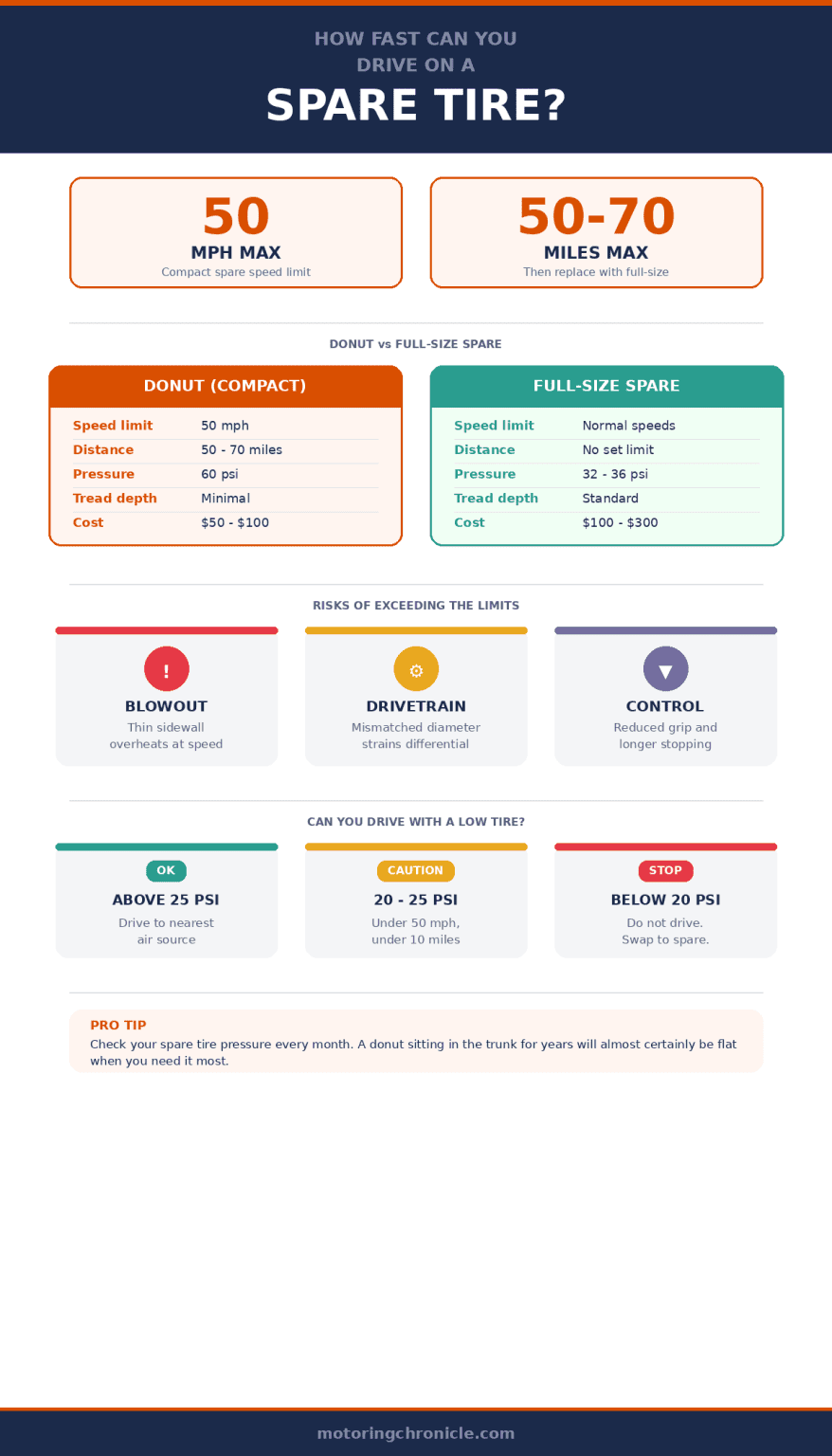
Most temporary spare tires, commonly known as donuts, have a strict speed limit of 50 mph (80 km/h). Exceeding this limit compromises your vehicle’s braking ability, traction, and tire structural integrity, leading to a high risk of failure.
If you are currently rolling on a temporary spare tire, the golden rule you need to know immediately is 50 mph. Driving faster than 50 miles per hour on a compact spare—commonly called a “donut”—puts your vehicle, your safety, and other drivers at extreme risk.
Most modern vehicles manufactured through 2026 come equipped with these lightweight, temporary donuts designed strictly for emergency transport to a nearby repair shop. Ignoring this speed threshold compromises your car’s critical safety systems and can lead to a catastrophic blowout.
Key Takeaways
- Never exceed 50 mph when driving on a compact temporary spare tire.
- Limit your driving distance to a maximum of 50 miles before replacing it.
- Temporary spares require a much higher tire pressure, typically around 60 psi.
- Full-size matching spares allow for normal highway speeds and standard driving habits.
- Always avoid sharp turns, sudden braking, and highway speeds on a donut tire.
What Causes Safety Risks When Driving Too Fast on a Spare Tire
The Physics of Reduced Traction and Braking
A compact spare tire is roughly half the width of your standard tire. This dramatically decreases the surface area touching the road. When you exceed 50 mph, your car loses significant grip, especially during emergency maneuvers. Furthermore, braking distances increase drastically. If you have to slam on your brakes at 65 mph on a donut, your stopping distance can double compared to driving on a full-size tire, making rear-end collisions much more likely.
Structural Vulnerabilities and Heat Buildup
- Thin Tread: Donuts feature very shallow tread depth, which eliminates effective water displacement and invites immediate hydroplaning at highway speeds.
- High PSI Demands: Temporary spares require much higher air pressure—usually around 60 psi—to support vehicle weight on a smaller footprint.
- Extreme Heat: The internal casing of a donut cannot handle sustained high-speed friction, causing rapid heat generation that destroys the rubber compound.
How to Safely Drive and Fix Your Flat Tire Problem
Distance Limitations and Pressure Requirements
Speed is only part of the equation when managing a roadside flat in 2026. You must also strictly monitor the distance you travel. Most compact spares are engineered for a maximum lifespan of 50 miles. Driving further than that wears down the temporary rubber until the internal cords fail.
Before you even pull away from the shoulder, verify your tire pressure. Even if the spare has been sitting in your trunk for years, it leaks air naturally. A low-pressure spare combined with high speeds is a recipe for a secondary blowout.
Best Practices for Limiting Road Hazards
- Stay in the Slow Lane: Keep your vehicle in the rightmost lane of traffic and use your hazard lights if you are driving significantly below the flow of traffic.
- Avoid Aggressive Driving: Take turns slowly. High-speed cornering puts lateral stress on the narrow wheel structure, which can cause the tire to unseat from the rim.
- Head Straight to a Shop: Do not run errands or delay. Navigate directly to the nearest tire service center to repair or replace your primary flat tire.
What If It Still Doesn’t Work or You Need to Travel Farther
Sometimes road conditions, extreme distances, or safety warnings complicate using a standard compact donut. If the temporary tire is compromised, or if you must travel beyond the safe 50-mile limit, drivers must adapt immediately. Continuing on a damaged or overused temporary unit risks catastrophic tread separation.

Recognizing Alternative Roadside Scenarios
If you face compounding vehicle issues or long-distance travel requirements, specific protocols prevent further damage. Modern roadside assistance platforms report average wait times of 45 to 60 minutes for professional towing services in 2026. Weighing a roadside tow against risking a blowout is vital for driver safety.
- Evaluate the distance: If your destination exceeds 50 miles, pull over safely and arrange for a flatbed tow truck rather than risking a blowout on the highway.
- Inspect for secondary damage: Check if the wheel well, brake lines, or ABS sensors sustained impacts during the initial blowout.
- Call roadside assistance: Contact AAA, your auto insurer, or a local mobile tire repair service to bring a full-sized replacement directly to your location.
- Budget for professional help: Standard professional towing services and mobile tire installations typically range from $100 to $250 depending on your exact geographic location and time of day.
Best Practices for Maintaining and Replacing Temporary Spares
Proper maintenance ensures your temporary tire performs reliably when emergencies happen. Many drivers neglect their spares for years, leading to dangerous deflation or rubber dry rot. Industry standards recommend inspecting your emergency equipment at least twice a year during routine seasonal maintenance intervals.
Proactive Maintenance Steps
Keeping your emergency setup road-ready requires minimal effort but yields massive safety benefits. Temperature fluctuations naturally cause tire pressure to drop by approximately 1 to 2 PSI for every 10-degree drop in ambient air temperature.
- Check pressure semi-annually: Inflate your compact spare to the manufacturer-specified 60 PSI, which is significantly higher than standard daily-driver tires.
- Inspect for aging: Examine the rubber compound for dry rot, deep cracks, or bald spots every four to six years, as rubber degrades over time regardless of mileage.
- Secure proper tools: Ensure the vehicle jack, lug wrench, and tow hook are present, rust-free, and fully operational in their designated trunk compartment.
- Upgrade to a full-size spare: For frequent long-distance commuters, replacing a donut with a matching full-size wheel and tire eliminates speed restrictions entirely.
Conclusion
Driving on a spare tire requires strict adherence to safety limits, specifically maintaining speeds under 50 mph and traveling no more than 50 miles. Ignoring these boundaries jeopardizes vehicle stability and risks severe mechanical damage. According to verified research and expert sources from the National Highway Traffic Safety Administration, immediate replacement with a permanent tire remains the safest resolution. Your next actionable step is to inspect your spare tire pressure and tool kit today to ensure complete preparedness for your next roadside emergency.
❓ Frequently Asked Questions
What happens if you drive over 50 mph on a spare tire?
Driving over 50 mph on a compact spare causes extreme heat buildup, tread separation, and potential tire blowout due to their lightweight, narrow construction.
Can I drive long distances on a compact spare tire?
No, compact spares are strictly meant for temporary emergency use to get you to a nearby repair shop, generally within a 50-mile limit.
How can I tell what type of spare tire I have?
Check the sidewall of the spare tire. Compact donuts will explicitly state ‘Temporary Use Only’ along with the 50 mph speed restriction.
Does a spare tire affect anti-lock brakes and traction control?
Yes, because a donut is smaller and lighter than standard tires, it can trigger ABS, traction control, and stability control warning lights while driving.
Can I get a speeding ticket for driving too fast on a spare?
While police rarely ticket specifically for exceeding spare tire limits, you can be cited for unsafe operation of a vehicle if you drive recklessly on a compromised tire.
Is it safe to drive in the rain with a spare tire?
Driving in wet weather with a compact spare is extremely hazardous because the narrow tread has very little grip, drastically increasing hydroplaning risks.