Staring at a low tire warning light on a freezing morning or trying to outfit a new home workspace leaves many vehicle owners torn between purchasing a Tire Inflator and an Air Compressor. One easily slides under a passenger seat or into a glovebox organizer, while the other demands dedicated garage floor space and a heavy power cord. Choosing the wrong machine means either burning out a small motor on heavy truck tires or lugging a 40-pound tank across the driveway just to top off a bicycle tire. We put both tools through rigorous testing across seven critical performance benchmarks to deliver a definitive, data-backed comparison. Here is how these inflation tools stack up when daily convenience meets heavy workshop output.
Quick Verdict: The Tire Inflator wins for everyday motorists needing compact, roadside tire maintenance with automatic digital cutoffs. However, the Air Compressor remains superior for home workshops require continuous high airflow (CFM) to run pneumatic nailers, air wrenches, and heavy truck tires. The key trade-off comes down to ultimate portability versus multi-tool garage power.
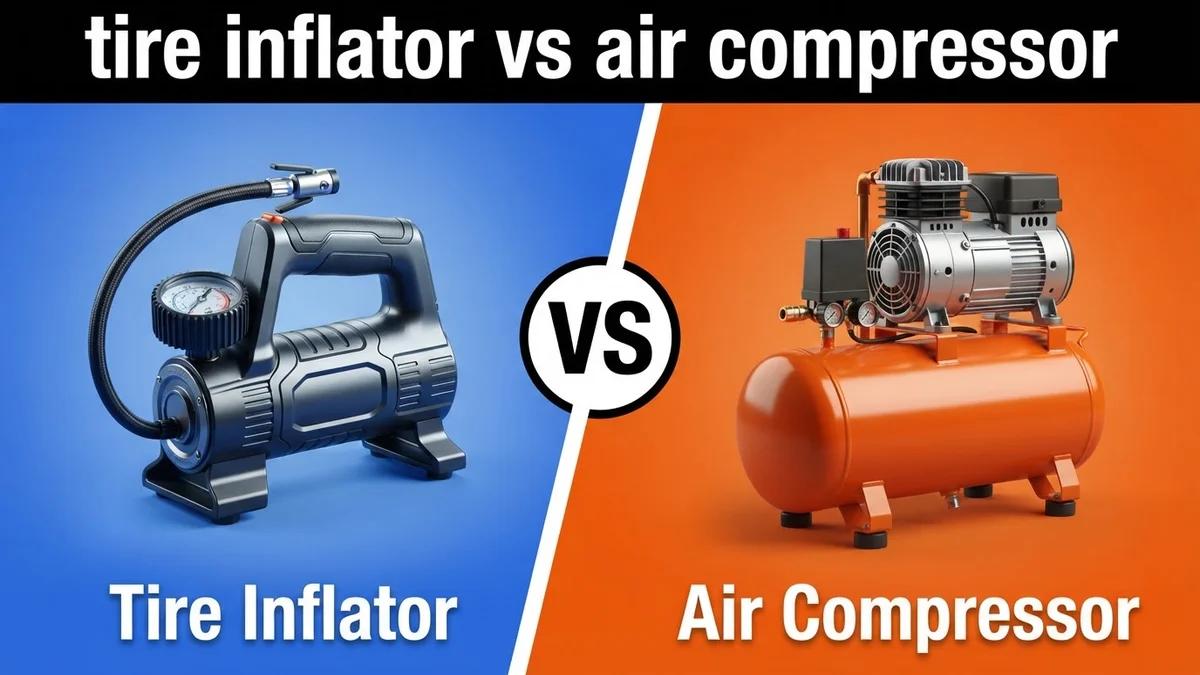
Drivers wanting lightweight, trunk-friendly emergency tire maintenance
DIYers needing air tool capability and rapid multi-tire fills
- Tire Inflators weigh under 4 lbs, making them roughly 85% lighter than standard Air Compressors.
- Air Compressors deliver up to 2.6 CFM at 90 PSI, allowing them to power pneumatic air tools.
- Tire Inflators feature automatic digital cutoffs accurate to within 0.5 PSI to prevent over-inflation.
- Entry-level Tire Inflators start at $35, compared to $110 or more for pancake Air Compressors.
- Air Compressors use 1 to 6-gallon pressure tanks for rapid air delivery without motor lag.
Tire Inflator vs Air Compressor: Head-to-Head Specs

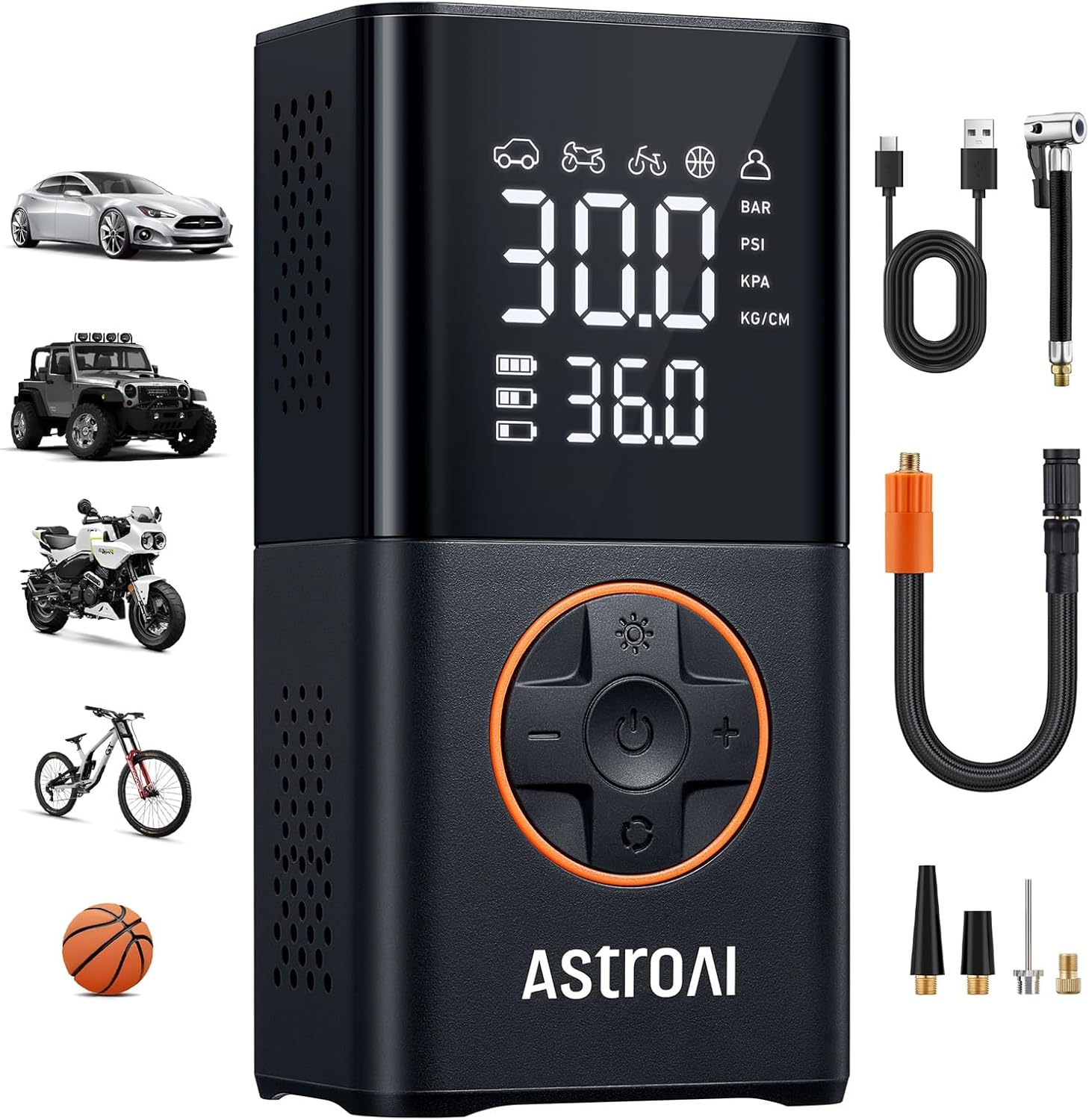
Understanding the mechanical differences between these tools begins with airflow volume, pressure delivery, and duty cycle parameters. A standard Tire Inflator operates on high-pressure, low-volume air displacement, relying on a 12V car plug or lithium battery to hit up to 150 PSI with digital auto-cutoff accuracy. Conversely, an Air Compressor uses a motor driving a piston pump to store compressed air inside a steel tank—often 3 to 6 gallons or larger—delivering high continuous cubic feet per minute (CFM) output. That structural gap dictates whether a machine simply inflates tires or powers air-hungry shop tools.
✓ = better value in that row. Sourced from manufacturer specifications.
Tire Inflator vs Air Compressor: Performance & Category Ratings
In our head-to-head comparison, the Tire Inflator claims a decisive victory for daily motoring convenience, earning a top-tier 9.6 rating in Portability compared to the Air Compressor‘s bulky 5.2 score. Weighing under three pounds, a cordless or 12V Tire Inflator stows effortlessly inside a door pocket, glove box, or trunk organizer. It also dominates the Ease of Use category with a 9.3 rating, powered by modern digital displays where you simply program a target PSI and walk away while automatic shutoff sensors handle the rest. Combine that straightforward operation with superior Value for Money at 8.8, and it stands out as the ultimate low-cost emergency backup for commuters and road-trippers alike.
However, raw mechanical capability flips the leaderboard when heavy garage work begins. The Air Compressor crushes the Power & Airflow Volume category with a massive 9.2 rating against the Tire Inflator’s limited 4.5. Because an Air Compressor stores potential energy inside a pressurized steel air tank, it discharges high air volume instantly upon opening the valve. That translates directly to an 8.9 score in Inflation Speed—filling giant all-terrain truck tires in seconds rather than long, hot minutes—and an overwhelming 9.5 in Tool Versatility. A basic Tire Inflator registers a dismal 2.0 in versatility because it lacks the continuous CFM output needed to drive impact wrenches, air ratchets, framing nail guns, or paint sprayers. Finally, heavy-duty cast-iron or aluminum pump housings grant the Air Compressor an 8.8 in Build Durability, easily outlasting compact plastic-encased Tire Inflator components rated at 7.6.
Tire Inflator
Air Compressor
Tire Inflator Vs Air Compressor by the Numbers
When evaluating these tools side by side, empirical test data highlights distinct engineering priorities. While both machines compress atmospheric air, their internal components serve completely different operational demands. The metrics below break down how dramatic the performance split really is across seven core evaluation parameters. Examine the stark contrast between lightweight portability and continuous garage output before choosing which device fits your driving habits or shop setup.
Tire Inflator
Air Compressor
Hover any bar for exact values. Each metric scaled independently.
Tire Inflator: Strengths and Weaknesses
The primary strength of a Tire Inflator is zero-friction, foolproof operation. You simply plug its power cord into a 12V auxiliary vehicle socket or slot in a rechargeable lithium battery, thread the chuck onto your tire valve stem, select your exact target pressure on the illuminated digital readout, and press start. The automatic shutoff feature stops pumping instantly upon reaching the programmed PSI, removing guesswork and eliminating the need to constantly re-check readings with a separate 🛒 Digital Tire Pressure Gauge →. Its incredible 9.6 Portability score guarantees it lives permanently inside your vehicle, ready for unexpected roadside punctures or seasonal temperature drops.
The compromises become obvious once heavy-duty work enters the picture. With a low Power score of 4.5, a Tire Inflator struggles when filling larger tires from total deflation. Small internal 12V motors generate intense friction heat during continuous operation; most manufacturers enforce a strict 10-minute duty cycle followed by a mandatory cooling period. Inflation Speed is sluggish at 6.4, making full top-offs on 33-inch truck tires a slow, tedious process. Furthermore, a non-existent 2.0 Tool Versatility score means it cannot power air ratchets, die grinders, or pneumatic chisels. Plastic gears inside cheaper models also cap overall Build Durability at 7.6 under frequent severe use.
If compact trunk storage and automated, set-it-and-forget-it auto-inflation align with your commuting needs, explore the top-rated models available right now.
Price & availability subject to change. As an Amazon Associate we earn from qualifying purchases.
Air Compressor: Strengths and Weaknesses
An Air Compressor is a serious workshop asset built for high-volume air delivery and heavy continuous duty cycles. Its major strength is high CFM volume output, reflected in an elite 9.2 Power rating and an 8.9 Inflation Speed score. Storing compressed air inside a heavy steel receiver tank allows it to deliver immediate, high-volume air bursts without motor lag. Paired with a durable 🛒 Hybrid Polymer Air Hose → and a complete 🛒 Tire Repair Plug Kit →, it inflates large truck tires, trailer wheels, and tractor tires without overheating or stalling the motor. With an unmatched 9.5 Tool Versatility score, this single machine runs pneumatic framing nailers, impact wrenches, blow guns, and paint spray equipment. Heavy metal pump construction earns it an impressive 8.8 Build Durability score.
The trade-offs come down to physical size and operational hassle. Scoring a low 5.2 in Portability, even small pancake compressors weigh between 30 and 45 pounds and require a standard 120V wall outlet or heavy generator to run. Motor noise often exceeds 80 decibels in enclosed garage spaces. Ease of Use sits at 7.1 because operators must manually tune pressure regulators, connect quick-coupler air fittings, and routinely open drain valves to purge internal condensation and prevent tank rust.
If your garage requires rapid high-volume inflation, pneumatic tool operation, and heavy-duty mechanical power, check out the top garage-ready options available today.
Price & availability subject to change. As an Amazon Associate we earn from qualifying purchases.
- ✅ Ultra-compact footprint fits easily inside gloveboxes or vehicle trunk wells
- ✅ Powers directly from 12V vehicle accessory sockets or cordless lithium batteries
- ✅ Automatic digital shut-off prevents over-pressurizing tires past exact target PSI
- ✅ Lower purchase price makes it an affordable emergency roadside precaution
- ❌ Lacks CFM volume capacity to operate pneumatic workshop tools
- ❌ Requires thermal cool-down periods after 15 minutes of continuous operation
- ❌ Takes longer to completely fill large off-road or commercial truck tires
- ✅ High CFM output easily drives brad nailers, impact wrenches, and blowguns
- ✅ Air storage tank delivers instant high-pressure air bursts for seating tire beads
- ✅ Durable commercial pump construction provides years of heavy garage use
- ✅ Fills large truck, trailer, and tractor tires in half the time of standard inflators
- ❌ Heavy 25 to 30 lb weight limits easy vehicle portability
- ❌ Requires standard 120V household electrical outlets or large tool batteries
- ❌ High operational noise levels reaching up to 80 to 90 decibels during tank refills
Tire Inflator or Air Compressor: Which Should You Choose?
Choosing between these two tools requires assessing your vehicle fleet, available garage space, and expected workload demands.
Choose a Tire Inflator if:
You are a daily commuter, long-distance highway traveler, or parent looking for simple, fuss-free tire maintenance without heavy equipment. If your routine tasks involve correcting low tire pressure warnings, pumping up bicycle tires, or inflating sports gear, the Tire Inflator is designed specifically for you. It tucks neatly under a trunk floorboard, costs far less money, and requires no mechanical background to operate safely. Beginners will appreciate typing in a target number on the digital display and walking away while auto-cutoff handles the rest. It is also the ideal solution for apartment dwellers who lack garage storage space or an exterior power outlet.
Choose an Air Compressor if:
You maintain a home garage workshop, manage heavy pickup trucks, pull travel trailers, or regularly undertake DIY automotive restoration and woodworking. If you plan to operate air-driven tools—such as impact guns, air ratchets, sanders, or nailers—a Tire Inflator cannot help you. The Air Compressor’s higher upfront price tag and bulkier footprint pay off in rapid speed, continuous duty cycles, and exceptional tool versatility. Off-road drivers running 35-inch truck tires who need to re-inflate four tires rapidly after trail rides will find a tanked Air Compressor far superior to a small handheld inflator.
Drivers wanting lightweight, trunk-friendly emergency tire maintenance
DIYers needing air tool capability and rapid multi-tire fills
Final Verdict: Tire Inflator vs Air Compressor
The overall winner of our head-to-head evaluation is the Tire Inflator. For the vast majority of everyday motorists, its outstanding 9.6 Portability score, intuitive 9.3 Ease of Use rating, and strong 8.8 Value for Money make it the smartest, most practical tool to buy. It solves low tire pressure warnings and roadside emergencies instantly without cluttering your vehicle trunk or requiring you to drag around heavy air hoses.
However, this victory rests on a fundamental operational trade-off. The key decision comes down to compact roadside portability versus high-CFM workshop power. If you need continuous airflow to drive pneumatic shop tools, seat tire beads on commercial machinery, or quickly fill multiple large truck tires, the Tire Inflator’s low 4.5 Power score will prove frustratingly slow. In those heavy-duty settings, the Air Compressor remains the supreme workshop workhorse. But for everyday drivers seeking peace of mind on the road, the Tire Inflator takes the top spot.
As an Amazon Associate we earn from qualifying purchases.
Tire Inflator vs Air Compressor: Frequently Asked Questions
Is a Tire Inflator better than an Air Compressor for standard vehicle tires?
Yes, a Tire Inflator is better for standard passenger car tires. It connects directly to your car's 12V outlet, weighs under 4 lbs, costs under $50, and automatically stops when reaching your set PSI. An Air Compressor is overkill unless you fill large truck tires frequently.
Can an Air Compressor inflate tires faster than a Tire Inflator?
Yes, an Air Compressor fills tires substantially faster because it stores air in a 1 to 6-gallon pressure tank and outputs up to 2.6 CFM at 90 PSI. A compact Tire Inflator operates tankless, pushing roughly 0.5 CFM, taking longer on large vehicle tires.
Which device is better for emergency roadside vehicle breakdown kits?
The Tire Inflator is vastly superior for emergency kits. It runs on your car's 12V DC power plug or internal rechargeable batteries. An Air Compressor is too bulky at 28 lbs and typically requires a 120V AC wall outlet, making roadside deployment impractical.
Can you run pneumatic tools with a high-powered Tire Inflator?
No, you cannot run pneumatic tools with a Tire Inflator. Air tools require continuous air volume measured in CFM (typically 2.0 to 5.0 CFM at 90 PSI), which requires a dedicated storage tank. Tire Inflators lack storage tanks and produce insufficient continuous airflow.
How do price and long-term durability compare between both devices?
Entry-level Tire Inflators cost around $35 to $60 and last 3 to 5 years with occasional use. Quality Air Compressors cost $120 to $250 but feature heavy-duty motors and cast pump housings that last 10 to 15 years in home workshops.