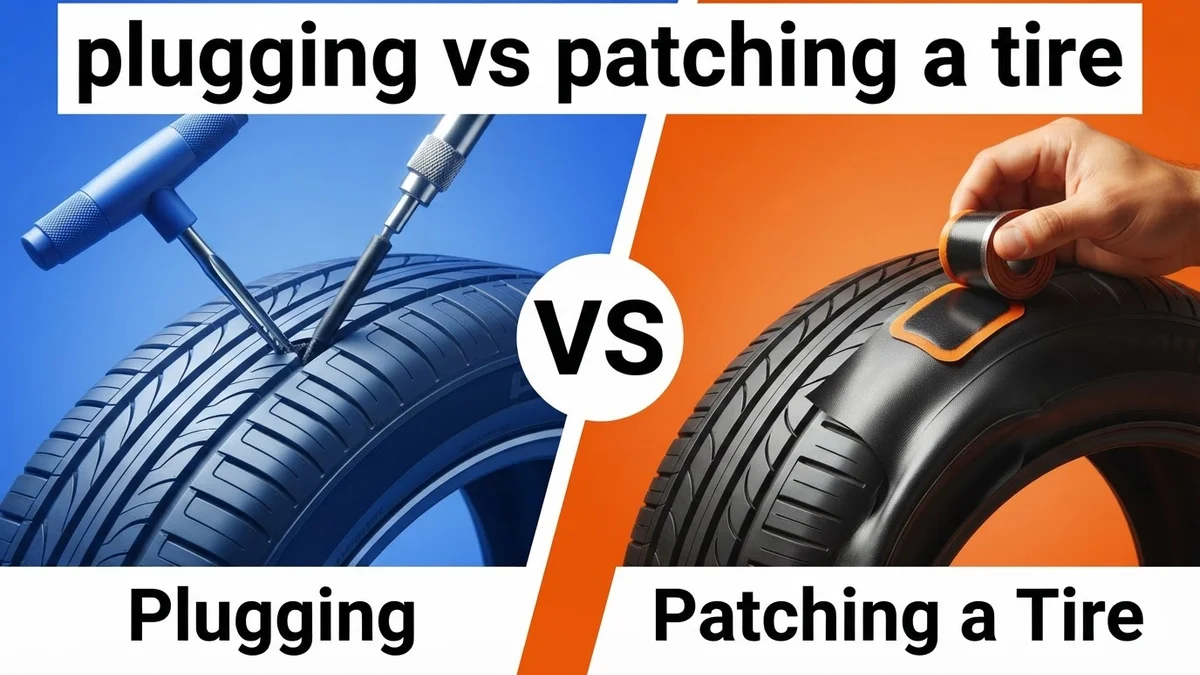
Most drivers assume a quick sticky plug permanently fixes a punctured tire, but safety data reveals a stark reality: external tire plugs carry a 0% compliance rating with major tire manufacturers. Puncture repairs seem straightforward when air is rushing out of your tread. Yet the technical divide between external Plugging and internal Patching a Tire represents a massive trade-off between fifteen-minute roadside convenience and long-term structural safety. Plugging forces a thick rubber cord into the tread channel from the outside, while Patching a Tire requires dismounting the tire to seal the inner liner permanently. Choosing the wrong method can ruin your casing.
Quick Verdict: Patching a Tire is the clear winner for long-term safety and structural integrity, permanently sealing tread punctures from the inside to preserve speed ratings. Plugging offers unmatched convenience and speed for emergency roadside situations at under $15, but lacks official tire manufacturer endorsement for permanent usage.
Drivers seeking a quick, low-cost roadside repair without removing the wheel.
Drivers wanting a permanent, safety-certified tire repair that lasts the life of the tread.
- Patching a Tire provides a permanent seal lasting up to 50,000 miles, whereas Plugging is a temporary 20,000-mile solution.
- A Tire Plug kit costs under $15 for DIY use, while professional Patching services cost $35 to $60.
- Plugging takes under 10 minutes roadside without wheel removal, compared to 45 minutes for shop Patching.
- Patching preserves 100% of factory tire speed ratings, whereas Plugging voids original speed ratings.
- Both methods are restricted to tread punctures under 0.25 inches and cannot repair sidewalls.
Plugging vs Patching a Tire: Head-to-Head Specs
When comparing these two repair methods, mechanical differences become obvious immediately. Plugging can be executed in under 15 minutes right on the shoulder of an interstate without taking the wheel off your car hub. Conversely, Patching a Tire requires 45 to 60 minutes, complete wheel dismounting, and breaking the bead seal. While a simple plug kit costs under $15, a professional internal patch completely restores tire casing integrity up to 100% of its original factory speed rating.

✓ = better value in that row. Sourced from manufacturer specifications.
Plugging vs Patching a Tire: Performance & Category Ratings
In our comparison, category score splits highlight a sharp division in real-world utility. Plugging dominates Convenience & Speed with an exceptional 9.6 rating against Patching a Tire at 5.2, alongside an outstanding Ease of DIY Use score of 9.3 compared to Patching’s humble 3.8. You do not need a shop lift, bead breaker, or wheel balancer to force a sticky cord into a punctured tread block. It gets you rolling again long before a roadside assistance tow truck even arrives.

However, Patching a Tire takes complete control of structural safety and overall longevity categories. Scoring a massive 9.6 in Safety & Integrity and 9.8 in Long-Term Durability, Patching a Tire seals the inner air liner directly from inside the tire carcass. Internal air pressure actively forces the patch against the rubber, completely sealing out moisture that would otherwise rust internal steel belts. Plugging manages a mediocre 6.2 for safety and 6.8 for durability because external plugs can dry out, seep air, and fail under aggressive driving heat. Furthermore, Patching a Tire scores a near-perfect 9.9 in Industry Standard Compliance, whereas Plugging drops down to a 4.0 rating because major tire manufacturers explicitly refuse permanent endorsement for external plugs.
Tire Plug
Tire Patch
Plugging Vs Patching A Tire by the Numbers
Head-to-head performance metrics demonstrate why these two repair options suit radically different driving scenarios. From repair times under 15 minutes to strict temperature operating limits, raw technical data uncovers what actually happens inside a tire carcass under load. Evaluating speed ratings, repair costs, structural pressure limits, and official warranty compliance gives you an accurate picture of tire durability on the road.
Tire Plug
Tire Patch
Hover any bar for exact values. Each metric scaled independently.
Plugging: Strengths and Weaknesses
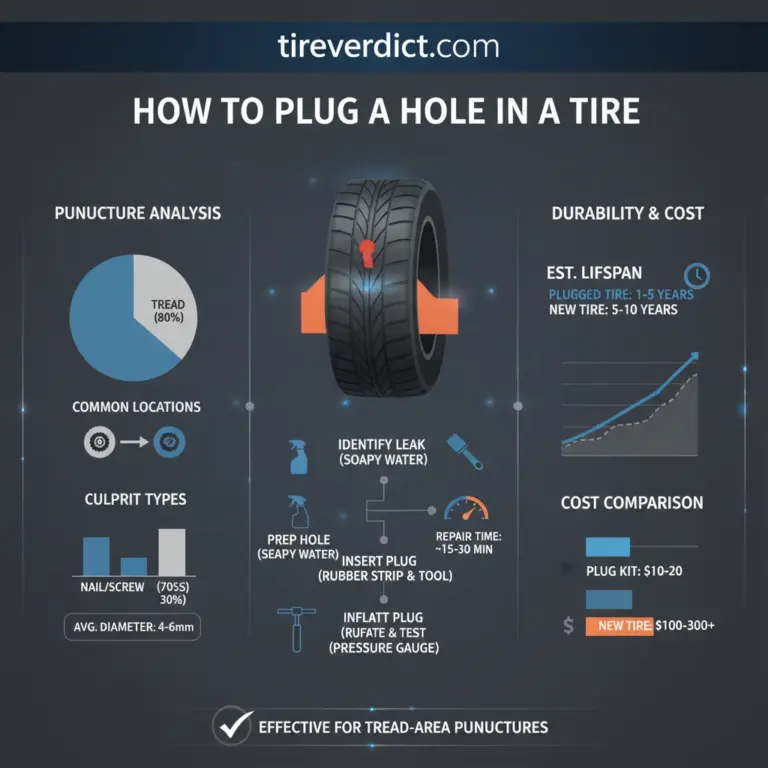
Plugging excels when you are stranded on a dark highway with a rapidly deflating tire. The primary strength of Plugging is instant self-sufficiency. A complete plug kit fits neatly inside your glove compartment, costs under $15, and works without lifting your car off the ground. You ream the puncture, push a sticky rubber cord into the tread hole with an insertion tool, trim the top, and re-inflate. In less than fifteen minutes, your tire holds pressure, allowing you to commute home or reach a local service station safely.
The drawbacks, however, are impossible to ignore. Plugging is purely a mechanical wedge. Because you insert the rubber cord blindly from the outside, you cannot inspect the tire’s inner liner for heat damage or hidden sidewall cord separation caused by low air pressure. Over time, road friction heat hardens the plug material, causing slow leaks. Pushing the reamer tool through the puncture channel can also spread steel belts apart, allowing road water to seep in and corrode the core wiring. If you want to keep a reliable emergency setup ready in your trunk, pairing a quality plug kit with a compact 🛒 12V Portable Air Compressor → ensures you can inflate and drive away instantly.
Price & availability subject to change. As an Amazon Associate we earn from qualifying purchases.
Patching a Tire: Strengths and Weaknesses
Patching a Tire represents the gold standard of professional tire repair, backed by every major tire manufacturer and safety standard organization. The process requires unseating the tire bead from the rim, thoroughly inspecting the internal air liner for hidden flex damage, grinding down the inner rubber surface, and chemically vulcanizing a thick radial patch over the hole. When technicians combine an internal patch with an expanding rubber stem—creating a combination patch-plug—it permanently seals the puncture channel against moisture while preserving 100% of the tire’s factory speed rating.
The trade-off is high labor complexity and a complete lack of emergency roadside convenience. You cannot install an internal radial patch on the shoulder of a highway with simple hand tools. It demands specialized bead breakers, tire mounting equipment, chemical vulcanizing fluid, and precision dynamic wheel balancing. Consequently, Patching a Tire takes 45 to 60 minutes and costs between $30 and $60 at a tire center. If you maintain your vehicle at home and intend to dismount your own tires, acquiring a heavy-duty 🛒 Tire Bead Breaker Tool → is crucial for stripping tough truck and passenger tires off the wheel hub.

Price & availability subject to change. As an Amazon Associate we earn from qualifying purchases.
- ✅ Extremely fast repair achievable in under 10 minutes
- ✅ Performed directly on the vehicle without dismounting the wheel
- ✅ Highly affordable DIY kit costs under $15 for multiple repairs
- ✅ Simple process requiring basic hand tools and minimal mechanical skill
- ❌ Not recognized as a permanent repair by the USTMA
- ❌ Cannot inspect internal tire lining for hidden low-pressure damage
- ❌ Higher risk of slow air seepage over extended mileage
- ❌ Voids manufacturer speed ratings and tire warranties
- ✅ Permanent repair that lasts the remaining lifespan of the tire
- ✅ Fully compliant with USTMA and rubber manufacturer safety standards
- ✅ Dismounting allows full internal inspection for hidden sidewall damage
- ✅ Preserves factory speed ratings and overall driving stability
- ❌ Requires removing the wheel and dismounting the tire from the rim
- ❌ Higher service cost ranging between $35 and $60 at repair shops
- ❌ Time-consuming process taking up to 45 minutes
- ❌ Difficult DIY task without specialized tire shop machinery
Plugging or Patching a Tire: Which Should You Choose?
Deciding between these two tire repair choices comes down to your driving environment, technical access, and safety tolerance. If you commute daily on interstate highways, tow heavy trailers, or drive a high-performance vehicle, Patching a Tire is the only responsible option. An internal patch maintains the casing’s structural rating, protects inner steel belts, and ensures maximum safety during hard emergency braking. Spending $40 for a permanent professional patch is a small price to pay compared to the extreme financial and physical dangers of a high-speed blowout.
On the flip side, if you explore remote wilderness trails, drive work trucks around nail-strewn construction sites, or encounter a flat tire late at night, Plugging is an unbeatable emergency lifeline. It requires zero shop tools, takes under fifteen minutes, and prevents you from getting stranded in unsafe locations. However, experienced drivers treat Plugging as a temporary patch to reach safety rather than a permanent solution. Trail drivers frequently plug a flat on the rocks, then take the tire to a certified shop for an internal radial patch once back in town. How do you monitor air stability after performing a quick roadside fix? Keeping a high-accuracy 🛒 Tire Pressure Gauge → in your glove compartment lets you track minor PSI drops over your next few commutes.
Drivers seeking a quick, low-cost roadside repair without removing the wheel.
Drivers wanting a permanent, safety-certified tire repair that lasts the life of the tread.
Final Verdict: Plugging vs Patching a Tire
In our head-to-head comparison, Patching a Tire earns the overall victory. While Plugging provides exceptional convenience, low costs under $15, and quick emergency utility, it cannot match the structural safety, long-term durability, and industry compliance of a proper internal patch. Patching a Tire permanently seals punctures from the inside out, shielding steel belts from water damage and preserving original factory speed ratings.
The central trade-off comes down to immediate roadside convenience versus long-term driving safety. Plugging gets you rolling again without removing the wheel, but it remains a temporary fix without official manufacturer endorsement. For long-term reliability and complete highway confidence, Patching a Tire is the superior choice.
As an Amazon Associate we earn from qualifying purchases.
Plugging vs Patching a Tire: Frequently Asked Questions
Is Plugging better than Patching a Tire?
No, Patching a Tire is safer and more durable than Plugging. While Plugging is faster and cheaper roadside, Patching seals the inner liner using vulcanizing cement. The USTMA considers a combination plug-patch the only permanent, industry-compliant repair method for tread punctures under 0.25 inches.
How much does Tire Plugging cost versus Patching?
A DIY Tire Plugging kit costs between $10 and $15, providing supplies for multiple repairs. Professional Patching costs between $35 and $60 per tire, which includes wheel removal, tire dismounting, internal inspection, patch installation, and wheel rebalancing.
Can you drive long distances on a plugged tire?
While many plugged tires hold air for 10,000 to 20,000 miles, tire manufacturers classify plugs as temporary fixes. For high-speed highway driving and long trips, replacing the plug with an internal vulcanized patch is strongly recommended to prevent sudden pressure loss.
Can you patch or plug a tire sidewall puncture?
No, neither Plugging nor Patching is safe for sidewall punctures. Both repair methods are strictly limited to punctures within the tread area located at least 0.5 inches inside the shoulder. Sidewall damage compromises internal steel belts and requires total tire replacement.
Which repair method is easier for DIY beginners?
Plugging is significantly easier for beginners. It involves inserting a rubber strip into the puncture from outside the tire without taking the wheel off. Patching requires removing the wheel, breaking the tire bead, cleaning the inner liner, and using vulcanizing cement.