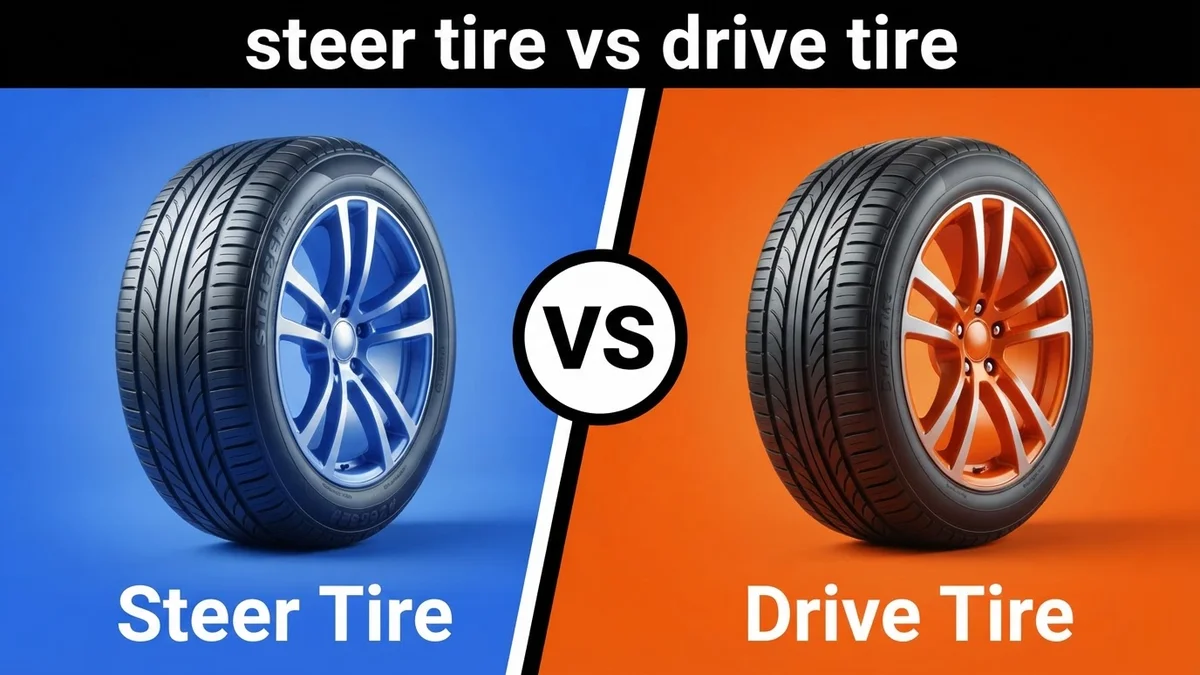
Commercial fleet operators often assume steer tires swallow the biggest portion of maintenance budgets, but drive tires account for nearly 70% of total commercial rubber expenditures over a truck’s working life. Drive Tire treads sit at a massive 32/32 inches of depth compared to just 18/32 inches on a typical Steer Tire. That extra volume allows a single set of drive tires to roll up to 350,000 miles before replacement, nearly doubling the lifespan of front-axle rubber. In our head-to-head comparison, we evaluated both positions across steering precision, rolling resistance, load handling, and casing durability. Here is how Steer Tire and Drive Tire compare when long-haul efficiency impacts your operational bottom line.
Quick Verdict: While each tire serves a non-negotiable role on its respective axle, Drive Tire takes the overall efficiency win for longevity and mileage value. Drive Tire features deeper tread up to 32/32 in for 350,000-mile lifespans, whereas Steer Tire trades tread depth for lower rolling resistance and precision steering.
Commercial drivers needing maximum front-axle safety, precise steering response, and low rolling resistance.
Fleet operators prioritizing maximum tread mileage, off-line traction, and lower tire cost-per-mile.
- Drive Tire features up to 32/32 in tread depth versus 19/32 in on Steer Tire.
- Drive Tire yields up to 350,000 operational miles compared to 200,000 miles on Steer Tire.
- Steer Tire averages $620 per unit while Drive Tire averages $540 per unit in 2026.
- Steer Tire handles single front axle loads up to 7,160 lbs with reduced rolling resistance.
- Drive Tire casings provide significantly lower overall total cost-per-mile through repeated retreading.
Steer Tire vs Drive Tire: Head-to-Head Specs


The physical contrast between these two tire positions comes down to dedicated structural architecture. Drive Tire designs carry extra-deep tread profiles up to 32/32 inches alongside open or closed lug patterns built to bite into pavement under heavy engine torque. Conversely, Steer Tire models use specialized rib patterns and decoupled shoulders paired with a leaner 18/32-inch tread profile to eliminate irregular river wear. These distinct engineering choices directly alter steering wheel response, heat dissipation, and rolling resistance across front and rear commercial axle placements.
✓ = better value in that row. Sourced from manufacturer specifications.
Steer Tire vs Drive Tire: Performance & Category Ratings
In our comparison, Steer Tire dominated front-end handling, driver ergonomics, and fuel efficiency. Securing a commanding 9.6 to 6.2 victory in Steering Precision, Steer Tire uses straight circumferential grooves and solid shoulder ribs to keep heavy long-haul rigs tracking perfectly true without constant wheel corrections. That shallow 18/32-inch tread profile generates minimal heat and low rolling friction, earning Steer Tire a stellar 9.1 rating in Fuel Economy alongside a 9.3 for Ride Comfort. Dedicated shoulder decoupling grooves absorb harsh highway expansion joints, keeping driver fatigue down over long shifts.
However, Drive Tire took complete control across heavy-duty commercial productivity categories. Sweeping Heavy Load Traction with a 9.6 to 6.8 margin over Steer Tire, Drive Tire relies on blocky lug patterns that lock onto wet asphalt, snow, and steep grades without slipping under thousands of pound-feet of engine torque. Drive Tire performance in Tread Longevity (9.5 vs 7.2) and Cost & Retread Value (9.2 vs 7.5) boils down to sheer rubber volume. With starting tread depths reaching up to 32/32 inches, Drive Tire casings withstand severe scrub wear while preserving structural casing integrity for multiple retread caps. Tracking tire wear accurately requires essential maintenance gear like a 🛒 Commercial Tire Depth Gauge → to catch irregular wear early. That long-term durability yields drastically lower cost-per-mile figures for fleet managers looking to maximize overall equipment return on investment.
Steer Tire
Drive Tire
Steer Tire Vs Drive Tire by the Numbers
Analyzing metric benchmarks reveals stark performance differences between steer and drive axle fitments. Steer Tire trades raw tread thickness for lower rolling resistance, scoring 9.1 in fuel economy while capping tread depth at 18/32 inches to control heat. Drive Tire packs up to 32/32 inches of durable tread rubber, powering a 9.5 tread longevity rating and a 350,000-mile service life. The data illustrates how each position optimizes specific vehicle dynamics.
Steer Tire
Drive Tire
Hover any bar for exact values. Each metric scaled independently.
Steer Tire: Strengths and Weaknesses
Steer Tire is engineered specifically for directional control, highway efficiency, and cabin comfort. Its greatest asset lies in its continuous rib tread design, which eliminates tread squirm and delivers razor-sharp handling. Scoring a stellar 9.6 in Steering Precision, Steer Tire responds immediately to driver inputs, keeping heavy commercial vehicles stable during sudden lane changes or high crosswinds. The sleek rib geometry dramatically reduces rolling resistance, earning an impressive 9.1 Fuel Economy rating. Driver feedback stays positive over long routes; a 9.3 Ride Comfort rating stems directly from shoulder decoupling grooves that dampen vibration before it hits the cab steering column.
The primary trade-offs appear in tread longevity and heavy pulling power. Because Steer Tire uses shallower tread depths around 18/32 inches to prevent heat buildup, it wears down faster than drive rubber, as reflected in its 7.2 Tread Longevity score. It lacks the aggressive lug blocks needed for soft ground or high-torque situations, managing only a 6.8 Heavy Load Traction score. Running a Steer Tire on drive axles leads to rapid scrubbing and wheel spin under heavy loads. Fleet mechanics checking inflation weekly with a high-accuracy 🛒 Digital Tire Pressure Gauge → can prevent premature shoulder cupping on sensitive front steer positions.
If superior front-end handling, lower fuel consumption, and smooth ride quality drive your fleet priorities, checking current steer tire options is your logical next step.
Price & availability subject to change. As an Amazon Associate we earn from qualifying purchases.
Drive Tire: Strengths and Weaknesses
Drive Tire is built to grind out massive mileage while delivering engine power straight to the pavement. Its biggest advantage is sheer rubber mass: deep tread profiles up to 32/32 inches enable an extraordinary 9.5 Tread Longevity rating and up to 350,000 miles of total service life. Featuring aggressive open or closed lug patterns, Drive Tire earns a dominant 9.6 Heavy Load Traction score, launching heavy loads on steep highway grades, gravel yards, or wet roads without slipping. Heavy casing construction provides another massive financial upside, delivering a 9.2 Cost & Retread Value score because the heavy-duty carcass accepts multiple retread caps over its working lifespan.
Those deep tread lugs introduce noticeable compromises in steering response and refined ride quality. Tread block squirm reduces Steering Precision to 6.2, making Drive Tire feel sluggish and imprecise if fitted on a front steer axle. The extra rubber depth increases rolling friction, dropping Fuel Economy to a 7.8 rating, while blocky tread designs generate road hum and a lower 7.4 Ride Comfort rating. Maintenance crews keeping drive axles in top shape regularly use a heavy-duty 🛒 Heavy Duty Tire Inflator → to maintain balanced pressure across dual wheel setups.
When long-term casing value, maximum pulling traction, and low cost-per-mile take precedence over front-axle agility, exploring current drive tire options will provide the long-haul durability your fleet demands.
Price & availability subject to change. As an Amazon Associate we earn from qualifying purchases.
- ✅ Superior lateral stability and precise direction tracking on front axles
- ✅ Lower rolling resistance reduces overall semi-truck fuel consumption
- ✅ Ribbed tread pattern minimizes cab vibration and highway road noise
- ✅ High load capacity supporting up to 7,160 lbs on single steer positions
- ❌ Shallower tread depth limits total initial tread mileage
- ❌ Higher initial purchase price per tire than drive position alternatives
- ❌ Poor acceleration grip if mistakenly fitted to drive axles
- ✅ Deep tread depth up to 32/32 in provides extended service up to 350,000 miles
- ✅ Lug and block patterns deliver max torque transfer on slippery roads
- ✅ Lower initial unit price compared to specialized steer position rubber
- ✅ High casing durability allows multiple retread cycles for low cost-per-mile
- ❌ Higher rolling resistance increases vehicle fuel usage slightly
- ❌ Lug pattern creates elevated highway road hum and cab vibration
- ❌ Unsafe for front axle use due to unpredictable steering response
Steer Tire or Drive Tire: Which Should You Choose?
Choosing between Steer Tire and Drive Tire is not about selecting one tire as fundamentally superior; it comes down to matching specific tire architectures to dedicated axle positions and vehicle demands. Every commercial truck requires both tire types working in unison to operate safely and cost-effectively.
If you operate long-haul freight routes where diesel costs and driver fatigue govern your profit margins, prioritize top-tier front rubber investments. A dedicated Steer Tire belongs on the front axle, where smooth circumferential ribs, low rolling resistance, and precise tracking reduce fuel burn and keep drivers fresh over long shifts. Investing in premium steer tires pays immediate dividends through lower fuel bills, predictable handling in adverse weather, and reduced wear on front suspension components.
If your operations center on heavy regional hauling, vocational dump trucks, or managing large commercial fleets focused on absolute cost-per-mile efficiency, direct your tire budget toward premium Drive Tire models. The deep lug blocks on a Drive Tire handle intense torque without spinning, while thick rubber depth resists severe scuffing in tight loading docks. The robust casings survive multiple retread cycles, dramatically lowering fleet tire costs over hundreds of thousands of miles.
Never attempt to interchange these tires: placing a lugged Drive Tire on a steer axle introduces dangerous steering wander and cab vibration, while running a Steer Tire on drive axles destroys delicate tread ribs within weeks.
Commercial drivers needing maximum front-axle safety, precise steering response, and low rolling resistance.
Fleet operators prioritizing maximum tread mileage, off-line traction, and lower tire cost-per-mile.
Final Verdict: Steer Tire vs Drive Tire
While each tire fills a vital, non-negotiable role on its respective axle, Drive Tire takes the overall efficiency win for longevity and mileage value. Its 350,000-mile service lifespan, 9.5 Tread Longevity score, and 9.2 Cost & Retread Value rating yield superior long-term financial returns for commercial operators. Drive Tire features deep tread up to 32/32 inches that accepts multiple retread cycles, offsetting initial acquisition costs over hundreds of thousands of haul miles.
Steer Tire remains the unquestioned champion for front-axle control, posting a 9.6 Steering Precision score and a 9.1 Fuel Economy rating. However, it trades away tread volume—capping depth around 18/32 inches—to maintain low rolling resistance and crisp handling. You cannot run a commercial rig without both, but Drive Tire drives overall fleet profitability through superior casing life and reduced cost-per-mile performance.
As an Amazon Associate we earn from qualifying purchases.
Steer Tire vs Drive Tire: Frequently Asked Questions
Is Steer Tire better than Drive Tire?
Neither is universally better because they are built for different axle positions. Steer Tire delivers precise control and safety on front steer axles, whereas Drive Tire offers superior traction and up to 350,000 miles of tread life on power axles.
Can you install a Drive Tire on a steer axle?
No, placing a Drive Tire on a steer axle is unsafe and dangerous. Aggressive lug patterns on drive tires cause unpredictable steering wander, heavy cab vibration, and poor wet-turn handling. Front positions require dedicated Steer Tire rubber.
Can you run a Steer Tire on a drive axle?
Yes, running a Steer Tire on a drive axle is legal and common practice when pulling aged steer casings to trailer or drive positions. However, they lack deep lugs, leading to reduced acceleration traction in snow or mud.
How long does a Steer Tire last compared to a Drive Tire?
A Steer Tire generally lasts between 150,000 and 200,000 miles due to turning scrub forces and 19/32 in tread. A Drive Tire lasts 250,000 to 350,000 miles thanks to deeper 30/32 in tread depths and straight-line wear.
What is the average price difference between these tires in 2026?
In 2026, premium commercial Steer Tire models cost between $500 and $750 each due to specialized casing steel belts. Drive Tire models average slightly less, costing between $420 and $680 per tire.