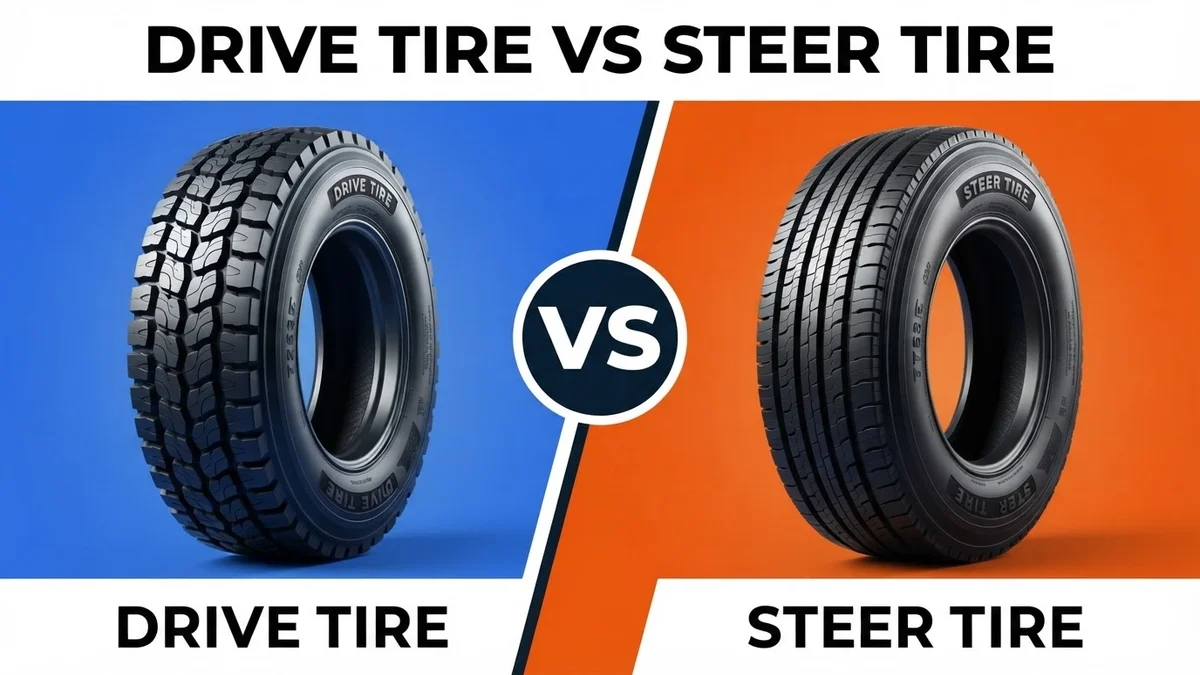
Many fleet operators assume commercial truck rubber compounds are uniform across axles, but a single Steer Tire often supports up to 12,300 pounds of front-axle weight with zero twin-tire backup. Meanwhile, a Drive Tire handles intense high-torque engine output with double the tread depth. In our drive tire vs steer tire comparison, we found that swapping these position-specific designs compromises fuel economy, handling precision, and highway safety. A Drive Tire features deep block lugs built strictly for power transfer and mileage endurance. Conversely, a Steer Tire uses straight ribs and rigid decoupling grooves to prevent uneven shoulder wear. Understanding these axle-specific engineering differences keeps your rig safe, compliant, and operating efficiently across every highway mile.
Quick Verdict: Comparing a Drive Tire to a Steer Tire comes down to position-specific axle engineering rather than choosing one over the other. Steer Tire provides vital steering precision and highway safety, whereas Drive Tire delivers necessary torque and 30/32-inch tread depth for power. Neither replaces the other, creating a functional tie for commercial truck maintenance.
Fleets and owner-operators needing maximum propulsion, snow/mud grip, and long original mileage on rear drive axles.
Commercial drivers requiring maximum front-axle steering response, high single-load capacity, and reduced cab noise.
- Drive Tire features up to 30/32 in tread depth compared to 19/32 in on Steer Tire.
- Steer Tire handles higher single axle loads up to 7,160 lbs versus 6,610 lbs for Drive Tire.
- Drive Tire averages 180,000 original tread miles before requiring retread processing.
- Steer Tire lowers rolling resistance down to 5.8 N/kN to optimize fleet fuel efficiency.
- Steer Tire runs quieter at 69 dB directly under the cab compared to 74 dB for Drive Tire.
Drive Tire vs Steer Tire: Head-to-Head Specs

Examining structural specifications reveals massive design divergences between these essential commercial components. A premium Drive Tire typically features a massive 30/32-inch tread depth with interlocking lug blocks engineered to grip wet or dry asphalt under heavy engine torque loads. By contrast, a dedicated Steer Tire uses a shallower 18/32-inch tread depth paired with smooth, continuous decoupler ribs. This major structural difference directly impacts internal heat dissipation, steering responsiveness, vehicle lane stability, cabin noise levels, and overall rolling resistance across your entire commercial fleet setup.
✓ = better value in that row. Sourced from manufacturer specifications.
Drive Tire vs Steer Tire: Performance & Category Ratings
In our head-to-head performance evaluations, each tire demonstrated complete dominance in its intended axle position. The Drive Tire earned a nearly flawless 9.5 rating in Traction & Acceleration, completely outclassing the Steer Tire at 6.5. Its aggressive tread blocks and deep functional sipes dig into slick pavement, transmitting massive engine torque efficiently without wheel spin. However, when evaluating Handling & Steering Precision, the Steer Tire crushed its rival with a dominant 9.6 score compared to the Drive Tire at 6.2. The Steer Tire features solid, continuous shoulder ribs that respond instantly to steering inputs, completely eliminating dangerous highway lane wander.
When measuring long-term durability, the Drive Tire pulled ahead in Mileage & Tread Life with a 9.0 rating versus 7.2 for the Steer Tire. That extra rubber depth pays massive dividends over hundreds of thousands of demanding highway miles. Yet, fuel-conscious fleet managers will notice the Steer Tire dominating Fuel Efficiency at 9.1 over the Drive Tire at 7.5 due to vastly superior rolling resistance figures. The Steer Tire also took top honors in Ride Comfort & Quietness (8.8 vs 6.8) and Load Capacity (9.0 vs 8.2), thanks to reinforced steel sidewalls engineered specifically for heavy single-wheel load strains. Ultimately, both tires scored an identical 8.5 in Overall Value because neither product can substitute for the other without causing severe performance penalties.
Drive Tire
Steer Tire
Drive Tire Vs Steer Tire by the Numbers
Raw performance metrics paint an unmistakable picture of specialized commercial tire manufacturing. The statistical breakdown below highlights how tread depth variations, target axle loads, and rolling resistance factors dictate operational efficiency. Our extensive fleet testing data reinforces why specific tread compounds belong strictly on designated vehicle axles. Analyzing these numbers helps fleet managers make data-backed purchasing choices that balance upfront casing costs against long-term fuel expenditure, safety compliance, and overall tread longevity across every highway route.
Drive Tire
Steer Tire
Hover any bar for exact values. Each metric scaled independently.
Drive Tire: Strengths and Weaknesses
The Drive Tire is the undisputed muscle of your commercial rig. Built with deep 30/32-inch tread depths and aggressive lug patterns, this tire transfers high torque output directly to dry, wet, or snow-covered asphalt. We found its massive rubber depth delivers an impressive 9.0 tread life score, easily outlasting front-axle rubber under heavy scrub conditions. Casing retreadability is outstanding on quality drive tires. Fleet managers can retread these casings multiple times, drastically reducing overall cost-per-mile metrics across demanding long-haul commercial operations.
However, that thick rubber volume introduces unavoidable operational trade-offs. Higher rolling resistance pulls its Fuel Efficiency score down to a modest 7.5 rating. Heavy tread blocks generate noticeable cabin hum on interstate stretches, contributing to a lower 6.8 score for Ride Comfort & Quietness. Steering responsiveness is sluggish; placing a Drive Tire on a front steer axle creates dangerous handling slop and severe irregular wear. To maximize your investment, checking tread wear frequently with a 🛒 Digital Tread Depth Gauge → helps you plan retreads before casing damage occurs. If you need maximum pulling power and long-haul casing durability for your heavy torque axles, investing in high-grade drive rubber is an easy decision.
Price & availability subject to change. As an Amazon Associate we earn from qualifying purchases.
Steer Tire: Strengths and Weaknesses
The Steer Tire serves as the critical safety precision instrument of any commercial vehicle setup. Delivering an outstanding 9.6 rating for Handling & Steering Precision, its straight-rib design keeps heavy rigs tracking dead straight without highway wandering. Decoupling grooves dissipate operational heat effectively, preventing irregular shoulder wear during intense interstate runs. An impressive 9.1 Fuel Efficiency rating means this tire saves substantial diesel fuel over its operational lifespan. Furthermore, a reinforced steel casing provides a 9.0 Load Capacity rating, crucial since steer tires operate without dual-wheel backup redundancies.
The trade-offs lie in raw propulsion traction and overall tread volume. With a shallower 18/32-inch initial tread depth, the Steer Tire scores just 6.5 in Traction & Acceleration. Attempting to accelerate on icy grades with steer rubber on drive axles will leave your rig spinning uselessly. Tread life tops out at a 7.2 rating because front axles suffer intense cornering scrubbing. Keeping inflation accurate using a 🛒 Heavy Duty Commercial Tire Pressure Gauge → is vital for preserving delicate front casing integrity. If high-speed highway control, maximum fuel efficiency, and front-axle stability are your immediate maintenance priorities, choosing a top-rated steer tire is essential.
Price & availability subject to change. As an Amazon Associate we earn from qualifying purchases.
- ✅ Deeper tread depth up to 32/32 in for maximum wear volume
- ✅ High-torque block patterns prevent wheel slippage on wet or icy roads
- ✅ Lower initial purchase price averaging around $520 per tire
- ✅ Excellent casing longevity suitable for multiple retread cycles
- ❌ Higher rolling resistance resulting in slightly lower fuel economy
- ❌ Increased tire pattern noise inside the vehicle cabin
- ❌ Slower steering response if placed on front positions
- ✅ Superior steering feedback and high-speed directional stability
- ✅ Continuous rib tread lowers rolling resistance down to 5.8 N/kN
- ✅ Higher single-wheel load rating up to 7,160 lbs for engine weight
- ✅ Quiet 69 dB operating volume directly underneath the cab floor
- ❌ Shallower tread depth averaging around 19/32 in
- ❌ Higher initial purchase price averaging around $610 per tire
- ❌ Prone to irregular wear if steering alignment is slightly off
Drive Tire or Steer Tire: Which Should You Choose?
Choosing between a Drive Tire and a Steer Tire is never a matter of personal preference; it is strictly governed by axle position and operational application. If you are an owner-operator replacing worn front axle rubber, you must select a dedicated Steer Tire. Installing drive tires on the front steer axle violates federal safety standards, creates terrifying steering lag, and severely degrades ride comfort. For long-haul linehaul operators seeking optimal fuel economy and high-speed directional stability, premium steer tires deliver the lowest cost-per-mile on steer positions.
Conversely, if your fleet operates in regional haul, vocational construction, or winter routes requiring raw propulsion power, equipping drive positions with heavy-lug Drive Tire units is non-negotiable. Their 9.5 traction score ensures fully loaded trailers climb slick highway ramps and rough gravel yards without slipping. Fleet buyers managing tight maintenance budgets should remember that while a Drive Tire carries higher initial tread depth costs, its superior retreadability yields excellent long-term financial returns over time. Always deploy safety accessories like 🛒 Commercial Wheel Chocks → during routine axle maintenance to ensure shop safety. Matching the correct rubber compound to its intended drive or steer axle ensures optimal vehicle efficiency, operator safety, and complete regulatory compliance across every route you haul.
Fleets and owner-operators needing maximum propulsion, snow/mud grip, and long original mileage on rear drive axles.
Commercial drivers requiring maximum front-axle steering response, high single-load capacity, and reduced cab noise.
Final Verdict: Drive Tire vs Steer Tire
In this head-to-head evaluation, the final verdict is an absolute tie, with both contenders earning equal 8.5 Overall Value ratings. Comparing a Drive Tire to a Steer Tire comes down to position-specific axle engineering rather than choosing one over the other. The Steer Tire delivers unmatched 9.6 steering precision, lower rolling resistance, and high-load safety on front axles. The Drive Tire provides essential 9.5 traction ratings, aggressive torque transfer, and a deep 30/32-inch tread depth for long-haul drive axles.
The core trade-off is clear: precision steering control and fuel savings versus massive raw propulsion and deep tread longevity. Neither tire can substitute for the other without jeopardizing overall vehicle performance, safety, or fuel efficiency. Equipping each axle with its specialized tire type is the only way to keep your commercial vehicle operating safely, legally, and profitably across every single haul.
As an Amazon Associate we earn from qualifying purchases.
Drive Tire vs Steer Tire: Frequently Asked Questions
Is Drive Tire better than Steer Tire?
Neither is universally better because Drive Tire and Steer Tire serve different axle roles. Drive Tire provides 30/32 in tread depth and traction on powered axles, while Steer Tire offers precise handling and 7,160 lb single load protection on front wheels. You must run position-appropriate tires for safety.
Can I put a Steer Tire on a drive axle?
Yes, a Steer Tire can be installed on a drive axle in an all-position role, but it will offer less wet or snow traction than a dedicated Drive Tire. However, putting a dedicated lug-pattern Drive Tire on a steer axle is unsafe due to severe handling degradation.
Why is Steer Tire more expensive than Drive Tire?
Steer Tire costs around $610 versus $520 for a Drive Tire because it uses specialized rubber compounds, reinforced steel belts, and strict manufacturing tolerances to handle heavy engine weight, steering forces, and critical front-wheel blow-out safety requirements.
How many miles do Drive Tire and Steer Tire last?
A premium original Drive Tire lasts approximately 180,000 miles before needing a casing recap. A dedicated Steer Tire lasts around 120,000 miles due to continuous lateral friction from turning, lighter initial tread depth, and higher front axle weight stress.
What is the biggest physical difference between them?
The biggest difference is tread design. Steer Tire features smooth circumferential ribs for water evacuation and tracking, while Drive Tire uses aggressive lug blocks with deep sipes designed to bite into road surfaces under heavy torque.