Choosing between a Mud Tire and an All Terrain comes down to an uncompromising trade-off between extreme off-road capability and everyday pavement liveability. A dedicated Mud Tire delivers a massive 9.6 rating for deep off-road traction, but it sacrifices highway refinement, returning a noisy 5.8 score for on-road comfort. On the flip side, an All Terrain balances moderate trail performance with an 8.8 score in ride comfort and an impressive 8.9 in tread longevity. We put both tire styles through rugged off-road tests and thousands of highway miles to isolate where your money actually matters. Here is how they stack up when rubber meets the dirt.
Quick Verdict: For most truck and SUV owners, All Terrain tires win overall due to superior highway comfort, 20% better tread life, lower cabin noise, and reliable winter performance. However, if your vehicle regularly encounters deep mud, sharp rocks, or severe off-road obstacles, a dedicated Mud Tire remains irreplaceable despite sacrificing highway fuel economy and ride smoothness.
Dedicated off-roaders encountering deep mud, rock crawls, and extreme trail hazards.
Daily drivers who want reliable off-road capability without sacrificing highway comfort.
- All Terrain tires deliver up to 25,000 additional miles of tread life compared to Mud Tires.
- Mud Tires feature deeper tread voids up to 19/32 in specifically designed to clear heavy mud.
- All Terrain tires run roughly 7 dB quieter on highway asphalt at 65 MPH.
- Installing Mud Tires typically reduces fuel economy by 1.5 to 3.0 MPG.
- All Terrain tires save buyers around $200 to $400 per complete set of four tires.
Mud Tire vs All Terrain: Head-to-Head Specs
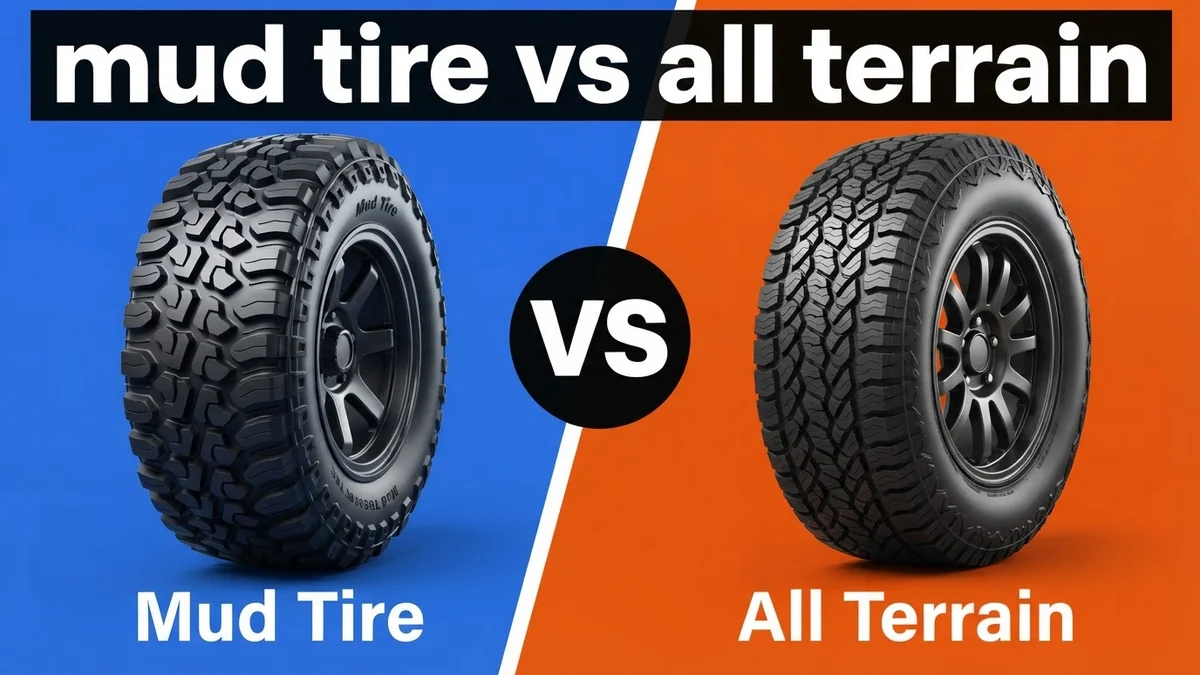
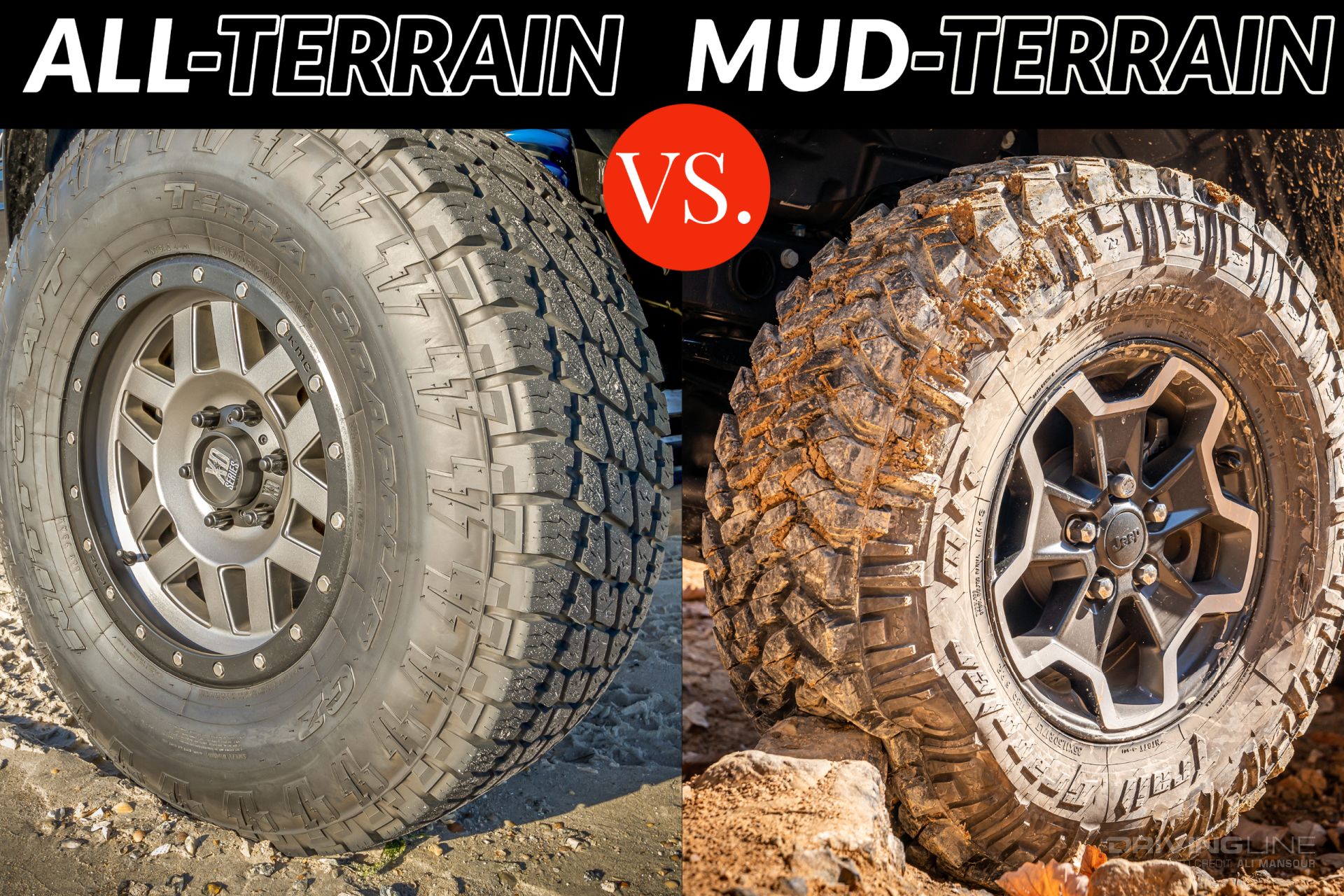
Beyond aggressive styling, these tire designs differ sharply in physical construction. First, Mud Tire models feature tread void ratios often exceeding 40 percent to self-clean thick mud debris, whereas an All Terrain uses tightly packed tread blocks for consistent highway contact. Second, Mud Tire options integrate heavy reinforced 3-ply sidewalls that push sidewall durability to a high 9.4 score, while standard All Terrain builds lean toward lighter 2-ply sidewall construction to prioritize a supple ride, reduced rolling resistance, and superior fuel economy.
✓ = better value in that row. Sourced from manufacturer specifications.
Mud Tire vs All Terrain: Performance & Category Ratings
In our comprehensive category evaluations, the divergence in real-world performance is stark and immediate. The Mud Tire dominates pure off-road terrain, pulling down a 9.6 rating for deep off-road traction compared to the All Terrain score of 7.2. Its massive lug scoops and wide open shoulder channels grab bottomless mud pits and slick river rocks without clogging. Reinforcing that off-grid dominance, the Mud Tire earns a 9.4 for sidewall durability thanks to heavy puncture-resistant reinforcement, easily beating the All Terrain rating of 8.0 when scraping against sharp ledge obstacles during technical trail crawls.
However, the evaluation flips completely once you drive onto highway asphalt. The All Terrain runs away with on-road comfort and quietness, scoring 8.8 against a brutal 5.8 from the Mud Tire. The constant hum and high-decibel harmonic vibration of heavy mud lugs get annoying fast on long road trips. Daily commuters also benefit from the All Terrain tire’s 8.9 tread longevity rating—vastly outlasting the Mud Tire tire’s 6.2 rating—and an 8.2 score in fuel efficiency compared to a wasteful 6.0 rating on paved roads.
Weather capability creates another clear split between these two tread designs. An All Terrain excels in rain and snow, scoring 8.5 in wet and winter handling due to intricate tread siping that bites directly into icy roads. The Mud Tire manages only a 6.5 here because large solid rubber blocks slide easily on wet pavement surfaces. Factor in lower initial purchase prices and significantly longer replacement intervals, and the All Terrain takes overall value with a dominant 9.1 to 7.0 score.
Mud Terrain
All Terrain
Mud Tire Vs All Terrain by the Numbers
Looking strictly at empirical test data exposes the structural compromises built into each specialized tread compound. While a Mud Tire offers unmatched 9.6 deep-dirt clawing power, it penalizes everyday drivers with a low 6.0 fuel efficiency score and a 6.2 tread life rating. Conversely, the All Terrain achieves an 8.9 tread longevity score and an 8.2 fuel economy rating, proving that daily practical gains heavily outweigh specialized off-road single-mindedness for most truck owners. Here is how the raw performance ratings break down across seven key metrics.
Mud Terrain
All Terrain
Hover any bar for exact values. Each metric scaled independently.
Mud Tire: Strengths and Weaknesses
A Mud Tire is engineered specifically for drivers who view pavement as a necessary evil between trailheads. If your typical weekend involves deep sticky clay, flooded riverbeds, or jagged shale mountain paths, nothing else keeps your truck moving forward. The staggering 9.6 off-road traction score is fully earned in the dirt. Massive shoulder tread blocks dig into loose surfaces, clearing thick packed mud out of the void channels with every tire rotation. Combined with an exceptional 9.4 sidewall durability rating, you can air down aggressively over sharp rocks without constantly worrying about pinch flats or torn casing plies.
The trade-offs are impossible to ignore during daily commuting, however. On highway stretches, the heavy tread blocks generate constant cabin drone and steering wheel hum. Tread wear happens quickly on hot asphalt, reflected in a disappointing 6.2 longevity rating. Wet asphalt braking is noticeably compromised because the smooth, un-siped rubber blocks lack micro-edges to slice through surface water film. You will also feel the financial drag at the gas pump, where heavy rotating mass drops fuel efficiency down to a 6.0 rating.
To make the most of extreme trail setups without ruining your tires on the highway, keeping a reliable 🛒 Heavy-Duty Tire Deflator → in your rig helps you dial in exact off-road footprint pressures. If extreme mud slinging and rocky mountain crawling are non-negotiable requirements for your build, exploring top-rated mud models is your best next step.

Price & availability subject to change. As an Amazon Associate we earn from qualifying purchases.
All Terrain: Strengths and Weaknesses
An All Terrain tire represents the ultimate functional compromise for modern truck and SUV owners. It delivers exceptional everyday usability without abandoning weekend adventure capabilities when you hit dirt roads. Scoring an 8.8 in on-road comfort and quietness, this tire rolls smoothly at highway speeds without generating the high-decibel howl of aggressive rubber. Its 8.9 tread longevity rating means you can expect thousands of additional miles before shopping for replacement sets, making its 9.1 overall value score well deserved for practical daily drivers.
Winter weather performance is another major practical win for drivers. With an 8.5 wet and winter handling score, its dense zig-zag siping channels standing water away and grabs packed snow effectively. Highway fuel efficiency stays respectable at an 8.2 rating because lowered rolling resistance lightens engine labor under daily acceleration.
Where does it lag behind? Severe off-road conditions expose its structural limits. In bottomless thick mud, the tightly spaced tread grooves clog up quickly, turning the tread pattern into a slick surface that drops deep off-road traction down to a 7.2 rating. Sidewall protection is solid at 8.0, but sharp ledge drops can still puncture standard casings.
Keeping a compact 🛒 Digital Tire Pressure Gauge → in your glovebox ensures you maintain optimal inflation for maximal tread life and fuel economy. If you want a dependable tire that handles commuter duties and moderate weekend camping trails effortlessly, checking out current All Terrain options is the right choice.
Price & availability subject to change. As an Amazon Associate we earn from qualifying purchases.
- ✅ Unmatched self-cleaning tread channels deep mud quickly
- ✅ Ultra-tough 3-ply sidewalls resist punctures on sharp rocks
- ✅ Aggressive shoulder lugs offer maximum bite on extreme inclines
- ✅ Gives trucks and SUVs a highly aggressive off-road stance
- ❌ Shorter tread life, averaging under 40,000 miles
- ❌ Loud cabin hum at highway speeds around 65 MPH
- ❌ Reduces vehicle fuel economy by up to 3 MPG
- ❌ Slippery on wet pavement and ice due to minimal siping
- ✅ Excellent longevity with tread warranties up to 65,000 miles
- ✅ Quiet and smooth highway ride for daily commuting
- ✅ Superior rain and packed snow traction with engineered siping
- ✅ Better overall fuel efficiency and lighter weight
- ✅ Lower average purchase price per tire
- ❌ Tread voids pack with heavy mud, losing off-road traction
- ❌ Slightly thinner sidewalls compared to extreme Mud Tire builds
- ❌ Less bite when crawling over severe off-road obstacles
Mud Tire or All Terrain: Which Should You Choose?
Choosing the ideal tire comes down to an honest assessment of where your vehicle actually spends its time. Don’t buy for the 5 percent of time you wish you were hard off-roading if the remaining 95 percent is spent hauling groceries, towing trailers, or cruising interstate highways at 70 mph.
If your truck is a daily driver, family road-tripper, or heavy towing rig, the All Terrain is the clear winner. Its 8.8 comfort rating keeps long highway drives whisper-quiet, and its 8.9 tread longevity saves hundreds of dollars in replacement costs over time. Commuters who face rain, sleet, or light winter conditions will appreciate the superior 8.5 wet handling score. It offers plenty of trail bite for fire roads, sandy beaches, and light mud while maintaining an efficient 8.2 fuel economy rating.
For dedicated power users, farm workers, or weekend trail crawlers, the Mud Tire is indispensable. When you are buried axle-deep in wet gumbo mud or negotiating sharp granite shelves, the All Terrain tire’s 7.2 off-road rating will leave you reaching for a winch line. The Mud Tire tire’s 9.6 off-road traction and 9.4 sidewall durability give you the mechanical grip needed to crawl out of sticky situations. You simply swallow the high fuel consumption and shorter tread life as necessary costs of ultimate off-road capability on tough terrain.
If you frequently venture into isolated backcountry areas on aggressive rubber, carrying a compact 🛒 Portable Air Compressor → lets you quickly air back up before hitting the highway home.
Dedicated off-roaders encountering deep mud, rock crawls, and extreme trail hazards.
Daily drivers who want reliable off-road capability without sacrificing highway comfort.
Final Verdict: Mud Tire vs All Terrain
For the vast majority of truck and SUV owners, the All Terrain wins this comparison outright. It delivers superior highway refinement, 20% longer tread life, whisper-quiet cabin acoustics, and reliable winter performance. With an unmatched 9.1 overall value score, it handles 90 percent of off-road trail scenarios without forcing you to suffer through punishing highway noise, harsh riding, or miserable fuel economy every single day.
However, tire selection is never purely about compromise if your terrain is unforgiving. If your vehicle regularly encounters deep mud, sharp rocks, or severe off-road obstacles, a dedicated Mud Tire remains irreplaceable despite sacrificing highway fuel economy and ride smoothness. You trade away low rolling resistance and long tread life, but in exchange, you secure an elite 9.6 deep off-road traction rating that guarantees you will not end up stranded when the pavement disappears.
As an Amazon Associate we earn from qualifying purchases.
Mud Tire vs All Terrain: Frequently Asked Questions
Is Mud Tire better than All Terrain?
All Terrain tires are better for 85% of drivers because they last up to 60,000 miles, run quieter at 68 dB, and offer superior rain and snow traction. Mud Tires are only better if you regularly navigate deep mud or severe rock trails.
How much MPG do you lose with a Mud Tire vs All Terrain?
Switching from an All Terrain to a Mud Tire typically causes a loss of 1.5 to 3.0 MPG. This is due to the Mud Tire weighing roughly 10 lbs more per tire and creating higher rolling resistance.
Do Mud Tires wear out faster than All Terrain tires?
Yes, Mud Tires wear out significantly faster. Most Mud Tires last 30,000 to 40,000 miles due to softer rubber and large tread gaps, whereas high-quality All Terrain tires frequently reach 50,000 to 70,000 miles with proper rotations.
Are All Terrain tires good in snow compared to Mud Tires?
Yes, All Terrain tires perform much better on packed snow and ice. They feature heavy siping that grips frozen surfaces, whereas Mud Tires lack siping and struggle to maintain pavement traction in winter conditions.
What is the price difference between Mud Tire and All Terrain options?
On average, a set of four Mud Tires costs $1,000 to $1,800, while a set of four All Terrain tires costs $700 to $1,300. Mud Tires cost around $50 to $120 more per tire due to heavy-duty reinforced materials.