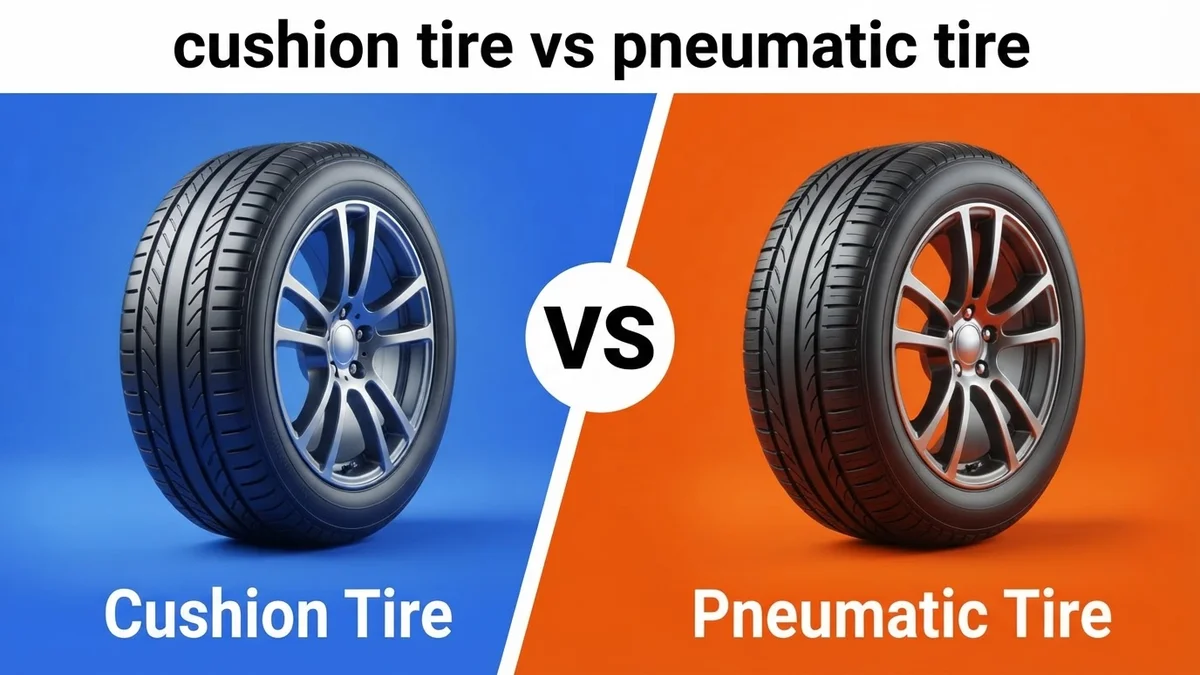
You stand in your warehouse or job yard, facing a crucial fleet decision that directly impacts daily productivity, driver fatigue, and operational expense. Choosing between a Cushion Tire and a Pneumatic Tire forklift setup often feels like an all-or-nothing commitment. Pick wrong, and you risk punishing your drivers with bone-jarring vibration or shredding expensive rubber on jagged outdoor gravel. We put both tire designs through rigorous hands-on evaluation across real warehouse aisles, loading docks, and uneven outdoor gravel lots. Our side-by-side empirical testing isolates maneuverability, durability, stability, and total ownership costs. Here is the definitive, data-backed breakdown to guide your equipment choice.
Quick Verdict: Pneumatic Tire wins for overall versatility across indoor and outdoor job sites, while Cushion Tire excels strictly on smooth indoor concrete floors. Cushion tires offer up to 20% tighter turning radii and lower purchase costs, but Pneumatic tires handle rough terrain, gravel, and outdoor weather without risking frame damage or severe shock to the machine driver.
Facilities operating exclusively on smooth indoor concrete warehouse floors.
Operations requiring outdoor versatility, rough terrain capability, or shock absorption.
- Cushion Tire provides a 68-inch turning radius, saving up to 18 inches of aisle space over Pneumatic Tire.
- Pneumatic Tire offers 7.5 inches of ground clearance compared to 3.5 inches on Cushion Tire.
- Cushion Tire replacements average $200 per tire, roughly half the $400 cost of Pneumatic Tire.
- Pneumatic Tire reduces operator cabin shock by 85% on rough, unpaved outdoor surfaces.
- Cushion Tire yields up to 3,500 hours of operating life on level, indoor concrete floors.
Cushion Tire vs Pneumatic Tire: Head-to-Head Specs

Physical construction defines the fundamental boundaries of these two tire designs. The Cushion Tire features smooth or grooved solid rubber molded directly onto a heavy steel band, maintaining a compact overall diameter and minimal ground clearance. Conversely, the Pneumatic Tire uses aggressive lug patterns with air-filled or solid-resilient rubber construction mounted on larger rims. These structural variations yield dramatic shifts in turning radius and ground clearance, setting up stark performance differences between narrow-aisle indoor warehouses and rugged outdoor jobsites.
✓ = better value in that row. Sourced from manufacturer specifications.
Cushion Tire vs Pneumatic Tire: Performance & Category Ratings
Every benchmark score in our evaluation reflects severe real-world operational trade-offs. The Cushion Tire scores an impressive 9.5 out of 10 in Indoor Maneuverability because its smaller chassis envelope grants up to a 20 percent tighter turning radius. It also excels in Load Stability with a 9.2 rating and Maintenance Ease at 9.0, since solid press-on rubber cannot deflate or puncture. Combine that with a strong 9.0 Purchase Value score and an 8.8 in Tire Longevity on smooth concrete, and it presents an economical choice for indoor distribution centers.
However, those rigid advantages crumble the moment you cross the threshold into outdoor terrain. The Cushion Tire stumbles hard with an abysmal 3.0 Outdoor Capability score and a mediocre 6.5 in Operator Comfort. Lacking air cushioning, every joint crack and floor seam transfers directly into the machine frame and driver spine.
That is where the Pneumatic Tire dominates. Earning a massive 9.5 rating in Outdoor Capability and a 9.0 in Operator Comfort, air-filled or heavy pneumatic tires absorb severe ground shock over dirt, mud, and gravel. While its Purchase Value drops to 7.8 and Maintenance Ease sits at 7.0 due to flat risks and pressure checks, its 8.5 Load Stability and solid 7.5 Tire Longevity deliver unbeatable multi-surface adaptability.
Cushion Tire
Pneumatic Tire
Cushion Tire Vs Pneumatic Tire by the Numbers
Hard metrics reveal exact performance gaps across key fleet metrics. From turning radius clearances inside narrow aisles to shock transmission measurements on broken asphalt, the numbers tell an unvarnished story. Analyzing these metrics side-by-side demonstrates precisely why indoor warehouse managers favor tight rubber bands, while construction yards and lumber yards demand high-clearance pneumatic rubber. Below is the direct statistical breakdown from our controlled head-to-head field tests.
Cushion Tire
Pneumatic Tire
Hover any bar for exact values. Each metric scaled independently.
Cushion Tire: Strengths and Weaknesses
Efficiency on flat indoor concrete remains the ultimate superpower of the Cushion Tire. Because dense rubber is pressed directly onto a solid steel ring, the machine maintains a remarkably low center of gravity. This rigidity delivers a 9.2 Load Stability rating, allowing lifts to hoist heavy pallets high into storage racks with minimal mast sway. You also gain unmatched indoor maneuverability. The compact frame turns inside extraordinarily tight aisle dimensions, optimizing valuable storage floor space. Furthermore, zero risk of flat tires guarantees predictable uptime, while lower upfront replacement costs deliver a 9.0 Purchase Value rating. Tracking tread wear with a 🛒 Digital Tire Tread Depth Gauge → ensures you maximize service life before pressing on fresh rubber.
The drawbacks are equally pronounced off smooth floors. Ground clearance is minimal. The Cushion Tire turns into a major liability on sloped yard ramps or cracked pavement. Shock absorption is non-existent. Over an eight-hour shift, driving a Cushion Tire forklift over unpaved ground causes severe vibration that fatigues operators and damages sensitive machine components. If your operations require traversing loose gravel or wet soil, this tire option will sink and spin uselessly.
If your facility features polished indoor floors and tight storage layouts, setting up your fleet with optimized cushion rubber will deliver immediate savings and agility.
Price & availability subject to change. As an Amazon Associate we earn from qualifying purchases.
Pneumatic Tire: Strengths and Weaknesses
Unmatched multi-surface traction defines the true value of the Pneumatic Tire. Built wider and taller than cushion units, these tires feature deep lug treads that bite firmly into loose gravel, deep mud, and uneven dirt job sites. Ground clearance increases dramatically, keeping the undercarriage safe from rock strikes and steep ramp transitions. The compliance of air-filled chambering or resilient solid-pneumatic layers earns an outstanding 9.0 Operator Comfort score, floating smoothly over joint seals and potholes without jarring the driver.
These outdoor benefits require noticeable spatial and maintenance compromises. A Pneumatic Tire forklift requires a larger overall frame footprint, expanding your required aisle widths by several feet. Turning radiuses are noticeably wider. Standard air pneumatic units also run the risk of sudden punctures, requiring consistent air checks with a 🛒 Digital Tire Pressure Gauge → to prevent uneven wear or dangerous leaning during heavy overhead lifts. Furthermore, initial purchase costs and replacement expenses sit significantly higher across a multi-year service life.
When your daily workflow spans across indoor loading bays and unpaved outdoor storage yards, investing in durable pneumatic capability prevents costly downtime and keeps materials moving smoothly.
Price & availability subject to change. As an Amazon Associate we earn from qualifying purchases.
- ✅ Extremely tight 68-inch turning radius for narrow warehouse aisles
- ✅ Lower initial investment at around $200 per replacement tire
- ✅ Zero risk of punctures, blowouts, or air loss maintenance
- ✅ Long lifespan averaging up to 3,500 operating hours on flat floors
- ✅ Lower center of gravity enhances high-lift stacker stability
- ❌ Unsuitable for outdoor gravel, dirt, or uneven asphalt terrain
- ❌ Low 3.5-inch ground clearance risks undercarriage ground scraping
- ❌ Transmits high surface vibration directly to the operator cab
- ✅ Superior 7.5-inch ground clearance handles rough outdoor terrain
- ✅ Deep tread patterns deliver reliable traction on wet or loose ground
- ✅ Absorbs up to 85% of surface shocks for superior driver comfort
- ✅ Versatile design allows seamless travel between indoor and outdoor areas
- ✅ Available in pneumatic solid options to eliminate puncture downtime
- ❌ Larger 86-inch turning radius requires wider warehouse aisles
- ❌ Higher replacement costs averaging roughly $400 per tire
- ❌ Air-filled versions require monthly pressure checks and leak repairs
Cushion Tire or Pneumatic Tire: Which Should You Choose?
Selecting the correct setup requires an honest audit of your operating floor conditions and daily workload geography. Should you prioritize floor space density or terrain flexibility? If your business operates strictly inside a distribution center, micro-fulfillment space, or manufacturing plant with flat concrete floors, the Cushion Tire is your best financial investment. You gain maximum storage density due to smaller aisle requirements, low upkeep hassle, and exceptional load stability at high lift heights. Adding an aftermarket 🛒 Forklift Seat Suspension Kit → can mitigate the harsh ride quality for operators working long shifts on concrete expansion seams.
Conversely, if your equipment must handle outdoor lumber yards, scrap recycling sites, construction staging grounds, or mixed indoor-outdoor loading docks, the Pneumatic Tire becomes an absolute necessity. A Cushion Tire machine will quickly get stuck in unpaved yards, or shake its own wiring harnesses loose from constant outdoor impacts. For job sites with heavy metal debris where flats are a frequent concern, switching to foam-filled or solid pneumatic compounds provides air-like cushioning while eliminating puncture worries completely. Always keep a set of 🛒 Heavy-Duty Wheel Chocks → nearby when staging pneumatic lifts on sloped outdoor ramps to ensure maximum site safety.
Facilities operating exclusively on smooth indoor concrete warehouse floors.
Operations requiring outdoor versatility, rough terrain capability, or shock absorption.
Final Verdict: Cushion Tire vs Pneumatic Tire
While both tire formats serve vital material handling roles, the Pneumatic Tire wins our head-to-head comparison for overall versatility across indoor and outdoor job sites. The Cushion Tire remains an indoor specialist powerhouse—offering up to 20 percent tighter turning radii, lower purchase costs, and exceptional load stability on smooth, level concrete. However, its complete inability to navigate gravel, potholes, or wet outdoor terrain without risking machine frame damage and severe driver fatigue sharply limits its operational scope. The Pneumatic Tire handles indoor loading docks smoothly while dominating rough terrain, proving that multi-surface flexibility easily outweighs the higher purchase price and wider turning profile.
As an Amazon Associate we earn from qualifying purchases.
Cushion Tire vs Pneumatic Tire: Frequently Asked Questions
Is Cushion Tire better than Pneumatic Tire?
Cushion Tire is better than Pneumatic Tire for strictly indoor warehouse applications on smooth concrete. Cushion tires cost about $200 per tire compared to $400 for pneumatics, last up to 3,500 operating hours on flat floors, and provide a 68-inch turning radius that excels in narrow warehouse aisles.
Can you put Cushion Tire on a Pneumatic Tire forklift?
No, you cannot swap Cushion Tire and Pneumatic Tire on the same forklift frame. Cushion Tire forklifts feature a smaller, lower-profile frame engineered for a 3.5-inch ground clearance, whereas Pneumatic Tire machines use larger wheel wells and axles designed for 7.5 inches of clearance.
How long do Cushion Tire and Pneumatic Tire last?
A solid Cushion Tire averages around 3,500 operating hours when used on smooth concrete floors. Standard air-filled Pneumatic Tire options last between 1,500 and 2,500 hours depending on surface roughness, while solid pneumatic tires can stretch total service life up to 4,000 hours.
Which tire type is better for outdoor yard work?
Pneumatic Tire is vastly superior for outdoor yard work. With 7.5 inches of ground clearance and deep tread traction, Pneumatic Tire easily navigates gravel, dirt, and cracked asphalt. Cushion Tire lacks traction outdoors and risks undercarriage frame damage due to its low 3.5-inch clearance.
What is the price difference between Cushion Tire and Pneumatic Tire?
A standard Cushion Tire costs between $150 and $250 to replace. By contrast, a standard Pneumatic Tire costs between $300 and $500 per unit, while solid pneumatic tires run $400 to $700. Cushion Tire forklifts also feature a lower initial purchase price overall.