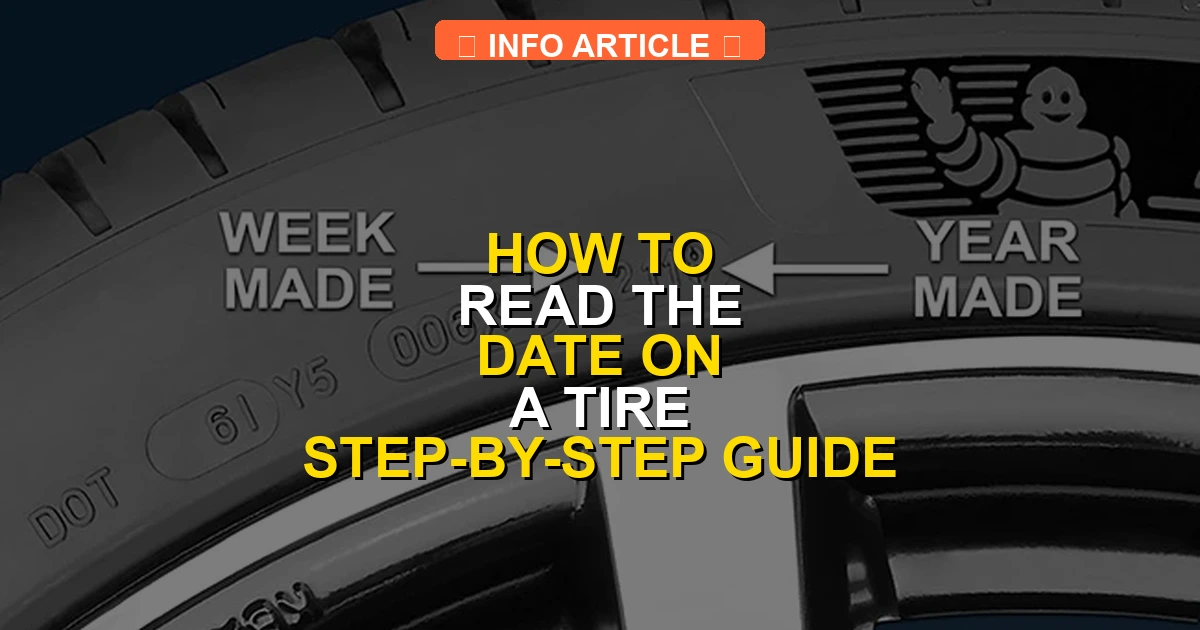
Every tire features a DOT manufacturing code stamped on its sidewall that reveals exactly when it was made. By learning how to read this code, you can easily determine tire age and prevent dangerous blowouts from expired rubber.
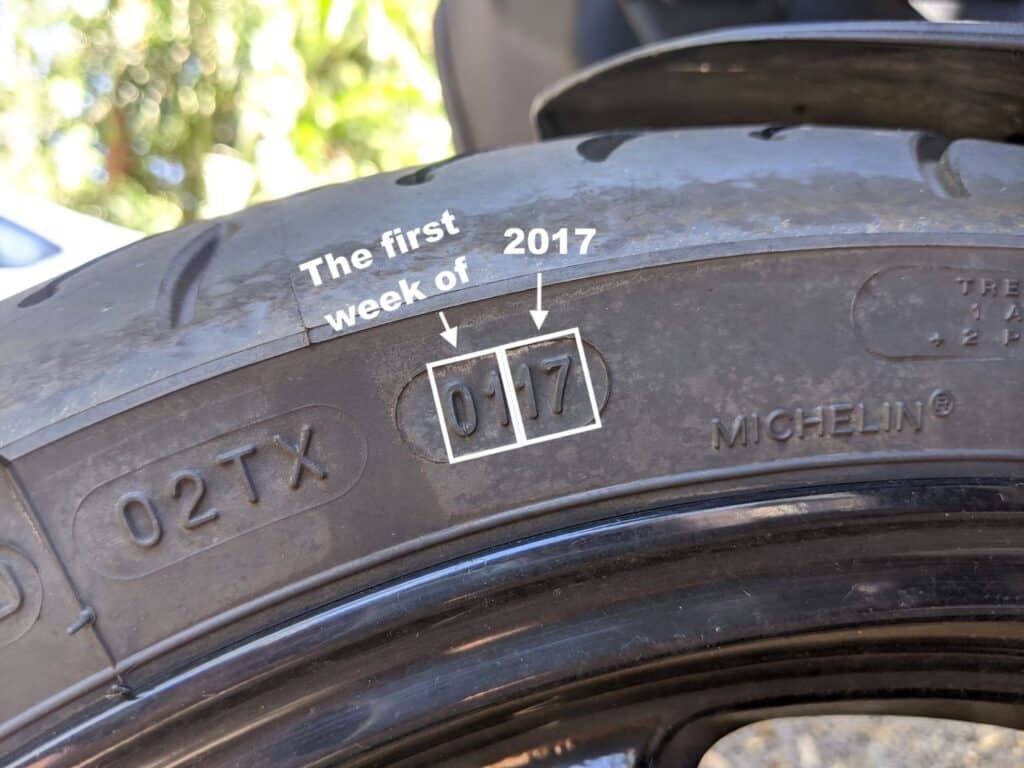
You can find the age of your tire by locating the letters DOT on the sidewall and reading the final four digits of the stamped code. The first two digits show the manufacturing week, and the last two digits show the manufacturing year.
Checking this code takes less than a minute. Whether you are inspecting a used car in 2026 or checking the spare tire in your trunk, knowing this sequence protects you from driving on dangerous, degraded rubber.
Key Takeaways
- Locate the letters ‘DOT’ on the outer or inner sidewall of your tire.
- Look for the final sequence of numbers in the DOT oval stamp.
- A 4-digit code means the first two digits are the week, and the last two are the year.
- Tires older than 6 to 10 years should be replaced regardless of tread depth.
- Pre-2000 3-digit codes indicate severely degraded tires that require immediate replacement.
What Causes Tire Aging and Why the DOT Code Matters
Rubber degrades constantly, even when a tire sits unused in a garage. Environmental exposure breaks down the compound from the inside out long before the tread wears down.

The Chemistry of Rubber Degradation
-
UV Radiation: Sunlight dries out the volatile oils in the rubber compounds.
Heat Exposure: Pavement heat and regional climates accelerate chemical breakdown.
Oxidation: Oxygen reacts with the rubber, causing microscopic cracking in the sidewall and tread grooves.
Safety Risks of Expired Tires
Rubber loses its elasticity and structural integrity over time. Driving on aged tires drastically increases your risk of a sudden tread separation or blowout at highway speeds in 2026. Internal steel belts can also separate from the degraded rubber matrix, causing handling instability.
Master Tire Date Codes in 5 Simple Steps
Knowing how to read the date on a tire is a crucial safety skill for every vehicle owner. Tires degrade over time due to UV exposure, heat, and natural rubber oxidation, even if they have plenty of tread remaining. Old tires can suffer from sudden tread separation or catastrophic blowouts on the highway. This comprehensive, step-by-step walkthrough will teach you how to locate, decode, and evaluate the manufacturing date stamp on any passenger car, truck, or SUV tire, ensuring your vehicle remains safe for the road.
Step 1: Locate the Department of Transportation (DOT) Serial Number
What you need: A flashlight, a rag or paper towel, and perhaps your smartphone camera to use as a magnifying glass.
Instructions: Walk around your vehicle and inspect the outer sidewall of each tire. Look for a string of raised characters that begins with the letters “DOT”. This is the Department of Transportation safety code mandated for all tires sold in the United States. The code contains a sequence of letters and numbers indicating the manufacturing plant, tire size, and batch code, ending with a final four-digit grouping. You may need to wipe away brake dust, road grime, or mud using your damp rag to make the characters clearly legible.
Pro Tip: On many modern vehicles, the full date code is only stamped on the outside facing sidewall. However, some asymmetrical or directional tires may require you to look at the inside sidewall facing the vehicle’s suspension if the outside only shows partial data.
Step 2: Identify the Four-Digit Date Code Box
What you need: Your flashlight and a keen eye for the final digits of the DOT sequence.
Instructions: Scan the entire length of the DOT serial code until you reach the very end. The date code is almost always grouped together as the last four digits of the long string, sometimes enclosed in a small, slightly depressed oval-shaped border on the rubber. Do not confuse other numbers—such as the tire size (e.g., 205/55R16) or load index rating—with the age stamp. The date code will specifically be a standalone block of four consecutive numbers with no letters mixed in.
Pro Tip: If your tire only shows a three-digit code (common on tires manufactured prior to the year 2000), the tire is over 24 years old and must be replaced immediately without driving another mile.
Step 3: Decode the Manufacturing Week
What you need: Basic arithmetic skills and the first two digits of your four-digit code.
Instructions: Take the first two numbers of the four-digit sequence. These digits represent the exact calendar week of the year in which the tire was manufactured, running from 01 through 52. For example, if the first two digits are “24”, the tire was built during the twenty-fourth week of the year, which falls approximately in mid-June. Keep in mind that weeks do not neatly align with month boundaries, so this number simply tells you the relative production timing within that specific year.
Pro Tip: Do not expect all four tires on your car to have the exact same manufacturing week. It is completely normal for front and rear tires, or a recently replaced spare tire, to vary by several weeks or even a few months.
Step 4: Decode the Manufacturing Year
What you need: The final two digits of your four-digit code and a calendar.
Instructions: Examine the last two numbers of the four-digit sequence. These represent the specific year of manufacture. For instance, if the final two digits are “21”, the tire was produced in the year 2021. Combine this with what you learned in the previous step: a code reading “2421” means the tire was manufactured during the 24th week of 2021 (around June 2021). Always read the final two digits as a complete year rather than trying to calculate days or months.
Pro Tip: If you are buying a “new” set of tires from a discount shop or online warehouse, check the date codes upon delivery. Tires stored properly in a climate-controlled warehouse are generally considered new for up to 2-3 years, but you want to ensure you aren’t getting stock that has already aged significantly.
Step 5: Assess Tire Age and Determine Replacement Needs
What you need: The current calendar year and your completed date calculation.
Instructions: Subtract the tire’s manufacturing year from the current year to find its age. Most major tire manufacturers, automotive safety agencies, and car insurance providers strongly recommend replacing tires when they reach 6 to 10 years of age, regardless of how much tread depth remains. Rubber naturally dries out, hardens, and develops microscopic dry-rot cracks over time, severely compromising traction, braking distance, and structural integrity during high-speed driving.
Pro Tip: If your vehicle is stored outdoors in hot, sunny climates (like Arizona or Florida), rubber degrades much faster; aim to replace these tires closer to the 6-year mark rather than waiting until year 10.
✅ Final Checklist
- Located the “DOT” prefix on the tire sidewall
- Successfully identified the final four-digit sequence in the code
- Decoded the first two digits to find the manufacturing week (01-52)
- Decoded the last two digits to determine the exact year of production
- Calculated the total age of the tire and verified it falls within safe operating limits (under 6-10 years)
Important Notes:
- Never drive on tires older than 10 years, even if they look visually acceptable and have deep tread.
- If you find deep sidewall cracking, bulging, or exposed internal cords regardless of age, seek professional mechanical help immediately.
- Checking all four tires and the spare takes approximately 5 to 10 minutes and costs $0 in tools if you already own a flashlight.
How to Locate the DOT Stamp on Your Tire Sidewall
Finding the manufacturing date code requires a quick visual search of the outer sidewall. Manufacturers do not always print the code on both sides of the tire.
Scanning the Outer Sidewall
Run your eyes along the inner edge of the sidewall near the wheel rim. Look for the letters DOT raised in an oval-shaped border. The date code sits at the very end of this long alphanumeric sequence.
Tips for Hard-to-Read Codes
-
Check Both Sides: Some asymmetric or directional tires only display the full DOT manufacturing stamp on the inner sidewall facing the vehicle suspension.
Clean the Rubber: Brake dust and road grime easily obscure shallow stampings. Wipe the area with a damp rag and a brush if the numbers look faded.
Use a Flashlight: Shine a light sideways across the rubber surface to cast shadows inside the stamped digits, making them much easier to read.
Step-by-Step Guide to Reading 4-Digit and 3-Digit Date Codes
Decoding the Tire Identification Number requires locating the sequence at the end of the DOT text string. Manufacturers format these numbers specifically to communicate the exact production timeframe. Following a precise procedure ensures you correctly interpret both modern and legacy stamps.
Decoding Modern 4-Digit Codes (Post-2000 Tires)
- Locate the last four digits of the DOT code stamped inside the rectangular box on the tire sidewall.
- Isolate the first two digits, which represent the exact production week of the year, running from 01 through 52.
- Examine the final two digits, which indicate the exact production year. For example, a code ending in “26” designates 2026.
- Combine these figures to determine the tire age. A code reading “1426” means the tire was manufactured during the 14th week of 2026.
Decoding Legacy 3-Digit Codes (Pre-2000 Tires)
- Identify a 3-digit code at the end of the DOT string, which signifies the tire was manufactured before the year 2000.
- Read the first two digits to find the production week of the calendar year.
- Read the final single digit to determine the manufacturing year within that decade.
- Look for a small triangle symbol following the DOT code, which indicates the tire was produced in the 1990s rather than the 1980s.
What If the Code Is Missing or You Need to Replace Expired Tires
Sometimes environmental wear, manufacturing flaws, or curb damage obscures the DOT date stamp. If standard inspection fails to reveal the production age, specific troubleshooting steps ensure safety compliance.
- Inspect the inner sidewall. Occasionally, the complete DOT code is stamped exclusively on the inside facing wall of the tire, requiring a flashlight or vehicle lift to view.
- Clean the rubber surface thoroughly using a stiff nylon brush and automotive degreaser to remove heavy brake dust and road grime obscuring shallow stamps.
- Check for secondary regulatory stamps or retread markers if you are evaluating commercial or budget replacement tires.
- Consult a certified tire technician at a local service center if the DOT serial number is completely missing, which often indicates a non-compliant or counterfeit product. Professional inspection generally ranges from free visual checks to a standard diagnostic fee of $20 to $50.
- Replace any tire exceeding the critical six-to-ten-year threshold immediately, regardless of remaining tread depth, to prevent catastrophic highway tread separation.
Conclusion
Checking your tire manufacturing date is a vital maintenance step that directly impacts road safety and vehicle handling. By locating the DOT code and decoding the production week and year, drivers can easily identify aging rubber before structural failure occurs. According to verified research and expert sources from the National Highway Traffic Safety Administration, tires degrade chemically over time even when stored or lightly driven. Take the actionable next step today by inspecting all four tires on your vehicle and replacing any set older than six years for optimal driving security in 2026.
❓ Frequently Asked Questions
How can I tell if my tire date code is from the 1990s?
Tires manufactured before 2000 feature a 3-digit code without any triangles or special markers. If your tire has a 3-digit code, it is more than 25 years old and extremely unsafe for driving.
What should I do if the DOT code is worn off or unreadable?
Check the inner sidewall of the tire, as the stamp is sometimes only molded on one side. If neither side shows a readable code, the tire should be replaced immediately.
Does tire tread depth matter more than the manufacturing date?
Both matter, but age is critical because rubber degrades, dries out, and cracks over time regardless of how much tread is left. An old tire with deep tread can still fail catastrophically.
Can I return a brand new tire if the manufacturing date is old?
Many retailers consider tires up to a few years old as ‘new’ if stored properly, but you can request fresher stock if the tires are more than 3 to 4 years old at purchase.
Do spare tires have manufacturing date codes too?
Yes, spare tires in your trunk or mounted underneath your vehicle also have DOT date codes and degrade at the same rate, often going unnoticed until an emergency.
Does sunlight exposure speed up tire aging?
Yes, ultraviolet (UV) rays, ozone exposure, and extreme heat accelerate rubber degradation and sidewall cracking, which makes checking the date code even more important.