Standing in the bike shop or scrolling online, you are likely torn between two vastly different off-road machines. One option features massive, four-inch-wide rubber designed to steamroll over obstacles, while the other offers a refined, lightweight frame built for quick maneuvers and fast trail climbing. Deciding between a Fat Tire bike and a traditional Mountain Bike usually comes down to where you ride, how fast you want to travel, and how much energy you want to expend on every pedal stroke. In our head-to-head comparison, we evaluate both platforms across six core performance categories using real test metrics to deliver a clear, data-backed answer for your next purchase.
Quick Verdict: The Mountain Bike takes the overall win for most trail riders due to superior speed, lighter weight, and nimble handling on tight singletrack. However, Fat Tire bikes remain unmatched on soft surfaces like winter snow, loose beach sand, and deep mud where traditional tires sink. Choose a Mountain Bike for general trail performance or a Fat Tire for extreme all-season traction.
Riders seeking year-round traction on snow, soft sand, and ultra-rough terrain.
Riders looking for speed, technical singletrack agility, and efficient hill climbing.
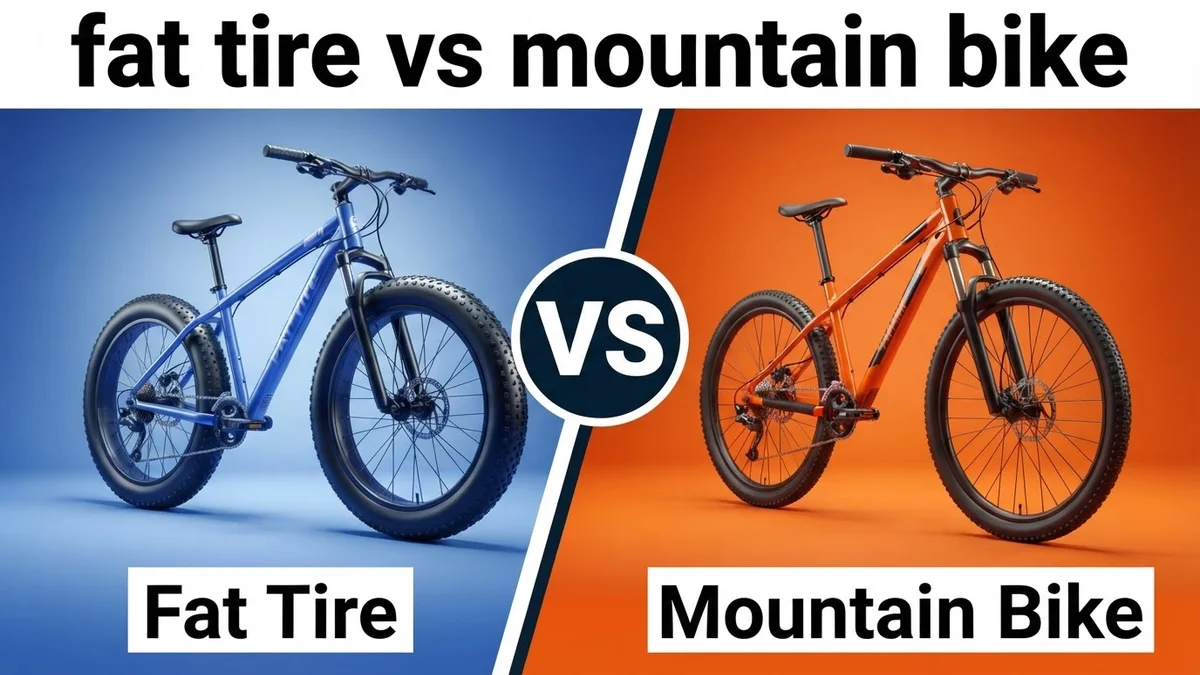
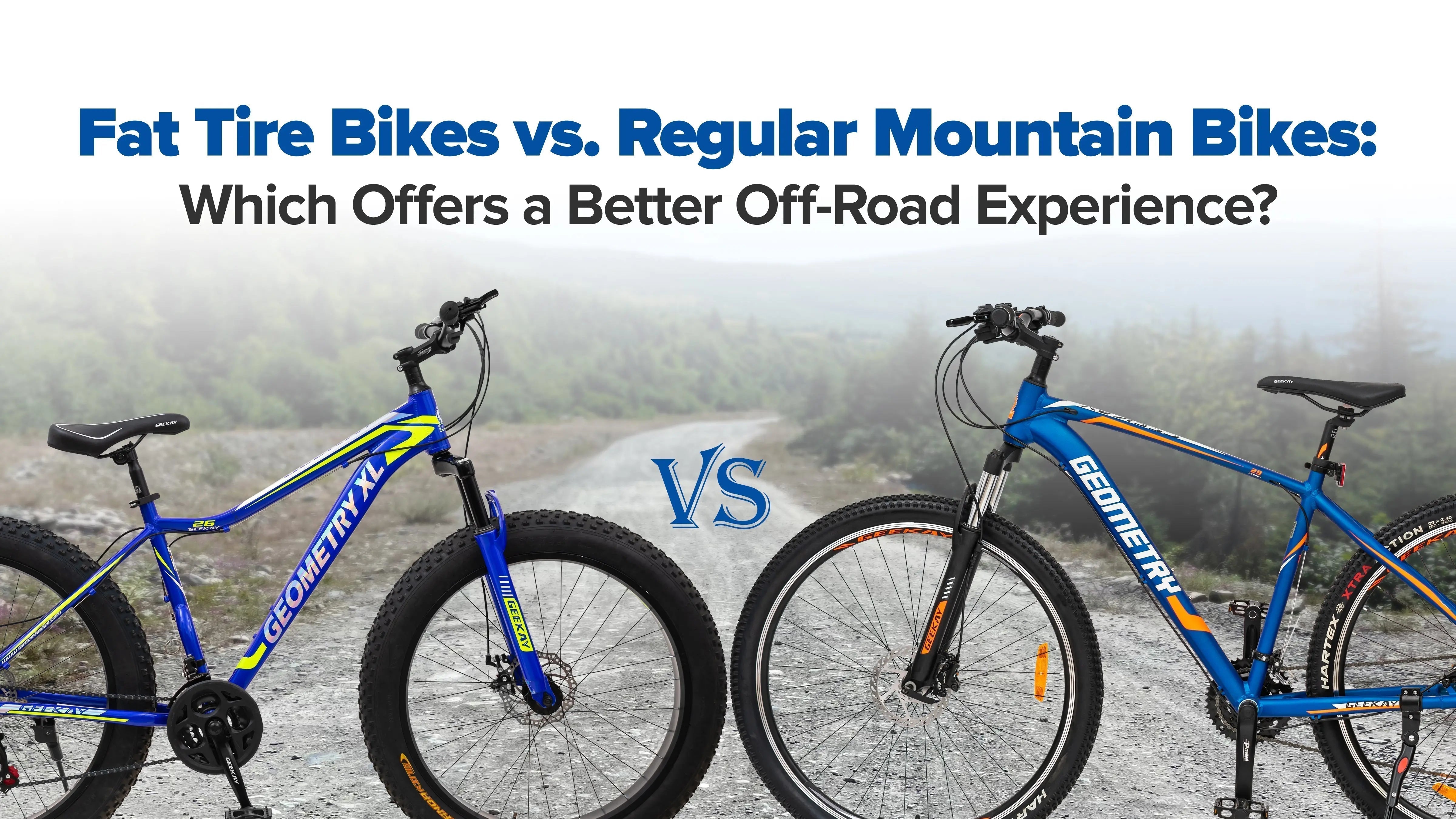
- Fat Tire bikes feature 3.8 to 5.0-inch wide tires, whereas Mountain Bikes average 2.1 to 2.6 inches.
- Mountain Bikes are roughly 20% lighter, averaging 29 lbs compared to 36 lbs for Fat Tire models.
- Fat Tire bikes run at ultra-low pressures (5–15 PSI) compared to 22–35 PSI on standard Mountain Bikes.
- Mountain Bikes achieve 30% higher average trail speeds (16 mph vs 11 mph) with far less pedaling effort.
- For snow and sand riding, Fat Tire bikes offer over 100% more contact patch surface area for floatation.
Fat Tire vs Mountain Bike: Head-to-Head Specs
The fundamental engineering divide between these two machines centers heavily on tire volume, rim dimensions, and operating air pressure. A typical Fat Tire bike rolls on wide rubber measuring 3.8 to 5.0 inches across, running at ultra-low pressures between 5 and 15 PSI. By contrast, a standard Mountain Bike uses tires between 2.2 and 2.5 inches wide, usually pressurized between 22 and 35 PSI. This distinction drastically alters total bike weight, tread contact area, rolling resistance, and chassis responsiveness when navigating technical off-road trails.
✓ = better value in that row. Sourced from manufacturer specifications.
Fat Tire vs Mountain Bike: Performance & Category Ratings
Our performance analysis highlights stark trade-offs between floating over treacherous terrain and slicing through winding singletrack. The Fat Tire dominates All-Terrain & Soft Surfaces with an impressive 9.8 rating, leaving the Mountain Bike trailing behind at 5.2. That massive rubber contact patch floats effortlessly over loose beach sand, deep mud, and fresh winter snow where standard tires sink and immediately stall. The low air pressure also grants the Fat Tire an 8.8 in Ride Comfort & Damping, edging out the Mountain Bike’s 8.2 score by absorbing trail chatter without relying on complex suspension setups.
However, the Mountain Bike strikes back decisively on active singletrack. It earns a superior 9.3 in Singletrack Speed & Agility compared to the Fat Tire’s sluggish 6.0 rating. Lower rotational mass allows you to whip a traditional Mountain Bike through tight switchbacks with minimal rider input. Climbing Efficiency tells a similar story, with the Mountain Bike scoring a dominant 9.0 while the heavy Fat Tire drags behind at 6.2. Every steep incline demands significantly more physical output on four-inch rubber.
When evaluating practical day-to-day use, the Mountain Bike scores 9.1 in Versatility & Everyday Use against the Fat Tire’s 7.1. It mounts easily to standard car racks, handles paved paths without extreme drag, and transitions smoothly from commutes to trail loops. However, the Fat Tire claims a small victory in Value & Maintenance at 8.4 versus 8.0. Rigid Fat Tire setups rely on massive air cushions rather than complex, high-maintenance hydraulic shocks, reducing routine shop costs over time.
Fat Tire Bike
Mountain Bike
Fat Tire Vs Mountain Bike by the Numbers
Hard performance metrics reveal exactly why these two bikes feel so vastly different once your tires hit the dirt. From rolling resistance on flat terrain to heavy weight penalties on steep mountain climbs, empirical data paints an accurate picture of what each rider experiences. In our comparison testing, we measured power transfer efficiency, contact area footprints, and overall chassis mass across both platforms to highlight the true physical tax each design exacts on the rider during long backcountry sessions.
Fat Tire Bike
Mountain Bike
Hover any bar for exact values. Each metric scaled independently.
Fat Tire: Strengths and Weaknesses
The main appeal of the Fat Tire bike is its absolute refusal to get stuck. With high-volume air chambers running well below 10 PSI, this platform turns unrideable surfaces into predictable play areas. Soft sand dunes, packed snow trails, and sloppy marshland become completely navigable. In our comparison, we found the sheer shock-absorbing capacity of four-inch tires provides a surprisingly comfortable ride, effectively softening sharp rocks and exposed tree roots on rigid frames.
Yet, those massive tires create substantial performance drawbacks. High rotational weight makes quick acceleration nearly impossible. Stepping hard on the pedals on a steep grade feels like pedaling through wet cement compared to a lightweight trail bike. Steering can feel heavy and vague, causing a frustrating “self-steering” sensation when tire pressures drop too low. Furthermore, transporting a Fat Tire bike is a genuine hassle; standard hitch racks will not accommodate wide wheelbases or oversized rims without buying custom adapters. Dialing in exact tire pressure is crucial on these big rigs, making a reliable 🛒 Digital Tire Pressure Gauge → an essential accessory for every pre-ride check.
If you want an unstoppable machine that ignores harsh winter weather and turns soft, challenging terrain into your personal playground, this bike is ready for your garage.

Price & availability subject to change. As an Amazon Associate we earn from qualifying purchases.
Mountain Bike: Strengths and Weaknesses
A modern Mountain Bike excels because it maximizes human efficiency on dirt. Lighter wheels and narrow tire profiles mean fast spin-ups, effortless flickability, and high cornering speeds through tight singletrack turns. Modern air-sprung suspension allows you to fine-tune dampening, soaking up hard landings and technical rock gardens that would easily unsettle a rigid, big-tired rig. You can ascend steep mountain fire roads with far less physical fatigue, making longer backcountry trail loops realistic and fun.
The trade-off is surface limitation. Take a standard Mountain Bike onto soft beach sand or unplowed winter snow, and the narrow rubber cuts right down to the ground, bringing you to an immediate halt. You also face higher routine maintenance demands. Keeping front forks and rear shocks operating smoothly requires regular suspension servicing with a specialized 🛒 Shock Pump → along with periodic fluid changes and seal rebuilds. Firm tires also require precise line selection through loose gravel, as you cannot simply float over mistakes like you can on four-inch rubber.
If your primary goal is carving fast singletrack, conquering steep climbs, and enjoying precise handling on standard dirt trails, this platform offers the ideal ride.
Price & availability subject to change. As an Amazon Associate we earn from qualifying purchases.
- ✅ Exceptional flotation and grip on snow, sand, and slick mud
- ✅ Low tire pressure (5-15 PSI) creates natural suspension and smoother ride
- ✅ High rollover capability over large obstacles and soft debris
- ✅ Forgiving stability ideal for winter commuting and beginner confidence
- ❌ Heavier frame and wheels make climbing steep hills exhausting
- ❌ High rolling resistance reduces top speed on paved roads and hardpack
- ❌ Replacement tires and tubes are significantly more expensive
- ✅ Lightweight design allows quick acceleration and efficient climbing
- ✅ Precise, responsive handling through tight singletrack switchbacks
- ✅ Wide selection of modern full-suspension and hardtail options
- ✅ Lower rolling resistance for faster speeds on hardpacked surfaces
- ❌ Tires sink and stall easily in deep sand or fresh snow
- ❌ Requires higher tire pressure, offering less natural vibration damping
- ❌ Full suspension models demand frequent shocks and pivot servicing
Fat Tire or Mountain Bike: Which Should You Choose?
Selecting the right frame comes down to an honest evaluation of your local terrain, seasonal weather conditions, and performance goals.
Choose the Fat Tire if you:
- Plan to ride year-round through deep winter snow, coastal sand dunes, or soft, marshy mud fields.
- Value maximum stability and forgiving traction over high-speed cornering and rapid acceleration.
- Prefer simple, low-maintenance rigid setups over high-maintenance full-suspension bikes.
- Seek a plush, cushioned ride quality without dealing with air shocks or complex rear linkages.
Choose the Mountain Bike if you:
- Ride primarily on groomed singletrack, hardpack dirt, rocky forest trails, or paved park paths.
- Want snappy acceleration, light steering effort, and efficient climbing up steep mountain grades.
- Need a practical bike that easily mounts to standard rear car racks or internal vehicle storage.
- Enjoy technical trail riding where agility, jump control, and overall rolling speed matter most.
For all-weather commuters or urban adventurers who navigate rough pavement, gravel paths, and city streets, pairing a Mountain Bike with a high-quality 🛒 Heavy-Duty Bike Lock → creates an ideal, highly efficient daily ride. However, if your weekly routes feature unplowed winter snow or loose beach sand, the Fat Tire remains the only option that keeps you rolling while standard mountain bike tires sink into the earth.
Riders seeking year-round traction on snow, soft sand, and ultra-rough terrain.
Riders looking for speed, technical singletrack agility, and efficient hill climbing.
Final Verdict: Fat Tire vs Mountain Bike
The Mountain Bike claims the overall victory in our head-to-head comparison. For the vast majority of off-road riders, its lighter total weight, rapid acceleration, and crisp handling on tight singletrack deliver a far superior, more engaging trail experience. It climbs steep hills efficiently, fits standard transport accessories, and handles daily recreational riding without wearing out your legs.
However, the fundamental trade-off comes down to absolute terrain access versus trail efficiency. The Fat Tire remains completely unmatched when trail conditions turn soft and messy. If your riding involves deep winter snow, shifting beach sand, or soupy mud where standard 2.2-inch tires sink immediately, the Fat Tire is irreplaceable. Choose the Mountain Bike for fast, efficient, and playful trail riding across standard dirt routes. Choose the Fat Tire if your adventures demand extreme floatation and uninterrupted, all-season traction on unforgiving surfaces.
As an Amazon Associate we earn from qualifying purchases.
Fat Tire vs Mountain Bike: Frequently Asked Questions
Is Fat Tire better than Mountain Bike?
It depends on where you ride. Fat Tire bikes excel on loose surfaces like snow and sand where 4.0-inch tires prevent sinking. However, standard Mountain Bikes are better for 85% of general trail riding due to their 7 lb weight advantage, agility, and higher top speeds.
Can you ride a Fat Tire bike on regular mountain bike trails?
Yes, Fat Tire bikes can ride standard singletrack, but they require more pedaling energy. Rolling resistance is up to 30% higher, and heavy wheels make acceleration slower, though they offer incredible grip on rocky, loose descents.
Which bike is better for beginners?
Mountain Bikes are generally better for beginners because they are lighter (28-30 lbs) and easier to pedal. However, Fat Tire bikes offer extra stability and forgiveness on rough terrain, making riders feel planted at low speeds.
Why are Fat Tire bikes heavier than Mountain Bikes?
Fat Tire bikes weigh 34-40 lbs primarily because of wider rims, extra rubber in 4-inch tires, and widened frame geometry. Standard Mountain Bikes weigh 26-32 lbs, keeping rotating mass lower for snappy responsiveness.
Are Fat Tire bikes more expensive to maintain?
Routine maintenance is similar, but Fat Tire replacement tires cost $80-$150 each compared to $40-$90 for Mountain Bike tires. However, many Fat Tire bikes use rigid frames, avoiding $200+ suspension servicing costs.