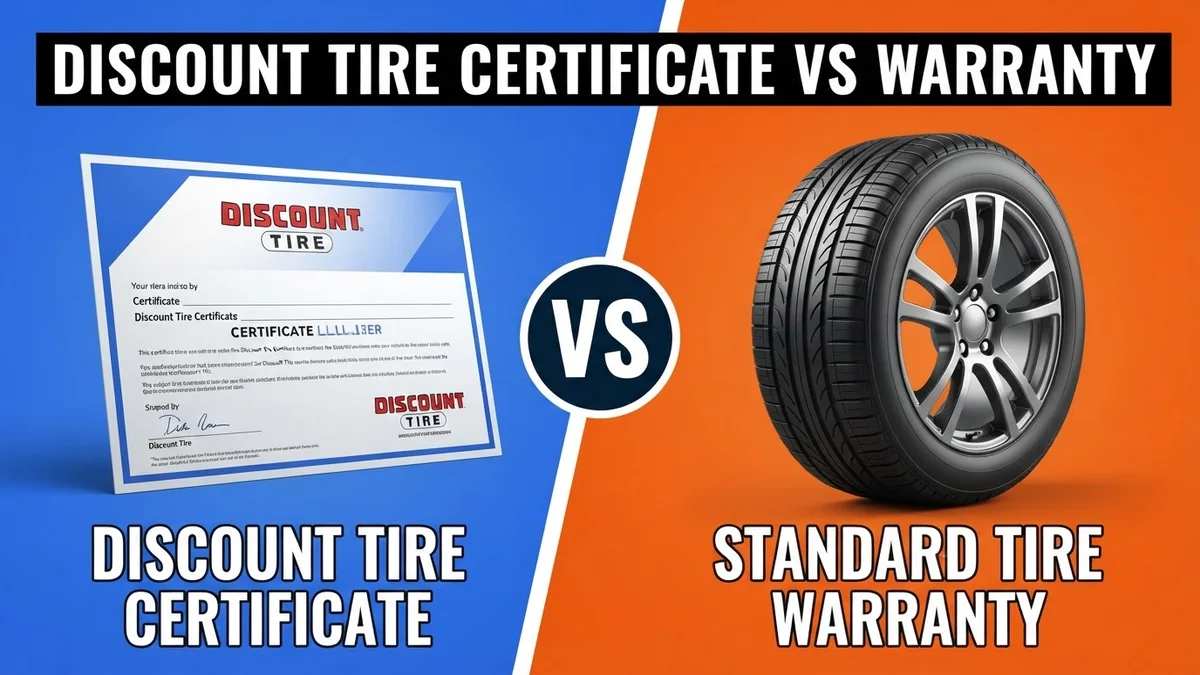
A single sidewall tear from a severe pothole costs exactly $0 out of pocket with a Discount Tire Certificate, whereas a Standard Tire Warranty leaves you paying 100% of the replacement tire price. That stark financial contrast defines the entire discount tire certificate vs warranty debate. Standard manufacturer coverage comes free on every new tire, guarding against factory structural defects for up to six years or 80,000 miles. But it completely ignores nails, road debris, and impact tears. Discount Tire Certificates demand an upfront fee—typically 15% of the tire price—yet offer non-prorated, full replacements down to 3/32 inch of remaining tread depth. Choosing between paid protection and free baseline coverage hinges entirely on your daily road hazards.
Quick Verdict: The Discount Tire Certificate wins for complete peace of mind, offering 100% non-prorated tire replacement for non-repairable road hazard damage like pothole cuts down to 3/32 inch tread depth. However, standard manufacturer warranties are free and cover structural defects up to 6 years and 80,000 miles. Pick Certificates if you frequently face poor road conditions; rely on Standard Warranty if saving upfront costs matters most.
Drivers wanting 100% free replacement against potholes and unrepairable punctures.
Budget-conscious drivers relying on mileage guarantees and safe highway driving.
- Discount Tire Certificate provides 100% free non-prorated tire replacements down to 3/32 inch remaining tread.
- Certificates add an upfront cost of approximately 15% to 20% ($15 to $45 per tire) to your tire purchase.
- Standard Warranty comes at $0 extra cost and covers treadwear mileage guarantees up to 80,000 miles.
- Standard Warranty typically excludes non-repairable road hazard damage like sidewall cuts from potholes.
- A single ruined tire replacement pays back the initial Certificate investment across a set of 4 tires.
Discount Tire Certificate vs Standard Tire Warranty: Head-to-Head Specs
Evaluating coverage policies requires looking past retail sales pitches to examine hard terms. The biggest structural contrast appears in road hazard protection, where the Discount Tire Certificate earns a stellar 9.8 rating compared to the Standard Tire Warranty score of 3.0. Standard factory coverage rebounds in long-term treadwear value with a 9.2 rating against the Certificate’s 6.0, as manufacturer terms span up to 80,000 miles while retail certificates expire when tread wears down to 3/32 inch.
✓ = better value in that row. Sourced from manufacturer specifications.
Discount Tire Certificate vs Standard Tire Warranty: Performance & Category Ratings
We analyzed both policies across core ownership dimensions to establish clear performance boundaries. The Discount Tire Certificate completely dominates road hazard protection with a 9.8 rating compared to a miserable 3.0 for standard coverage. Hit a stray bolt on the highway? Standard factory policies offer zero financial relief. They strictly cover manufacturing defects like belt separation or rubber compounding flaws. Conversely, the retail certificate acts as real-world physical insurance against unpredictable road debris.
On the financial ledger, Standard Tire Warranty claims the upfront cost category with a perfect 10.0 rating against the Certificate’s 6.5. You pay nothing extra at checkout for standard protection. However, claim experience reverses this dynamic entirely, favoring the Certificate 9.5 to 6.0. Filing a claim under a standard warranty requires detailed maintenance records, tread depth calculations, and prorated out-of-pocket costs. With a certificate, a store technician inspects the non-repairable puncture, verifies remaining tread is above 3/32 inch, and hands you a brand-new tire without tedious math.
For long-term treadwear, standard warranties lead with a 9.2 rating by offering prorated credit up to 80,000 miles. However, the Certificate takes overall value with an 8.7 to 7.8 victory. Single-use non-prorated replacements save drivers hundreds during unexpected tire emergencies, easily offsetting the initial retail add-on price.
Discount Tire Certificate
Standard Warranty
Discount Tire Certificate Vs Warranty by the Numbers
The raw metrics demonstrate where your dollars go and how risk transfers between driver and manufacturer. While Standard Tire Warranty scores 8.8 on coverage timeframe thanks to multi-year mileage limits, Discount Tire Certificate scores 9.5 in claim experience because it skips prorated calculations. Balancing the 10.0 upfront cost score of free warranties against the 9.8 road hazard protection of certificates reveals the exact financial trade-off every vehicle owner evaluates at checkout.
Discount Tire Certificate
Standard Warranty
Hover any bar for exact values. Each metric scaled independently.
Discount Tire Certificate: Strengths and Weaknesses
The primary strength of the Discount Tire Certificate lies in its uncompromising, non-prorated safety net. Pothole tears, curb impacts, and non-repairable shoulder punctures are covered 100%. If your tire catches a construction nail two weeks after installation, you get an identical replacement without paying a dime for the replacement rubber. The replacement process takes minutes at any company location nationwide, making the 9.5 claim experience rating well deserved. You can easily monitor your remaining rubber using a basic 🛒 Tire Tread Depth Gauge → to ensure you stay above the 3/32 inch refund threshold.
However, weaknesses exist on the balance sheet. Paying an extra 15% upfront per tire adds up quickly on premium truck or high-performance fitments, driving the upfront cost rating down to 6.5. Furthermore, coverage terminates the moment a certificate is redeemed for a new tire. To cover the brand-new replacement wheel, you must purchase an additional certificate for that individual tire. The policy also excludes normal wear-and-tear tread degradation, leaving mileage guarantees entirely to the tire manufacturer.
If you frequently navigate chaotic urban streets or industrial corridors, securing your investment at the service counter remains the smartest next step.
Price & availability subject to change. As an Amazon Associate we earn from qualifying purchases.
Standard Tire Warranty: Strengths and Weaknesses
The standard factory tire warranty shines brightest in immediate affordability and extended mileage lifespan. Scoring a perfect 10.0 in upfront cost, every set of major-brand tires includes this baseline protection automatically. Manufacturer treadwear warranties stretch up to 80,000 miles or six years, giving long-distance commuters financial backstopping against premature compound failure. Paired with a compact 🛒 Portable Tire Inflator → in your trunk, standard warranties keep highway drivers moving forward without added retail fees.

The weaknesses, however, become obvious the moment steel hits road debris. A road hazard rating of 3.0 highlights the total absence of protection against nails, glass, impact bulges, and pothole cuts. If a sidewall splits on a tire with 50% tread remaining, standard coverage provides zero dollars toward a replacement. Furthermore, claiming standard warranty credits for premature treadwear demands meticulous maintenance records, including regular rotation receipts every 5,000 miles. Prorated calculations mean you still pay for the worn fraction of the tire out of pocket, creating tedious administrative friction during claims.
If keeping your initial cash outlay low matters most and your routes are clean, relying on baseline factory coverage remains a sound financial approach.

Price & availability subject to change. As an Amazon Associate we earn from qualifying purchases.
- ✅ 100% free non-prorated tire replacement for non-repairable road hazards.
- ✅ Covers common road damage like sidewall punctures and pothole blowouts.
- ✅ Quick in-store replacement approval across 1,100+ Discount Tire locations.
- ✅ Valid down to 3/32 inch remaining tread depth for up to 3 years.
- ❌ Adds 15% to 20% extra to your initial tire purchase cost.
- ❌ Must purchase a new Certificate for the newly replaced tire.
- ❌ Coverage is limited strictly to Discount Tire store locations.
- ✅ Included at no extra upfront cost with eligible tire purchases.
- ✅ Provides treadwear mileage guarantees up to 80,000 miles.
- ✅ Covers structural manufacturing defects for 5 to 6 years.
- ✅ Honored at any authorized brand dealer across North America.
- ❌ Does not cover accidental road hazards like nail cuts in sidewalls.
- ❌ Prorates claim value based on used mileage and remaining tread.
- ❌ Requires rigorous maintenance records and manufacturer approval.
Discount Tire Certificate or Standard Tire Warranty: Which Should You Choose?
Selecting between a Discount Tire Certificate vs warranty protection depends entirely on your driving environment, vehicle setup, and financial priorities.
Urban Commuters and Low-Profile Fitments: If your daily drive includes under-construction highways, pot-holed city streets, or tight parallel parking spots, choose the Discount Tire Certificate. Low-profile tires mounted on modern crossovers or sedans suffer sidewall damage easily from minor edge strikes. Paying an extra $25 to $45 per tire upfront prevents a sudden $250 out-of-pocket replacement bill later. Stashing a durable 🛒 Car Emergency Kit → in your trunk adds extra peace of mind while routing to the nearest service bay.
Highway Cruisers and Tight Budgets: Drivers logging long mileage on well-paved interstate highways can confidently rely on the Standard Tire Warranty. If you strictly follow rotation schedules every 5,000 miles and check inflation regularly with a 🛒 Digital Tire Pressure Gauge →, standard manufacturer coverage protects your investment against tread burn for up to 80,000 miles. You avoid spending an extra $100 to $180 on certificates at purchase, keeping cash in your wallet.
High-Value SUV and Truck Applications: For heavy trucks carrying high-load tires, a single ruined tire hurts financially. Investing in Discount Tire Certificates shields your wallet when replacing an individual 20-inch or 22-inch tire costs upwards of $350 out of pocket.
Drivers wanting 100% free replacement against potholes and unrepairable punctures.
Budget-conscious drivers relying on mileage guarantees and safe highway driving.
Final Verdict: Discount Tire Certificate vs Standard Tire Warranty
In our head-to-head evaluation, the Discount Tire Certificate emerges as the overall winner with an 8.7 to 7.8 score advantage over the Standard Tire Warranty. While free factory warranties excel at long-term structural coverage—extending up to 6 years and 80,000 miles—they fall completely flat when potholes or debris slash your tread. The Certificate’s 9.8 score in road hazard protection and 9.5 score in claim experience provide total financial protection, handing you a 100% non-prorated replacement tire whenever usable tread remains above 3/32 inch.
The core trade-off comes down to risk tolerance versus immediate spending. The Standard Tire Warranty costs nothing extra upfront, making it ideal for drivers on pristine roads with strict budgets. But for complete peace of mind against real-world driving hazards, paying the upfront fee for Discount Tire Certificates is the clear winning move.
As an Amazon Associate we earn from qualifying purchases.
Discount Tire Certificate vs Warranty: Frequently Asked Questions
Is Discount Tire Certificate better than Warranty?
Discount Tire Certificate is better if you encounter road hazards like nails or potholes, offering 100% non-prorated replacement down to 3/32 inch tread depth. Standard Warranty is better for factory defect protection and long mileage guarantees up to 80,000 miles without paying an extra $15 to $45 per tire upfront.
What happens if I get a flat tire with a Certificate?
If your tire suffers non-repairable damage like a sidewall puncture, Discount Tire replaces it for $0 out-of-pocket, saving you around $150 to $300. You will only pay nominal disposal fees and the optional cost of buying a new Certificate ($20 to $40) for the replacement tire.
Does a Standard Warranty cover pothole damage?
No, a Standard Warranty typically excludes accidental road hazard damage such as potholes, curb scrapes, or glass cuts. It only covers manufacturing workmanship defects and tread wear. If a pothole ruins a tire with 50% tread remaining, a Standard Warranty yields $0 while a Certificate gives a 100% free tire.
How long does Discount Tire Certificate coverage last?
Discount Tire Certificates cover your tires for 3 years from the purchase date or until tread wear reaches 3/32 inch remaining depth, whichever comes first. In contrast, standard manufacturer treadwear warranties often stretch between 5 and 6 years or up to 80,000 miles depending on tire model.
Can I transfer a Discount Tire Certificate to another vehicle?
No, Discount Tire Certificates are non-transferable and remain tied to the specific tire serial number and vehicle registered at purchase. However, if you sell the vehicle, the remaining coverage period stays with those specific tires on the vehicle, benefiting the new vehicle owner for the 3-year term.