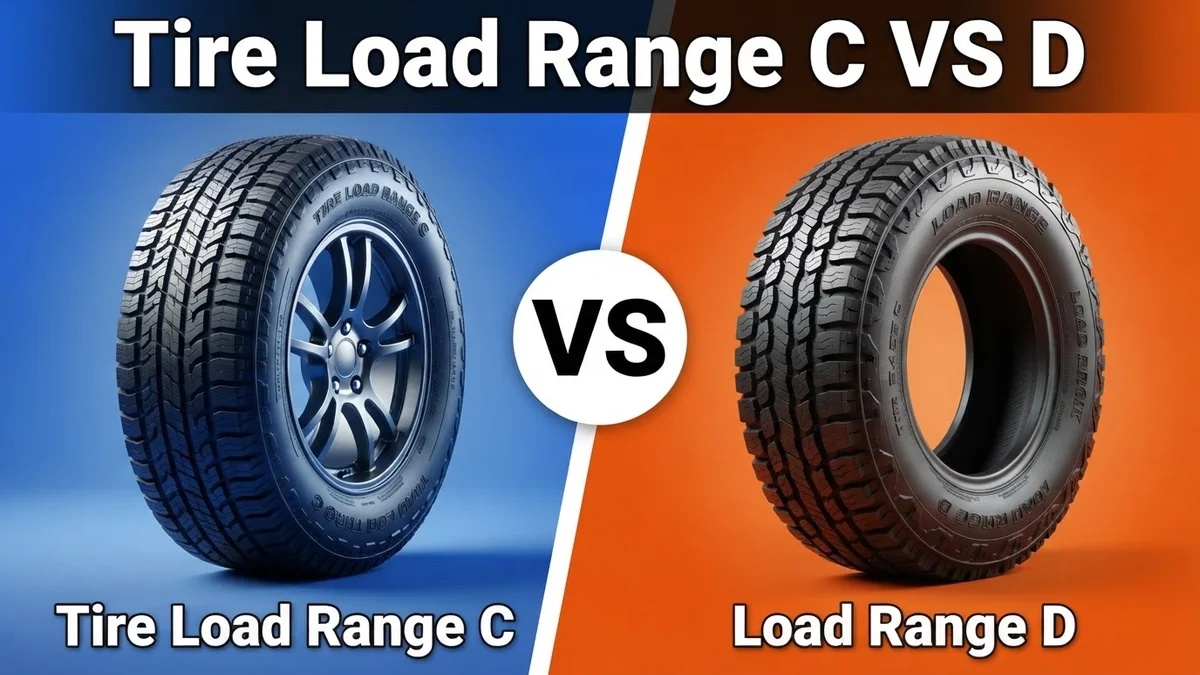
Load Range D holds up to 15 PSI higher maximum air pressure—running at 65 PSI compared to Tire Load Range C’s 50 PSI limit—which fundamentally changes how your truck reacts to every pothole, expansion joint, and road seam. That elevated pressure capability translates directly to higher weight capacities, but it comes at a noticeable penalty in everyday ride quality. Swapping between these two specs reveals that choosing the wrong rating either ruins your vehicle’s factory comfort or compromises your towing safety. Understanding how these light truck tire construction standards perform under real loads ensures you select the correct carcass strength without over-specifying your daily setup.
Quick Verdict: Tire Load Range C is the overall winner for daily-driven light trucks and SUVs, offering a significantly smoother ride and better fuel efficiency. However, Load Range D is essential for heavy towing and aggressive off-roading, providing 65 PSI max pressure and up to 3,000 lbs load capacity per tire at the expense of stiffer ride quality.
Half-ton truck and SUV owners seeking smooth daily driving and fuel economy.
3/4-ton truck owners, heavy trailer haulers, and aggressive off-roaders.
- Load Range C caps at 50 PSI, whereas Load Range D handles up to 65 PSI max pressure.
- Load Range D offers an 8-ply equivalent rating, compared to the 6-ply rating of Load Range C.
- Tire Load Range C weighs approximately 6 lbs less per tire, saving up to 1.5 MPG in fuel economy.
- Load Range D delivers up to 3,000 lbs max load per tire versus 2,470 lbs on standard Load Range C.
- Tire Load Range C averages $100 lower per set of 4 while delivering a far more compliant ride quality.
Tire Load Range C vs Load Range D: Head-to-Head Specs
The primary physical distinction between these tires boils down to ply rating equivalents and maximum operating inflation pressures. Tire Load Range C uses a 6-ply equivalent construction capped at 50 PSI max pressure, whereas Load Range D steps up to an 8-ply equivalent carcass rated for up to 65 PSI. That 15 PSI difference directly impacts sidewall stiffness, total load capacity per wheel, and overall tire weight.
✓ = better value in that row. Sourced from manufacturer specifications.
Tire Load Range C vs Load Range D: Performance & Category Ratings
Ride comfort heavily favors Tire Load Range C, earning a stellar 8.8 rating compared to Load Range D’s harsh 6.9 score. The standard 6-ply equivalent construction of Tire Load Range C flexes naturally over expansion joints, small bumps, and gravel ruts, absorbing surface impacts before they vibrate into your truck cabin. Load Range D, built with stiffer 8-ply equivalent sidewalls, transmits significantly more road chatter directly through the suspension when running unladen.
Towing and hauling flips this dynamic completely. Load Range D earns a dominant 9.1 rating against Tire Load Range C’s 7.2 score. Supporting up to 3,000 lbs per tire at 65 PSI, Load Range D eliminates rear-end squirm and highway sway when pulling heavy trailers or carrying heavy bed loads.
Fuel economy swings back to Tire Load Range C with an 8.5 rating versus Load Range D’s 7.4 score. Lighter internal casing materials mean Tire Load Range C reduces rotating mass at all four corners, saving fuel during stop-and-go acceleration.
Off-road durability belongs to Load Range D with a 9.0 score over Tire Load Range C’s 7.8 rating. The extra carcass reinforcement in Load Range D wards off sidewall punctures from sharp granite and jagged tree roots.
Value and price favors Tire Load Range C at 8.6 over Load Range D’s 7.8 rating. Lower manufacturing costs and superior gas mileage save money continuously. Finally, tread longevity slightly favors Load Range D at 8.4 versus 8.0 for Tire Load Range C, as stiffer tread blocks reduce squirm under heavy torque loads.
Load Range C
Load Range D
Tire Load Range C Vs D by the Numbers
Examining the raw specifications reveals the exact engineering trade-offs between load capacity, maximum inflation pressure, and tire mass. The data highlights why lighter trucks benefit from lower pressure thresholds while heavy haulers require elevated inflation limits to stay stable under high payloads.
Load Range C
Load Range D
Hover any bar for exact values. Each metric scaled independently.
Tire Load Range C: Strengths and Weaknesses
Tire Load Range C excels on daily-driven light trucks, Jeep Wranglers, and midsize SUVs. Its softer casing provides superior shock absorption on paved roads, capturing an 8.8 ride comfort rating that feels virtually identical to original equipment passenger tires. Weighing several pounds less per tire than higher load ranges, Tire Load Range C keeps un-sprung weight low across your suspension setup. This enhances responsiveness during city driving and delivers a strong 8.5 fuel economy score over thousands of commuting miles. Furthermore, lower manufacturing costs mean replacement sets are noticeably cheaper, driving an 8.6 rating in overall value.
The primary weakness lies in extreme heavy-duty applications. With a maximum pressure ceiling of 50 PSI and a 7.2 towing and hauling score, Tire Load Range C tires can feel squishy when loaded down with a heavy travel trailer or maxed-out bed payload. Off-road durability also caps out at 7.8; the 6-ply equivalent sidewalls lack the dense puncture defense required for punishing, razor-sharp rock crawling trails. If you plan to air down frequently on rough terrain, keeping a high-precision 🛒 Digital Tire Pressure Gauge → in your glovebox helps maintain correct pressures and avoid rim pinches.
If your vehicle stays on pavement or mild dirt trails most of the week, this tire spec provides the optimal balance of efficiency and comfort.
Price & availability subject to change. As an Amazon Associate we earn from qualifying purchases.
Load Range D: Strengths and Weaknesses
Load Range D is engineered for serious work and demanding off-road environments. Its standout feature is an outstanding 9.1 towing and hauling rating, backed by a 65 PSI maximum pressure rating and up to 3,000 lbs of load capacity per tire. When pulling heavy equipment or driving fully loaded overlanding rigs, the stiff 8-ply equivalent carcass prevents tire squirm and highway sway. Off-road durability is equally impressive at 9.0, giving drivers maximum confidence against sidewall slashes when navigating sharp rock gardens. It also earns an 8.4 rating in tread longevity, outlasting softer tires under heavy torque.
The trade-off comes strictly down to daily drivability and weight. A harsh 6.9 ride comfort rating means everyday commutes feel noticeably firmer, transferring small road imperfections directly into the cab when driving without cargo. Fuel economy drops to a 7.4 rating due to the extra mass of the heavy casing plies. You will also spend more upfront, resulting in a modest 7.8 value rating. For those who frequently pull heavy loads, pairing these stiff tires with a 🛒 Weight Distribution Hitch → creates a rock-solid, sway-free highway towing setup. Before taking Load Range D tires onto technical off-road trails, using a 🛒 Heavy-Duty Tire Deflator → helps soften the rigid sidewalls to gain crucial traction over rocks.
When heavy payloads and rugged trail protection take priority over daily comfort, this tough specification is the clear choice.
Price & availability subject to change. As an Amazon Associate we earn from qualifying purchases.
- ✅ Supple sidewalls provide superior daily ride comfort
- ✅ Lighter rotational mass improves city fuel economy
- ✅ Lower purchase price per set of four
- ✅ Less strain on light truck steering and suspension components
- ❌ Lower maximum payload and towing capacities
- ❌ More sidewall flex under heavy trailer loads
- ❌ Easier to puncture sidewalls on rugged rocky trails
- ✅ Higher 65 PSI capability prevents heavy trailer sway
- ✅ Up to 3,000 lbs payload capacity per tire
- ✅ Stouter 8-ply construction resists trail punctures
- ✅ Greater wear resistance when frequently hauling loads
- ❌ Noticeably stiffer and rougher ride on unpaved roads
- ❌ Heavier tire mass reduces fuel efficiency by 1-2 MPG
- ❌ Higher initial purchase price
Tire Load Range C or Load Range D: Which Should You Choose?
Choosing between these two tire specs comes down to how you actually use your truck or SUV seven days a week. It is easy to assume that buying a tougher tire is always better, but over-specifying your vehicle causes real penalties in daily drivability.
For commuters, daily drivers, and weekend outdoor enthusiasts driving midsize trucks like the Toyota Tacoma, Ford Ranger, or Jeep Gladiator, Tire Load Range C is the smarter pick. It maintains your vehicle’s factory suspension geometry and compliance, saving you money at the gas pump while delivering a comfortable ride on long highway trips. Mild dirt roads and light towing present no issue for this capability tier.
Are you willing to sacrifice highway comfort every single morning just to haul a heavy camper twice a year?
If your setup involves towing heavy trailers near your vehicle’s maximum gross vehicle weight rating, carrying permanent overlanding gear, or tackling sharp rock trails, Load Range D is necessary. The stiffer 8-ply equivalent sidewalls stabilize high-center-of-gravity loads and protect your investment against trail hazards. Power users and heavy haulers will easily tolerate the firmer ride quality in exchange for peace of mind under heavy loads.
Half-ton truck and SUV owners seeking smooth daily driving and fuel economy.
3/4-ton truck owners, heavy trailer haulers, and aggressive off-roaders.
Final Verdict: Tire Load Range C vs Load Range D
Tire Load Range C takes the overall victory in our head-to-head comparison for daily-driven light trucks and SUVs. It delivers a significantly smoother ride, superior fuel efficiency, and better upfront value while easily handling standard highway and light-duty chores.
However, the decision rests on one central trade-off: daily driving comfort versus heavy load stability and puncture resistance. While Tire Load Range C wins for general use, Load Range D remains the indispensable choice for drivers who demand maximum towing capacity and extreme off-road durability, providing 65 PSI max pressure and up to 3,000 lbs load capacity per tire at the expense of a stiffer ride. Match your tire load range to your actual payload requirements rather than buying carcass strength you will never use.
As an Amazon Associate we earn from qualifying purchases.
Tire Load Range C vs D: Frequently Asked Questions
Is Tire Load Range C better than D?
Tire Load Range C is better for daily driving, fuel economy, and comfort because of its lighter construction and 50 PSI cap. However, Load Range D is better for heavy towing, handling up to 65 PSI and roughly 3,000 lbs per tire compared to Range C's 2,470 lbs maximum load capacity.
What is the difference in PSI between Load Range C and D?
The primary operational difference is max inflation pressure. Load Range C tires max out at 50 PSI, whereas Load Range D tires operate up to 65 PSI. This extra 15 PSI allows Load Range D tires to carry substantially heavier loads and maintain sidewall stability under high stress.
Can I put Load Range D tires on a truck rated for Load Range C?
Yes, you can safely upgrade to Load Range D tires on a truck rated for Load Range C. Upgrading increases sidewall puncture resistance and load safety margins, though you may notice a firmer ride and a slight decrease of 0.5 to 1.5 MPG in fuel efficiency.
Does Load Range D affect gas mileage compared to C?
Yes, Load Range D tires typically reduce fuel economy by 1 to 2 MPG compared to Load Range C. Load Range D tires weigh about 5 to 8 lbs more per tire, creating extra rotational mass that forces your engine to work harder during acceleration.
Which load range lasts longer on highway driving?
Load Range D tires often yield slightly longer tread life during heavy highway towing due to stiffer 8-ply construction that resists squirm. However, unladen daily driving results in comparable tread life around 50,000 to 65,000 miles for both ranges when properly maintained.