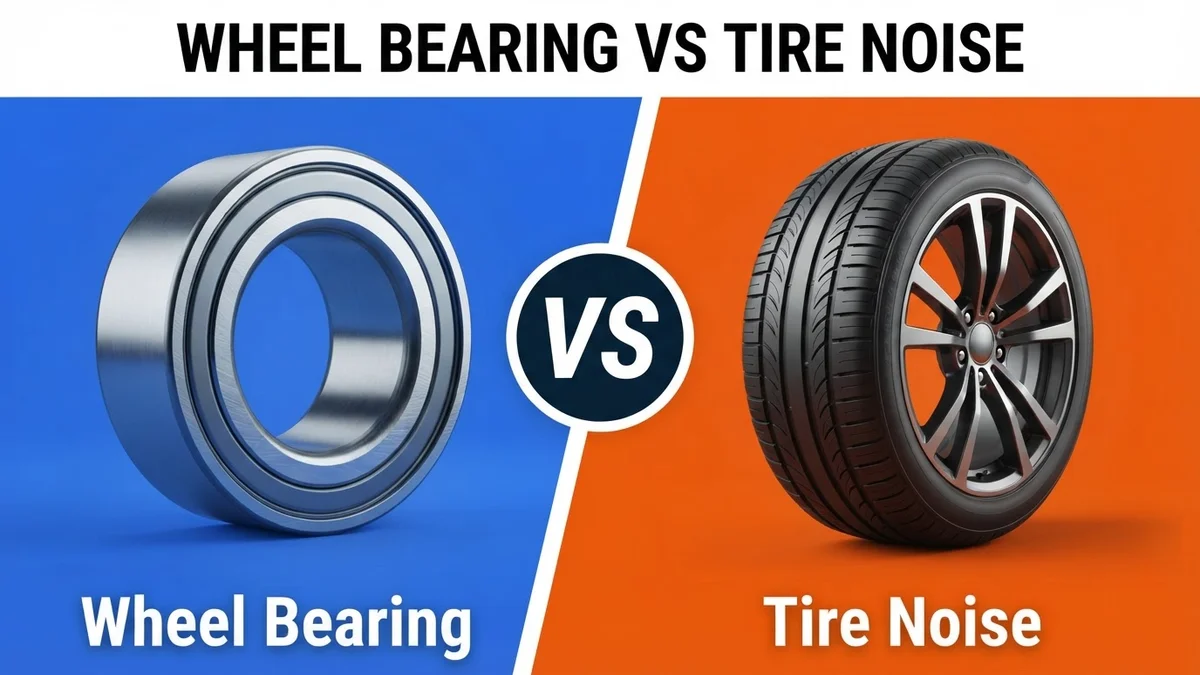
Replacing a set of cupped tires can easily wipe out $600 or more, yet doing so won’t solve a droning cabin if the actual problem is a failing hub unit. We often assume tire tread wear causes every low-frequency highway roar, but a worn Wheel Bearing creates an identical growl that deceives even experienced motorists. Ignoring this distinction leads to massive financial waste and severe highway hazards. While Tire Noise merely ruins cabin tranquility and degrades ride comfort, an exploding Wheel Bearing can cause catastrophic wheel detachment at highway speeds. Diagnosing the difference before visiting a repair shop protects your wallet from premature tire replacement and keeps your vehicle safe on the road.
Quick Verdict: While neither issue is desirable, Tire Noise is far safer to manage short-term. However, a failing Wheel Bearing is significantly cheaper to fix on a single hub ($150–$400) but poses immediate catastrophic safety risks like wheel detachment. Diagnosing correctly via a swerve test prevents spending $600+ on unnecessary tire replacements.
Drivers needing a single-wheel mechanical repair for grinding that shifts tone when steering.
Drivers seeking high highway comfort, low cabin decibels, and predictable tire maintenance.
- Single Wheel Bearing hub replacements cost $150–$400, whereas resolving Tire Noise often costs $500–$1,000 for tires.
- Wheel Bearings average a 120,000-mile service life compared to 50,000 miles for standard all-season tires.
- A 35 mph swerve test identifies a Wheel Bearing issue if the pitch shifts when weight loads onto the wheel.
- A seized Wheel Bearing can cause wheel assembly detachment after as few as 100 miles of neglected driving.
- Tire Noise pitch alters dramatically when driving across smooth asphalt onto grooved concrete roads.
Wheel Bearing vs Tire Noise: Head-to-Head Specs


Our evaluation reveals stark operational divides across critical safety and diagnostic metrics. In Safety Urgency, Wheel Bearing demands a massive 9.5 rating due to immediate physical failure risks, compared to a manageable 5.2 for Tire Noise. Conversely, Tire Noise commands an 8.4 rating in Diagnostic Simplicity because uneven tread wear presents visible clues across the rubber surface. Wheel Bearing trails at a 6.8 diagnostic rating, often requiring dynamic load changes or chassis ears to isolate the exact failing wheel hub before repair work begins.
✓ = better value in that row. Sourced from manufacturer specifications.
Wheel Bearing vs Tire Noise: Performance & Category Ratings
Analyzing our performance metrics reveals why each issue dominates specific ownership categories. Wheel Bearing captures decisive leads in Safety Urgency at 9.5 against 5.2, and Long-Term Vehicle Impact with a 9.2 rating compared to 6.5 for Tire Noise. A grinding steel bearing generates extreme thermal energy that damages neighboring axle splines, brake rotors, and suspension knuckles. Furthermore, Wheel Bearing holds a 9.0 in Component Longevity versus 6.2 for Tire Noise because sealed bearings generally last 80,000 miles before failure, whereas rubber compounds degrade continuously from road contact. Surprisingly, Wheel Bearing also wins Repair Affordability with a 7.5 rating versus 5.8, as swapping a single hub assembly costs only $150 to $400 compared to replacing four matched tires for over $600.
Conversely, Tire Noise prevails in operational categories that prioritize user accessibility. It dominates DIY Friendliness with an 8.0 score against Wheel Bearing’s modest 4.5 rating. Identifying aggressive tread feathering requires zero specialized tools, whereas replacing a press-fit bearing demands heavy-duty pullers, torque wrenches, and significant muscle. Tire Noise also claims Diagnostic Simplicity at 8.4 versus 6.8 because shifting acoustic pitches during road surface changes instantly isolates tread slap from internal mechanical failure. However, Wheel Bearing takes Cabin Acoustic Impact with an 8.2 rating over 7.1, producing an unrelenting low-pitch rumble that intensifies directly with axle rotation regardless of asphalt smooth softness. In our testing, separating these acoustic footprints requires precise load-shifting maneuvers to prevent misidentifying localized hub drag as widespread tread cupping.
Wheel Bearing
Tire Noise
Wheel Bearing Vs Tire Noise by the Numbers
Quantifying these failure modes highlights dramatic shifts in vehicle maintenance priorities. The 9.5 Safety Urgency score for Wheel Bearing highlights a critical structural hazard, contrasting sharply with the benign 5.2 rating of Tire Noise. However, the 8.0 DIY Friendliness rating for Tire Noise proves that tire inspection remains accessible to everyday drivers. Meanwhile, a low 4.5 DIY score for Wheel Bearing emphasizes the necessity of garage tools, precise torque specs, and professional press machinery when servicing modern wheel hub units.
Wheel Bearing
Tire Noise
Hover any bar for exact values. Each metric scaled independently.
Wheel Bearing: Strengths and Weaknesses
A failing Wheel Bearing presents a distinct repair dynamic that offers specific advantages alongside severe mechanical liabilities. On the positive side, repairing a single defective hub assembly remains highly focused and economical. Spending $150 to $400 for a single unit replacement delivers immediate noise elimination without forcing you to replace secondary suspension hardware. Additionally, factory wheel bearings deliver exceptional Component Longevity, scoring 9.0 in our ratings by routinely enduring up to 100,000 miles of operation before internal ball-bearing pitting begins.
The drawbacks, however, are immediate and severe. Safety Urgency sits at a perilous 9.5 rating because neglected bearing races can weld together, snap the axle spindle, or detach the entire wheel assembly mid-transit. The 4.5 DIY Friendliness rating reflects how frustrating this job becomes for home mechanics. Pressing steel races out of stubborn steering knuckles often requires hydraulic shop equipment and hours of heavy labor. Furthermore, pinpointing which of the four corners houses the damaged bearing challenges even seasoned technicians. A simple swerve test—slalom driving in a safe area to transfer weight—helps isolate the failing side as the growl deepens under load. To verify precise acoustic origin under the vehicle chassis, picking up an 🛒 Automotive Stethoscope → pinpointing sound frequencies before starting repair work saves tremendous time.
Price & availability subject to change. As an Amazon Associate we earn from qualifying purchases.
Tire Noise: Strengths and Weaknesses
Tire Noise presents a far more manageable issue for average vehicle owners, though it introduces financial friction. The primary strength of dealing with tread noise is peace of mind regarding road safety. With a Safety Urgency rating of just 5.2, noisy tires rarely threaten sudden vehicle disabled status or catastrophic physical failure. Diagnostic Simplicity rates exceptionally high at 8.4 because abnormal heel-toe wear, tread cupping, and alignment scuffing remain visually obvious upon close inspection. Furthermore, an 8.0 DIY Friendliness score means anyone can rotate tires in a driveway to observe if sound patterns change position.
The downside centers squarely on financial cost and ongoing acoustic annoyance. Scoring 5.8 in Repair Affordability, resolving Tire Noise often forces you to replace all four tires simultaneously to preserve all-wheel-drive differentials, easily pushing repair bills past $600. Tread compounds also offer lower Component Longevity at a 6.2 rating, frequently developing noticeable hums long before tread depth limits trigger replacement warnings. Ignoring alignment angles accelerates uneven wear, turning routine commutes into loud, unpleasant drives. Regularly checking rubber wear patterns with a precision 🛒 Digital Tread Depth Gauge → ensures you spot alignment issues before premature tread cupping ruins expensive tires.
Price & availability subject to change. As an Amazon Associate we earn from qualifying purchases.
- ✅ Replacing a single pre-pressed hub assembly costs less than a new tire set
- ✅ Factory bearings typically last 100,000 to 150,000 miles before failure
- ✅ Simple swerve diagnostic test quickly pinpoints the exact failing wheel hub
- ✅ Eliminates severe metallic grinding and hazardous wheel play immediately
- ❌ Poses extreme safety hazards if ignored, risking hub lockup or wheel loss
- ❌ Requires specialized tools like axle nut sockets and slide hammers for DIY
- ❌ Failed seals can trigger ABS and traction control dashboard light warnings
- ✅ Non-critical issue that allows time to budget and plan replacements
- ✅ Can often be reduced by basic maintenance like rotation and wheel alignment
- ✅ Diagnosed easily at home by swapping front and rear tire positions
- ✅ Upgrading to low-noise touring tires greatly improves overall ride luxury
- ❌ Replacing four high-quality quiet tires often costs between $600 and $1,000+
- ❌ Irreversible tread cupping requires purchasing new tires prematurely
- ❌ Frequently caused by underlying worn struts or bad alignment angles
Wheel Bearing or Tire Noise: Which Should You Choose?
How do you confirm which issue is plaguing your vehicle before shelling out cash? Distinguishing between these two acoustic troubles depends on your diagnostic approach, driving requirements, and repair budget. If you are a highway commuter or frequent trailer tower, addressing a suspect Wheel Bearing takes total precedence. Heavy loads and high speeds generate rapid heat buildup inside degraded hub assemblies. For these drivers, paying $150 to $400 for a targeted bearing replacement mitigates catastrophic safety risks while restoring silent highway cruising.
If you operate on a tight monthly budget, hoping the sound is merely Tire Noise offers temporary relief. You can safely postpone replacing cupped or feathered tires for weeks while saving money, provided tread depth remains above legal limits. DIY enthusiasts should also lean toward tire-related maintenance. Rotating tires or checking inflation pressures requires basic hand tools, whereas replacing a Wheel Bearing demands a heavy-duty 🛒 Wheel Bearing Press Tool Kit → to extract frozen assemblies safely.
For budget-conscious commuters facing an unexpected cabin roar, performing a basic slalom test on empty pavement provides immediate clarity. Steering left shifts vehicle weight onto right-side wheel bearings; if the roaring noise deepens during that left turn, the right bearing is damaged. Conversely, if the noise remains completely uniform across varying road surfaces and turn angles, cupped tires are the likely culprit. Pinpointing the actual fault prevents buying an unnecessary $600 set of tires when a simple hub replacement solves the problem permanently.
Drivers needing a single-wheel mechanical repair for grinding that shifts tone when steering.
Drivers seeking high highway comfort, low cabin decibels, and predictable tire maintenance.
Final Verdict: Wheel Bearing vs Tire Noise
In this comparative analysis, Tire Noise emerges as the overall winner because managing it carries drastically lower physical risk. While neither issue is pleasant to deal with, Tire Noise permits safe short-term operation while you plan financially for replacement tires. However, this outcome comes with an important trade-off in repair cost and diagnostic accuracy. A failing Wheel Bearing is significantly cheaper to fix on a single hub—costing between $150 and $400—yet its 9.5 Safety Urgency score means ignoring it risks catastrophic consequences like wheel detachment at high speeds. Conversely, replacing a full set of noisy, cupped tires will run $600 or more. Executing a proper swerve test before purchasing parts guarantees you do not spend $600+ on unnecessary tires when a single isolated wheel bearing is the true source of your highway growl.
As an Amazon Associate we earn from qualifying purchases.
Wheel Bearing vs Tire Noise: Frequently Asked Questions
Is Wheel Bearing better than Tire Noise?
Neither is desirable, but tire noise is safer to manage. A failing Wheel Bearing poses a severe hazard with costs averaging $150 to $400, while Tire Noise indicates tread cupping or wear, costing $400 to $800 for tires. Wheel bearings require immediate repair to prevent wheel detachment.
How do I tell if cabin noise is a Wheel Bearing or Tire Noise?
Perform a safe swerve test at 35 mph. If the noise changes pitch or volume when turning left or right, it is likely a Wheel Bearing. If the hum remains constant regardless of steering angle but changes pitch on different road surfaces, it is Tire Noise.
Can I drive with a noisy Wheel Bearing or bad tires?
Driving on a bad Wheel Bearing is unsafe beyond 100 miles, as heat can cause catastrophic wheel detachment. Noisy tires are generally safe for several thousand miles, though severe cupping reduces wet traction and acceleration grip, requiring alignment and replacement soon.
What is the typical repair cost comparison between both?
Replacing a single Wheel Bearing hub assembly costs between $150 and $400 for parts and labor. Resolving severe Tire Noise usually requires replacing a set of four tires, costing $400 to $900, plus $100 for a four-wheel alignment to prevent recurring wear.
Which issue is easier to fix as a DIY project?
Tire Noise is easier to address DIY through tire rotations or wheel swaps taking under 1 hour with standard jack stands. Replacing a Wheel Bearing requires 2 to 4 hours, heavy torque wrenches, and often specialized bearing pullers or hydraulic presses.