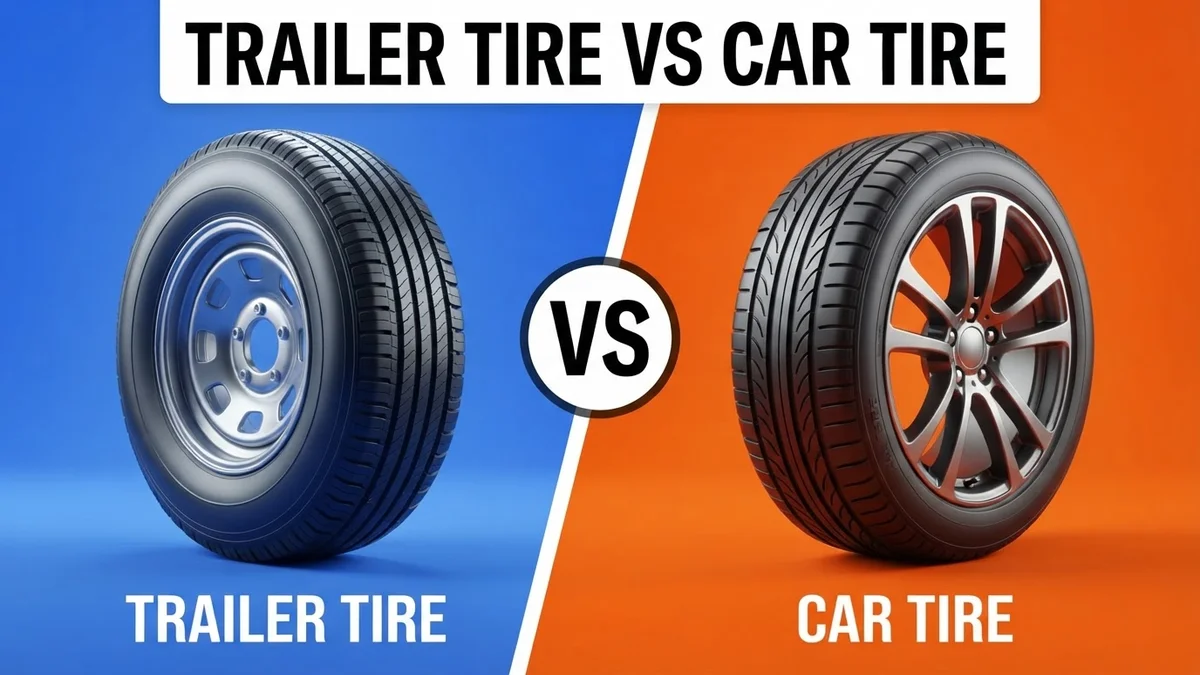
Mounting a passenger Car Tire on a trailing axle reduces your load safety capacity by a full 10% compared to a dedicated Trailer Tire. That penalty might look manageable on paper, but on the open highway with a 6,000-pound load, it creates a severe driving hazard. Trailer Tires feature stiff, reinforced sidewalls built specifically to handle heavy vertical loads and extreme lateral stress without flexing under pressure. Car Tires rely on flexible sidewalls to cushion human passengers, which induces dangerous trailer sway behind your tow vehicle. While passenger rubber excels at highway speeds above 81 mph and delivers double the tread longevity, it fails at the fundamental job a trailer demands: unyielding structural support.
Quick Verdict: Trailer Tires win overall for towing applications due to reinforced sidewalls and higher load capacities built specifically for trailing axles. While Car Tires offer superior ride comfort and higher speed ratings above 81 mph, using them on trailers reduces load safety by 10% and increases dangerous trailer sway.
Towing travel trailers, boat trailers, or heavy cargo haulers safely without sway.
Passenger vehicles, daily driving, or ultra-light utility trailers needing high-speed flexibility.
- Trailer Tire models offer up to 30% higher load capacity than equivalent-sized Car Tire options.
- Using a Car Tire on a trailer requires a mandatory 10% load capacity safety reduction.
- Standard Trailer Tire models carry speed limits between 65 and 81 mph, compared to 112+ mph for Car Tire models.
- Trailer Tire operating pressures reach 50 to 80 PSI, almost double the standard 32 to 35 PSI of a Car Tire.
- Trailer Tire replacement is required every 3 to 5 years due to structural rubber aging, whereas Car Tire models offer up to 85,000-mile warranties.
Trailer Tire vs Car Tire: Head-to-Head Specs


On paper, the physical construction of a Trailer Tire and a Car Tire diverges dramatically. Trailer Tires feature heavy-duty steel belts with double the sidewall ply thickness, whereas Car Tires use flexible polyester cords to smooth out rough road impacts. Additionally, Trailer Tires carry speed ratings typically capped at 65 to 81 mph, while standard Car Tires easily handle continuous speeds up to 112 mph or higher. In our comparison, these structural differences dictate how each rubber compound behaves under dynamic load conditions.
✓ = better value in that row. Sourced from manufacturer specifications.
Trailer Tire vs Car Tire: Performance & Category Ratings
In our detailed analysis, the specialized engineering of the Trailer Tire dominates every heavy hauling category. For Heavy Towing Load Capacity, the Trailer Tire earns a massive 9.8 score versus the Car Tire’s weak 6.2. The extra steel plating and thick rubber compound allow it to carry immense tongue weight without dangerous sagging. That same rigid sidewall construction propels the Trailer Tire to a 9.5 rating in Trailer Stability & Sway Control. Car Tires score a low 5.5 here because their squishy sidewalls flex during sudden lane changes, causing terrifying tail-wagging movements on the highway.
However, the performance table flips completely when you detach heavy load demands and evaluate highway driving dynamics. The Car Tire scores a dominant 9.4 in High-Speed Performance compared to the Trailer Tire’s modest 6.0 rating. Car Tires dissipate friction heat far better at continuous 70+ mph cruising speeds. They also crush the competition in Ride Comfort & Cushioning, scoring 9.2 against the stiff 4.5 of the Trailer Tire. In terms of Tread Life & Longevity, the Car Tire takes an 8.8 rating over the Trailer Tire’s 6.5, as passenger tread compounds resist dry rot and uneven wear far better during extended highway use. Finally, Value & Purchase Price favors the Trailer Tire with an 8.8 score against the Car Tire’s 7.8, thanks to lower manufacturing costs for unpowered, non-steering rubber.
Trailer Tire
Car Tire
Trailer Tire Vs Car Tire by the Numbers
The raw performance figures highlight a stark divide between pure towing security and everyday passenger comfort. A 9.8 load rating for the Trailer Tire reflects thick structural ply layers engineered specifically for dead vertical weight. Meanwhile, the Car Tire’s 9.2 ride comfort score underscores its softer, passenger-friendly casing. Inspecting these quantitative benchmarks shows exactly why mixing these two tire classes on a trailer setup creates serious safety and performance trade-offs on the open highway.
Trailer Tire
Car Tire
Hover any bar for exact values. Each metric scaled independently.
Trailer Tire: Strengths and Weaknesses
Choosing a Trailer Tire gives you purpose-built performance that single-mindedly targets heavy cargo hauling. The thick sidewalls prevent lateral sway, keeping your travel trailer or boat tracking straight when commercial semi-trucks blow past you at highway speeds. With a heavy towing load rating of 9.8, these tires bear massive vertical loads safely without dangerous squatting. They are also budget-friendly, earning an 8.8 value score because manufacturers do not need to integrate complex noise-dampening patterns or high-speed traction sipes into unpowered rubber.
The drawbacks become obvious as soon as you look at highway comfort and tread life. Rated at just 4.5 for ride comfort, a Trailer Tire transfers every single road impact directly into your trailer’s suspension and frame, rattling loose delicate cargo if your leaf springs are stiff. Speed ratings are another limitation; most Trailer Tires max out between 65 and 81 mph, leaving zero safety margin for aggressive passing maneuvers. Moreover, their 6.5 tread life rating means they suffer from premature weathering and flat-spotting during long off-season storage periods. To protect your rubber during extended downtime, wrapping your set in 🛒 Heavy-Duty Tire Covers → prevents harsh UV damage and premature sidewall cracking. If you are ready to upgrade your rig’s highway stability, check out the top-rated models below.
Price & availability subject to change. As an Amazon Associate we earn from qualifying purchases.
Car Tire: Strengths and Weaknesses
Car Tires represent the pinnacle of high-speed refinement and passenger comfort. Scoring a 9.2 in ride cushioning, a passenger radial dampens road vibrations effortlessly, protecting delicate trailer contents from severe chattering on rough pavement. Their 9.4 high-speed performance rating means they run dramatically cooler at 75 mph, significantly reducing heat-induced blowouts on long cross-country trips. Furthermore, an 8.8 tread life score guarantees you will get more usable miles out of the tread compound before rubber breakdown forces a replacement.
The fundamental flaw of mounting a Car Tire on a trailing axle is structural flex. Passenger tires use flexible sidewalls engineered to lean smoothly into sharp turns and absorb potholes. Put that same flex under a heavy boat trailer or camper, and you induce severe trailer sway that drops stability down to a dismal 5.5 score. You also lose 10% of the tire’s rated load capacity immediately upon mounting it to a trailer axle due to federal safety guidelines. Monitoring inflation levels closely with a reliable 🛒 Digital Tire Pressure Gauge → helps reduce heat risks, but it cannot fix inherent sidewall squishiness under load. If you prioritize smooth highway rolling for light utility loads, browse the leading options today.
Price & availability subject to change. As an Amazon Associate we earn from qualifying purchases.
- ✅ Higher load carrying capacity size-for-size than passenger options
- ✅ Ultra-stiff sidewalls prevent dangerous high-speed trailer sway
- ✅ Engineered with heavy oxidation and UV inhibitors for outdoor storage
- ✅ Lower average initial purchase price per tire
- ❌ Lower speed rating ceiling (typically 65 to 81 mph)
- ❌ Extremely rigid construction transmits all shock directly to trailer payload
- ❌ Must be replaced every 3 to 5 years regardless of remaining tread depth
- ✅ Superior high-speed capability rated for 112 to 149+ mph
- ✅ Excellent traction compounds for cornering and responsive braking
- ✅ Generous mileage treadwear warranties up to 85,000 miles
- ✅ Smooth, shock-absorbing ride quality for passengers and delicate cargo
- ❌ Mandatory 10% load capacity reduction when mounted on trailer axles
- ❌ Flexible sidewalls increase dangerous trailer sway under heavy loads
- ❌ Higher initial purchase price for heavy-load rated specifications
Trailer Tire or Car Tire: Which Should You Choose?
Deciding between a Trailer Tire and a Car Tire comes down to what you are pulling, how heavy it gets, and how fast you drive.
Choose a Trailer Tire if:
You regularly tow heavy travel trailers, double-axle boat trailers, or fully loaded horse trailers. If your gross trailer weight pushes past 2,000 pounds, the 9.5 stability rating and 9.8 load capacity of a Trailer Tire are non-negotiable for highway safety. Beginner towers should stick exclusively to Trailer Tires because their rigid sidewalls compensate for inexperienced steering inputs, stopping dangerous sway before it starts. They are also the clear choice for budget-conscious haulers wanting maximum load safety per dollar spent. Before hitting the interstate on a long trip, secure your parked rig using reliable 🛒 Trailer Wheel Chocks → and equip a wireless 🛒 Tire Pressure Monitoring System → to track tire heat in real time.
Choose a Car Tire if:
You operate a lightweight, single-axle utility trailer hauling lawnmowers, kayaks, or light camping gear under 1,500 pounds total weight. Power users who frequently pull ultra-light cargo at continuous 75+ mph highway speeds might prefer the Car Tire’s 9.4 high-speed performance and 9.2 ride comfort ratings. The flexible sidewalls reduce harsh vibrations that bounce lightweight empty trailers across lane lines. However, you must downrate the tire’s stamped load limit by 10% to stay legal and safe under federal towing standards. If you keep loads light and speed high, a Car Tire provides a noticeably smoother ride.
Towing travel trailers, boat trailers, or heavy cargo haulers safely without sway.
Passenger vehicles, daily driving, or ultra-light utility trailers needing high-speed flexibility.
Final Verdict: Trailer Tire vs Car Tire
When the dust settles, the Trailer Tire emerges as the clear overall winner for towing applications. While a Car Tire offers a plush 9.2 ride comfort score and superior high-speed heat dissipation, those advantages vanish when heavy loads hit the highway. Mounting passenger rubber on a trailer axle cuts load safety capacity by 10% and drops sway control to a dangerous 5.5 rating. The reinforced, rigid sidewalls of the Trailer Tire provide the unyielding structural support and 9.8 load rating required to keep heavy tow loads stable and secure behind your truck. You sacrifice some ride plushness and high-speed margin above 81 mph, but you gain critical stability where it matters most. For any genuine hauling task, always equip your trailing axle with a dedicated Trailer Tire.
As an Amazon Associate we earn from qualifying purchases.
Trailer Tire vs Car Tire: Frequently Asked Questions
Is Trailer Tire better than Car Tire?
Trailer Tire is significantly better for towing because its stiff sidewalls handle up to 30% higher loads and eliminate trailer sway. Car Tire is superior for passenger cars, as using passenger tires on trailers requires a 10% load capacity penalty and increases sway hazards under heavy payloads.
Can you put a Car Tire on a trailer?
Yes, but federal safety standards require derating the Car Tire load capacity by 10%. For example, a 1,800 lb rated passenger tire drops to 1,620 lbs on a trailer axle. Flexible sidewalls on passenger tires also increase swaying under heavy cargo loads.
What is the biggest difference between a Trailer Tire and a Car Tire?
The critical difference is sidewall rigidity and load design. Trailer Tire features thick, heavy-duty sidewalls to resist sway without needing traction for driving or steering. Car Tire features flexible sidewalls engineered for cornering traction, steering response, and absorbing road vibration for passenger comfort.
How long do Trailer Tires last compared to Car Tires?
Car Tire typically lasts 40,000 to 80,000 miles over 6 to 7 years. Trailer Tire generally expires after 3 to 5 years regardless of remaining tread depth, as rubber compounds degrade internally from UV exposure and sitting stationary under heavy loads.
Which tire is better for high-speed highway driving?
Car Tire is far safer at higher highway speeds, with standard speed ratings ranging from 112 to 149 mph. Most Trailer Tire models are speed-rated at 65 to 81 mph (N or M rating), making them prone to overheating blowouts if driven above recommended speeds.