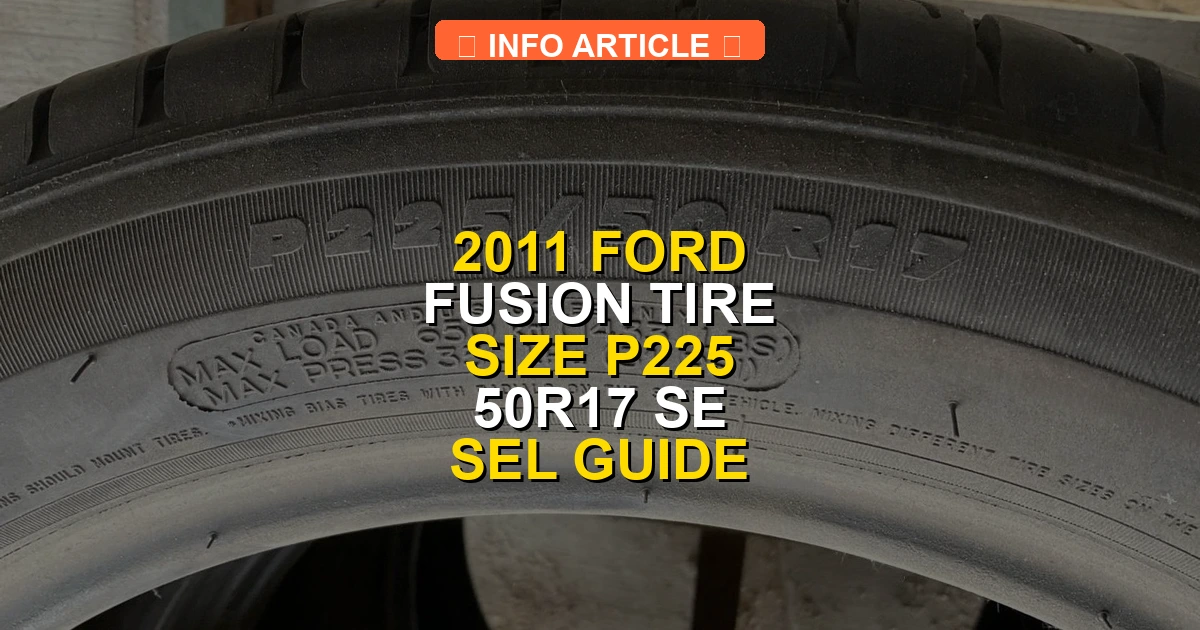
The correct factory tire size for the 2011 Ford Fusion SE and SEL equipped with 17-inch wheels is P225/50R17. Ensuring you use this exact OEM specification maintains proper speedometer accuracy, handling performance, and fuel economy.
The correct factory tire size for a 2011 Ford Fusion SE and SEL equipped with 17-inch wheels is P225/50R17. If your mid-size sedan came rolling off the assembly line with the standard 17-inch alloy wheels, this is the exact metric specification you need for replacements.
Maintaining the proper P225/50R17 tire size on your 2011 Fusion SE or SEL ensures your speedometer remains accurate, your traction control systems function correctly, and your fuel economy stays optimized as we head through 2026. Running the wrong dimensions can negatively impact your handling and cause premature wear on your suspension components.
Key Takeaways
- The OEM tire size for the 2011 Ford Fusion SE and SEL is P225/50R17.
- Always check the driver’s door jamb placard for exact cold tire pressure specifications.
- The standard recommended cold tire pressure is typically 35 PSI for both front and rear.
- The ’94’ load index and ‘V’ or ‘H’ speed rating are standard for this application.
- Maintaining proper alignment prevents premature wear on P225/50R17 tires.
What Causes Incorrect Tire Sizes on a 2011 Ford Fusion SE SEL
You might wonder how a vehicle ends up with the wrong rubber installed. Drivers often inherit mismatched setups or make intentional changes that cause long-term calibration issues.

Previous Owner Modifications and Aftermarket Changes
Many 2011 Ford Fusion SE and SEL models have passed through multiple owners by 2026. Previous owners may have installed cheaper alternative sizes like 215/55R17 or 225/45R17 simply because they were on sale, without considering the impact on vehicle dynamics.
- Installing narrower tires that reduce cornering grip
- Mounting lower-profile sidewalls that harsh out the ride quality
- Altering the overall rolling diameter by more than three percent
Confusion Between Trim Levels and Wheel Options
The 2011 Fusion lineup featured several trim levels with vastly different wheel packages. It is entirely too easy to confuse the SE and SEL 17-inch setup with the smaller 16-inch wheels found on base models, or the larger 18-inch wheels that came standard on the Sport trim.
- Base S models typically utilized 16-inch wheels requiring 205/60R16 tires
- SE and SEL trims primarily utilized the 17-inch wheels requiring P225/50R17 tires
- Sport trims stepped up to 18-inch wheels requiring 225/45R18 tires
Master Ford Fusion P225/50R17 Tire Maintenance in 6 Simple Steps
Navigating tire care and replacement for your 2011 Ford Fusion SE or SEL equipped with P225/50R17 tires requires precision and attention to detail. This comprehensive walkthrough guides you through decoding your tire specifications, checking inflation pressures, evaluating tread wear, preparing for a safe swap, mounting the correct tire size, and performing final post-installation checks to ensure optimal vehicle handling and fuel efficiency.
Step 1: Decode Your Specific Tire Dimensions and Ratings
What you need: Flashlight, current tire sidewall, owner’s manual.
Instructions: Examine the sidewall of your current tire to locate the alphanumeric code P225/50R17. The ‘P’ designates a passenger vehicle tire, ‘225’ represents the nominal section width in millimeters from sidewall to sidewall, ’50’ indicates the aspect ratio where the sidewall height is 50% of the tread width, and ‘R’ signifies radial construction fitting a 17-inch wheel diameter. Verify your Fusion’s SE or SEL door placard located on the driver-side B-pillar to cross-reference this size with Ford’s factory engineering specifications. Understanding these metrics ensures that any replacement tire you purchase matches the exact load capacity and rolling circumference required for your midsize sedan.
Pro Tip: Never mix different aspect ratios or width measurements across the same axle, as this disrupts the Anti-lock Braking System (ABS) and Traction Control sensors.
Step 2: Measure Tread Depth and Assess Wear Patterns
What you need: Tread depth gauge or a standard US penny, clean rag.
Instructions: Inspect all four P225/50R17 tires for uneven wear, cupping, or foreign objects embedded in the rubber. Insert a tread depth gauge into the principal tread grooves across the center and outer edges of the tire. Alternatively, place a penny upside down into the tread groove with Abraham Lincoln’s head facing down; if the top of his head is visible, your tread is below 2/32 of an inch and immediate replacement is required. For winter safety, a measurement below 4/32 of an inch indicates it is time to shop for new rubber.
Pro Tip: Uneven wear on the inner or outer shoulders of your 17-inch tires is a definitive indicator of a bad wheel alignment or worn suspension components that must be corrected.
Step 3: Establish Correct Cold Inflation Pressure
What you need: Digital tire pressure gauge, portable air compressor or service station air pump.
Instructions: Check your tire pressure when the vehicle has been parked for at least three hours or driven less than one mile, ensuring the P225/50R17 tires are completely “cold.” Unscrew the valve stem caps on all four wheels. Press your digital pressure gauge firmly onto the valve stem until the hissing sound stops and a digital reading appears. The factory specification for the 2011 Ford Fusion SE/SEL with 17-inch tires is typically 35 PSI (Pounds per Square Inch) for both front and rear. Add or release air until every tire matches this exact manufacturer recommendation.
Pro Tip: Temperature fluctuations impact tire pressure significantly; expect a drop of about 1 PSI for every 10-degree Fahrenheit decrease in ambient outdoor temperature.
Step 4: Secure the Vehicle and Loosen Lug Nuts
What you need: Hydraulic floor jack, rated jack stands, 19mm lug wrench or breaker bar, wheel chocks.
Instructions: Park your Fusion on a flat, level concrete surface and engage the parking brake firmly. Place wheel chocks securely against the tires diagonal to the wheel you intend to service first. Using your 19mm lug wrench, crack loose all five lug nuts on the target wheel by turning them counterclockwise one full turn while the tire is still firmly on the ground. Position your hydraulic jack under the factory-approved reinforced pinch weld jacking points located along the rocker panels. Raise the vehicle smoothly until the tire clears the ground by approximately two inches, then slide a robust jack stand underneath the frame for secure backup support.
Pro Tip: Never rely solely on a hydraulic jack to support the vehicle while you are working; always use rated jack stands to prevent catastrophic accidents.
Step 5: Mount and Torque Replacement P225/50R17 Tires
What you need: New or replacement P225/50R17 tire/wheel assembly, wire brush, torque wrench.
Instructions: Completely remove the loosened lug nuts and pull the wheel straight off the wheel hub. Use a wire brush to clean any rust or corrosion off the wheel mounting surface and hub flange to ensure a flush fit. Lift the new P225/50R17 tire onto the wheel studs carefully, taking care not to damage the threaded studs. Thread all five lug nuts on by hand in a clockwise motion until snug. Lower the vehicle off the jack stands until the tire supports the vehicle’s weight partially. Use a calibrated torque wrench in a star pattern to tighten all lug nuts to the factory specification of 100 lb-ft (135 Nm).
Pro Tip: Always follow a strict star (criss-cross) tightening pattern when installing lug nuts to guarantee uniform clamping force across the wheel rotor.
Step 6: Perform Final Calibration and Reset TPMS
What you need: TPMS reset tool (if applicable), pressure gauge, test drive route.
Instructions: After installing and properly torquing your tires, verify that all four P225/50R17 tires maintain an even 35 PSI reading. If your 2011 Ford Fusion displays a Low Tire Pressure warning light on the instrument cluster, perform a Tire Pressure Monitoring System (TPMS) training procedure or drive the vehicle at speeds above 25 mph for 10 to 15 minutes to allow the sensors to recalibrate automatically. Take the car for a short test drive on local roads and a highway stretch, paying close attention to steering feedback, alignment tracking, and abnormal road vibrations.
Pro Tip: Re-check your wheel lug nut torque values with a torque wrench after driving the first 50 to 100 miles to account for initial settling of the wheel hardware.
✅ Final Checklist
- All four tires match the P225/50R17 specification and load rating
- Cold tire inflation pressure is precisely set to 35 PSI on all wheels
- Lug nuts are torqued securely to the factory specification of 100 lb-ft
- Tread depth measures safely above the minimum legal limit of 2/32 of an inch
- TPMS warning light is cleared and steering tracking is completely straight
Important Notes:
- Always prioritize vehicle safety by wearing eye protection and gloves while servicing wheels and heavy tire assemblies.
- Seek professional assistance from a certified alignment and suspension shop if you notice persistent vibrations or uneven tire wear.
- Estimated time for inspection and single tire replacement ranges from 45 to 90 minutes; professional tire replacement and balancing costs generally range from $15 to $30 per tire excluding the cost of new rubber.
How to Verify and Fix Your P225 50R17 Tire Specifications
Confirming that your 2011 Ford Fusion SE or SEL has the right rubber installed takes only a few minutes. You should never rely solely on what is currently mounted on the car, as past replacements might have been incorrect.

Checking the Driver Door Placard
Open the driver-side front door and look at the white and yellow certification label affixed to the B-pillar. This factory placard displays the exact Original Equipment Manufacturer tire size—P225/50R17—along with the correct cold inflation pressures.
- Locate the section labeled Tire and Loading Information
- Confirm the front and rear size reads P225/50R17 93V (or similar load/speed rating)
- Note the recommended cold tire pressure, which is typically set at 35 PSI for these Fusion models
Inspecting Your Current Sidewalls
Walk out to your vehicle and read the raised lettering molded directly into the rubber sidewall of your current tires. Look for the exact sequence to ensure your speedometer and transmission shift points stay properly calibrated.
- Find the series starting with P225/50R17 or 225/50R17
- Verify the rim diameter number at the end matches your 17-inch alloy wheels
- Check the date code to ensure your tires are safe and not degraded by age
Step-by-Step Guide to Correct Cold Tire Inflation Pressure
Maintaining the proper inflation pressure for your P225/50R17 tires is critical for vehicle safety, fuel economy, and even tread wear. According to the National Highway Traffic Safety Administration (NHTSA), under-inflated tires generate excessive heat, which significantly accelerates tread degradation and increases the risk of a blowout. Follow this precise procedure to set your cold tire pressure accurately.
1. Check Pressure Only When Tires Are Cold
Measure your tire pressure after the Ford Fusion has been parked for at least three hours or driven less than one mile. Driving generates friction that heats the internal air, artificially inflating pressure readings by up to 5 PSI.
2. Locate the Manufacturer Specification
Open the driver-side door and find the Tire and Loading Information placard affixed to the B-pillar. For the 2011 Ford Fusion SE and SEL trims equipped with P225/50R17 tires, the recommended cold inflation pressure is 35 PSI for both front and rear positions.
3. Inflate and Verify with a Calibrated Gauge
Remove the valve stem caps and press a reliable digital or stick-type pressure gauge firmly onto the valve stem. If the pressure falls below 35 PSI, use an air compressor to add air in short bursts. Recheck the reading until all four tires match the factory specification precisely.
What If Your Tire Wear Issues Still Do Not Resolve
If you have installed the correct P225/50R17 size, maintained proper 35 PSI inflation, and still notice uneven tread wear or handling vibrations, underlying mechanical problems may be present. Addressing these issues promptly prevents premature tire replacement.
- Inspect Steering and Suspension Components: Worn control arm bushings, failing ball joints, or loose tie rods allow wheel alignment angles to shift dynamically while driving, destroying new tread rapidly.
- Perform a Professional Four-Wheel Alignment: Even minor deviations in camber, caster, or toe settings will cause rapid shoulder wear. Expect a professional alignment service to cost between $100 and $250.
- Check for Wheel Assembly Imbalance: Persistent vibrations at highway speeds often indicate bent alloy wheels or lost balance weights, requiring professional spin-balancing starting at around $15 to $25 per wheel.
- Consult a Certified Suspension Technician: If mechanical wear is severe or difficult to diagnose, take your vehicle to a licensed alignment specialist or automotive service center for a comprehensive multi-point suspension inspection.
Conclusion
Properly maintaining the factory-specified P225/50R17 tire size on your 2011 Ford Fusion SE or SEL ensures optimal braking performance, predictable handling, and maximum tread life. By adhering strictly to the recommended 35 PSI cold inflation standard and addressing alignment anomalies early, drivers can avoid costly premature replacements. According to verified research and automotive safety experts, routine monthly pressure checks remain the single most effective way to protect your tire investment. Take the next step today by grabbing a digital pressure gauge and verifying your Fusion tire pressures before your next commute.
❓ Frequently Asked Questions
Why is the P225/50R17 tire size crucial for the 2011 Ford Fusion SE and SEL?
This exact size ensures your vehicle’s anti-lock braking system, traction control, and speedometer function correctly without electronic calibration errors. Deviating from this factory specification can negatively impact your fuel economy and ride comfort.
What load and speed rating should I look for when replacing P225/50R17 tires?
You should look for a minimum load index of 94 and a speed rating of H or V to safely handle the weight and performance capabilities of the midsize sedan.
How often should I check the tire pressure on my 2011 Ford Fusion?
It is best to check your cold tire pressure at least once a month and whenever ambient temperatures change drastically, as pressure fluctuates roughly 1 PSI for every 10-degree temperature drop.
Will installing wider tires like a 235-width fit on a stock 2011 Fusion SE 17-inch wheel?
While a slightly wider tire might physically mount onto the factory 17-inch alloy rim, it can cause rubbing against the inner wheel well or suspension components during sharp turns.
What causes uneven wear on P225/50R17 tires on these Ford Fusion models?
Uneven tread wear is most commonly caused by improper wheel alignment, worn suspension components like tie rods or control arms, or consistently driving with incorrect tire pressure.
Should I rotate my P225/50R17 tires, and how often?
Yes, you should rotate your tires every 5,000 to 7,500 miles to ensure even tread wear across all four positions, thereby extending the overall lifespan of the set.