Staring at endless rows of tread patterns at your local auto shop or online dealer often leads to a major dilemma: do you buy a smooth-riding Touring Tire or a standard All Season tire? Both promise reliable year-round usability, but they cater to fundamentally different road conditions and driver expectations. Do you spend extra cash for hushed highway efficiency, or choose a budget-friendly option engineered to bite into slush? We analyzed rigorous laboratory testing data, warranty metrics, and real-world ownership costs to bring you an unbiased, data-backed answer so you can make the absolute right choice for your vehicle.
Quick Verdict: Touring Tire wins overall for highway commuters and passenger sedans, delivering exceptional acoustic comfort, smoother bump absorption, and warranties up to 85,000 miles. However, standard All Season tires provide better siping for light snow and cost approximately $220 less per set, making them the superior choice for severe winter climates and tight budgets.
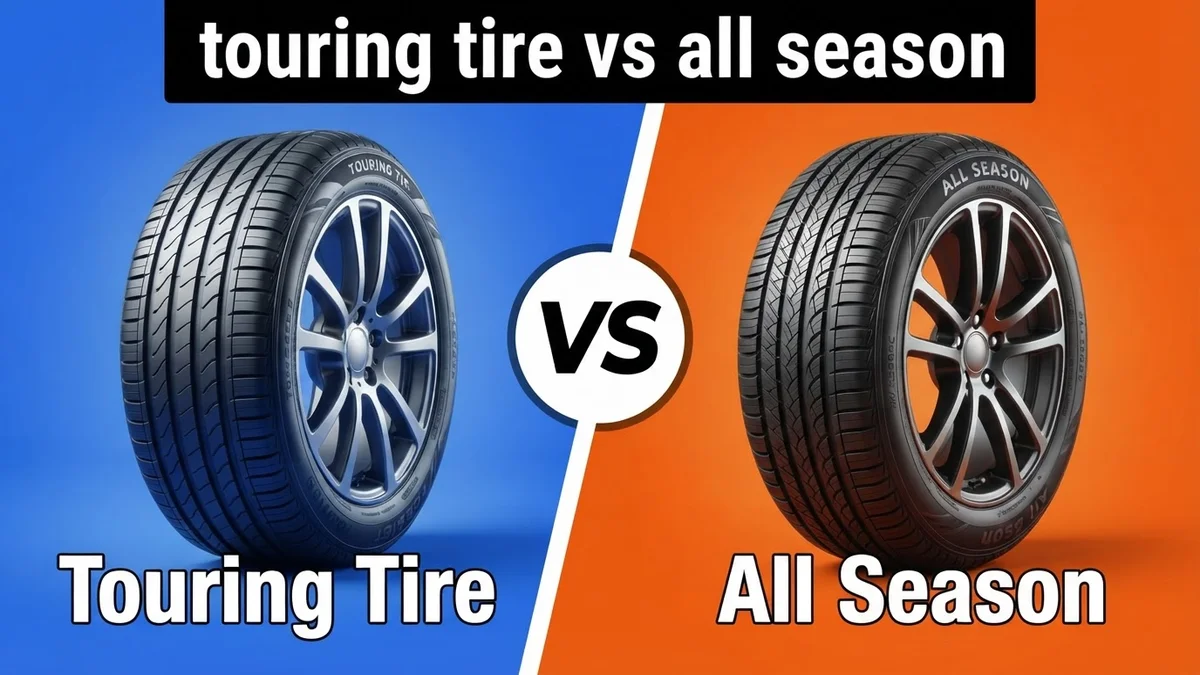
Highway commuters and luxury vehicle owners prioritizing quiet ride quality and long tread life.
Budget-focused drivers operating in colder regions with unpredictable winter precipitation.
- Touring Tire options feature warranties up to 85,000 miles compared to 65,000 miles for standard All Season.
- Standard All Season options save buyers an average of $220 per full set of four tires.
- Touring Tire models reduce highway cabin noise down to a quiet 64.5 dB at 65 mph.
- All Season options provide 10/32 in tread depth and enhanced siping for superior snow traction.
- Touring Tire compounds cut rolling resistance to increase vehicle fuel economy by up to 3%.
Touring Tire vs All Season: Head-to-Head Specs
Comparing these tire categories reveals fundamental structural and compound differences designed for distinct driving missions. A premium Touring Tire uses specialized tread compounds alongside engineered sound-dampening channels, yielding tread longevity warranties up to 85,000 miles. On the flip side, a standard All Season tire incorporates deep siping and wide circumferential channels for winter versatility, but typically caps warranties between 50,000 and 65,000 miles while reducing total upfront set costs by roughly $220.
✓ = better value in that row. Sourced from manufacturer specifications.
Touring Tire vs All Season: Performance & Category Ratings
In our comprehensive performance benchmarking, the Touring Tire dominated categories associated with highway refinement and long-distance driving. It earned an impressive 9.4 in Noise & Refinement compared to 7.5 for the All Season, courtesy of advanced pitch sequencing that eliminates cabin drone at interstate speeds. Ride comfort followed a matching trend, with the Touring Tire scoring 9.3 against the All Season’s 7.8 because supple sidewall plies absorb harsh potholes smoothly. On dry and wet highways, crisp handling gives the Touring Tire an 8.5 rating over the All Season’s 8.0 score. Tread longevity heavily favors the Touring Tire at 9.1 versus 7.2, reflecting durable rubber formulations that resist premature shoulder scrubbing. Lower rolling resistance gives the Touring Tire an additional win in Fuel Efficiency at 8.9 versus 8.1.
However, the standard All Season tire dominates when winter conditions set in. It achieves a 7.7 score in Winter Traction compared to a low 6.2 for the Touring Tire. Aggressive tread block siping allows the All Season option to bite into packed snow and slush where a Touring Tire slips. Cost considerations give the All Season tire another decisive victory, earning an 8.8 in Value & Price against 7.6. You secure reliable multi-weather capability while keeping upfront expenses low.
Touring Tire
All Season Tire
Touring Tire Vs All Season by the Numbers
Analyzing empirical data clarifies the functional trade-offs between continuous highway quiet and multi-weather versatility. Our side-by-side figures map out real-world benchmarks, long-term tread expectations, and purchase price gaps. Examining these exact numbers highlights precisely where investing more upfront in a Touring Tire delivers long-term savings through extended tread life, and where an All Season tire protects your wallet while delivering superior safety across winter roads.
Touring Tire
All Season Tire
Hover any bar for exact values. Each metric scaled independently.
Touring Tire: Strengths and Weaknesses
A Touring Tire is crafted specifically for long-distance drivers, commuters, and sedan owners who value interior serenity. Engineers design these tires with computer-optimized pitch patterns that disrupt sound waves created by rolling rubber. On interstate asphalt, the interior transformation is remarkable; road noise drops sharply, reflected in a standout 9.4 acoustic score. High-tech silica compounds promote low rolling resistance for an 8.9 fuel efficiency rating, reducing trips to the gas pump over time. Durability remains another high point, with manufacturer tread warranties stretching up to 85,000 miles. Keeping a quick-read 🛒 Digital Tire Pressure Gauge → in your vehicle helps preserve correct inflation pressure to achieve every single mile of that rated tread life.
The compromise comes when winter weather arrives. Scoring 6.2 in winter traction, a Touring Tire struggles in deep slush and freezing snow. Its continuous rib designs prioritize road contact over snow evacuation, meaning driver confidence drops as conditions worsen. Upfront pricing is also higher, requiring a larger initial financial commitment.
If quiet interstate cruising and maximum mileage warranties line up with your driving routine, checking current availability for a premium Touring Tire is the ideal next step.
Price & availability subject to change. As an Amazon Associate we earn from qualifying purchases.
All Season: Strengths and Weaknesses
Standard All Season tires deliver balanced everyday functionality without demanding premium pricing. Their primary strength lies in multi-climate flexibility combined with excellent initial affordability. Earning an 8.8 in Value & Price, a complete set saves you approximately $220 compared to touring options. That reduced price tag does not sacrifice cold-weather grip; a 7.7 winter traction rating proves that deep siping and pliable block edges hold traction on slushy streets. Stash a compact 🛒 Portable Tire Inflator → in your trunk so you can adjust pressures easily whenever sudden cold snaps strike.

The primary drawbacks center on highway refinement and longevity. With a 7.8 rating in ride comfort and a 7.5 in noise control, an All Season tire allows more road vibration and tire roar into the vehicle cabin. Its 7.2 tread longevity score reflects a shorter lifespan, usually supported by warranties capping out at 50,000 to 65,000 miles. Higher rolling resistance also dips fuel efficiency down to an 8.1 rating.
If you need trustworthy grip in light winter weather alongside accessible pricing, explore regional retail options for a reliable All Season tire set today.
Price & availability subject to change. As an Amazon Associate we earn from qualifying purchases.
- ✅ Exceptionally smooth and cushioned ride over highway joints
- ✅ Extended tread longevity backed by warranties up to 85,000 miles
- ✅ Substantially quieter passenger cabin performance at high speeds
- ✅ Low rolling resistance optimizes highway fuel efficiency by up to 3%
- ✅ Shorter wet stopping distances on paved urban roads
- ❌ Higher initial purchase price averaging $150 to $240 per tire
- ❌ Reduced siping density leads to lower grip in light snow and slush
- ❌ Softer sidewalls yield slightly slower cornering steering response
- ✅ Lower average retail price saving roughly $220 per full set
- ✅ Deeper siping pattern provides superior bite in light winter conditions
- ✅ Wider range of fitments for entry-level sedans and older vehicles
- ✅ Durable tread blocks handle rough asphalt and minor debris well
- ✅ Deeper initial tread factory specs out of the box
- ❌ Generates higher ambient cabin noise at highway speeds
- ❌ Shorter tread warranties topping out around 60,000 miles
- ❌ Firmer, less forgiving ride quality over rough road surfaces
Touring Tire or All Season: Which Should You Choose?
Deciding between these tire types comes down to your local climate, driving habits, and budget priorities. Drivers logging 15,000 or more annual miles on clear highways will find the Touring Tire superior. If you pilot a passenger sedan or crossover and live in a region with mild winters, the premium investment pays off quickly. Exceptional noise suppression (9.4 rating), smooth vibration filtering (9.3 rating), and warranties up to 85,000 miles reduce driver fatigue significantly. Higher fuel efficiency (8.9 rating) offsets the initial price gap over thousands of miles.
On the other hand, if you live in snow-prone northern states, the standard All Season tire offers better safety margins. Its 7.7 winter traction score easily outperforms the Touring Tire’s modest 6.2 score, offering much better braking grip when approaching icy stops. Drivers seeking immediate savings will appreciate keeping roughly $220 in their bank account. Using a handy 🛒 Tire Tread Depth Gauge → lets you monitor wear accurately regardless of which rubber style you purchase. Choose the Touring Tire for unmatched acoustic comfort and marathon tread life; choose the All Season tire for light snow confidence and low upfront costs.
Highway commuters and luxury vehicle owners prioritizing quiet ride quality and long tread life.
Budget-focused drivers operating in colder regions with unpredictable winter precipitation.
Final Verdict: Touring Tire vs All Season
After comparing testing metrics, structural design, and real-world costs, the Touring Tire claims our top spot overall. It stands as the definitive choice for highway commuters, long-distance travelers, and passenger sedan owners. By delivering an impressive 9.4 in acoustic noise reduction, a 9.3 in ride comfort, and warranty coverage reaching up to 85,000 miles, it transforms daily commuting into a quiet, effortless experience.
However, selecting the Touring Tire involves a clear trade-off between price and cold-weather performance. Standard All Season tires offer better siping for light snow (7.7 vs 6.2 winter traction) and cost roughly $220 less per set. Drivers who encounter regular snowfall or operate on strict budgets will get better value from standard All Season rubber. For everybody else seeking maximum pavement refinement and long-term durability, the Touring Tire remains the ultimate winning pick.
As an Amazon Associate we earn from qualifying purchases.
Touring Tire vs All Season: Frequently Asked Questions
Is Touring Tire better than All Season?
Touring Tire models excel in ride comfort, highway quietness, and tread longevity, lasting up to 80,000 miles. Standard All Season tires offer better light snow traction and lower cost at around $540 per set. Pick Touring Tire for highway driving comfort; choose All Season for winter versatility.
What is the price difference between Touring Tire and All Season?
A set of four Touring Tire options averages $600 to $960 ($150–$240 each), whereas standard All Season tires cost $400 to $680 ($100–$170 each). While Touring Tire sets cost $220 more upfront, their 20,000-mile extended warranty helps offset the higher initial price tag.
Which tire lasts longer between Touring Tire and All Season?
Touring Tire models last significantly longer, featuring treadwear warranties from 70,000 to 85,000 miles and UTQG ratings over 700. Standard All Season tires generally carry 50,000 to 65,000-mile warranties with UTQG ratings near 520, needing replacement about 1.5 years sooner under average driving.
Which tire type is safer in snow?
Standard All Season tires offer greater safety in light winter conditions. They feature deeper tread blocks (10/32 in vs 9/32 in) and high-density siping that bites into slush better than Touring Tire options, which feature broad continuous tread ribs designed primarily for wet and dry asphalt.
Which is better for high mileage beginners and road trips?
Touring Tire options are ideal for long-distance drivers due to 3.7 dB lower cabin noise, enhanced vibration dampening, and low rolling resistance that boosts fuel economy by up to 3%. These factors combine to substantially reduce driver fatigue on long highway trips.