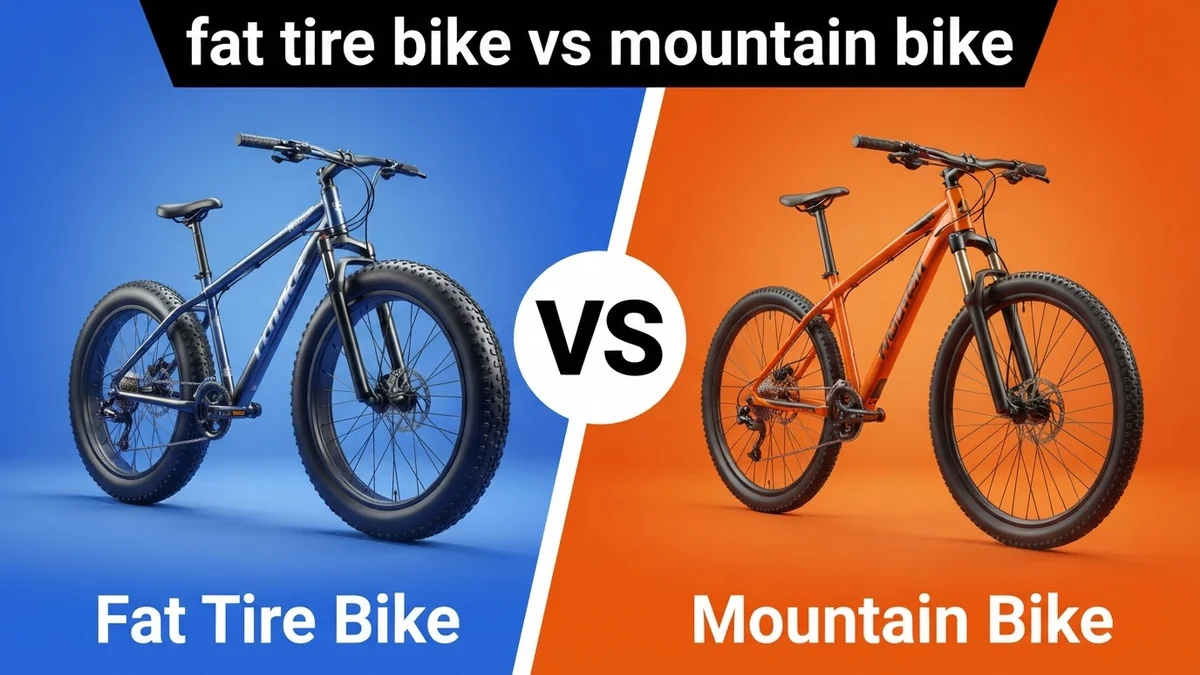
You stand at the trailhead staring at two drastically different machines: a rugged Mountain Bike with sleek lines and a monstrous Fat Tire Bike rolling on cartoonishly thick rubber. Both promise an escape into wild off-road terrain, but they deliver radically different experiences under your boots. Choosing the wrong setup leaves you either gasping for air on steep climbs or sliding uncontrollably through loose gravel and packed snow. We pitted these two off-road contenders head-to-head to measure real-world performance, weight penalties, and handling dynamics. Below, our data-backed analysis breaks down every crucial metric so you buy the precise ride for your local conditions.
Quick Verdict: While the Fat Tire Bike dominates soft surfaces like snow, mud, and sand thanks to its massive 3.8-5.0 inch tires running under 10 PSI, the classic Mountain Bike wins overall for general versatility, climbing efficiency, and speed. Choosing a Mountain Bike saves roughly 8 to 12 pounds in weight and provides responsive handling across standard singletrack trails, making it the smarter everyday investment.
Riders tackling deep snow, sand dunes, or seeking maximum rollover comfort.
Trail riders wanting speed, efficient climbing, and nimble technical handling.
- Mountain Bikes weigh roughly 28 lbs average, making them 8 lbs lighter than typical 36 lb Fat Tire Bikes.
- Fat Tire Bikes use 3.8 to 5.0-inch tires compared to 2.1 to 2.6-inch tires on Mountain Bikes.
- Fat bikes run ultra-low tire pressures between 5 and 15 PSI, delivering roughly 28 sq in of ground contact patch.
- Mountain Bikes achieve 20% to 30% higher pedaling efficiency and faster climbing speeds on hardpack trails.
- Tire replacement costs favor Mountain Bikes at $40-$80 per tire versus $70-$120 per tire for Fat Tire Bikes.
Fat Tire Bike vs Mountain Bike: Head-to-Head Specs


Direct mechanical differences define how these machines perform once dirt replaces pavement. The most obvious divergence lies in tire clearance and rim dimensions: a Fat Tire Bike swallows massive 3.8 to 5.0-inch tires, whereas a standard Mountain Bike settles between 2.1 and 2.6 inches. This drastic hardware difference directly impacts chassis mass. A typical Mountain Bike weighs roughly 24 to 30 pounds, while a Fat Tire Bike tips the scales between 32 and 40 pounds—carrying an extra 8 to 12 pounds of rotating momentum.
✓ = better value in that row. Sourced from manufacturer specifications.
Fat Tire Bike vs Mountain Bike: Performance & Category Ratings
Our testing highlights dramatic performance splits across core riding conditions. The Fat Tire Bike absolutely dominates in Loose Terrain Traction with an outstanding 9.6 rating compared to the Mountain Bike’s 6.8 score. Running sub-10 PSI inflation, those massive contact patches conform to snow, soft sand, and deep mud where narrow rubber immediately sinks and spins. The Fat Tire Bike also edges out a win in Rider Comfort & Shock Absorption (8.7 vs 8.4), using massive pneumatic air volume to cushion trail chatter even on rigid frames.
However, the traditional Mountain Bike claims dominance across almost every speed and agility metric. It takes a commanding lead in Technical Trail Agility with a 9.1 rating against the Fat Tire Bike’s sluggish 6.2 score. Quick direction changes, tight switchbacks, and jumping obstacles feel effortless on the lighter chassis. That lower overall mass pays massive dividends in Climbing & Speed, where the Mountain Bike earns an 8.8 versus the Fat Tire Bike’s tiring 6.0 score. Dragging heavy rims up steep singletrack burns energy fast.
For everyday practicality, the Mountain Bike scored a dominant 9.2 in Versatility & Availability over the Fat Tire Bike’s 7.0 score. Standard tires, inner tubes, and replacement components sit on shelves in every bike shop nationwide. Finally, while the Fat Tire Bike scores an 8.5 in Maintenance & Simplicity due to frequent rigid fork configurations, the Mountain Bike earns a higher Overall Value rating of 8.9 compared to 7.8. The classic trail bike simply serves more riders across a broader range of trail networks year-round.
Fat Tire Bike
Mountain Bike
Fat Tire Bike Vs Mountain Bike by the Numbers
Raw numbers reveal the physical trade-offs between these two platforms. Operating pressures tell the biggest story: Fat Tire Bike tires run at ultra-low pressures from 5 to 12 PSI, creating massive traction footprints. Conversely, a Mountain Bike typically runs between 22 and 35 PSI to protect narrower rims from harsh bottom-outs. That pressure differential directly influences rolling resistance, rotational inertia, and total physical effort over long distances on firm trail surfaces.
Fat Tire Bike
Mountain Bike
Hover any bar for exact values. Each metric scaled independently.
Fat Tire Bike: Strengths and Weaknesses
The Fat Tire Bike shines brightest when Mother Nature turns hostile. Its massive rubber volume lets you float over frozen lakes, powdery snow, and coastal beaches where conventional trail tires stall instantly. You get unbelievable flotation and tractor-like grip. Because the high-volume rubber acts as built-in air suspension, many riders choose rigid frames. This eliminates suspension servicing while lowering long-term mechanical failure rates. It is an incredible winter tool and a comfortable cruiser over unpaved washboards.
Yet, those exact benefits create serious liabilities on standard singletrack. The heavy wheels act like gyroscopes, making quick steering adjustments physically demanding. Accelerating from a dead stop requires heavy pedal force, and climbing steep fire roads quickly becomes exhausting. Pavement riding feels sluggish and produces an unmistakable hum. Transporting one also requires specialized car racks due to the extra-wide wheel hubs and rims. Checking low pressures accurately requires a dedicated 🛒 Digital Tire Pressure Gauge → designed for sub-10 PSI readings, as standard pump gauges lack low-end resolution.
If your winter riding goals demand unstoppable traction across frozen trails and sand dunes, this wide-tired cruiser offers unmatched capability.
Price & availability subject to change. As an Amazon Associate we earn from qualifying purchases.
Mountain Bike: Strengths and Weaknesses
Precision handling and rapid acceleration make the classic Mountain Bike the undisputed ruler of dry trail networks. Weighing 8 to 12 pounds less than its wide-tired counterpart, it climbs efficiently and responds instantly when you stomp on the pedals. Sharp turns, steep drop-offs, and technical rock gardens showcase its superior maneuverability. With decades of geometric refined engineering, modern trail bikes offer unbelievable control at high speeds while keeping rider fatigue low over long weekend epics.
The drawback comes when trail surfaces lose firm packing. Thin tires quickly slice through loose sand or wet snow, burying the rim and killing forward momentum entirely. You also face higher maintenance demands if you select full-suspension setups, requiring regular air adjustments with a 🛒 High-Pressure Shock Pump → to keep suspension forks functioning smoothly. Transporting a standard trail bike is straightforward, fitting comfortably onto almost any standard bike carrier without buying wide-wheel adapters.
If your local routes consist of packed dirt, rocky descents, flowing singletrack, and steep ascents, the traditional trail machine delivers a far superior riding experience.
Price & availability subject to change. As an Amazon Associate we earn from qualifying purchases.
- ✅ Exceptional grip on snow, ice, sand, and deep mud
- ✅ Low tire pressure (5-15 PSI) provides built-in dampening and comfort
- ✅ Superior stability on loose or unpredictable off-road conditions
- ✅ Simple rigid frames require less suspension maintenance
- ❌ Significantly heavier (average 36 lbs) than standard trail bikes
- ❌ High rolling resistance makes pedaling sluggish on paved roads
- ❌ Harder to climb steep hills due to rotational tire weight
- ❌ Limited replacement tire and rim options in local bike shops
- ✅ Lighter weight (25-30 lbs) allows faster climbing and acceleration
- ✅ Agile, sharp handling for technical singletrack and tight switchbacks
- ✅ Massive ecosystem of components, suspension forks, and accessories
- ✅ Lower rolling resistance for efficient long-distance trail rides
- ✅ Broader selection across all price points from entry-level to pro
- ❌ Sinks easily into deep soft snow, beach sand, and loose gravel
- ❌ Requires high-end suspension setup for maximal high-speed comfort
- ❌ Narrow tires offer less natural stability for beginner balance
Fat Tire Bike or Mountain Bike: Which Should You Choose?
Selecting between these off-road machines depends entirely on your primary trail conditions, local weather, and personal riding goals.
Choose the Fat Tire Bike if:
- You want to ride year-round through deep winter snow, slush, or soft beach sand.
- You prioritize maximum stability and cushy roll-over comfort over flat-out trail speed.
- You prefer low-maintenance rigid frames without tuning complex suspension shocks.
- You ride at a relaxed pace and do not care about setting fast times on steep ascents.
Choose the Mountain Bike if:
- Your daily routes consist of packed singletrack, loose dirt, and technical rock gardens.
- You want crisp acceleration, nimble cornering, and effortless climbing efficiency.
- You plan to ride long distances where extra bike weight causes severe rider fatigue.
- You want easy access to replacement tires, tubes, and service at any local bike shop.
Budget riders should note that while entry-level Fat Tire Bikes seem affordable initially, high-quality replacement tires can be surprisingly expensive. Conversely, buying a standard Mountain Bike gives you an endless component upgrade path over time. When transporting your investment to distant trailheads, protect frame finishes from highway grit using a heavy-duty 🛒 Waterproof Bike Cover →. Focus on where you spend 80% of your actual saddle time rather than edge-case riding scenarios.
Riders tackling deep snow, sand dunes, or seeking maximum rollover comfort.
Trail riders wanting speed, efficient climbing, and nimble technical handling.
Final Verdict: Fat Tire Bike vs Mountain Bike
While the Fat Tire Bike dominates soft surfaces like snow, mud, and sand thanks to its massive 3.8-5.0 inch tires running under 10 PSI, the classic Mountain Bike wins overall for general versatility, climbing efficiency, and speed. Choosing a Mountain Bike saves roughly 8 to 12 pounds in weight and provides responsive handling across standard singletrack trails, making it the smarter everyday investment.
The fundamental trade-off comes down to flotation versus agility. The Fat Tire Bike is an unbeatable specialized tool for harsh winter conditions and loose terrain where standard tires sink and stall out. However, for 90% of trail riders tackling dirt, rocks, and tight switchbacks, the agility and efficient power transfer of a true Mountain Bike simply cannot be beaten. Choose the Mountain Bike for everyday trail speed, or pick the Fat Tire Bike to turn winter snowdrifts into your personal playground.
As an Amazon Associate we earn from qualifying purchases.
Fat Tire Bike vs Mountain Bike: Frequently Asked Questions
Is Fat Tire Bike better than Mountain Bike?
For standard singletrack trails, a Mountain Bike is better due to its 8 lb weight advantage and lower rolling resistance. However, a Fat Tire Bike excels on soft surfaces like snow and sand where 4.0-inch tires operate at 8 PSI to provide floatation that narrow 2.35-inch mountain bike tires cannot match.
Can you ride a Fat Tire Bike on regular paved roads?
Yes, you can ride a Fat Tire Bike on paved roads, but it requires roughly 20% to 30% more pedaling energy compared to a Mountain Bike. High rolling resistance and heavy wheel rotation limit top cruising speeds to around 12 to 15 mph on asphalt.
Which bike is easier to maintain for long-term ownership?
Fat Tire Bikes are often simpler to maintain because many rely on rigid frames rather than complex air shocks. However, replacement 4.0-inch tires cost between $70 and $120 each, whereas common 29-inch Mountain Bike tires cost $40 to $80 and are easier to find in standard shops.
Which bike type is best for absolute beginners?
For general trail riding, a Mountain Bike is easier for beginners because it weighs under 30 lbs and handles naturally. However, beginners riding on loose gravel, snow, or beaches will prefer a Fat Tire Bike for its wide contact patch and superior stability at low speeds.
What is the biggest functional difference between these two bikes?
The main functional difference is tire width and air pressure. A Fat Tire Bike runs 3.8 to 5.0-inch tires at 5 to 15 PSI for floatation over soft surfaces, while a Mountain Bike uses 2.1 to 2.6-inch tires at 25 to 35 PSI for speed and agility.