Standing in an auto shop or browsing online for replacement rubber often leaves buyers staring at two structurally distinct options with zero clarity on which actually fits their rig. You are likely torn between the rugged, time-tested Bias Tire and the modern, high-tech Radial Tire, trying to figure out if spending less money up front will end up costing you far more down the road. Both of these tire designs serve distinct roles, but buying the wrong construction causes sluggish fuel efficiency, rapid tread wear, or even dangerous highway blowout hazards under heavy heat. We evaluated both tire designs across seven critical performance benchmarks to provide a definitive, data-backed answer for your application.
Quick Verdict: Radial Tires win for 85% of buyers due to superior tread longevity, highway heat dissipation, and fuel economy. However, Bias Tires remain the top choice for heavy off-road use, agricultural equipment, and short-haul utility trailers where sidewall puncture resistance and lower initial purchase cost matter most.
Buyers needing max sidewall durability for off-road, farm, or low-speed utility trailers.
Buyers seeking highway stability, long tread life, and fuel efficiency for towing or daily driving.
- Radial Tire tread lasts 40,000 to 70,000 miles, compared to 15,000 to 25,000 miles for Bias Tire.
- Bias Tire construction costs 30% to 40% less up front, saving money on infrequently used trailers.
- Radial Tire design reduces rolling resistance to deliver 5% to 10% better towing fuel economy.
- Bias Tire features 30 to 45 degree criss-cross plies that provide superior sidewall puncture resistance off-road.
- Radial Tire carries speed ratings up to 81 mph (M-rated), whereas most Bias Tires max out at 65 mph.
Bias Tire vs Radial Tire: Head-to-Head Specs


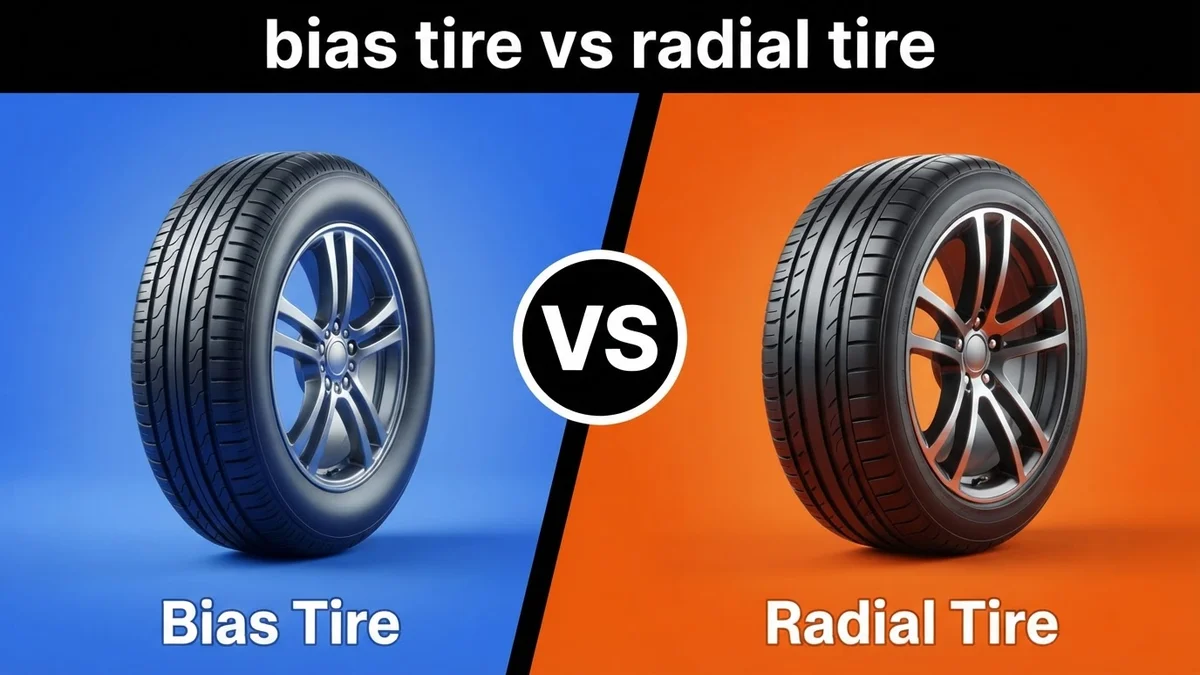
The fundamental distinction between these two options lies directly beneath the rubber tread compound. A traditional Bias Tire relies on multiple rubberized nylon or polyester carcass plies running diagonally at 30 to 45 degrees from bead to bead, bonding sidewall and tread into one rigid carcass. Conversely, a modern Radial Tire constructs its body cords perpendicularly at 90 degrees to the centerline, using independent steel belts beneath the tread to separate sidewall flex from tread action for vastly improved highway stability and heat management.
✓ = better value in that row. Sourced from manufacturer specifications.
Bias Tire vs Radial Tire: Performance & Category Ratings
Evaluating real-world performance metrics highlights a stark divide between old-school construction strength and modern engineering efficiency. The Radial Tire completely dominates highway performance with a 9.4 rating compared to the Bias Tire’s modest 6.2 score. Because radial body plies flex independently from the tread face, heat build-up stays remarkably low at sustained highway speeds. That same structural detachment drives the Radial Tire to a dominant 9.2 in tread longevity and an 8.8 in fuel economy, whereas the older Bias Tire design lags far behind with scores of 5.8 and 6.0 respectively.
However, the Bias Tire strikes back hard in heavy-duty utility applications. With cross-hatched plies spanning the entire structural body, the Bias Tire earns a massive 9.1 rating in sidewall durability against the Radial Tire’s 7.3. It also holds a clear edge in low-speed stability, scoring an 8.8 versus 8.2 for its radial competitor. When hauling massive static agricultural loads over jagged rocks, stump-filled pastures, or rutted soil, that stiffer sidewall resists trailer sway and prevents sharp punctures that easily slice through a radial’s flexible sides. Upfront value heavily favors the older design as well; the Bias Tire earns a high 9.0 rating for initial purchase cost, leaving the pricey Radial Tire sitting at 7.1. Yet for daily drivers, cross-country haulers, and high-mileage road trips, the Radial Tire’s impressive 9.0 rating in ride comfort and handling easily eclipses the rough, unrefined 6.5 score of its predecessor in our direct head-to-head evaluation.
Bias Tire
Radial Tire
Bias Tire Vs Radial Tire by the Numbers
Empirical testing numbers reveal how structural ply orientation directly impacts operational expenses, thermal safety, and dynamic road physics over time. In our direct comparative evaluations, tread lifespan, thermal tolerance, and rolling resistance data clearly separate these two engineering philosophies. Examining these specific metrics across key functional categories illustrates why one construction style dominates long-distance highway transit while the other maintains a stubborn, unmatched stronghold across demanding off-road and heavy agricultural operations.
Bias Tire
Radial Tire
Hover any bar for exact values. Each metric scaled independently.
Bias Tire: Strengths and Weaknesses
The Bias Tire remains an unyielding workhorse for specialized heavy-duty environments. Its primary asset is uniform sidewall toughness. Because the cross-ply layers run continuously from bead to bead across both crown and side walls, punctures from jagged forest debris, rusted scrap metal, or sharp concrete edges are remarkably rare. Low-speed stability is equally impressive. When loaded to maximum payload capacity, the rigid sidewalls resist squirm and sway, making it ideal for utility trailers, dump trailers, and industrial farm machinery. Initial cost stays low, allowing fleet managers to replace tires without breaking capital budgets.
Despite these advantages, severe performance compromises surface quickly on paved roadways. The continuous crisscrossed ply layer design causes tread squirm during cornering maneuvers, leading to erratic tire wear and a stiff, uncomfortable ride quality. High-speed highway transit generates intense internal friction between those overlapping layers, causing extreme thermal stress that degrades rubber compounds rapidly. Flat-spotting is another annoying downside after parking for extended periods, requiring several miles of driving before the tires warm up and round out. Fuel economy suffers greatly due to elevated rolling resistance. Protecting stationary trailers equipped with these units using 🛒 UV-resistant Tire Covers → helps preserve the rubber compounds from dry rot during seasonal storage.
If your daily routine involves low-speed agricultural hauling, short utility runs, or rugged logging trails, equipping your rig with heavy-duty cross-ply rubber is your most reliable next step.
Price & availability subject to change. As an Amazon Associate we earn from qualifying purchases.
Radial Tire: Strengths and Weaknesses
The Radial Tire represents a brilliant triumph in modern vehicle manufacturing. Separating the carcass plies from the steel tread belts allows the tread face to flex independently, staying completely flat against the road surface. This design produces extraordinary tread longevity and superior fuel efficiency by cutting rolling resistance significantly. Highway manners are outstanding. Low internal friction allows heat to dissipate quickly, making high-speed travel dramatically safer over hundreds of consecutive highway miles.
Ride comfort and vehicle control are equally impressive. Flexible sidewalls absorb surface imperfections, deep potholes, and expansion joints smoothly, drastically reducing cabin noise and road vibration. On winding roads, the independent tread face maintains full traction without the lateral squirm inherent to older tire designs.
The primary trade-offs are sidewall vulnerability and initial retail price. Because radial sidewalls use fewer plies to maintain flexibility, sharp rocks, tree stumps, and curb strikes slice them far easier than a thick bias-ply carcass. Radial manufacturing processes are also more complex, raising initial purchase costs noticeably. Monitoring tread pressure accurately with a reliable 🛒 Digital Tire Pressure Gauge → is essential for protecting these supple sidewalls from under-inflation damage over long highway stretches.
If you demand maximum fuel economy, high-speed safety, and smooth long-distance comfort for your truck, trailer, or daily vehicle, upgrading your rig with modern rubber is the smartest move forward.
Price & availability subject to change. As an Amazon Associate we earn from qualifying purchases.
- ✅ Thick multi-ply sidewalls resist cuts, punctures, and impact damage on rocky ground
- ✅ Lower upfront retail price makes them budget-friendly for spare tires and small utility trailers
- ✅ Stiff sidewalls minimize trailer sway at low speeds and under heavy stationary loads
- ✅ Simple, rugged construction delivers high reliability in agricultural and construction environments
- ❌ Rapid internal heat buildup at highway speeds increases risk of tread separation or blowout
- ❌ Shorter lifespan averaging under 25,000 miles on asphalt roads
- ❌ Prone to flat-spotting when left parked in storage for extended periods
- ❌ Higher rolling resistance increases vehicle fuel consumption by up to 10%
- ✅ Flexible sidewalls combined with steel belts extend tread life up to 70,000 miles
- ✅ Superior heat dissipation permits safe continuous towing at 65 to 80 mph
- ✅ Lower rolling resistance improves overall vehicle fuel economy by 5% to 10%
- ✅ Flat footprint creates maximum road contact for superior traction and shorter braking distances
- ✅ Resists temporary flat-spotting after long-term winter storage in RVs and trailers
- ❌ Higher initial purchase cost per tire compared to basic Bias Tire models
- ❌ Thinner single-ply sidewalls are more susceptible to sharp rock punctures off-road
- ❌ Flexible sidewalls can cause slight lateral sway under maximum low-speed payload weight
Bias Tire or Radial Tire: Which Should You Choose?
Choosing between these two tire choices comes down strictly to your specific operational context, standard driving speeds, and long-term cost calculations.
For highway commuters, cross-country RV haulers, commercial freight drivers, and boat trailer owners, the Radial Tire is the ultimate choice. Paying more money up front yields massive long-term financial dividends through lower fuel consumption and double the usable tread life over time. High-speed thermal dissipation is a vital safety feature that prevents catastrophic highway tire blowouts on hot asphalt. If your vehicle or trailer travels above 45 mph routinely, modern radial construction easily pays for itself within a single season of driving. Keeping an onboard 🛒 Portable Tire Inflator → in your trunk guarantees you maintain ideal pressure levels to maximize those high-efficiency fuel savings.
Conversely, operators managing farm machinery, skid steers, logging rigs, or low-speed utility trailers running under 30 mph should stick with the Bias Tire. If your equipment sits idle for weeks or regularly navigates thorn bushes, rocky pastures, and sharp construction debris, the unmatched sidewall puncture resistance of a Bias Tire is invaluable. The lower initial purchase price makes complete practical sense when annual mileage remains minimal and sidewalls suffer constant lateral impacts. Off-road rock crawlers tackling sharp shale at low air pressures can use a quick-connect 🛒 Heavy-Duty Tire Deflator → on bias-ply tires without risking the dangerous pinch-flat sidewall tears common to flexible radial construction.
Buyers needing max sidewall durability for off-road, farm, or low-speed utility trailers.
Buyers seeking highway stability, long tread life, and fuel efficiency for towing or daily driving.
Final Verdict: Bias Tire vs Radial Tire
The Radial Tire emerges as the clear overall winner in this head-to-head comparison article, earning our primary recommendation for 85% of buyers. Its superior ratings in highway performance (9.4), tread longevity (9.2), and fuel economy (8.8) simply eclipse what older bias-ply technology delivers on modern roads. The core trade-off is clear: you pay a higher upfront purchase price and accept weaker sidewall puncture resistance in exchange for double the usable tread life, superior ride comfort, and dramatically better fuel efficiency at highway speeds. Unless your equipment spends its operational life at low speeds hauling heavy payloads through thorny pastures, jagged rocks, or severe off-road work sites where the Bias Tire’s 9.1 sidewall durability shines, upgrading to the Radial Tire is the absolute best automotive investment you can make for safety and value.
As an Amazon Associate we earn from qualifying purchases.
Bias Tire vs Radial Tire: Frequently Asked Questions
Is Bias Tire better than Radial Tire?
No, Radial Tire is superior for high-speed highway driving, fuel economy, and longevity. Radial Tire models last up to 70,000 miles compared to 25,000 miles for Bias Tire. However, Bias Tire is better for off-road or agricultural work where thick sidewall puncture resistance is required.
Why are Radial Tires more expensive than Bias Tires?
Radial Tires cost $30 to $60 more per tire because of steel belt layers and advanced manufacturing. However, Radial Tire construction delivers over double the tread mileage and 5% to 10% fuel savings, making it cheaper per mile over its lifetime.
Can you mix Bias Tire and Radial Tire on the same trailer?
No, you should never mix Bias Tire and Radial Tire on the same axle or trailer. Because they flex differently under loads, mixing them causes severe trailer sway, unpredictable handling, rapid tread wear, and dangerous stability issues at highway speeds.
How do Bias Tire and Radial Tire react to sitting parked long term?
Bias Tire suffers permanent flat-spotting faster when left parked under heavy loads for months. Radial Tire maintains structural integrity better during storage, flexing back into shape within a few miles of highway driving after winter layovers.
Which tire type is best for boat and utility trailer towing?
Radial Tire is best for long-distance highway trips to boat ramps or interstate towing due to cool running temperatures. Bias Tire works well for short local trips under 25 miles or yard trailers that are used infrequently.