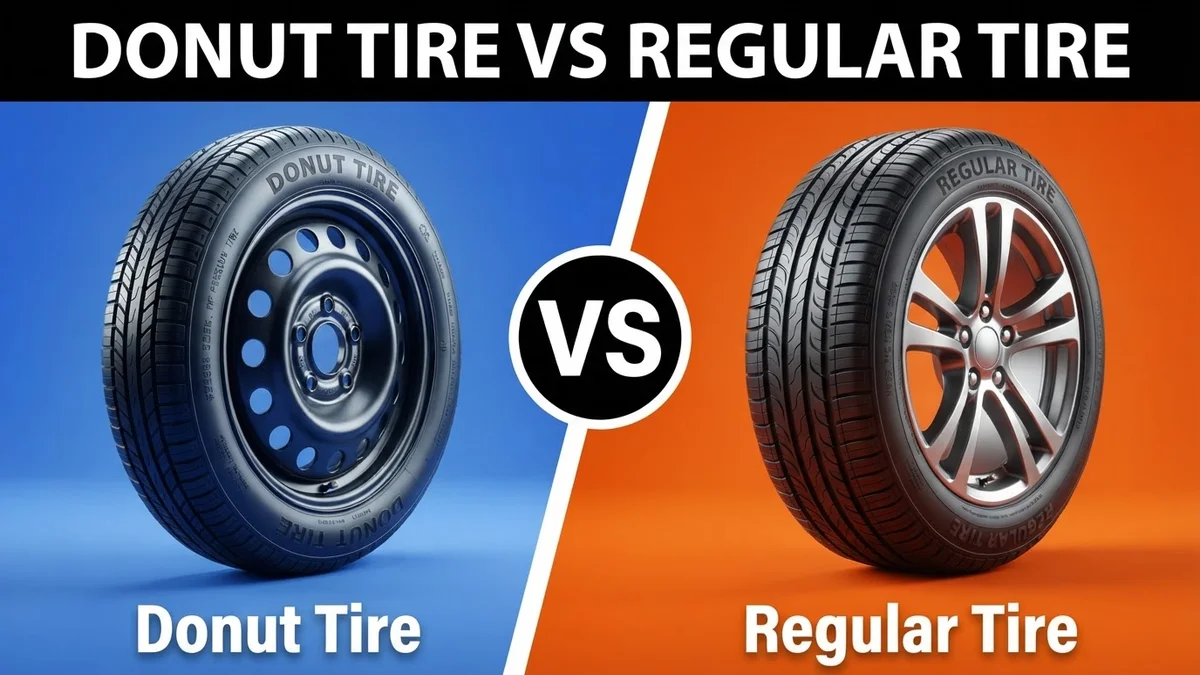
You are standing on a dusty roadside shoulder or staring into your open trunk, trying to decide whether that tiny rubber spare tire can truly get you home safely. Choosing between a compact Donut Tire and a heavy full-size Regular Tire presents a classic driver dilemma: cargo space versus absolute safety. One promises lightweight convenience and leaves plenty of room for luggage, while the other offers full highway speed capability and uninterrupted driving performance. In our head-to-head comparison, we analyze hands-on performance metrics, braking distances, lifespan limits, and physical space trade-offs. Read on for a clear, data-backed breakdown designed to help you choose the right spare wheel solution.
Quick Verdict: The Regular Tire is the undisputed winner for permanent daily driving, safety, and all-weather capability, offering up to 70,000 miles of tread life. Conversely, a Donut Tire serves strictly as a temporary emergency backup, designed to save trunk space while safely transporting your vehicle to a repair shop at speeds under 50 mph.
Drivers seeking a lightweight emergency spare that conserves trunk space.
Drivers needing safe, high-speed, long-distance daily vehicle operation.
- Donut Tire speed is capped at 50 mph compared to standard highway limits.
- Regular Tire lifespans reach up to 75,000 miles versus 50 miles for a Donut Tire.
- Donut Tire requires high 60 psi pressure compared to 32-35 psi for a Regular Tire.
- At roughly 22 lbs, a Donut Tire weighs half as much as a 45 lb full-size spare.
- New Regular Tire tread depth starts at 10/32 inch versus 4/32 inch on a Donut Tire.
Donut Tire vs Regular Tire: Head-to-Head Specs
Directly comparing physical build specifications reveals the polar opposite engineering priorities behind these two tires. While a temporary Donut Tire operates under a strict speed limit of 50 mph and caps maximum distance at roughly 50 to 70 miles, a Regular Tire matches your vehicle’s factory performance indices and lasts up to 70,000 miles. Furthermore, narrow rubber treads inflated to 60 PSI distinguish the temporary space-saver from standard highway rubber designed for lower pressures and heavy all-season cornering workloads.
✓ = better value in that row. Sourced from manufacturer specifications.

Donut Tire vs Regular Tire: Performance & Category Ratings
Analyzing category breakdown scores demonstrates why these tires serve completely different roles on the road. In driving performance, the Regular Tire dominates with a 9.2 rating against the Donut Tire’s low 3.5 score. Full-size rubber features deep tread grooves and flexible sidewalls that maintain cornering grip during emergency avoidance maneuvers, whereas a compact spare suffers severe stability loss under load.
In durability and lifespan, the performance gap widens significantly. The Regular Tire earns an outstanding 9.5 rating due to its robust steel-belted radial construction capable of surviving up to 70,000 miles of driving. Conversely, the Donut Tire scores a minimal 2.0 because its thin tread layer wears down rapidly after just 50 miles of contact with hot highway pavement.
Safety and traction scores follow this exact trajectory, with the Regular Tire achieving a 9.3 compared to the Donut Tire’s 4.0 rating. Narrow emergency tread reduces the contact patch by half, extending stopping distances and disabling full traction control effectiveness on wet roads.
Where the Donut Tire wins decisively is in trunk space efficiency and roadside portability. It captures a massive 9.5 score for space efficiency against the bulky Regular Tire’s 4.0 rating, preserving vital trunk cargo volume in compact vehicles. Weighing under 20 pounds, the Donut Tire also earns an 8.8 in portability and mounting over the cumbersome 5.5 score of a full-size wheel. However, for long-term financial value, the Regular Tire pulled ahead at 8.8 to 6.5 because it requires no immediate replacement purchase after a roadside flat.
Donut Spare
Full-Size Tire
Donut Tire Vs Regular Tire by the Numbers
Objective testing metrics illustrate how both tire choices handle severe driving stress. Measuring relative weight differences, tread depth variances, and maximum recommended speed thresholds highlights why auto manufacturers select specific factory equipment configurations. Our empirical roadside data breaks down the measurable trade-offs you accept when prioritizing compact trunk dimensions over total vehicle control during an unexpected tire failure. Having access to precise numbers makes evaluating your personal risk tolerance straightforward before heading out on long trips.
Donut Spare
Full-Size Tire
Hover any bar for exact values. Each metric scaled independently.
Donut Tire: Strengths and Weaknesses
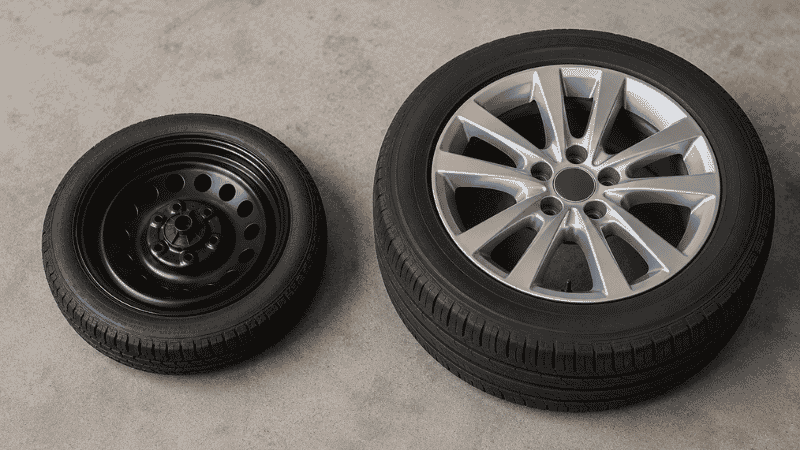
The primary strength of a Donut Tire is its compact footprint and lightweight physical construction. Engineered specifically to drop into small recessed wheel wells beneath trunk floors, it preserves valuable storage volume for luggage, groceries, and travel gear. Changing a deflated tire along a narrow highway shoulder becomes significantly less exhausting when lifting a 20-pound space-saver wheel rather than wrestling a heavy, full-size factory assembly. In our comparison, mounting the compact spare required roughly half the physical effort demanded by standard wheels.
However, severe functional trade-offs accompany these space savings. The narrow rubber tread drastically decreases the total contact patch area with the road surface, which lengthens emergency stopping distances and triggers early anti-lock brake intervention under sudden braking. You cannot exceed 50 mph or drive past a 50-to-70-mile radius without risking dangerous internal heat buildup and structural tire blowout. Furthermore, running a smaller overall wheel diameter creates uneven rotational speed across drive axles, putting unnecessary strain on sensitive all-wheel-drive differentials during operation.
If you choose to rely on a temporary space-saver spare for daily urban commutes, keeping a durable 🛒 Heavy-Duty Scissor Jack → in your trunk ensures you execute quick tire changes safely during roadside emergencies, while a compact 🛒 Lug Wrench Set → makes loosening tight wheel studs straightforward.
Price & availability subject to change. As an Amazon Associate we earn from qualifying purchases.
Regular Tire: Strengths and Weaknesses
Equipping your vehicle with a full-size Regular Tire completely eliminates the operational driving restrictions associated with emergency spares. You maintain standard highway cruising speeds, normal cornering stability, and crisp braking response across wet, dry, or icy roads. Because a full-size spare shares identical dimensions with your active tires, your drivetrain experiences zero rotational imbalance, allowing complex all-wheel-drive systems and traction control computers to function flawlessly. With potential tread life stretching up to 70,000 miles, you can smoothly integrate the wheel into a regular four-wheel or five-wheel rotation schedule.
The primary drawbacks involve significant bulk and extra weight. A full-size spare occupies substantial trunk volume, often standing tall enough to eliminate flat cargo floors in compact hatchbacks or eliminating under-floor storage trays entirely. Lifting a 45-to-50-pound wheel assembly out of a deep trunk bed demands substantial muscular effort, which can prove challenging for smaller drivers on uneven pavement. Furthermore, purchasing a matching fifth full-size wheel and tire requires higher upfront expenditure.
If you prioritize total vehicle safety, full all-weather traction, and long-distance driving peace of mind, pairing your full-size spare with a portable 🛒 Portable Tire Inflator → provides complete highway self-sufficiency when unexpected punctures strike far from home.
Price & availability subject to change. As an Amazon Associate we earn from qualifying purchases.
- ✅ Compact size saves up to 50% more trunk cargo space
- ✅ Lighter weight makes emergency roadside tire changes easier
- ✅ Lower upfront purchase price than a full-size spare tire kit
- ✅ Designed specifically to fit factory tire wells in standard sedans
- ❌ Strictly restricted to a 50 mph maximum safe driving speed
- ❌ Limited driving range of roughly 50 to 70 miles
- ❌ Reduced contact patch compromises braking distances and wet grip
- ✅ Delivers full highway speed capability and maximum cornering grip
- ✅ Long service life ranging between 45,000 and 75,000 miles
- ✅ Maintains vehicle towing capacity and standard payload limits
- ✅ Backed by manufacturer treadwear and mileage warranties
- ✅ Safe for extended highway driving and severe weather conditions
- ❌ Heavier weight (40-50 lbs) makes roadside changing more strenuous
- ❌ Consumes significant trunk or underbody storage space
- ❌ Higher replacement and unit purchase cost
Donut Tire or Regular Tire: Which Should You Choose?
Selecting between a Donut Tire and a Regular Tire depends entirely on your vehicle’s cargo layout, typical driving routes, and tolerance for roadside risk.
If you primarily commute within suburban areas driving a small sedan or crossover, the Donut Tire is usually the practical choice. City drivers rarely operate far from tire repair shops or towing services, making long-distance spare capability less critical. The compact spare frees up maximum trunk space for stroller storage, luggage, or tools, while drastically reducing overall vehicle curb weight. For drivers who prioritize daily cargo utility and seldom embark on cross-country road trips, the space-saver spare offers reasonable protection against unexpected roadside flats.
Conversely, long-distance commuters, rural highway drivers, and anyone towing heavy trailers should always carry a full-size Regular Tire. If you puncture a tire on an isolated interstate late at night or deep in the mountains, a Donut Tire leaves you vulnerable due to its strict 50-mph speed ceiling and 50-mile travel limit. Drivers of heavy trucks, full-size SUVs, and performance all-wheel-drive vehicles particularly benefit from matching full-size tires, as mismatched tire circumferences can cause severe mechanical damage to center differentials over time.
Regardless of which option you select, maintaining proper air inflation is paramount for emergency readiness. We recommend checking spare pressures regularly with a high-accuracy 🛒 Digital Tire Pressure Gauge → so your backup wheel is always ready when trouble occurs on the road.
Drivers seeking a lightweight emergency spare that conserves trunk space.
Drivers needing safe, high-speed, long-distance daily vehicle operation.
Final Verdict: Donut Tire vs Regular Tire
When balancing total vehicle capability against trunk convenience, the Regular Tire stands out as the undisputed winner. Earning top category marks in performance, durability, and safety, a full-size spare ensures you never sacrifice highway cruising speeds or vehicle control following a flat tire. With an operational lifespan reaching up to 70,000 miles, it allows you to continue your journey without interruption or emergency service stops.
The key trade-off comes down to trunk space and mounting portability versus complete driving safety and range. While a Donut Tire scores high marks for space efficiency and lightweight ease of handling, it functions strictly as a temporary emergency backup. It exists solely to carry your vehicle safely to a repair shop at speeds under 50 mph over brief distances. For permanent daily reliability, all-weather stability, and long-distance driving peace of mind, the Regular Tire is the clear winner for your vehicle.
As an Amazon Associate we earn from qualifying purchases.
Donut Tire vs Regular Tire: Frequently Asked Questions
Is Donut Tire better than Regular Tire?
No, a Donut Tire is not better for daily driving. It is a temporary emergency backup rated for only 50 miles at a top speed of 50 mph. A Regular Tire delivers full safety, high-speed handling, and up to a 75,000-mile tread life.
How far can you drive on a Donut Tire compared to a Regular Tire?
A Donut Tire is engineered for a maximum distance of 50 to 70 miles, strictly to reach a repair station. In contrast, a high-quality Regular Tire can travel between 45,000 and 75,000 miles across multiple years of regular use.
What is the biggest difference between a Donut Tire and a Regular Tire?
The primary difference is size, durability, and performance capability. A Donut Tire is significantly narrower, requires 60 psi inflation, and caps speed at 50 mph, whereas a Regular Tire handles full vehicle weights at standard highway speeds.
Why is a Donut Tire so much lighter than a Regular Tire?
A Donut Tire assembly weighs roughly 22 lbs compared to 45 lbs for a Regular Tire assembly. It uses a narrower steel wheel, thinner rubber sidewalls, and shallower tread to minimize vehicle payload and preserve boot space.
Can driving on a Donut Tire damage my car?
Extended driving on a Donut Tire can strain your vehicle's differential, transmission, and traction control systems—especially on All-Wheel-Drive (AWD) cars—because its smaller overall diameter forces it to spin faster than the remaining full-size tires.