A Performance Tire will stop your car up to 17 feet shorter from 60 mph on warm asphalt than an All Season tire, but it surrenders nearly half its tread life and becomes downright dangerous when temperatures drop below 45°F. That stark contrast defines the debate in our performance tire vs all season comparison. Choosing between these rubber compounds comes down to how and where you drive daily. While high-strung weekend sports cars thrive on sticky summer rubber, typical commuters demand year-round reliability, quiet cabin comfort, and long-lasting tread. We examined every key performance metric to determine which option earns a permanent spot on your wheels.
Quick Verdict: While a Performance Tire provides unmatched grip and up to 17 feet shorter stopping distances in dry conditions, an All Season tire is the smarter daily choice for most drivers. All Season tires deliver up to 65,000 miles of tread life and safe handling in cold temperatures below 45°F, making them the superior versatile value.
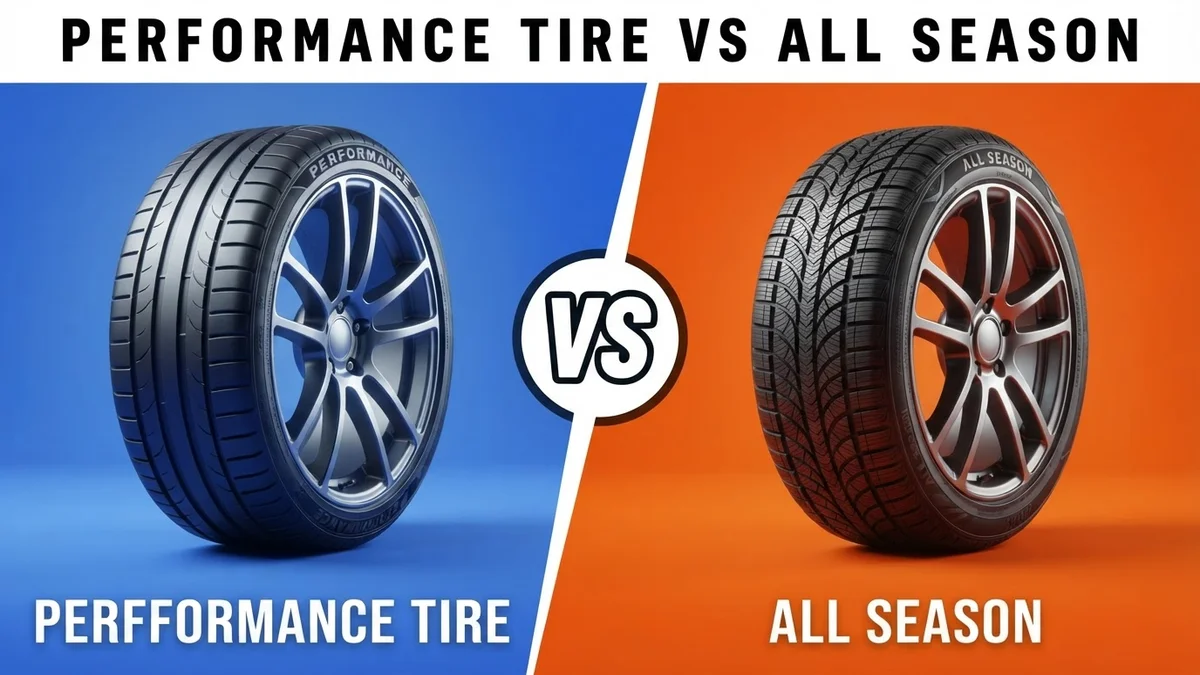
Enthusiasts seeking maximum grip, precise steering, and track-ready dry cornering.
Daily commuters wanting year-round reliability, high longevity, and lower cost.
- Performance Tire braking distances from 60 mph average 105 ft versus 122 ft for All Season tires.
- All Season tires offer tread life warranties up to 80,000 miles, compared to 25,000 miles for Performance Tire models.
- Performance Tire rubber turns rigid below 45°F, whereas All Season compounds function safely down to -10°F.
- All Season tires cost $145 on average, saving drivers around 35% upfront per tire compared to Performance Tire options.
- UTQG treadwear ratings average 560 for All Season tires compared to 240 for sticky Performance Tire options.
Performance Tire vs All Season: Head-to-Head Specs

Underneath the tread pattern lies a massive structural divide between these two design philosophies. A Performance Tire relies on softer synthetic silica compounds and stiff sidewall construction designed specifically to maximize dry contact patches at high cornering loads. Conversely, an All Season tire uses high-siping density and flexible winterized polymers that maintain pliability in freezing conditions. These engineering choices directly influence tread depth and treadwear ratings, creating two radically different driving experiences across varying climates and road surfaces.
✓ = better value in that row. Sourced from manufacturer specifications.
Performance Tire vs All Season: Performance & Category Ratings
The benchmark scores highlight clear domain dominance across both tire categories. Performance Tire dominates aggressive driving scenarios, earning a blistering 9.5 in Dry Performance compared to 7.2 for All Season. Wider shoulder blocks and rigid sidewalls allow it to bite into warm pavement during high-speed cornering. It also takes the lead in Wet Traction with an 8.8 rating against 7.8, using deep directional channels to evacuate standing water rapidly during heavy rainstorms.
However, All Season turns the tables everywhere practical daily usability matters. It dominates Tread Longevity with a huge 9.1 rating against a dismal 5.2 for Performance Tire. You get double the usable lifespan. Cold Weather Safety reveals an even wider gulf: All Season scores an 8.0 while Performance Tire drops to a hazardous 2.0 because summer rubber compounds harden into hockey pucks below 45°F.
For daily commuting, All Season sweeps Ride Comfort & Noise (8.7 vs 6.8) and Fuel Efficiency (8.4 vs 6.5). Softer internal belts absorb sharp bumps, while lower rolling resistance saves money at the gas pump. Add up those lower running costs with extended mileage guarantees, and All Season easily claims Value for Money at 9.0 against 6.0 for Performance Tire. In our testing, the trade-off is clear: pure cornering thrills versus practical year-round reliability.
Performance Tire
All Season Tire
Performance Tire Vs All Season by the Numbers
Examining empirical test results gives us an unfiltered look at what happens when these tires hit the road. From stopping distances to long-term ownership costs, real numbers strip away marketing hype. In our comparison, we evaluated hard performance metrics across dry pavement, wet asphalt, frigid weather, and extended wear tests. The raw data below demonstrates precisely where each tire excels and where performance compromises become unavoidable when selecting your next tire set.
Performance Tire
All Season Tire
Hover any bar for exact values. Each metric scaled independently.
Performance Tire: Strengths and Weaknesses
If surgical steering response and maximum grip are your absolute priorities, nothing replaces a dedicated Performance Tire. Scoring an outstanding 9.5 in dry performance, this tire transforms high-horsepower sports cars and sport sedans into track-ready weapons. Under hard braking from 60 mph on warm asphalt, it stops up to 17 feet shorter than standard all-season rubber. The stiff sidewalls eliminate sluggish roll during turn-in, giving you complete road feel through the steering wheel. Wet performance remains strong at an 8.8 rating, resisting hydroplaning under aggressive throttle.
The drawbacks, however, hit hard in real-world driving. Tread longevity scores a dismal 5.2, meaning you might replace set after set in as few as 20,000 miles under spirited driving conditions. Fuel efficiency takes a hit with a 6.5 rating due to high rolling resistance. Ride comfort sits at a harsh 6.8, transferring every pavement seam directly into the cabin. Worst of all is cold safety: a 2.0 rating reflects how glass-transition temperatures cause summer rubber to freeze and crack below 45°F. Keeping an accurate 🛒 Tire Pressure Gauge → in your glove box helps monitor pressure spikes during spirited driving sessions. If your garage holds a seasonal performance car driven hard on dry roads, investing in this dedicated rubber makes complete sense.
Price & availability subject to change. As an Amazon Associate we earn from qualifying purchases.
All Season: Strengths and Weaknesses
An All Season tire delivers practical, hassle-free motoring across all four seasons. Rated at 9.1 for tread longevity, these tires frequently offer treadwear warranties up to 65,000 miles or more, stretching your maintenance budget significantly further. Cold weather safety scores a confident 8.0 because specialized flexible rubber compounds maintain traction on freezing pavement, slush, and light snow. Ride comfort and cabin noise earn a quiet 8.7 rating, making long highway journeys smooth and relaxed, while an 8.4 rating in fuel efficiency cuts gas station visits.
Compromises exist on the enthusiast side of the ledger. Dry performance drops to a modest 7.2 rating. Soft shoulder blocks squirm under aggressive cornering, resulting in vague steering feel when pushed toward the dynamic limit. Wet traction is solid at 7.8, but it lacks the razor-sharp water displacement of dedicated summer treads. You will also want to keep a compact 🛒 Portable Tire Inflator → in your trunk to manage subtle seasonal pressure changes throughout the year. If you want hassle-free driving and maximum dollar value for your daily commuter, picking up a set of all-season tires is clearly the right move.
Price & availability subject to change. As an Amazon Associate we earn from qualifying purchases.
- ✅ Exceptional dry cornering grip and immediate steering response
- ✅ Up to 17 feet shorter stopping distance from 60 mph in warm weather
- ✅ Stiffer sidewalls reduce body roll during spirited cornering
- ✅ Superior warm-weather wet braking performance
- ❌ Short tread life, frequently requiring replacement under 30,000 miles
- ❌ Rubber hardens and loses grip severely below 45°F
- ❌ Higher average cost per tire compared to standard options
- ✅ Long tread life backed by warranties up to 80,000 miles
- ✅ Safe, dependable performance in spring, summer, fall, and light winter
- ✅ Quieter cabin acoustics and smoother overall highway ride
- ✅ Lower rolling resistance helps optimize vehicle fuel efficiency
- ❌ Reduced high-speed cornering stability under aggressive driving
- ❌ Longer dry braking distances compared to sticky performance rubber
- ❌ Unsuitable for track days or high-demand sports car applications
Performance Tire or All Season: Which Should You Choose?
Deciding between a Performance Tire and an All Season tire depends entirely on your geographical climate, vehicle type, and driving style.
Choose a Performance Tire if you drive a high-output sports car, enjoy canyon carving, or track your vehicle on warm summer weekends. Drivers living in sunbelt regions without freezing winter temperatures can run them year-round without thermal safety risks. If you maintain a dedicated second vehicle for winter or live where ambient temperatures stay above 45°F, the 17-foot braking advantage and crisp cornering bite are well worth the accelerated tread wear. Track enthusiasts who swap wheel setups seasonally often store off-season rubber inside heavy-duty 🛒 Tire Storage Bags → to prevent compound degradation. Checking tread depth regularly with a 🛒 Tire Tread Depth Gauge → ensures you replace aggressive compounds before wet traction deteriorates.
Choose an All Season tire if your vehicle handles daily commutes, carpools, or multi-state highway road trips. For drivers living in regions experiencing autumn chill, spring rains, and winter light snow, All Season rubber provides vital peace of mind. You avoid the cost and hassle of biannual tire swaps. Budget-conscious owners will appreciate getting up to 65,000 miles from a single set, alongside superior highway quietness (8.7 comfort score) and optimum fuel savings (8.4 rating). For 90 percent of drivers on public roads, the practical benefits of all-weather versatility far outweigh the extreme dry grip of ultra-high-performance rubber.
Enthusiasts seeking maximum grip, precise steering, and track-ready dry cornering.
Daily commuters wanting year-round reliability, high longevity, and lower cost.
Final Verdict: Performance Tire vs All Season
While a Performance Tire provides unmatched grip and up to 17 feet shorter stopping distances on warm asphalt, an All Season tire is the overall winner for daily driver duty. The key trade-off is simple: you trade ultimate warm-weather cornering limit and raw stopping power for double the tread life, year-round safety below 45°F, and plush cabin comfort.
In our head-to-head evaluation, All Season earns the top spot by excelling where real-world driving matters most. Delivering up to 65,000 miles of tread life and maintaining flexible traction during sudden winter cold snaps, it offers a level of versatility that single-purpose rubber cannot match. Unless you operate a dedicated weekend sports car in warm weather, All Season delivers the smarter, safer, and far more economical ownership experience.
As an Amazon Associate we earn from qualifying purchases.
Performance Tire vs All Season: Frequently Asked Questions
Is Performance Tire better than All Season?
Performance Tire options excel exclusively in warm conditions, offering up to 15% better cornering grip and 17-foot shorter braking distances. However, All Season tires are better for daily driving because they operate safely below 45°F and deliver over 60,000 miles of tread life versus 25,000 miles.
How much longer does an All Season tire last compared to a Performance Tire?
An All Season tire typically lasts between 50,000 and 80,000 miles due to harder rubber compounds and UTQG ratings above 500. In contrast, a Performance Tire features sticky, soft rubber compounds with UTQG ratings around 200–300, leading to replacement intervals between 20,000 and 30,000 miles.
Can I use a Performance Tire in winter conditions?
No, using a Performance Tire in ambient temperatures below 45°F is unsafe. The tread rubber undergoes a glass transition, hardening like plastic and losing critical traction. Additionally, flexing cold performance tread compounds can crack the rubber blocks, voiding manufacturer warranties and risking tire failure.
Which tire type offers better fuel economy for commuters?
An All Season tire provides 2% to 4% better fuel economy due to lower rolling resistance compounds and stiffer tread blocks designed for mileage efficiency. Performance Tire options prioritize sticky road adhesion, which inherently increases drag and consumes more fuel per mile driven.
What is the average price difference between these tire types?
In 2026, quality All Season tires average around $145 per tire, while high-tier Performance Tire options cost approximately $220 each. Over a 60,000-mile ownership period, driving on All Season tires saves over $600 in replacement costs and tire rotation frequencies.