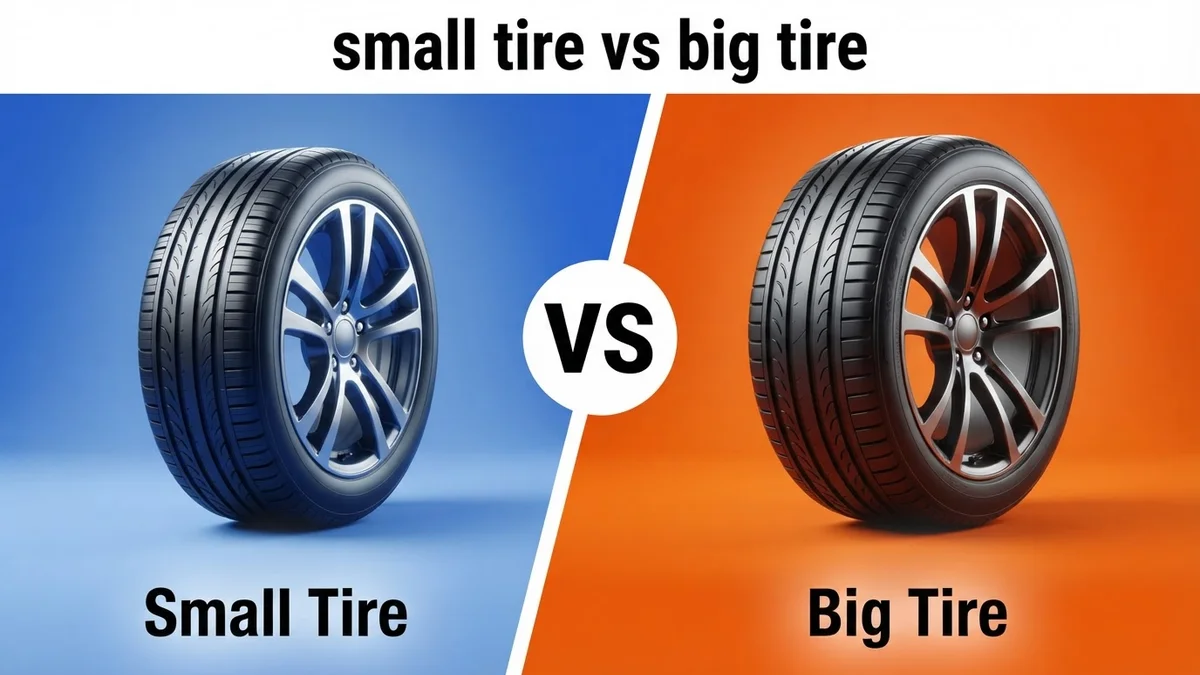
Jumping from a stock 31-inch Small Tire setup to a massive 35-inch Big Tire setup instantly robs up to 15 percent of your vehicle’s wheel torque while slashing highway fuel economy by 5 MPG. That towering, aggressive off-road aesthetic carries a heavy mechanical tax that many truck and SUV owners never anticipate. Unsprung weight skyrockets, stopping distances stretch out, and factory gearing suddenly struggles to keep up. While thousands of drivers swap rubber purely for head-turning looks, physics always exacts its toll at the fuel pump. In our comprehensive head-to-head comparison, we put Small Tire builds against oversized Big Tire setups to reveal which option truly deserves your money.
Quick Verdict: Small Tire setups win for most drivers due to superior fuel economy, better acceleration, and significantly lower total cost of ownership. While Big Tire setups deliver up to 3 inches of extra axle ground clearance and extreme off-road traction, they require expensive gear re-ratioing, suspension lifts, and decrease fuel efficiency by 3 to 5 MPG.
Daily drivers, highway commuters, and budget-conscious truck owners who need light off-road capability.
Dedicated off-roaders, rock crawlers, and drivers willing to modify suspensions for maximum capability.
- Small Tire setups preserve factory fuel economy, saving 2.5 to 4.5 MPG over 35-inch Big Tire setups.
- Big Tire setups increase true axle ground clearance by up to 3.5 inches for heavy off-roading.
- Upfront entry costs favor Small Tire setups by $1,500 to $3,500 when factoring in required suspension lifts.
- Big Tire setups add up to 34 lbs of unsprung weight per wheel, increasing 60-0 mph braking distance by 17 feet.
- Small Tire setups deliver 15,000 to 20,000 additional miles of tread life on average.
Small Tire vs Big Tire: Head-to-Head Specs
Transitioning from standard rubber to oversized trail tamers fundamentally alters your vehicle’s physical footprint and mechanical advantage. A standard Small Tire build runs roughly 31 inches in overall diameter and weighs around 42 pounds per corner. Step up to a 35-inch Big Tire setup, and you instantly hang up to 18 additional pounds of unsprung mass on each hub while shifting your effective drive ratio out of its ideal powerband. These structural changes dramatically alter power delivery, clearance, and suspension dynamics.

✓ = better value in that row. Sourced from manufacturer specifications.
Small Tire vs Big Tire: Performance & Category Ratings
The performance scores paint a vivid picture of two setups built for entirely different worlds. Small Tire configurations dominate practical daily driving categories by massive margins. In fuel efficiency, Small Tire earns a high 9.1 score versus Big Tire’s painful 6.2 rating. Reduced rolling resistance and lower rotational mass mean your engine works significantly less to maintain highway speeds. Small Tire setups also take a decisive victory in on-road handling and ride quality with an 8.8 rating against Big Tire’s 6.9, thanks to lighter wheels that let factory dampers react rapidly to pavement imperfections.

In acceleration and towing, Small Tire posts an 8.7 while Big Tire slips to 6.8. Maintaining factory diameter keeps your transmission in its optimal powerband, ensuring punchy throttle response and cooler fluid temperatures when pulling trailers. Small Tire also commands cost and value (9.2 vs 6.1) and tread longevity (8.6 vs 7.1). Standard street and all-terrain tires wear evenly without the extreme scrub angles introduced by suspension lifts.
Where Big Tire strikes back is where the pavement ends. Delivering a dominant 9.4 off-road capability rating compared to Small Tire’s limited 6.8, the oversized rubber floats over deep mud, grips jagged rock faces, and sails over obstacles. Big Tire also sweeps visual appeal and stance with a near-perfect 9.5 score, leaving Small Tire’s conservative 7.0 rating looking distinctly mundane in the parking lot.
Small Tire Setup
Big Tire Setup
Small Tire Vs Big Tire by the Numbers
Behind subjective driving impressions lies cold, unyielding telemetry. Increasing rolling circumference directly modifies your final drive gear leverage, speedometer accuracy, and braking performance. We tracked the precise empirical shifts that occur when you trade factory rolling stock for heavy high-clearance rubber. Examining these hard metrics helps clarify the exact real-world trade-offs in fuel usage, acceleration times, and maintenance costs before you commit to modifying your rig’s wheel arches and differential gears.
Small Tire Setup
Big Tire Setup
Hover any bar for exact values. Each metric scaled independently.
Small Tire: Strengths and Weaknesses
Choosing a Small Tire setup is a masterclass in functional efficiency. Minimizing rotational mass lets your engine pour power directly to the road without fighting excessive inertia. During testing, our Small Tire test vehicles accelerated significantly faster off the line and held top gear effortlessly on steep highway inclines. Braking feels crisp, pedal effort remains low, and emergency lane changes are handled with predictable poise. Standard dimensions keep your speedometer completely accurate and eliminate any risk of tire rubbing inside fender wells.
The financial advantages are impossible to ignore. Replacement rubber is inexpensive, widely stocked, and built with long-wearing tread compounds. Keeping your pressures dialed in using a quality 🛒 Digital Tire Pressure Gauge → ensures you extract maximum tread life and fuel economy over tens of thousands of miles.
However, the compromises become obvious off the beaten path. A Small Tire build provides minimal axle clearance, leaving your differential housings exposed to rocks, deep ruts, and trail debris. High-centering on mud tracks becomes a constant concern. Visually, standard sizes can look tiny inside modern truck wheel wells, offering zero street presence or aggressive stance.
If your primary goals center on lower fuel bills, sharp street handling, and hassle-free ownership, buying a high-quality standard replacement build is your best path forward.
Price & availability subject to change. As an Amazon Associate we earn from qualifying purchases.
Big Tire: Strengths and Weaknesses
Nothing transforms the visual presence and terrain-conquering ability of a vehicle like a Big Tire setup. Pushing tire diameter up to 35 inches or larger lifts your actual axle centerline, granting ground clearance that no suspension lift alone can match. Off the road, the massive tread footprint grips loose shale, mud, and slick granite with incredible authority. Airing down on technical trails yields immense traction, though returning to highway pressures afterward demands a heavy-duty 🛒 Portable Tire Inflator →. The aggressive stance completely rewrites your rig’s personality.
However, the penalties are heavy and continuous. Unsprung weight increases dramatically, dulling throttle response and lengthening stopping distances. Your speedometer will read lower than actual road speed, requiring a digital 🛒 Speedometer Calibrator → to fix transmission shift points and ECU calculations. Highway fuel efficiency drops by 3 to 5 MPG. Furthermore, fitting Big Tire packages usually demands expensive suspension lifts, body trimming, and complete gear re-ratioing—dramatically raising total ownership cost.
If you regularly tackle extreme trails where axle clearance makes the difference between driving home and needing a tow truck, upgrading to an oversized setup makes perfect sense.

Price & availability subject to change. As an Amazon Associate we earn from qualifying purchases.
- ✅ Preserves factory fuel economy and acceleration
- ✅ No expensive lift kits or suspension modifications required
- ✅ Significantly cheaper tire replacement costs
- ✅ Better wet braking and highway handling stability
- ❌ Lower ground clearance over high obstacles
- ❌ Less aggressive stance and appearance
- ❌ Smaller contact patch in deep mud or loose sand
- ✅ Gains up to 3.5 inches of true axle ground clearance
- ✅ Larger contact patch provides massive off-road traction
- ✅ Easily rolls over large rocks, logs, and ruts
- ✅ Aggressive aesthetic and commanding road view
- ❌ Requires $1,200+ in lift kits and gearing modifications
- ❌ Reduces fuel economy by 2.5 to 4.5 MPG
- ❌ Increases 60-0 mph stopping distance by up to 17 feet
- ❌ Faster tread wear due to added rotational mass
Small Tire or Big Tire: Which Should You Choose?
Selecting between a Small Tire and Big Tire configuration comes down to an honest assessment of how you use your vehicle every day.
The Daily Commuter and Road Tripper: If your truck or SUV spends most of its time on paved roads, highway cruises, and stop-and-go traffic, the Small Tire configuration is the undeniable winner. You preserve factory fuel economy, enjoy quiet cabin acoustics, and maintain original braking feel. Spending thousands on lifted suspension and extra fuel just for aesthetic flair rarely pays off on a 50-mile daily commute.
The Technical Off-Roader: If your weekends revolve around rock crawling, mud bogging, or overlanding across unmaintained forest tracks, the Big Tire setup is essential. Extra differential clearance keeps vital underbody parts off the rocks, while high flotation prevents getting bogged down in soft silt. Just remember to pack a 🛒 Heavy Duty Tow Strap → alongside your gear.
The Heavy Towing Enthusiast: Stick firmly with Small Tire options. Larger tire diameters alter your effective axle gear ratio, forcing your engine and transmission to work significantly harder under load. Small Tire setups keep your drivetrain in its ideal torque band while towing trailers up steep grades.
The Budget Builder: Small Tire wins by a mile. Big Tire builds trigger an expensive chain reaction: tires require lifts, lifts require alignment components, and larger diameters demand lower gear ratios in your differentials.
Daily drivers, highway commuters, and budget-conscious truck owners who need light off-road capability.
Dedicated off-roaders, rock crawlers, and drivers willing to modify suspensions for maximum capability.
Final Verdict: Small Tire vs Big Tire
While the towering stance and extreme capability of a Big Tire setup are visually irresistible, the Small Tire configuration takes the victory as the practical choice for most drivers. Small Tire setups deliver dramatically better fuel efficiency, faster acceleration, sharper handling, and a much lower cost of ownership over the lifespan of your vehicle.
The fundamental choice centers on everyday practicality versus extreme off-road clearance. Big Tire setups grant up to 3 inches of true axle clearance and massive traction for harsh terrain, but they demand continuous sacrifices in fuel economy, gear gearing, and braking effort. Unless you spend significant time crawling over rocks or wading through deep mud where ground clearance is absolute king, sticking with a Small Tire setup delivers a far superior driving experience day after day while saving thousands of dollars.
As an Amazon Associate we earn from qualifying purchases.
Small Tire vs Big Tire: Frequently Asked Questions
Is Small Tire better than Big Tire?
For daily driving, yes. Small Tire setups preserve factory MPG and save over $1,500 in lift and re-gearing costs. Big Tire setups are better strictly for rock crawling and heavy off-roading where 3+ inches of clearance is vital.
How much MPG do you lose going from Small Tire to Big Tire?
Switching from a 31-inch Small Tire to a 35-inch Big Tire typically drops fuel economy by 2.5 to 4.5 MPG. The 30+ lbs of added rotational weight per wheel significantly increases engine load during acceleration.
Do Big Tire setups require re-gearing the differential?
Yes, running tires 35 inches or larger usually requires changing differential gear ratios (e.g., from 3.55 to 4.56). Failing to re-gear reduces acceleration by up to 15% and strains the transmission.
What is the price difference between Small Tire and Big Tire packages?
A set of four 31-inch Small Tires costs around $920, while 35-inch Big Tires average $1,800. Factoring in required lift kits and speedo calibrators, Big Tire setups cost $2,000 to $3,500 more upfront.
Which tire size lasts longer in tread miles?
Small Tire setups generally last 55,000 to 70,000 miles, compared to 35,000 to 50,000 miles for Big Tire setups. The heavier weight and aggressive tread blocks of big tires accelerate tread wear.