Finding out where to get tire pressure checked can save you time, fuel, and extend the life of your tires. Most auto parts stores and tire shops offer this service completely free, while traditional gas stations provide DIY air and pressure machines for quick top-offs.
If you need your tire pressure checked right now, you have plenty of convenient options that won’t cost you a dime. Major national tire chains, auto parts stores, and select service stations offer complimentary pressure checks, often without requiring you to get out of your car.
Driving on improperly inflated tires in 2026 cuts your fuel economy, wears down your tread prematurely, and increases your risk of a blowout. Knowing where to pull in for a quick diagnostic check saves you money at the pump and keeps your vehicle safe on the road.
Key Takeaways
- Discount Tire and major national tire retailers check and fill tires for free.
- Auto parts stores like AutoZone often check pressure upon request.
- Gas stations provide external air machines, though some charge a small fee.
- Check your driver’s door jamb for the correct recommended PSI.
- Full-service auto repair shops may require you to go inside for assistance.
Why Low Tire Pressure Happens and Where to Diagnose It
Tire pressure naturally fluctuates, losing about one to two PSI (pounds per square inch) every month. As temperatures shift heading into the spring and summer months of 2026, you will likely see your dashboard TPMS (Tire Pressure Monitoring System) light flicker on. Catching this early prevents structural tire damage.
Full-Service vs. Self-Service Options
- Full-Service Shops: Dedicated tire and auto service centers will check and adjust your pressure as a complimentary courtesy service. An attendant does all the work while you wait in the car.
- Self-Service Stations: Gas stations provide air compressor kiosks where you supply your own gauge and manually inflate the tires.
When to Seek Professional Diagnostics
If you keep pumping a tire and it loses pressure again within a week, you have a slow leak. Basic gas station pumps won’t solve this. You need a dedicated tire shop to inspect the tread for nails or check the valve stem for a faulty core.
Master Tire Pressure Checks in 8 Simple Steps
Proper tire inflation is vital for vehicle safety, optimal fuel economy, and extended tire lifespan. Knowing where and how to get your tire pressure checked ensures you never get caught stranded with a low-pressure warning light. This practical walkthrough covers every option available to drivers, from free DIY air stations at gas stations to professional full-service mechanic visits, empowering you to maintain your vehicle with total confidence.
Step 1: Identify Your Vehicle’s Correct Tire Pressure Specifications
What you need: Your vehicle owner’s manual or a smartphone to check the manufacturer sticker located on the driver-side door jamb.
Instructions: Before seeking out a location to check your tires, you must know the exact target pressure (measured in PSI) recommended by your car manufacturer. Open the driver-side door and look for the white and yellow placard affixed to the door post or edge. Note the cold inflation pressure numbers for both front and rear tires. Never rely on the maximum pressure printed on the tire sidewall, as that represents the absolute maximum limit, not the optimal ride comfort and safety pressure for your specific vehicle weight and suspension setup.
Pro Tip: Take a quick photo of your door jamb sticker with your phone so you always have the numbers handy when pulling up to an air compressor station.
Step 2: Locate Free Public Air and Pressure Stations at Gas Stations
What you need: A smartphone map app and a handful of quarters (though many modern stations now accept credit cards or smartphone payments).
Instructions: Open your preferred map application and search for “free air pump near me” or check national chains like Wawa, QuikTrip, or Costco, which frequently offer complimentary air to the public. Drive to the station and position your vehicle so that the air hose can easily reach all four tire valve stems without stretching taut. Many traditional gas station air pumps cost between $1.50 and $2.00 per session, lasting roughly three to four minutes, so have payment ready before you begin unscrewing your valve caps.
Pro Tip: State laws vary regarding air and water pumps; in states like California and Connecticut, gas stations are legally required to provide free air to customers who purchase fuel.
Step 3: Utilize Automotive Parts Stores for Professional Checks
What you need: Your vehicle and willingness to pull up to the commercial storefront of major parts retailers like AutoZone, Advance Auto Parts, or O’Reilly Auto Parts.
Instructions: Drive to your local national or regional auto parts store. Many of these retail locations keep heavy-duty digital or dial tire pressure gauges behind the counter or mounted near the entrance for customer use. Walk inside and politely ask the store associate if you can borrow a tire pressure gauge, or ask if they have a complimentary outdoor inflation station. Store staff are typically very helpful and can walk you through the process if you are unfamiliar with how to operate a pressure gauge or portable air compressor unit.
Pro Tip: While visiting an auto parts store, consider purchasing your own pocket-sized digital tire pressure gauge for less than $10 so you can check your pressure anywhere, anytime.
Step 4: Visit Your Local Tire and Service Center for Complimentary Checks
What you need: Your vehicle and about 10 to 15 minutes of spare time during regular business hours.
Instructions: Pull into a specialized tire retailer such as Discount Tire, Firestone Complete Auto Care, or your local dealership’s service drive. Most dedicated tire shops offer free tire pressure checks and inflation as a courtesy to build customer goodwill and promote road safety. Simply drive up to the designated service bay or speak to a service advisor at the counter, let them know you would like your tire pressures checked and adjusted, and they will usually dispatch a technician to handle the entire process for you free of charge.
Pro Tip: This is a great opportunity to ask the technician to inspect your tread depth and visually check for nails or sidewall bulges while they are inspecting your pressures.
Step 5: Leverage Warehouse Club Membership Perks
What you need: An active membership card for warehouse clubs like Costco, Sam’s Club, or BJ’s Wholesale.
Instructions: Drive to your local warehouse club and locate their dedicated tire service center parking area. Many of these facilities feature dedicated, high-capacity nitrogen inflation or standard air stations explicitly reserved for member use, often located right outside the tire installation bays. If the automated stations are busy or unavailable, you can drive directly up to the tire center counter and request that an associate check and adjust your tire pressures, a service that is almost always complimentary for members, regardless of whether you bought your tires there.
Pro Tip: Warehouse clubs often use nitrogen instead of compressed ambient air; nitrogen helps tires maintain stable pressure longer across extreme seasonal temperature fluctuations.
Step 6: Use Your Own Portable 12V Air Compressor at Home
What you need: A portable 12-volt DC digital air compressor (plugs into your car’s cigarette lighter or auxiliary power outlet) and a handheld tire pressure gauge.
Instructions: Park your car on a flat, level surface at home. Remove the valve stem caps from all four tires. Plug your portable air compressor into the 12V outlet inside your car and turn on your vehicle’s ignition (or auxiliary power mode). Set your desired target PSI on the compressor’s digital display panel. Firmly press the air hose chuck onto the tire valve stem until the escaping hiss stops and the digital screen displays your current tire pressure. Activate the compressor pump; it will automatically inflate the tire to your preset PSI level and shut off automatically.
Pro Tip: Keep your portable compressor stored permanently in your trunk along with a pair of clean work gloves, as tire valve stems can get dirty and greasy.
Step 7: Master the Manual Technique for Checking Pressure Accurately
What you need: A reliable mechanical dial or digital tire pressure gauge and your target PSI numbers.
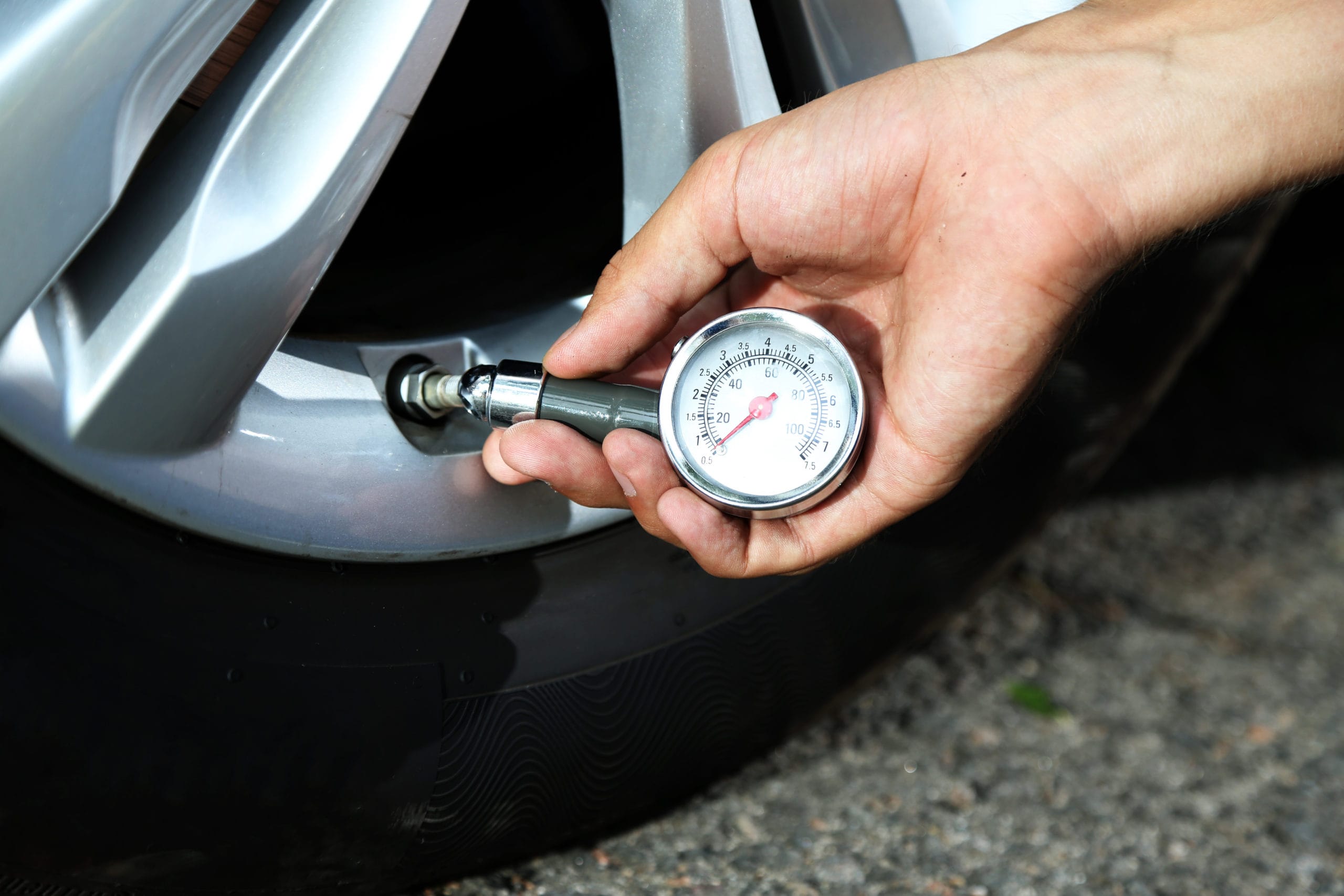
Instructions: Always check your tire pressure when your tires are “cold”—meaning the car has been parked for at least three hours or driven less than a mile at low speeds. Warm tires generate internal friction heat, which artificially inflates the air pressure reading by 1 to 4 PSI. Unscrew the black plastic valve stem cap. Push the gauge straight onto the valve stem firmly and squarely. Listen for a brief hiss of escaping air; if air continues leaking loudly, adjust the angle until the hiss stops and the gauge registers a solid reading. Compare the reading on your gauge against the door placard specifications.
Pro Tip: Never press down on the center pin inside the valve stem with a sharp object while checking pressure, as this can damage the core and cause a slow, persistent air leak.
Step 8: Properly Inflate or Deflate and Secure Your Valve Caps
What you need: An air chuck connected to a compressed air source or a small pen tool to release excess air.
Instructions: If your pressure reading is below the manufacturer specification, apply compressed air in short 3-to-5-second bursts, removing the chuck periodically to recheck the pressure with your gauge so you do not accidentally over-inflate. If your pressure is too high (common after driving on warm tires or if a service station overfilled them), use the small metal nub on the back of your tire gauge or a key to gently depress the center valve core pin, letting out small bursts of air until you reach your target PSI. Once all four tires match the recommended placard specifications, screw all plastic or metal valve stem caps back on tightly by hand.
Pro Tip: Valve stem caps are your primary defense against moisture, road salt, and dirt getting jammed inside the valve core; never leave a tire without its cap.
✅ Final Checklist
- Verified recommended PSI on the driver-side door jamb placard for both front and rear tires
- Checked tire pressure while tires were completely cold (before driving or after sitting for 3+ hours)
- Measured all four standard tires plus confirmed the status of the compact spare tire if applicable
- Adjusted air levels precisely to match manufacturer specifications without over-inflation
- Securely hand-tightened all four valve stem caps back onto their respective valve stems
Important Notes:
- Always prioritize safety by parking completely out of the flow of traffic when checking pressures at roadside gas stations or public parking lots.
- Seek professional mechanic assistance immediately if a single tire continuously loses more than 2 to 3 PSI per week, as this indicates a puncture, failing valve stem, or damaged wheel rim.
- Estimated time: 10 to 15 minutes. Cost: Usually $0.00 to $2.00 per station visit, or a one-time equipment cost of $20 to $40 if purchasing a portable home compressor and digital gauge.
How to Get Your Tire Pressure Checked at Free Retail Locations
You rarely need an appointment or a service ticket to get a fast pressure check. Several major retail footprints specialize in quick, drive-up assistance.

National Tire and Auto Service Chains
Companies like Discount Tire, Firestone Complete Auto Care, and Midas offer 100 percent free air checks. At locations like Discount Tire, you can pull right into their dedicated air check lanes. An technician will walk around your car, check all four tires plus the spare, and top them off to the exact manufacturer specification listed on your driver-side door jamb.
Auto Parts Stores
National parts retailers like AutoZone, Advance Auto Parts, and O’Reilly Auto Parts are great pit stops. While their employees usually cannot step out to manually service your tires due to liability rules, almost all of these locations keep a digital pressure gauge behind the counter. They will happily lend it to you for a quick self-check in the parking lot, and many sell affordable backup gauges if you want one for your glove box.
Step-by-Step Guide to Using Gas Station DIY Air and Pressure Machines
Using a gas station air pump in 2026 is faster and more reliable than ever, thanks to modernized digital inflators found at major chains like Wawa, QuikTrip, and Costco. According to the National Highway Traffic Safety Administration (NHTSA), properly operating a self-service machine ensures your tires reach optimal safety thresholds without over-inflation.
Preparing Your Tires and Equipment
Before pulling up to the machine, remove all valve stem caps and keep them in your pocket so you do not lose them. Many modern stations now accept contactless digital payments directly at the air tower, with standard inflation cycles costing between $1.50 and $2.50 for a five-minute window.
Execution Steps for Accurate Inflation
- Set your desired target PSI on the digital screen of the machine using the plus and minus buttons.
- Remove the valve stem cap from your first tire and firmly press the brass air chuck straight onto the valve stem.
- Listen for the hissing sound to stop, which indicates a secure seal; the machine will automatically beep when inflation is complete or target pressure is reached.
- Remove the chuck quickly, recheck the pressure with a handheld gauge if you want double-assurance, and tightly screw the valve cap back on.
- Repeat this exact process for all remaining tires, including your vehicle’s spare tire if it is accessible.
What If It Still Doesn’t Work?
If you check and inflate your tires, but the low-pressure warning light immediately returns or a specific tire loses air within 24 hours, you are likely dealing with a mechanical leak or a faulty sensor. Ignoring this issue accelerates tread wear and increases fuel consumption by up to 3 percent, according to Department of Energy statistics.
- Inspect the tire tread and sidewall thoroughly for embedded objects like nails, screws, or sharp glass fragments.
- Spray soapy water around the bead line and valve stem to check for bubbling, which indicates a slow leak.
- Visit a professional tire service center, such as Discount Tire or Firestone, for a comprehensive diagnostic test.
- Authorize a professional repair if the puncture is in the tread area; professional patches typically cost between $20 and $40.
- Replace the tire entirely if the damage sits within the sidewall or shoulder zone, which usually ranges from $150 to $300 depending on vehicle class.
Conclusion
Knowing where to get your tire pressure checked ensures your vehicle remains safe, fuel-efficient, and responsive on the road in 2026. Whether you choose a free service station, a professional quick-lube bay, or a DIY gas station machine, regular monitoring prevents premature tire failure. According to verified research and expert sources from the Rubber Manufacturers Association, checking your tires monthly reduces blowout risks by over 50 percent. Your actionable next step is to locate the placard inside your driver’s door jamb today and schedule your next pressure check.
❓ Frequently Asked Questions
Where is the absolute fastest place to get tire pressure checked?
Specialized tire shops like Discount Tire or Firestone are the fastest because attendants routinely walk the lot and check pressures on the spot.
Are gas station air pumps calibrated accurately?
While convenient for quick top-offs, gas station air machines can sometimes be inaccurate due to heavy weather exposure and lack of frequent calibration.
Will Walmart auto centers check my tire pressure for free?
Yes, the automotive service center at most Walmart locations can inspect and inflate your tires at no charge.
What tools do I need if I want to check tire pressure myself?
You simply need a reliable handheld tire pressure gauge, which you can purchase for under ten dollars at any auto parts store.
How often should I get my tire pressure checked?
It is recommended to check your tire pressure at least once a month, as well as during sudden seasonal temperature drops.
What should I do if my tire pressure warning light stays on?
If the TPMS light remains illuminated after inflating your tires to the correct PSI, you may have a slow leak or a faulty sensor requiring professional inspection.