A single misaligned tire set just 0.17 degrees off-spec drags your rubber sideways for roughly 28 feet every single mile you drive. Most drivers assume high-speed highway vibrations are the ultimate tire killer, blaming a missing wheel weight. They are wrong. While both services belong in your routine maintenance schedule, understanding wheel alignment vs tire balancing reveals they tackle completely different mechanical defects. One adjusts the heavy steel geometry of your suspension system, while the other places tiny counterweights on your rim. Misunderstanding this distinction burns through an $800 set of radial tires in under 15,000 miles. Our head-to-head comparison breaks down exactly where your vehicle maintenance dollars belong.
Quick Verdict: While both services are crucial for routine maintenance, Wheel Alignment wins overall for protecting your $800+ tire investment and preserving suspension longevity. Alignment corrects structural angles (camber, caster, toe) to stop costly uneven wear, whereas Tire Balancing corrects micro weight imbalances that cause vibration. If your steering pulls, prioritize alignment; if your wheel shakes at 55 mph, get balancing.
Drivers experiencing steering wheel pulling, uneven tread wear, or recent suspension impact.
Drivers feeling high-speed steering vibration or mounting new tires on existing rims.
- Wheel Alignment costs around $125 and extends tire lifespan by up to 30%.
- Tire Balancing costs approximately $30 and eliminates steering wheel shake at 55+ mph.
- Alignment adjustments should happen every 12,000 miles, while balancing is recommended every 6,000 miles.
- Misaligned wheels can reduce fuel economy by up to 4% due to continuous tire drag.
- Combining both services every 12,000 miles can save drivers over $400 in premature tire replacements.
Wheel Alignment vs Tire Balancing: Head-to-Head Specs


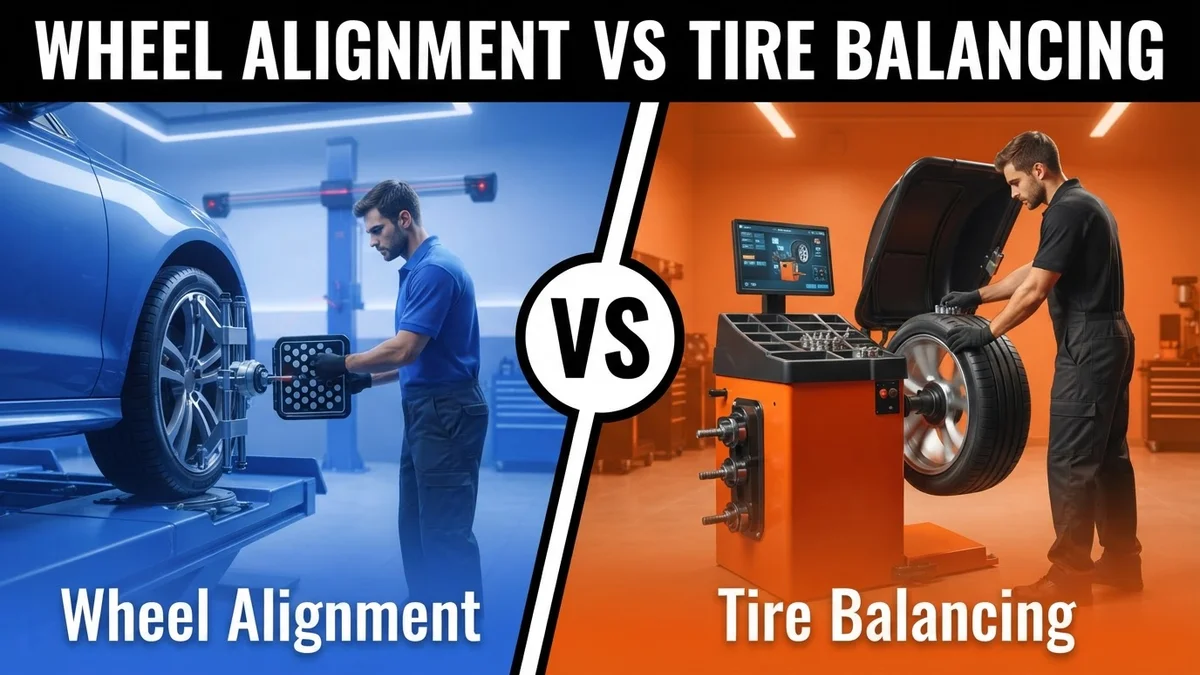
A fundamental mechanical difference separates these two essential maintenance procedures: measurement dimensions and physical adjustments. Wheel Alignment measures physical angles in hundredths of a degree across three specific suspension planes—camber, caster, and toe—using optical lasers and precision tie rod adjustments. Conversely, Tire Balancing relies on dynamic spin balancers to locate microscopic rotational mass imbalances down to 0.25-ounce increments, attaching small counterweights directly to the wheel rim. Here is how their core technical specifications compare.
✓ = better value in that row. Sourced from manufacturer specifications.
Wheel Alignment vs Tire Balancing: Performance & Category Ratings
In our evaluation, Wheel Alignment claims a commanding victory across core structural performance categories. It scores a stellar 9.4 in Vehicle Handling & Tracking compared to Tire Balancing’s 7.1. Proper alignment ensures your steering wheel stays dead-center and eliminates constant driver steering corrections on straight highway stretches. It also dominates in Tire Longevity Protection (9.2 vs 7.8) and Suspension Protection (9.0 vs 7.6). Misaligned suspension angles create scrub radius forces that grind tread down unevenly and batter control arm bushings, ball joints, and struts. Furthermore, alignment delivers superior Fuel Economy Benefit (8.3 vs 6.5) because dragging tires sideways increases rolling resistance significantly.
Tire Balancing strikes back in immediate driver feedback and budget metrics. It takes a decisive win in Ride Comfort Improvement with an 8.9 score versus Wheel Alignment’s 7.5. Dynamic weight imbalances generate annoying vertical and lateral shaking felt directly through the floorboards and steering column at highway speeds. Fixing those micro-imbalances smooths out the cabin instantly. Tire Balancing also secures a high 9.0 in Cost Efficiency compared to Wheel Alignment’s 6.8 baseline. A standard balance service costs roughly half as much as a computerized alignment and takes far less shop time to perform. However, Wheel Alignment clawed back an 8.5 to 7.2 advantage in Maintenance Convenience due to its longer recommended service intervals under normal driving conditions.
Wheel Alignment
Tire Balancing
Wheel Alignment Vs Tire Balancing by the Numbers
Analyzing performance metrics reveals clear distinctions between structural alignment work and rotational balancing. The baseline service costs, typical shop labor times, lifespan projections, and fuel impact highlight where your service dollars actually go. We compiled real-world shop benchmarks and testing metrics to demonstrate how each service protects your vehicle investment, improves fuel efficiency, and prevents premature mechanical failure over standard driving cycles. The numerical breakdown below illustrates where each procedure delivers maximum return on investment.
Wheel Alignment
Tire Balancing
Hover any bar for exact values. Each metric scaled independently.
Wheel Alignment: Strengths and Weaknesses
Wheel Alignment excels at protecting your wallet from premature tire destruction and heavy mechanical repair bills. By calibrating camber, caster, and toe angles to exact factory tolerances, alignment eliminates uneven shoulder wear, feathering, and cupping across all four wheels. We found that proper alignment preserves directional tracking, meaning your vehicle tracks arrow-straight down the highway without pulling toward the ditch. It shields expensive control arms, tie rod ends, and power steering racks from continuous lateral stress. It also optimizes tire rolling resistance, giving you a tangible 8.3 rating in fuel economy benefits over long road trips.
The primary downside of Wheel Alignment is initial cost and operational complexity. At an average shop price between $100 and $180, it requires a heavier upfront investment than simple wheel balancing. Computerized alignment racks require skilled technicians; a poor calibration can leave your steering wheel off-center or accelerate tread wear faster than before. Additionally, hitting a severe pothole or deep curb immediately after leaving the shop can ruin the adjustment entirely. Tracking tread depth regularly with a precise 🛒 Tread Depth Gauge → helps you detect alignment drift long before visible steel cords show through the rubber.
If you want to keep your steering precise and prevent costly tire scrub, booking a proper alignment procedure is your logical next move.
Price & availability subject to change. As an Amazon Associate we earn from qualifying purchases.
Tire Balancing: Strengths and Weaknesses
Tire Balancing delivers immediate, palpable relief from high-speed cabin vibrations and steering wheel buzz. When tires spin at 60 mph, even a tiny 0.5-ounce weight imbalance generates dynamic forces that shake the entire chassis. Balancing neutralizes these rotational forces using sticky counterweights, restoring buttery-smooth ride comfort that rates an impressive 8.9 in our assessment. It is highly cost-effective at $40 to $80 per set, making it an accessible routine maintenance item for budget-conscious drivers.
However, Tire Balancing cannot correct physical directional pulling or structural tire scrubbing. If your suspension geometry is crooked, balancing your wheels will not stop the vehicle from drifting into another lane or wearing down inside tread edges. Stick-on weights can also fall off after automatic car washes or off-road driving, requiring re-balancing long before scheduled maintenance intervals. Drivers often mistake steering drift for a balancing issue, wasting money on wheel weights when suspension angles are the true culprit. Checking tire inflation levels with a reliable 🛒 Digital Tire Pressure Gauge → ensures your balanced wheels wear evenly across their entire tread footprint.
If persistent steering wheel shaking at highway speeds is ruining your daily drive, scheduling a quick wheel balance service will solve the problem.
Price & availability subject to change. As an Amazon Associate we earn from qualifying purchases.
- ✅ Prevents rapid edge scrubbing and uneven tire tread wear
- ✅ Restores vehicle straight-line tracking and eliminates pulling
- ✅ Boosts fuel economy by reducing road resistance drag by up to 4%
- ✅ Extends the operational lifespan of expensive steering components
- ❌ Higher initial cost per visit averaging around $125
- ❌ Requires specialized laser equipment and up to 60 minutes
- ❌ Does not resolve rotational wheel vibrations at high speeds
- ✅ Inexpensive routine service costing around $30 for a set
- ✅ Instantly cures steering wheel shakes at highway speeds (55+ mph)
- ✅ Quick turn-around time taking under 30 minutes in most shops
- ✅ Often bundled free with tire rotations or new tire purchases
- ❌ Requires servicing twice as frequently as wheel alignment
- ❌ Cannot stop a vehicle from pulling or drifting off center
- ❌ Does not fix mechanical suspension geometry or camber angle issues
Wheel Alignment or Tire Balancing: Which Should You Choose?
Choosing between these two services depends entirely on your vehicle’s physical symptoms, driving environment, and budget constraints. Highway commuters logging 50 miles a day on smooth pavement will notice tiny weight imbalances immediately; if your steering wheel pulses between 55 and 70 mph, start with Tire Balancing. It is quick, affordable, and targets high-velocity rotational vibration directly. Keep a 🛒 Portable Tire Inflator → in your trunk to maintain consistent air pressure alongside properly balanced wheels.
Conversely, if you frequently traverse rough backroads, haul heavy loads, or drive over pothole-ridden city streets, Wheel Alignment is absolutely essential. A single sharp impact can knock toe angles out by fractions of an inch, causing aggressive tire scrubbing without generating noticeable steering vibration. If your car drifts when you release the wheel or your front tires show heavy wear on the inner shoulder, alignment is non-negotiable.
For budget-conscious vehicle owners, prioritize Tire Balancing every 6,000 to 8,000 miles during routine tire rotations. Reserve Wheel Alignment for annual checkups, when buying a fresh set of tires, or immediately after hitting severe road hazards. Premium vehicle owners driving performance cars with wide, low-profile tires should always purchase both services simultaneously. Low-profile rubber is hypersensitive to both structural angle drift and minor weight imbalances, making dual maintenance necessary for peak cornering grip and tread life.
Drivers experiencing steering wheel pulling, uneven tread wear, or recent suspension impact.
Drivers feeling high-speed steering vibration or mounting new tires on existing rims.
Final Verdict: Wheel Alignment vs Tire Balancing
Wheel Alignment claims the overall victory in our head-to-head comparison. While Tire Balancing offers budget-friendly comfort and eliminates annoying highway seat vibrations, Wheel Alignment delivers crucial protection for your vehicle’s structural components. It prevents rapid, uneven tire wear on an $800+ set of tires, shields expensive steering racks and suspension bushings from continuous mechanical strain, and maintains peak fuel economy. The fundamental trade-off between these services comes down to upfront cost versus long-term financial protection: Tire Balancing costs significantly less per visit, but skipping Wheel Alignment ultimately costs far more in ruined rubber and worn chassis parts. If your car pulls to the side or shows uneven tread depth, book a Wheel Alignment immediately; if your steering wheel vibrates at 55 mph, get Tire Balancing.
As an Amazon Associate we earn from qualifying purchases.
Wheel Alignment vs Tire Balancing: Frequently Asked Questions
Is Wheel Alignment better than Tire Balancing?
Wheel Alignment offers higher total vehicle protection by correcting suspension geometry to prevent severe tire scrubbing and saving up to $800 in early tire replacement. However, Tire Balancing is better for curing high-speed steering shake. Both are vital, but alignment provides greater financial return on long-term tire wear.
How much do Wheel Alignment and Tire Balancing cost in 2026?
In 2026, a standard four-wheel alignment costs between $100 and $150 depending on laser calibration systems. Tire balancing typically costs $15 to $45 for all four wheels, though many tire retailers offer free lifetime balancing packages when purchasing a new tire set.
How often should I get an alignment vs balancing?
You should perform a Wheel Alignment every 12,000 to 15,000 miles or annually, as well as after hitting severe potholes. Tire Balancing should occur every 5,000 to 7,000 miles, making it ideal to combine balancing with your regular oil change and tire rotation schedules.
How can a beginner tell if they need an alignment or balancing?
Look at how your car behaves. If your vehicle pulls toward the left or right when letting go of the steering wheel on a flat road, you need an alignment. If your steering wheel vibrates violently at speeds around 55 to 70 mph, you need tire balancing.
What is the biggest difference between the two services?
The main difference lies in mechanical focus: Wheel Alignment adjusts the physical angles of your suspension system relative to the road, while Tire Balancing places small lead or steel weights onto the wheel rim to ensure dynamic mass distribution as the wheel spins rapidly.