Maintaining optimal tire integrity is paramount for vehicle safety and performance, yet a critical aspect often overlooked by many drivers is regular tire tread assessment. Worn tire treads significantly compromise vehicle handling, braking efficiency, and increase the risk of hydroplaning, posing a serious threat on the road. Many drivers remain unaware of how to quickly and accurately determine if their tires meet safety standards without specialized tools. This comprehensive guide will empower you to master the simple, effective penny test, enabling you to confidently check your tire tread depth, understand the results, and take appropriate action to ensure your vehicle remains safe and compliant throughout 2026 and beyond.
Understanding Tire Tread Integrity: Why It Matters for Vehicle Safety and Performance
📤 Share Image
As a seasoned automotive expert with over 15 years in the field, I cannot overstate the critical role of tire tread depth in ensuring vehicle safety and optimal performance. The tread on your tires is not merely a cosmetic feature; it is an engineering marvel designed to maintain consistent contact with the road surface under varying conditions. To truly understand the importance of regular checks, it’s essential to grasp the fundamental functions of tire tread.
Traction and Grip
Tire tread patterns are meticulously designed to maximize traction and grip. The intricate network of grooves, sipes, and blocks works in concert to provide the necessary friction for acceleration, braking, and steering. On dry surfaces, these patterns distribute pressure evenly, while the rubber compound itself grips the road. As tread wears down, this intricate design is compromised, leading to reduced contact patch effectiveness and a noticeable degradation in handling characteristics.
Hydroplaning Prevention
One of the most critical functions of adequate tread depth is its ability to prevent hydroplaning. In wet conditions, the grooves in your tires act as channels, efficiently dispersing water from beneath the tire’s contact patch. This allows the rubber to maintain direct contact with the road. When tread depth is insufficient, these channels cannot evacuate water effectively, causing the tire to ride on a film of water, leading to a complete loss of steering and braking control. This is a primary cause of accidents in wet weather.
Legal and Safety Standards
Driving with worn tires isn’t just unsafe; it’s often illegal. Most regions, including nearly all states in the U.S. and provinces in Canada, mandate a minimum legal tread depth of 2/32 inch (approximately 1.6mm). This threshold is not arbitrary; it represents the point at which tire performance, particularly in wet conditions, becomes critically compromised. Research indicates that a vehicle with tires at 2/32-inch tread depth can require up to 40% more distance to stop in wet conditions compared to new tires. This dramatic increase in stopping distance translates directly into a higher risk of collision. Understanding this benchmark is the first step in mastering tire health.
Tire Longevity and Performance
Beyond immediate safety, maintaining adequate tread depth also contributes to the overall longevity and performance of your tires. Sufficient tread helps distribute heat more efficiently and maintains consistent handling characteristics, contributing to a smoother ride and better fuel economy. Neglecting tread depth can lead to premature tire failure, decreased vehicle stability, and reduced fuel efficiency.
By The Numbers
Minimum Legal Tread Depth
Increased Wet Stopping Distance with Worn Tires
Essential Preparations for an Accurate Penny Tread Check
Before you begin the actual penny test, proper preparation is key to ensuring both your safety and the accuracy of your assessment. As someone who has performed countless tire inspections, I can tell you that overlooking these preliminary steps often leads to misleading results or, worse, an unsafe situation. Learning these foundational steps will help you master the entire process.
Vehicle Safety First
Always prioritize safety. Begin by parking your vehicle on a flat, level surface. This prevents the vehicle from rolling and ensures that the tire’s contact patch with the ground is stable, allowing for an accurate measurement. Crucially, engage the parking brake. For an added layer of safety, especially if you’re working on a slight incline or feel unsure, consider placing wheel chocks behind the tires not being inspected. Never attempt to check tire tread while the vehicle is in motion or on uneven ground.
Tire Inspection and Cleaning
A visual inspection precedes any measurement. Take a moment to visually inspect the entire tire for any obvious foreign objects embedded in the tread, such as nails or stones. Look for signs of damage like cuts, bulges, or cracks in the sidewall. These issues require immediate professional attention regardless of tread depth. Next, check the tread grooves for excessive mud, small pebbles, or other debris that could obstruct your penny placement. Gently remove any obstructions using a small stick or a tire tool to ensure an unobstructed measurement point.
Gathering Your Tools
For the penny test, your primary tool is simple: a U.S. penny. The specific feature we rely on is the distance from the edge of the penny to the top of Abraham Lincoln’s head. If you’re in a country with different currency, ensure you find a coin with a distinguishable head that approximates the 2/32-inch measurement when inverted. Additionally, a small flashlight can be incredibly helpful for better visibility, especially in dimly lit garages or during overcast conditions, allowing you to clearly see Lincoln’s head.
Understanding Tread Wear Patterns
It’s crucial to understand that tire wear isn’t always uniform. Issues like improper tire inflation (over or under), misaligned wheels, or worn suspension components can cause certain parts of the tire to wear faster than others. Therefore, it’s imperative to check multiple points across each tire’s circumference and width. This approach helps identify early signs of uneven wear that a single measurement might miss, giving you a more comprehensive assessment of your tire’s health. Research indicates consistent measurement across the tire is vital to identify potential issues beyond simple wear.
Always check at least three points around the tire (e.g., 12 o’clock, 4 o’clock, 8 o’clock) and at various positions across the tread width (inner, middle, outer) to account for uneven wear patterns caused by alignment or inflation issues.

How To Check Tire Tread With A Penny: The Step-By-Step Procedure for Accurate Assessment
Now that your vehicle is safe and your tires are prepped, it’s time to discover the simplicity and effectiveness of the penny test. This method, while rudimentary, provides a reliably quick indication of whether your tires meet the critical safety minimum. Follow these steps meticulously to master this essential check.
📋
Step-by-Step Guide
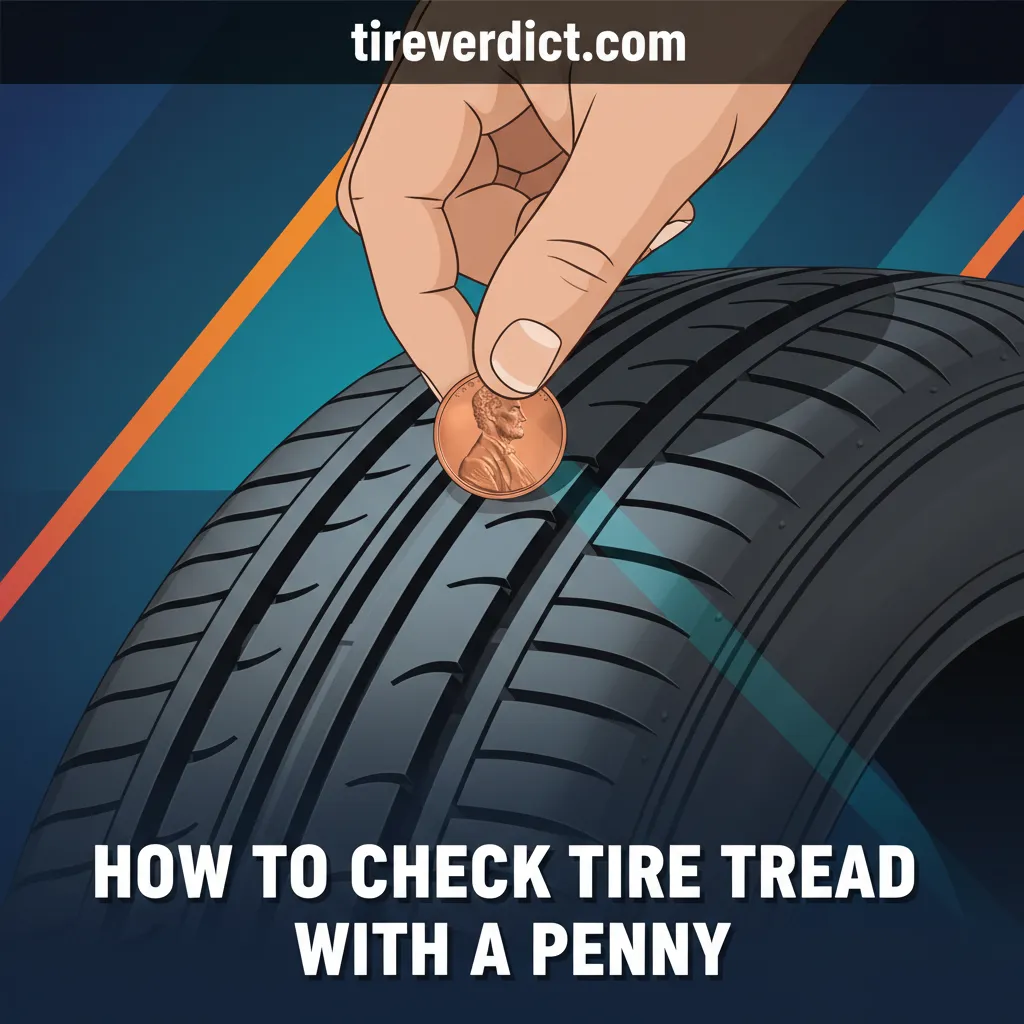
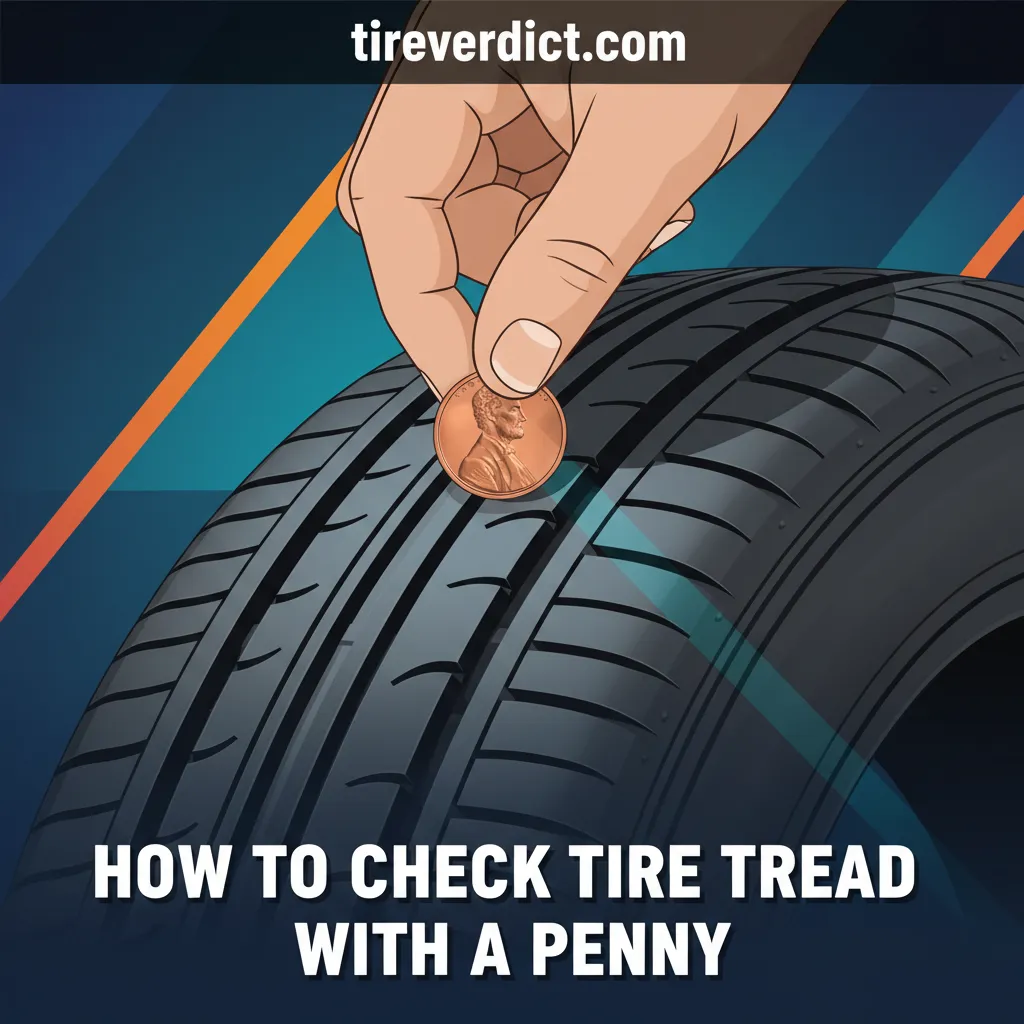
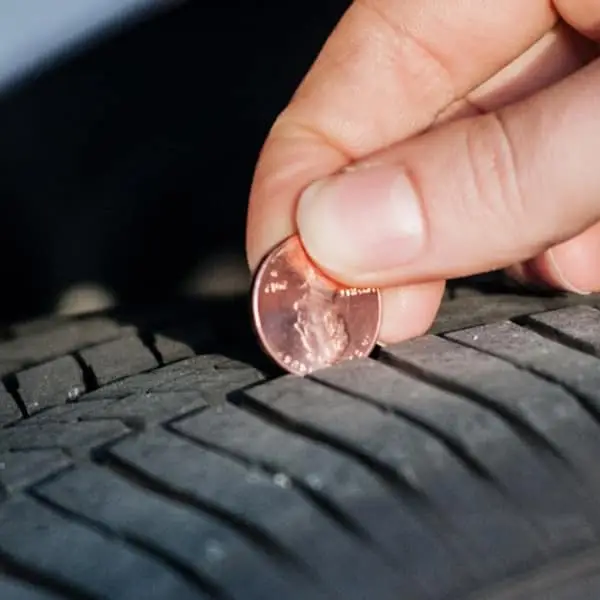
Take your U.S. penny and hold it so that Abraham Lincoln’s head is pointing downwards, directly into one of the main tire tread grooves. The top of his head should be facing the tire. It’s crucial that you insert the penny firmly but without force, ensuring it makes full contact with the bottom of the groove.
For an accurate assessment, choose a primary tread groove—those deep channels that run circumferentially around the tire. Avoid the small wear indicator bars molded into the grooves, as these are a separate visual cue for 2/32-inch wear and can interfere with the penny test. Select what appears to be the shallowest point within the groove at your chosen location.
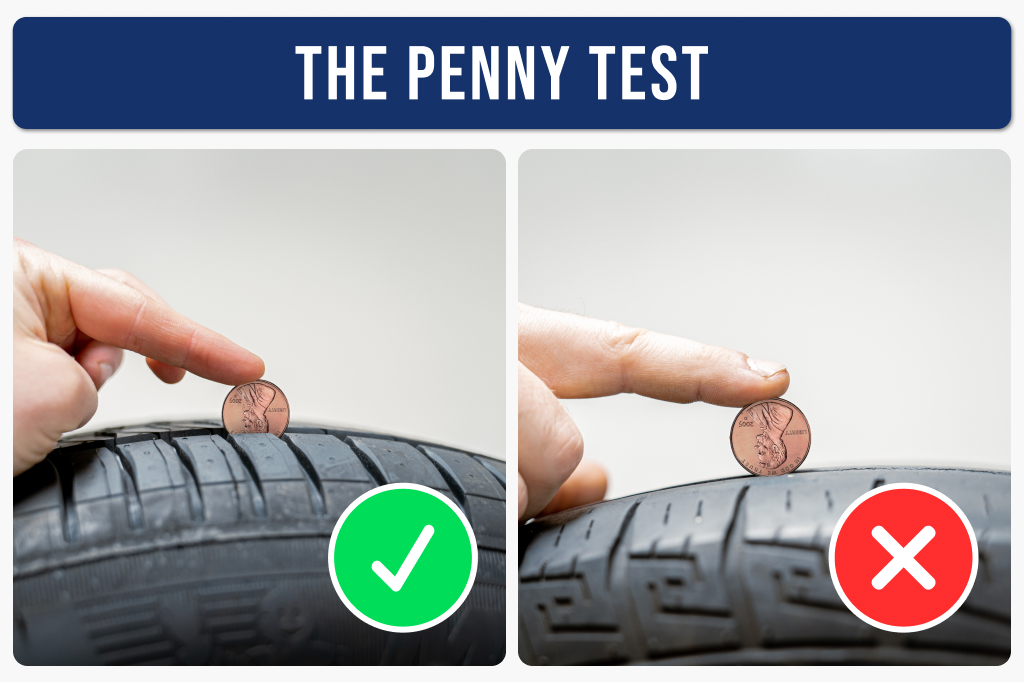
Once the penny is inserted, look closely at Lincoln’s head. The key is to observe how much of his head is visible above the tread block. The distance from the rim of a U.S. penny to the very top of Lincoln’s head is approximately 2/32 of an inch. This is the crucial reference point for the test.
If Lincoln’s entire head is fully visible above the tread surface, this is a strong indication that your tread depth is at or below the critical 2/32-inch mark. This signifies critical wear and warrants immediate attention. If part of his hair or scalp is obscured by the tread, your tires generally have sufficient depth, likely above the 2/32-inch threshold.
Since tire wear can be uneven, it is vital to repeat this test at multiple points around the circumference of each tire (e.g., at 12, 3, 6, and 9 o’clock positions). Furthermore, check across the width of the tire (inner, middle, outer grooves). If any single measurement reveals Lincoln’s head fully visible, that tire is considered worn to the critical limit and needs replacement.
Interpreting Penny Test Outcomes and Determining Next Actions
Successfully performing the penny test is only half the battle; knowing how to interpret the results and what actions to take is equally important. As a professional, I’ve seen countless drivers misinterpret these simple findings, leading to either unnecessary worry or, more dangerously, complacency. This section will help you understand the implications of your findings and guide your next steps.
‘Pass’ Scenario: Lincoln’s Head Obscured
If, after inserting the penny into the tread groove, any part of Lincoln’s hair or scalp is covered by the tread blocks, your tires have sufficient depth. This typically means your tread is above the 2/32-inch legal minimum. In this scenario, your tires are generally considered safe for continued service under normal driving conditions. However, this is not a one-and-done check. Regular monitoring, ideally with each oil change or every few months, remains essential to track wear over time.
‘Fail’ Scenario: Lincoln’s Head Fully Visible
This is the critical warning sign. If the entire top of Lincoln’s head is visible above the tread, it signifies that your tire tread is at or below the 2/32-inch critical mark. At this depth, the tire’s ability to maintain traction, especially in wet conditions, is severely compromised. Continuing to drive on such tires dramatically increases your risk of hydroplaning and extends stopping distances. This outcome mandates immediate tire replacement not only for your safety but also for legal compliance. Driving with tread below the legal minimum can result in fines and, in the event of an accident, potential insurance complications.
Marginal Results and Proactive Replacement
Sometimes, the penny test might show that Lincoln’s hair is barely covered. This indicates your tread is nearing the 2/32-inch mark. While technically still above the legal minimum, many tire experts and safety organizations, myself included, recommend proactive tire replacement when tread depth reaches 4/32 inch (approximately 3.2mm). This recommendation is particularly pertinent for vehicles frequently driven in wet climates. Tires with 4/32 inch of tread still offer significantly better hydroplaning resistance and overall wet-weather performance than those at 2/32 inch, providing an important safety buffer. This proactive approach allows you to master preventative maintenance.
Addressing Uneven Wear
If you find that different sections of the same tire, or different tires on the vehicle, yield varying results from the penny test, this is a clear indicator of uneven wear. For example, if the outer edges are worn more than the center, it could suggest under-inflation or alignment issues. Conversely, more wear in the center often points to over-inflation. Uneven wear patterns are not just cosmetic; they signify underlying mechanical issues such as improper wheel alignment, tire balance problems, or worn suspension components. When uneven wear is identified, it’s imperative to seek a professional inspection to diagnose and rectify the root cause, preventing further tire damage and maintaining vehicle stability.
Never ignore a ‘fail’ result on the penny test. Driving on tires with critically low tread depth drastically compromises your vehicle’s safety systems, increasing braking distances and the risk of accidents, especially in adverse weather. Prioritize immediate replacement.
Beyond the Penny Test: Advanced Tread Depth Assessment and Professional Consultation
While the penny test is an excellent, quick screening tool, it offers a binary outcome – essentially ‘above’ or ‘at/below’ 2/32 inch. For a more nuanced and comprehensive understanding of your tire health, it’s beneficial to explore more precise assessment methods and recognize when professional intervention is indispensable. This will help you truly master your vehicle’s tire maintenance.
Utilizing a Tread Depth Gauge
For definitive and precise measurements, a dedicated tire tread depth gauge is the preferred tool. These affordable instruments, available in both analog and digital versions, provide exact readings, typically in 32nds of an inch or millimeters. To use, simply insert the probe into the deepest part of a main tread groove, press the gauge shoulders flat against the tread block, and read the measurement. This allows you to accurately track wear over time and make informed decisions, particularly when tread is approaching the 4/32-inch recommendation or the 2/32-inch legal minimum. Precise measurements offer a more nuanced understanding of tire wear than the binary penny test outcome.
Understanding Wear Indicator Bars
Modern tires incorporate built-in wear indicator bars, sometimes called “tread wear indicators” or “wear bars,” molded into the main tread grooves. These are small, raised bars that are flush with the tread surface once the tread depth has worn down to 2/32 inch. They serve as a quick visual confirmation – if the tread blocks are level with these bars, the tire is at the legal minimum and requires replacement. While not a measurement tool like the penny or gauge, they offer a clear, unambiguous signal of critical wear, providing an instant ‘fail’ visual.
Recognizing Abnormal Wear Patterns
Beyond overall tread depth, diligently observing abnormal wear patterns can reveal underlying issues with your vehicle. These include:
- Feathering: Tread blocks are worn smoother on one side and sharper on the other, indicating alignment issues.
- Cupping or Scalloping: Irregular dips or scoops around the tread, often signaling worn shock absorbers or other suspension components.
- Center Wear: The center of the tread wears faster than the edges, typically caused by over-inflation.
- Shoulder Wear: The outer edges of the tread wear faster than the center, usually due to under-inflation or aggressive cornering.
Identifying these patterns during your tire checks provides valuable diagnostic information, empowering you to address mechanical problems before they escalate.
When Professional Inspection is Indispensable
While the penny test provides a great starting point, there are definite scenarios when a visit to a certified tire technician is not just recommended, but critical:
- If the penny test consistently yields a ‘fail’ result across multiple points on a tire.
- If you observe significant and persistent uneven wear patterns that indicate potential alignment or suspension issues.
- If you find any physical damage to the tire, such as bulges, deep cuts, punctures, or exposed cords.
- If the penny test yields ambiguous results, and you are unsure about the interpretation.
- As part of your routine vehicle maintenance, particularly before long trips or seasonal changes.
A professional can not only confirm tread depth with calibrated tools but also inspect the tire’s internal structure, wheel balance, and alignment, providing a holistic assessment of your tire and suspension system. This proactive approach can save money in the long run by preventing premature tire wear and potential safety hazards.
Regularly assessing tire tread depth is crucial for safety and compliance. The penny test offers a quick, accessible method to determine if tread is at or below the 2/32-inch safety minimum. Understanding how to interpret results accurately guides decisions on tire replacement or professional consultation. While effective, the penny test should be complemented by professional inspections and more precise tools for comprehensive tire health management.
Make the penny test a routine part of your vehicle maintenance. If your tires fail this simple check or show signs of uneven wear, consult a certified automotive technician immediately to ensure your continued safety and optimal vehicle performance. Explore additional resources on tire care to master comprehensive maintenance practices.
Frequently Asked Questions
How often should I check my tire tread with a penny?
It is advisable to check your tire tread depth at least once a month, or before any long road trips. Consistent monitoring helps you learn about your tires’ wear rate and anticipate replacement needs. Regular checks are a simple yet critical step in understanding and proactively maintaining vehicle safety.
Is the penny test truly accurate for all tire types?
The penny test provides a reliable indication of whether your tire tread is at or below the critical 2/32-inch mark, applicable to most passenger vehicle tires. While it’s an excellent screening tool, it doesn’t offer precise measurements like a dedicated tread depth gauge. For master-level assessment and absolute precision, particularly near the replacement threshold, professional tools are recommended to discover exact depth.
What is the legal minimum tire tread depth in most states?
In many regions across the United States, the legal minimum tire tread depth is 2/32 of an inch (approximately 1.6 millimeters). Driving with tread below this regulatory standard can result in fines and, more importantly, significantly compromises vehicle safety, especially in wet conditions. It’s crucial to understand and adhere to these regulations.
Besides the penny test, how else can I check tire tread depth?
Beyond the penny test, you can use a dedicated tread depth gauge for more precise measurements. Additionally, most modern tires feature wear indicator bars, which are small raised sections within the main grooves that become flush with the tread when it reaches 2/32 inch. These methods offer alternative ways to explore and confirm your tire’s condition.
Can worn tires affect my vehicle’s fuel economy?
Yes, severely worn tires can subtly impact fuel economy, though the primary concern is safety. Worn treads can alter the tire’s rolling resistance and grip, potentially requiring the engine to work slightly harder to maintain speed or traction. While not the most significant factor, maintaining proper tread depth contributes to overall optimal vehicle performance and efficiency.