You stand in the tire shop or scroll online, staring at load index tables and ply ratings. Upgrading the rubber on your heavy-duty truck isn’t easy when you need serious haul capacity without ruining your daily drive. You know factory highway tires won’t cut it for massive pin weights or rough job sites, but choosing between 10-ply and 12-ply options gets confusing fast.
Tire Load Range E and F sound similar on paper, yet they deliver vastly different performance on asphalt and gravel. We analyzed real-world testing data, capacity metrics, and ride characteristics to help you pick the exact rating for your truck.
Quick Verdict: Tire Load Range E is the clear overall winner for most 3/4-ton and 1-ton truck owners, providing up to 3,640 lbs of load capacity per tire at 80 PSI while keeping daily ride quality tolerable. Load Range F increases maximum pressure to 95 PSI for extreme payloads, but it drastically worsens empty ride comfort and increases tire cost.
Truck owners needing reliable 10-ply heavy towing capacity without an unbearable daily ride.
Commercial operators and heavy fifth-wheel haulers requiring maximum 12-ply sidewall stiffness.
- Tire Load Range E is rated for 80 PSI max pressure with a 10-ply equivalent casing.
- Load Range F supports 95 PSI max pressure with a heavy-duty 12-ply equivalent casing.
- Load Range F increases load capacity by roughly 330 lbs per tire over Tire Load Range E.
- Tire Load Range E weighs about 10 lbs less per tire, saving fuel and suspension wear.
- Tire Load Range E averages $250 per tire compared to $320 per tire for Load Range F.
Tire Load Range E vs F: Head-to-Head Specs

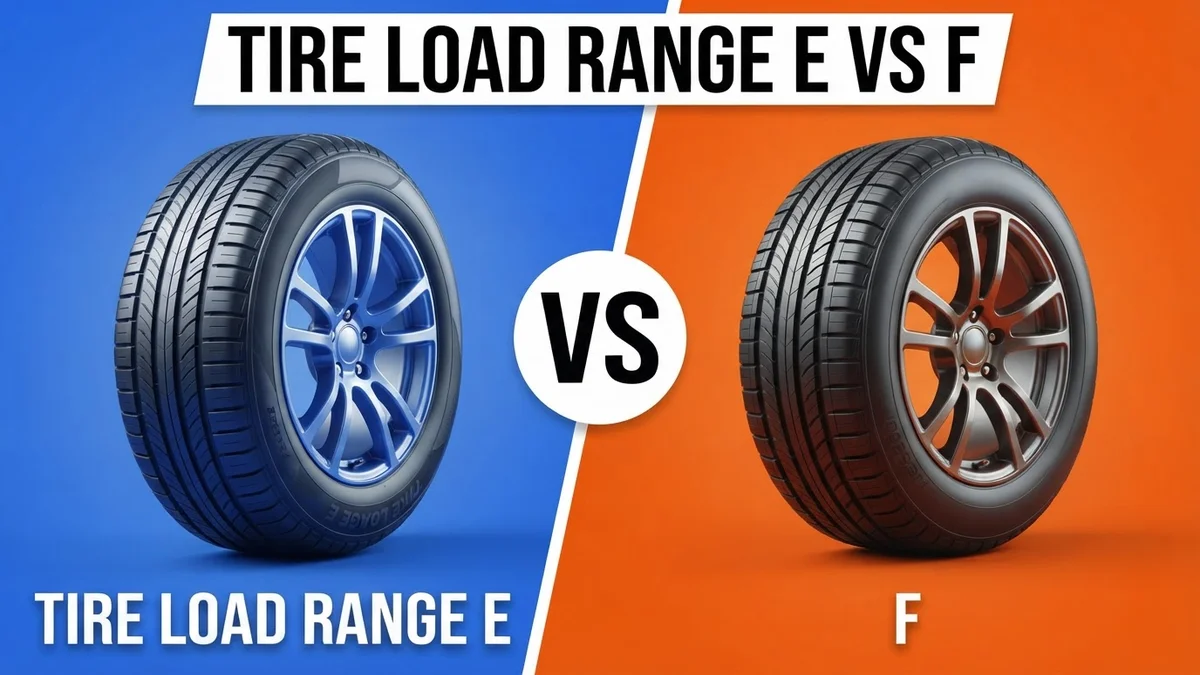
Tire Load Range E operates at a maximum pressure of 80 PSI using a traditional 10-ply rating equivalent. Stepping up to F pushes internal inflation limits to 95 PSI with a reinforced 12-ply equivalent construction. That 15 PSI pressure difference fundamentally changes how each tire supports massive payloads, resists tread squirm, and absorbs harsh road impacts.
✓ = better value in that row. Sourced from manufacturer specifications.
Tire Load Range E vs F: Performance & Category Ratings
Understanding how these two ratings perform requires looking at how extra internal plies affect daily driving mechanics. In our comparison, F dominated the pure utility categories. It earned a 9.8 out of 10 for Towing & Payload Capacity and a 9.5 for Durability & Off-Road Protection. The stiffer 12-ply casing and high 95 PSI operating threshold eliminate tread squirm when pulling heavy gooseneck trailers. The thicker rubber carcass resists punctures from jagged rocks and construction debris.
However, Tire Load Range E took the crown across everyday usability metrics. E earned a 7.2 out of 10 for Ride Comfort compared to a harsh 5.5 for F. When driving an unloaded 3/4-ton truck, E cushions expansion joints far better. Value for Money favored E heavily at 9.0 versus 7.5 for F, driven by lower retail prices and longer overall tread life under standard duties.
Fuel economy also tilted toward E with a 7.8 rating against 6.8 for F. The extra steel and fabric belts in F add noticeable rotational mass, which burns extra diesel during stop-and-go acceleration. Finally, E crushed the competition in Market Availability with a near-perfect 9.8 rating. Virtually every tire center stocks E-rated sizes, while F remains a specialized order item scoring just 7.0.
Load Range E
Load Range F
Tire Load Range E Vs F by the Numbers
Raw specs reveal the stark physical trade-offs built into these tire structures. Comparing inflation limits, structural ply equivalents, and maximum wheel loads highlights why each tire feels totally different on the highway.
Load Range E
Load Range F
Hover any bar for exact values. Each metric scaled independently.
Tire Load Range E: Strengths and Weaknesses
Tire Load Range E remains the benchmark standard for light-duty commercial trucks and passenger-driven heavy-duty pickups. Rated for up to 3,640 lbs per tire at 80 PSI, a set easily supports the full gross vehicle weight rating (GVWR) of modern 3/4-ton and 1-ton trucks. The 10-ply equivalent construction offers excellent structural support without turning your truck’s rear suspension into a concrete block.
We found that daily driving on E-rated tires keeps cab vibration low. The sidewalls flex just enough over sharp bumps, earning a respectable 7.2 comfort rating. Fuel economy stays respectable at a 7.8 rating because the lower weight reduces rolling resistance. If you get a flat tire on a cross-country towing trip, the 9.8 availability rating means almost any roadside shop will have a replacement sitting on the shelf.
The main limitation surfaces under extreme commercial work. When loaded to absolute gross limits with top-heavy slide-in campers, E tires display minor lateral sway compared to stiffer alternatives.
If you want the ideal balance between everyday highway comfort and dependable towing performance, taking a closer look at Tire Load Range E options will help you lock in the right setup.
Price & availability subject to change. As an Amazon Associate we earn from qualifying purchases.
F: Strengths and Weaknesses
F tires bring extreme industrial utility to heavy pickups and commercial chassis cabs. Built to handle up to 95 PSI, this rating uses a 12-ply equivalent casing engineered for brutal workloads. It commands a 9.8 towing and payload score, providing incredible tracking stability when pulling severe loads. Sidewall squirm disappears, even when hauling top-heavy slide-in campers or heavy machinery trailers.
Off-road durability is exceptional, scoring a 9.5 rating. The extra casing layers shield the carcass from sharp gravel, shale, and hidden construction site rebar. For severe off-grid hauling or commercial work sites, these tires resist carcass penetration far better than standard options.
The compromises appear the moment you empty the truck bed. Ride quality drops to a stiff 5.5 rating. At empty highway pressures, the extra-rigid tread carcass bounces over small bumps and transmits chatter straight through the frame. Fuel economy drops to a 6.8 rating due to heavy construction materials. Replacement availability scores a modest 7.0, meaning a blown tire on a remote highway might leave you stranded waiting for a special shipment.
When maximum weight capacity and ultimate tread puncture resistance are non-negotiable requirements for your work truck, exploring available F options is your logical next move.
Price & availability subject to change. As an Amazon Associate we earn from qualifying purchases.

- ✅ Lower retail price saving around $280 per full set of four tires
- ✅ Noticeably smoother unladen ride quality for daily driving duties
- ✅ Wider selection of tread designs, winter ratings, and major manufacturers
- ✅ Lower rotational mass improves overall fuel economy and stopping distance
- ✅ Direct fitment for standard factory 3/4-ton and 1-ton truck wheels
- ❌ Lower maximum load capacity limit per tire (3,640 lbs vs 3,970 lbs)
- ❌ Slightly more sidewall squirm under heavy high-profile trailer loads
- ❌ Less sidewall puncture resistance than 12-ply commercial options
- ✅ Higher maximum load rating reaching up to 3,970 lbs per tire at 95 PSI
- ✅ Ultra-stiff 12-ply sidewall construction minimizes sway with fifth-wheel trailers
- ✅ Superior puncture resistance for demanding commercial and rocky job sites
- ✅ Maintains structural integrity under constant heavy commercial hauling
- ❌ Significantly stiffer and harsher ride when driving the truck empty
- ❌ Higher weight adds rotational resistance and lowers fuel economy
- ❌ Requires high-pressure rated wheels capable of safely holding 95 PSI
- ❌ Limited availability across common light truck tire models and sizes
Tire Load Range E or F: Which Should You Choose?
Are you pulling heavy commercial loads every single day, or does your truck spend most of its time commuting empty with a travel trailer hooked up on weekends? Answering that single operational question directs you straight to the right tire.
Choose Tire Load Range E if your pickup pulls double duty as a family commuter and weekend tow vehicle. It supports fifth-wheels, toy haulers, and horse trailers without degrading your truck’s daily ride quality. You save money at purchase time, save fuel during long highway trips, and enjoy widespread replacement availability. To maintain your tires properly, keep a accurate 🛒 Digital Tire Pressure Gauge → in your glovebox and rely on a standard 🛒 Class 5 Trailer Hitch → for your towing setups.
Choose F if you operate a commercial fleet, transport heavy slide-in bed campers, or haul severe payloads daily. The 95 PSI ceiling stops high-load tire squirm dead in its tracks. If you spend considerable time pulling heavy trailers across rocky off-road job sites, the extra casing plies provide indispensable puncture resistance. Make sure you pack a portable 🛒 Heavy Duty Tire Inflator → capable of reaching 95 PSI to manage pressure changes on the job site.
Truck owners needing reliable 10-ply heavy towing capacity without an unbearable daily ride.
Commercial operators and heavy fifth-wheel haulers requiring maximum 12-ply sidewall stiffness.
Final Verdict: Tire Load Range E vs F
Tire Load Range E emerges as the clear overall winner for the vast majority of 3/4-ton and 1-ton truck owners. It comfortably supports up to 3,640 lbs per tire at 80 PSI, easily handling typical heavy-duty towing demands while keeping daily ride quality tolerable and fuel bills manageable.
Load Range F is a highly specialized tool built for extreme commercial payloads and high-stress towing environments. While its 95 PSI rating offers maximum payload stability and extreme puncture resistance, the harsh empty ride, lower fuel economy, higher purchase price, and limited market availability make it unnecessary for everyday truck owners. Stick with Tire Load Range E unless your continuous pin weights strictly require 95 PSI pressures.
As an Amazon Associate we earn from qualifying purchases.
Tire Load Range E vs F: Frequently Asked Questions
Is Tire Load Range E better than F?
For most buyers, Tire Load Range E is better because it offers a 3,640 lb capacity per tire at 80 PSI while maintaining reasonable ride comfort and saving about $70 per tire. Load Range F is only needed for extreme high-pressure towing near maximum trailer GCWR.
Can I put Load Range F tires on standard wheels?
Not always. Load Range F tires require up to 95 PSI, whereas many stock light truck wheels are only pressure-rated up to 80 PSI. Check your wheel's maximum pressure rating before buying Load Range F tires.
Does Load Range F last longer than Load Range E?
No, Load Range F tires typically yield shorter mileage warranties around 45,000 miles compared to 55,000 miles for Tire Load Range E. Their stiffer construction is engineered for weight support rather than extended highway treadwear.
How much stiffer is Load Range F compared to Load Range E?
Load Range F tires feature a 12-ply equivalent construction inflating to 95 PSI, making them roughly 20 percent stiffer than 80 PSI 10-ply Tire Load Range E tires, which creates a noticeably harsher ride over bumps when unladen.
Which load range is best for beginners towing heavy trailers?
Tire Load Range E is the ideal choice for beginners. It provides high payload capacities for trailers up to 14,000 lbs while maintaining compatibility with factory wheels and delivering acceptable unloaded ride comfort.
Can I Put Load Range F Tires on Wheels Rated for Load Range E?
No, you should not put Load Range F tires on wheels designed only for Load Range E without checking the wheel’s maximum pressure rating first. Load Range F tires operate at up to 95 PSI, whereas many standard 10-ply wheels are only rated for a maximum of 80 PSI. Exceeding your wheel rim’s pressure limit can cause catastrophic wheel failure.
Will Load Range F Tires Increase My Truck’s Official Towing Capacity?
No, mounting higher load-rated tires will never increase your vehicle’s official Gross Vehicle Weight Rating (GVWR) or Gross Combined Weight Rating (GCWR) set by the manufacturer. Load Range F tires simply offer greater tire-level safety margins, reduced tread flex, and higher puncture resistance when operating near your truck’s legal payload limits.
Why is Ride Comfort So Much Worse on Load Range F Tires?
Load Range F tires use a 12-ply equivalent structural carcass made with thicker steel and fabric belts designed to withstand 95 PSI. This extra reinforcement makes the tire sidewalls and tread face extremely stiff. When your truck is empty, the tires cannot flex over road imperfections, transmitting bumps directly into the truck suspension and cab.
Are Load Range E Tires Safe for Pulling Heavy Fifth-Wheel Trailers?
Yes, Load Range E tires are fully safe and represent the standard factory specification for most 3/4-ton and 1-ton trucks pulling fifth-wheel trailers. A set of four E-rated tires provides up to 14,560 lbs of total tire load capacity, which comfortably covers the rear axle weight and pin load of most personal RV trailers.