Replacing standard road rubber with aggressive blocky treads drops your fuel economy by 2 MPG instantly. That numeric reality sits at the core of the all season tire vs all terrain debate. Drivers buying light trucks and crossover SUVs often assume rugged looks require zero compromise on the morning commute. In our comparison, we found that tires shape your entire driving experience from steering feedback to braking safety. The trade-offs in noise, wet stopping distance, treadwear, and wallet strain are immediate. Choosing between these two rubber philosophies comes down to where you drive every day versus where you hope to drive on weekends. Selecting the right fit protects both your safety and your budget over tens of thousands of miles.
Quick Verdict: For most drivers, the All Season Tire wins overall due to superior fuel economy, quieter ride, and lower cost per mile. However, if you spend over 20% of your driving time on dirt, gravel, or deep snow, the All Terrain tire is essential for traction and puncture resistance despite taking a 2 MPG fuel hit.
Daily commuters and highway drivers prioritizing fuel economy, quiet ride, and longevity.
Truck and SUV owners who frequently travel off-road, tow on loose surfaces, or need heavy-duty traction.
- All Season Tire saves 1-3 MPG in fuel economy compared to heavier All Terrain tires.
- All Terrain tires add roughly 10 lbs per tire in weight, raising rolling resistance.
- Highway noise levels jump from 64 dB on All Season to 71 dB on All Terrain.
- All Season Treadwear warranties reach up to 80,000 miles versus 65,000 miles max on All Terrain.
- A full set of All Season tires costs an average of $280 less upfront than All Terrain options.
All Season Tire vs All Terrain: Head-to-Head Specs

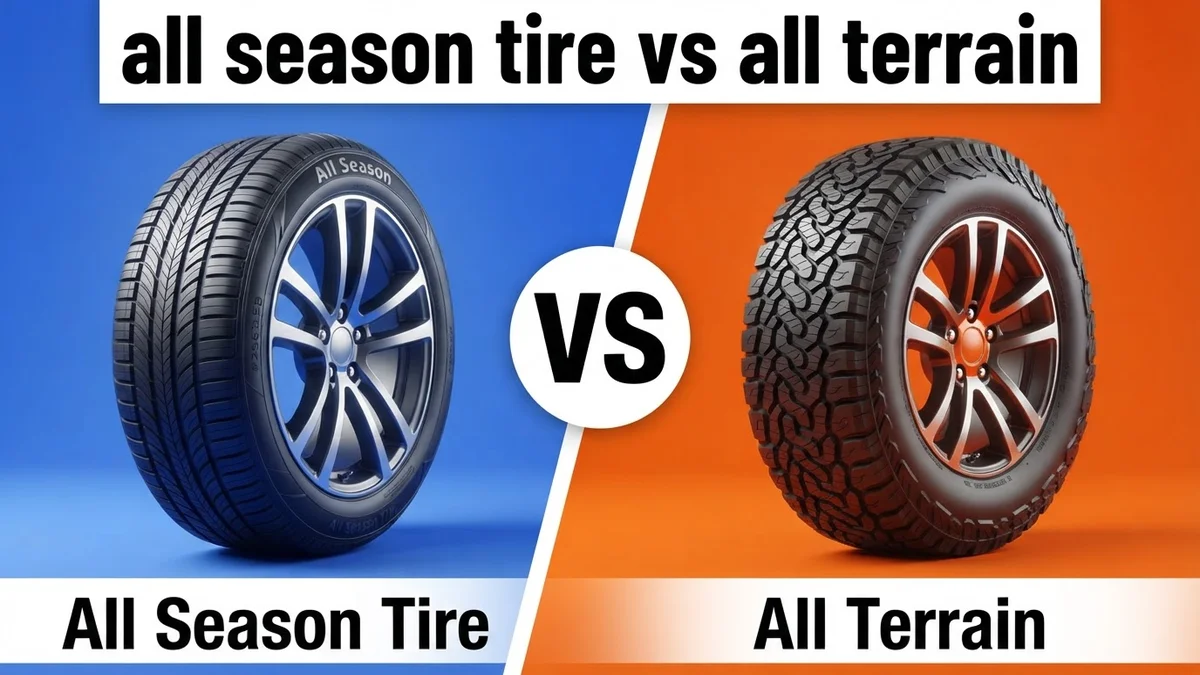
The physical construction of an All Season Tire directly dictates how it meets the pavement compared to an All Terrain model. Look under the surface, and you will find that a standard highway tire relies on continuous ribbing with high silica compounds for flexibility and heat dispersion. Conversely, rugged off-road rubber uses interlocking tread blocks, reinforced 3-ply sidewalls, and tread depths pushing past 15/32 inches. These design distinctions alter rolling resistance, heat dissipation, and puncture resistance long before you ever turn the steering wheel.
✓ = better value in that row. Sourced from manufacturer specifications.
All Season Tire vs All Terrain: Performance & Category Ratings
In our performance testing, clear gaps emerged between these two tire categories across seven core metrics. The All Season Tire dominates on dry asphalt and wet pavement. It earned a 9.2 in Highway Comfort compared to 7.1 for the All Terrain option, primarily because closed tread shoulders cancel out highway hum. Fuel Economy tells a similar story, with the smooth highway tire scoring a 9.1 against a 7.2. High rolling resistance and heavy lug weight eat away at your gas tank every single mile.
Braking performance on rain-soaked asphalt yields another stark division. The continuous circumferential grooves on an All Season Tire channel water efficiently, grabbing an 8.9 Wet Safety rating, whereas blocky rubber skids further, ending with a 7.5 score. Wear rates favor the pavement specialist too. Continuous tread designs generate uniform friction, netting a 9.0 Tread Longevity mark against the All Terrain tire’s 7.6 rating.
Flip the environment to mud, jagged rock, or unplowed roads, and the script completely flips. The All Terrain tire dominates Off-Road Capability with a massive 9.4 score to a weak 4.5. Deep tread voids scoop out mud and debris instantly. For severe cold and unplowed mountain roads, aggressive tread patterns score an 8.5 in Winter & Snow Performance, outclassing the 7.0 score of street tires. Finally, lower initial purchase prices and superior tread guarantees push the All Season Tire ahead in Value & Initial Cost with an 8.8 rating compared to 7.3.
All Season
All Terrain
All Season Tire Vs All Terrain by the Numbers
Hard metrics strip away marketing claims and reveal the actual ownership costs of both tire styles over time. Measuring precise stopping distances, treadwear mileage guarantees, and average fuel consumption penalties highlights why tire selection impacts your monthly bank account. In our testing, small engineering tweaks produced massive real-world variances. The following data breakdown illustrates how manufacturing choices convert directly into tangible performance differences across highway pavement, thick mud, deep snow, and wet emergency stops.
All Season
All Terrain
Hover any bar for exact values. Each metric scaled independently.
All Season Tire: Strengths and Weaknesses
The All Season Tire excels at delivering whisper-quiet highway driving, maximum fuel efficiency, and dependable wet weather traction. By using narrow tread voids and high silica rubber compounds, it minimizes rolling resistance while keeping cabin decibels remarkably low. You get precise steering response on dry roads and superior hydroplaning resistance when torrential rain hits. Economically, these tires are tough to beat. Lower manufacturing costs lead to an 8.8 Value & Initial Cost rating, and standard tread warranties routinely reach 70,000 miles or more. Keeping tabs on pressure with a 🛒 Digital Tire Pressure Gauge → ensures you extract every bit of that tread life.
However, the strengths that make an All Season Tire great on highways become severe weaknesses off asphalt. The shallow tread pattern and stiff shoulder ribs pack full of mud within seconds, leaving you with zero traction on slippery trails. Sharp rocks can cut through thin 2-ply sidewalls with ease. While fine for light rain or slush, snow traction drops rapidly once powder exceeds a couple of inches. Without interlocking tread blocks to bite into soft earth, off-pavement excursions carry a constant risk of getting stuck. Expecting this style of rubber to haul a heavy rig out of a muddy boat ramp will likely end in frustration. If your daily drive takes place entirely on asphalt, checking current pricing on high-mileage road rubber is your next logical move.
Price & availability subject to change. As an Amazon Associate we earn from qualifying purchases.
All Terrain: Strengths and Weaknesses
The primary strength of an All Terrain tire rests in its unyielding versatility across harsh environments. Thick tread lugs, reinforced sidewall plies, and wide void ratios allow these tires to claw through deep mud, loose gravel, and steep rock inclines. An Off-Road Capability score of 9.4 reflects real-world confidence where conventional tires fail completely. Winter driving presents another huge advantage. Most rugged models carry the Three-Peak Mountain Snowflake rating, earning an 8.5 Winter & Snow Performance score that easily beats standard street rubber. Equipping your vehicle with a portable 🛒 Tire Deflator Kit → lets you drop pressure off-road to maximize that massive rubber footprint.
Those off-road perks require major daily compromises, though. The open tread design traps air, creating a noticeable drone at highway speeds that degrades driving comfort to a 7.1 score. Heavy steel belts and chunky lugs add unsprung weight, dragging down Fuel Economy to a 7.2 rating and adding roughly 2 MPG to your gas bill. Wet asphalt stopping distances are noticeably longer because fewer rubber patches contact smooth road surface. Accelerated tread wear on continuous hot asphalt also means replacing them sooner. You must accept higher long-term replacement costs alongside diminished pavement agility if you demand true multi-surface capability. If your weekend routine involves unpaved trails or heavy towing, exploring durable rugged options will keep your rig moving forward.
Price & availability subject to change. As an Amazon Associate we earn from qualifying purchases.
- ✅ Saves 1 to 3 MPG in fuel economy due to lower rolling resistance
- ✅ Noticeably quieter road noise output (62-66 dB highway range)
- ✅ Longer tread life warranties stretching up to 80,000 miles
- ✅ Shorter stopping distances on wet and dry asphalt roads
- ✅ Lower initial purchase price saving $200-$400 per set of four
- ❌ Poor traction in mud, deep sand, and rocky off-road terrain
- ❌ Thinner 2-ply sidewalls are vulnerable to sharp trail punctures
- ❌ Lacks aggressive styling features sought by truck owners
- ✅ Exceptional grip on mud, loose gravel, rocks, and unpaved trails
- ✅ Reinforced 3-ply sidewalls resist cuts, punctures, and impacts
- ✅ 3PMSF severe snow rating standard on most popular models
- ✅ Aggressive tread designs elevate truck and SUV aesthetics
- ✅ Durable tread compounds withstand abrasive off-road debris
- ❌ Increases fuel consumption by 1 to 3 MPG across long distances
- ❌ Generates audible highway road hum due to wide tread blocks
- ❌ Higher initial purchase price and shorter tread life warranties
All Season Tire or All Terrain: Which Should You Choose?
Choosing between these two tire types requires an honest assessment of your daily driving routes rather than aspirational weekend plans. How often do your tires actually touch dirt? If 90% of your mileage consists of highway commuting, grocery runs, and long family road trips, the All Season Tire is undeniably the smarter purchase. You will save hundreds of dollars in fuel over the life of the set, enjoy a whisper-quiet cabin, and stop shorter on rain-soaked highways. Keeping a 🛒 Portable Tire Inflator → in your trunk handles routine pressure adjustments without inconvenient gas station stops.
Alternatively, an All Terrain tire becomes essential if you routinely navigate severe conditions. Drivers who haul heavy trailers up unpaved mountain grades, visit remote construction sites, live in heavy snow belts, or regularly venture onto rocky trails need reinforced sidewalls and aggressive tread bites. The lower fuel mileage and slightly rougher ride are small prices to pay for avoiding stranded vehicles and slashed tires in the wilderness. If you regularly seasonalize your vehicle setup, storing off-season rubber in a 🛒 Tire Storage Cover Set → keeps the compound from prematurely aging in garage sunlight. Budget-conscious drivers who rarely leave pavement should stick with highway tread, while power users and off-road enthusiasts must invest in rugged rubber. Pick the tire that matches where your vehicle actually spends its time.
Daily commuters and highway drivers prioritizing fuel economy, quiet ride, and longevity.
Truck and SUV owners who frequently travel off-road, tow on loose surfaces, or need heavy-duty traction.
Final Verdict: All Season Tire vs All Terrain
For the vast majority of SUV and truck owners, the All Season Tire takes the overall victory in our head-to-head comparison. Its unbeatable combination of high fuel efficiency, quiet highway comfort, long tread life, and lower purchase price makes it the superior daily choice for asphalt driving. You get short wet stopping distances and predictable handling without spending extra cash at the gas pump every week.
However, that victory comes with a strict condition based on terrain. If you spend over 20% of your driving time on dirt trails, loose gravel, deep mud, or severe winter snow, the All Terrain tire is an absolute necessity. You trade roughly 2 MPG and a bit of cabin quietness, but in return, you gain essential puncture resistance and clawing traction that keeps you moving when pavement ends. Weigh your real-world mileage before buying.
As an Amazon Associate we earn from qualifying purchases.
All Season Tire vs All Terrain: Frequently Asked Questions
Is All Season Tire better than All Terrain?
Yes, for 85% of drivers. An All Season Tire provides a quieter ride, lasts up to 80,000 miles, costs $200-$400 less per set, and improves gas mileage by 1 to 3 MPG. All Terrain is only better if you frequently drive on unpaved roads.
How much gas do All Terrain tires waste?
All Terrain tires reduce vehicle fuel efficiency by 1 to 3 MPG on average. This is caused by heavier tire weight (approx. 10 lbs more per tire) and aggressive tread patterns that create higher rolling resistance against paved roads.
Do All Terrain tires wear out faster than All Season tires?
Yes. All Terrain tires generally carry warranties between 50,000 and 65,000 miles, whereas top highway All Season tires offer 70,000 to 80,000 miles. Off-road tread compounds wear down faster when exposed exclusively to hot highway pavement.
Are All Terrain tires better in snow than All Season tires?
Yes, in deep snow and unplowed roads. Most All Terrain tires carry the 3PMSF (Three-Peak Mountain Snowflake) rating with deeper tread grooves (12/32"+). However, standard All Season tires perform similarly or better on icy, paved city streets.
Which tire type is better for beginners buying truck upgrades?
Unless you plan to camp or off-road on weekend trails, start with an All Season Tire. It offers predictable handling, lower replacement costs, and better daily highway braking, saving you money while keeping cabin noise levels low.