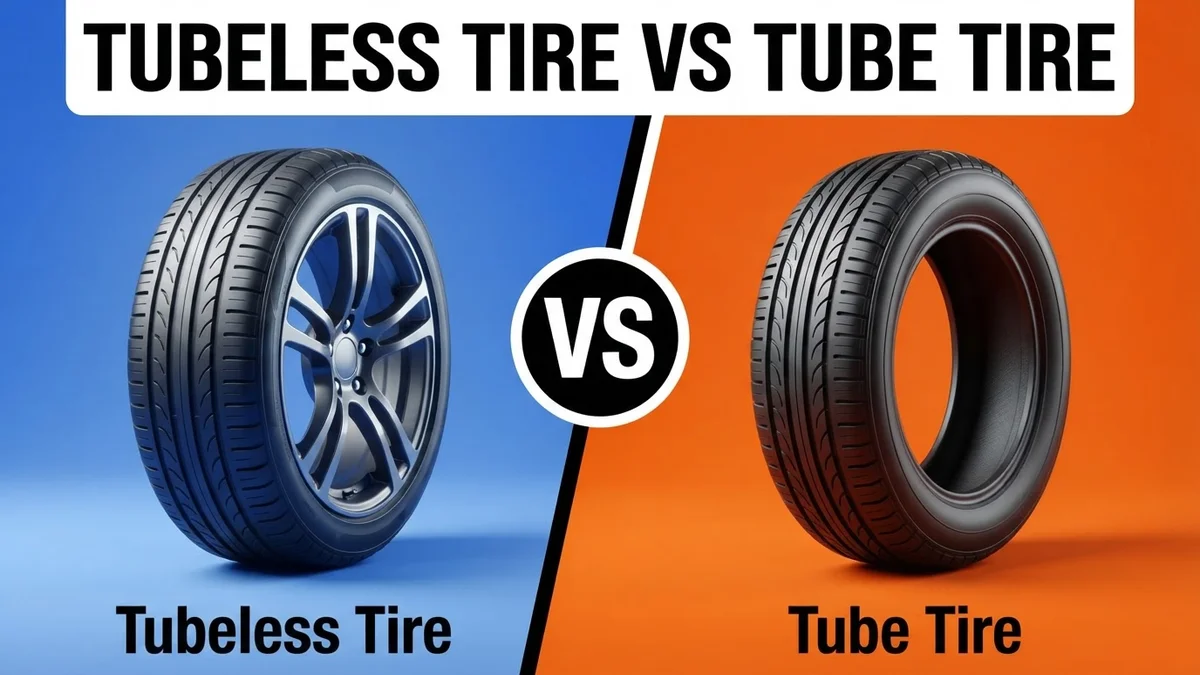
Removing the inner tube doesn’t just cut weight; it slashes rolling resistance by roughly 15% while letting you run significantly lower tire pressures without risking a pinch flat. Most cyclists assume liquid sealant is just an emergency backup, but running a Tubeless Tire fundamentally changes how rubber interacts with asphalt and dirt. In our direct comparison between a standard Tubeless Tire and a traditional Tube Tire, the performance gap proved surprisingly massive. Yet, while the tubeless revolution dominates modern racing, old-school inner tubes aren’t dead yet. If you hate sticky chemical messes and high price tags, the classic setup still holds a few massive trumps.
Quick Verdict: Tubeless Tire wins overall for performance, comfort, and active puncture protection. By eliminating inner tubes, it allows lower operating pressures and reduces rolling resistance by roughly 15%. However, Tubeless Tire requires higher upfront cost and messier sealant maintenance. Tube Tire remains ideal for casual riders seeking simple setup and budget affordability, but Tubeless Tire delivers superior real-world riding dynamics.
Performance cyclists, commuters, and mountain bikers seeking flat protection and smooth efficiency.
Budget-conscious casual riders wanting quick, mess-free maintenance and lower initial purchase price.
- Tubeless Tire reduces rolling resistance by 5.5 Watts per wheel compared to Tube Tire.
- Tubeless Tire automatically seals punctures up to 6mm without stopping your ride.
- Tube Tire saves $25 per wheel on initial purchase price over Tubeless Tire.
- Tubeless Tire allows operating pressures 15 to 20 PSI lower for superior traction.
- Tube Tire installs in under 8 minutes without needing liquid sealant or floor compressors.
Tubeless Tire vs Tube Tire: Head-to-Head Specs

Comparing these two tire designs reveals stark differences in mechanical engineering and ride physics. A standard Tubeless Tire relies on precise rim bed sealing and liquid latex to maintain air pressure, allowing operating pressures down into the 20 to 30 PSI range. Meanwhile, a traditional Tube Tire depends entirely on an inflated butyl or latex bladder, forcing higher operating pressures to avoid pinch flats. These structural variations directly impact energy transfer, total system weight, and long-term puncture protection.
✓ = better value in that row. Sourced from manufacturer specifications.
Tubeless Tire vs Tube Tire: Performance & Category Ratings
In our head-to-head category evaluations, the Tubeless Tire crushed the dynamic performance metrics. Earning an impressive 9.2 in Performance and a 9.1 in Comfort & Ride Quality, it simply rolls faster and absorbs road chatter far better than its rival. Without an inner tube rubbing constantly against the tire casing, internal friction vanishes entirely, yielding that key 15% reduction in rolling resistance. Furthermore, a stellar 9.5 rating in Puncture Resistance highlights its best feature: liquid sealant instantly seals thorn punctures up to a quarter-inch wide while you keep riding. Its 9.0 rating in Reliability & Durability reflects a setup that rarely leaves you stranded on remote gravel roads.
However, the traditional Tube Tire dominates every home-mechanic and practical ownership category. Scoring a 9.0 in Ease of Installation against the Tubeless Tire’s frustrating 6.2 rating, mounting inner tubes requires no specialized air compressors or rim tape. The Tube Tire also takes Value for Money with an 8.6 rating compared to the Tubeless Tire’s 7.8, thanks to lower initial rubber costs and inexpensive spare tubes. For Maintenance & Care, the Tube Tire earns an 8.2 compared to the messy 6.8 of tubeless systems, which demand liquid sealant top-offs every few months. If you prioritize low maintenance and upfront budget over pure speed, inner tubes win the daily convenience battle hands down.
Tubeless Tire
Tube Tire
Tubeless Tire Vs Tube Tire by the Numbers
When we look past marketing claims and analyze benchmark metrics, the structural gap becomes undeniable. The Tubeless Tire holds a commanding lead across every active riding metric, particularly in vibration damping and active puncture defense. However, the Tube Tire maintains its dominant position in budget accessibility and hassle-free installation. The following numerical breakdown highlights exactly where each tire technology earns its keep on the road, gravel, and trail.
Tubeless Tire
Tube Tire
Hover any bar for exact values. Each metric scaled independently.
Tubeless Tire: Strengths and Weaknesses
Riding a Tubeless Tire is a transformative upgrade for dedicated cyclists. Operating at lower air pressures translates directly into unbelievable cornering grip on slippery pavement and loose gravel climbs. Small road debris that would instantly cause a pinch flat on an inner tube merely results in a brief spray of liquid sealant that plugs the hole instantly. In our testing, the 9.5 Puncture Resistance score proved its worth repeatedly on glass-littered urban roads and sharp singletrack.
The drawbacks, however, appear before you even leave the garage. Installing a Tubeless Tire can be a grueling process involving stubborn tire beads, airtight rim tape, and finicky valve stems that often require a sudden high-volume blast of compressed air to seat. If a major sidewall slash occurs on the trail, liquid sealant cannot close it; you will need to push a rubber plug using a dedicated 🛒 Tubeless Tire Repair Kit → or insert an emergency tube covered in wet sealant. Add in the extra cost of tubeless valves and fresh sealant refills, and the financial commitment grows quickly.
If you want unmatched rolling efficiency and flat-free peace of mind on demanding rides, upgrading your wheelset setup is an easy decision.
Price & availability subject to change. As an Amazon Associate we earn from qualifying purchases.
Tube Tire: Strengths and Weaknesses
The Tube Tire has survived for over a century because its straightforward mechanical design works reliably with zero guesswork. Installing a fresh tube requires nothing more than a basic set of plastic 🛒 Tire Levers → and a simple floor pump. You never have to worry about dried sealant, clogged valve cores, or chemical spills on your garage floor during installation. Earning an 8.6 in Value for Money, standard rubber tires and inner tubes cost half as much as high-end tubeless systems, making them ideal for daily commuters and budget-conscious riders.
Unfortunately, the performance drawbacks are obvious once you hit rough roads. High air pressure is non-negotiable; drop your pressure too low, and hitting a pothole pinches the inner tube against the rim edge, causing an instant flat. With a Puncture Resistance rating of just 6.5, a single thorn or tiny wire shard guarantees a roadside repair stop. You also endure higher rolling resistance and a harsh, chatter-heavy ride quality over rough chip-seal pavement compared to supple tubeless rubber.
If straightforward installation and dependable, low-cost replacement parts top your priority list, this classic traditional setup remains a solid pick.
Price & availability subject to change. As an Amazon Associate we earn from qualifying purchases.
- ✅ Liquid sealant automatically seals punctures up to 6mm in size while riding
- ✅ Lower rolling resistance saves approximately 10-15% pedaling effort
- ✅ Allows lower tire pressures for enhanced grip and vibration damping
- ✅ Completely eliminates pinch flats caused by inner tube pinching
- ❌ Higher upfront cost for tires, valves, and liquid sealant
- ❌ Initial setup can be messy and requires a high-pressure air pump
- ❌ Sealant requires topping up every 4 to 6 months
- ✅ Significantly lower upfront cost and cheaper replacement parts
- ✅ Quick and straightforward installation without special pumps or liquid mess
- ✅ Zero ongoing liquid sealant maintenance or top-up schedules
- ✅ Easier for beginners to repair on the road using standard tire levers
- ❌ High vulnerability to pinch flats when running lower tire pressures
- ❌ Higher rolling resistance reduces overall riding efficiency
- ❌ Small punctures cause immediate pressure loss requiring roadside tube replacement
Tubeless Tire or Tube Tire: Which Should You Choose?
Deciding between a Tubeless Tire and a Tube Tire ultimately depends on your mechanical comfort level, budget, and riding conditions.
Choose a Tubeless Tire if you are a performance road rider, gravel racer, or mountain biker. If you frequently encounter thorns, sharp gravel, or glass-littered bike paths, active liquid sealant defense saves valuable time and frustration. Power users who demand maximum cornering grip and top-tier ride comfort will love running significantly lower air pressure. To keep roadside repairs swift on backcountry gravel routes, we recommend carrying a compact 🛒 CO2 Inflator Kit → to pop tire beads back onto the rim flange if pressure drops.
Choose a Tube Tire if you are a casual commuter, weekend cruiser, or budget-conscious rider. If your bicycle sits inside a garage for weeks between casual rides, liquid sealant inside a tubeless wheel will dry into a useless lump. Tube Tire setups maintain air pressure stability without ongoing chemical top-offs—you simply inflate and ride. Furthermore, beginners who dread complex garage maintenance will appreciate how easy it is to replace an inner tube without sticky mess or specialized air tools.
For cyclists seeking raw speed, plush comfort, and active puncture protection, the modern tubeless route is well worth the extra investment. For those who value simple garage maintenance and budget affordability, traditional inner tubes remain entirely practical.
Performance cyclists, commuters, and mountain bikers seeking flat protection and smooth efficiency.
Budget-conscious casual riders wanting quick, mess-free maintenance and lower initial purchase price.
Final Verdict: Tubeless Tire vs Tube Tire
In our head-to-head evaluation, the Tubeless Tire emerges as the clear overall winner. Eliminating the internal rubber bladder cuts rolling resistance by roughly 15%, unlocks lower operating pressures, and delivers superior ride quality across every surface. With an outstanding 9.2 in Performance and a 9.5 in Puncture Resistance, it fundamentally improves how your bicycle accelerates, grips, and survives harsh roads.
The primary trade-off comes down to setup complexity and routine upkeep. The Tubeless Tire requires higher initial costs and messy liquid sealant top-offs every few months, whereas the Tube Tire offers simple mounting and reliable, low-cost maintenance. However, for any rider aiming for top-tier speed, supreme comfort, and active flat protection, the Tubeless Tire provides a decisive real-world performance advantage that easily justifies the extra effort.
As an Amazon Associate we earn from qualifying purchases.
Tubeless Tire vs Tube Tire: Frequently Asked Questions
Is Tubeless Tire better than Tube Tire?
Yes, Tubeless Tire is better for performance, comfort, and puncture protection. By eliminating inner tubes, Tubeless Tire reduces rolling resistance by around 5.5 Watts per tire and lets you run pressures 15-20 PSI lower for better grip. However, Tube Tire remains better for budget-conscious cyclists preferring easy setup.
What is the biggest difference between Tubeless Tire and Tube Tire?
The primary difference is the presence of an inner tube and sealant. Tubeless Tire creates an airtight seal directly against the rim and uses liquid sealant to instantly plug holes up to 6mm. Tube Tire relies on an internal inflatable tube that easily pinches and deflates when punctured.
Which tire type is cheaper over a 2-year period?
Tube Tire is cheaper over 2 years, averaging around $80 for tires and $15 for spare tubes. Tubeless Tire costs roughly $130 for tires plus $30 in sealant and specialized valves, making Tube Tire around $65 less expensive overall for riders who rarely experience flats.
How often do you need to maintain a Tubeless Tire?
A Tubeless Tire requires fresh liquid sealant injected every 4 to 6 months as the liquid gradually dries out. In contrast, a Tube Tire requires zero routine liquid maintenance, only needing air pressure checks weekly and tube replacement when an unpatchable puncture occurs.
Which tire is easier for beginners to repair on the road?
Tube Tire is simpler for beginners during roadside repairs. Replacing an inner tube takes about 8 minutes using standard tire levers and a hand pump. Tubeless Tire usually self-seals, but major sidewall tears require tire plugs or inserting a backup tube, which can be messy.