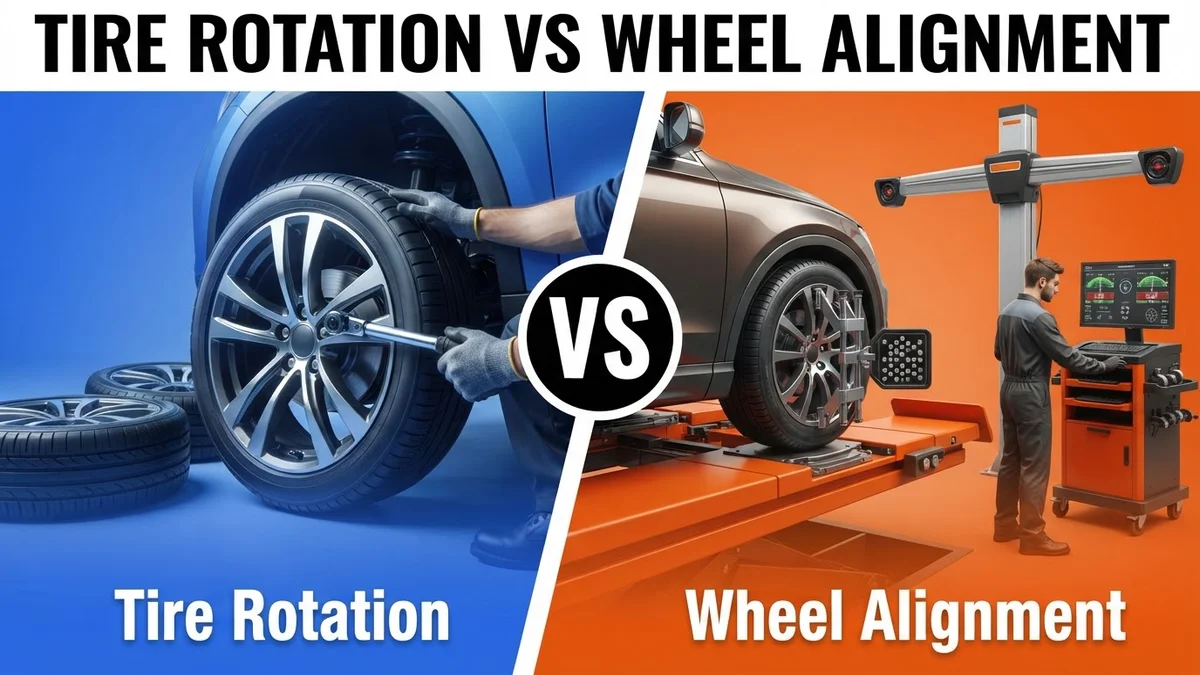
Most drivers assume tread wear comes from steering friction, but uneven vehicle weight distribution actually destroys tires twice as fast as crooked alignment angles. Skipping a quick $35 service regularly destroys a $1,000 set of rubber long before suspension geometry ever gets the chance to ruin it. In our head-to-head comparison, we pitted Tire Rotation against Wheel Alignment to determine where your routine vehicle maintenance dollars actually belong. While both procedures aim to protect tread life, they fix fundamentally different issues. One swaps wheel positions to even out friction, whereas the other mechanically adjusts physical suspension angles. Understanding this crucial technical distinction saves hundreds at the repair shop.
Quick Verdict: While both services protect overall tire life, Tire Rotation wins for routine prevention with its budget-friendly $35 cost and frequent 6,000-mile interval. Wheel Alignment costs more at $125 but fixes structural steering drift and severe suspension misalignments. Perform Tire Rotation regularly every oil change, and reserve Wheel Alignment for yearly tune-ups or steering issues.
Car owners wanting low-cost routine tread maintenance every 5,000 to 7,500 miles.
Drivers experiencing steering pull, uneven edge wear, or after hitting severe road hazards.
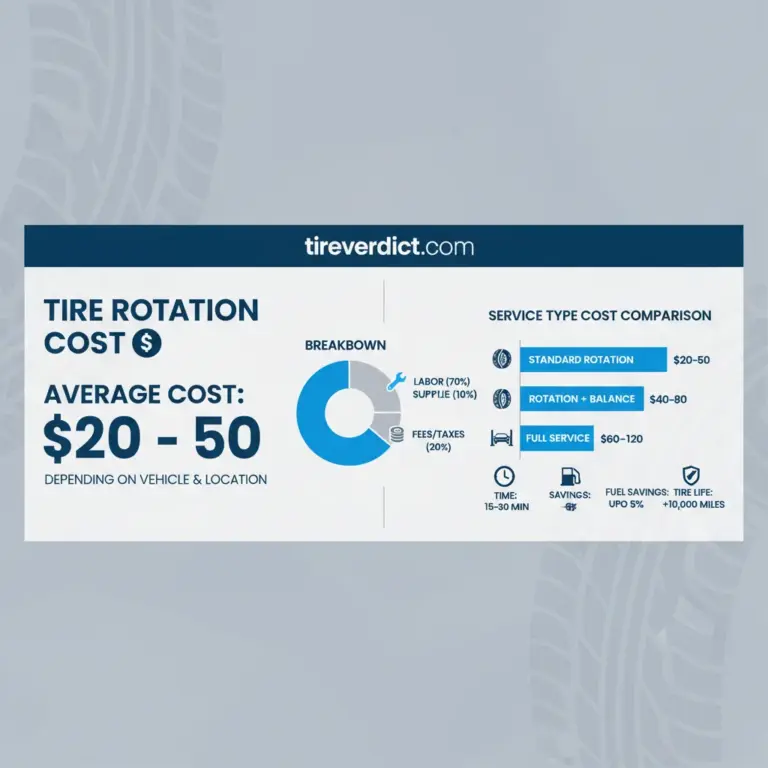
- Tire Rotation costs an average of $35 compared to $125 for a Wheel Alignment.
- Tire Rotation should occur every 6,000 miles, whereas Wheel Alignment is recommended every 12,000 miles.
- A proper Wheel Alignment can improve fuel efficiency by up to 3% by reducing drag.
- Tire Rotation takes only 20 minutes, while Wheel Alignment requires 50 minutes of service time.
- Combining both maintenance services regularly extends tire tread life to 60,000 miles or more.
Tire Rotation vs Wheel Alignment: Head-to-Head Specs
Looking at raw service specifications, two major operational differences separate these maintenance tasks: financial cost and service frequency. Tire Rotation demands a modest $35 standard fee every 6,000 miles, making it a frictionless add-on during routine oil changes. In contrast, Wheel Alignment carries a higher $125 price tag and typically occurs every 12,000 miles or once per calendar year. Service speed also diverges sharply, as rotating four tires takes roughly 15 minutes, whereas realigning complex suspension geometry requires a full hour on specialized rack machinery.
✓ = better value in that row. Sourced from manufacturer specifications.
Tire Rotation vs Wheel Alignment: Performance & Category Ratings
In our category benchmark breakdown, each service dominates specific operational areas. Tire Rotation steals the crown for overall Value for Money with an outstanding 9.4 rating compared to Wheel Alignment‘s 8.1 score. Spending $35 twice a year pays massive longevity dividends by extending overall tread life across all four wheel positions. It also leads Maintenance Frequency (8.7 vs 7.6) and Service Speed (9.2 vs 7.4) because shop technicians can swap tire positions in under fifteen minutes during routine oil changes.
For home mechanics, DIY Friendliness heavily favors Tire Rotation with an 8.6 score versus a dismal 1.5 for Wheel Alignment. Anyone equipped with a reliable 🛒 Heavy-Duty Hydraulic Floor Jack → and jack stands can complete a proper rotation in their driveway. Realigning suspension angles, however, demands specialized optical sensors, computer targets, and expensive alignment racks that home mechanics simply cannot access.
Where Wheel Alignment shines is structural suspension correction. It earns a dominant 9.3 rating for Driving Comfort Impact against Tire Rotation’s 7.1, along with a massive 9.5 rating for Severe Wear Prevention. Realigning camber, caster, and toe angles stops structural vehicle drift in its tracks. A rotated tire mounted on a crooked axle will still wear away rapidly, making alignment the undisputed winner for catastrophic tire damage prevention.
Tire Rotation
Wheel Alignment
Tire Rotation Vs Wheel Alignment by the Numbers
Quantifying these two services reveals a stark contrast in cost efficiency, precision requirements, and shop labor intensity. While Tire Rotation presents a minimal $35 price point with exceptionally rapid turnaround times, Wheel Alignment demands greater capital investment for specialized laser guidance equipment and trained chassis technicians. The raw benchmark numbers below highlight how preventative maintenance schedules diverge between simple rotational wheel swaps and highly technical vehicle suspension realignments.
Tire Rotation
Wheel Alignment
Hover any bar for exact values. Each metric scaled independently.
Tire Rotation: Strengths and Weaknesses
Tire Rotation excels as the single most cost-effective habit for prolonging tire rubber. Front tires handle the heavy brunt of steering friction, turning torque, and front-engine weight, causing them to wear down significantly faster than rear tires on front-wheel-drive vehicles. Swapping wheels between axles every 6,000 miles balances out these aggressive wear patterns across all four tires. The modest $35 service fee delivers immense long-term value, making it an essential task alongside every oil change. Home mechanics can easily complete this procedure in their garage using basic tools and a calibrated 🛒 Torque Wrench Set → to properly torque lug nuts.
However, Tire Rotation isn’t a miraculous fix for pre-existing suspension faults. Moving a tire suffering from severe edge wear or diagonal cupping to the rear axle merely relocates the damaged rubber—it does not solve the underlying mechanical problem causing it. If your car drifts toward the shoulder, rotating tires will not bring the vehicle back into a straight tracking line. It remains strictly a preventative maintenance routine rather than a corrective mechanical repair tool.
If you want to keep your current set of tires wearing evenly without spending high dealer service fees, scheduling this service is your best next step.
Price & availability subject to change. As an Amazon Associate we earn from qualifying purchases.
Wheel Alignment: Strengths and Weaknesses
Wheel Alignment operates as a precise surgical correction for your vehicle’s physical suspension geometry. When you strike a harsh pothole or bump a curb, the subtle angles holding your wheels parallel—camber, caster, and toe—knock completely out of manufacturer specification. Aligning those angles back to factory tolerances scores an unmatched 9.5 in severe wear prevention. It eliminates steering wheel vibration, tracks straight on open highways, and delivers superior driving comfort with a top-tier 9.3 rating. Checking tire inflation with a 🛒 Digital Tire Pressure Gauge → helps maintain efficiency, but nothing restores tracking stability quite like aligned suspension geometry.
The primary drawbacks of Wheel Alignment are overall cost and technical accessibility. At $125 per visit, an alignment costs nearly four times as much as a standard tire rotation. It earns a low 1.5 rating for DIY friendliness because common home tools cannot replicate the sub-millimeter accuracy of optical alignment equipment. Additionally, performing an alignment on badly worn tires will not magically restore tread depth that has already scrubbed away.
If your steering wheel sits off-center or your vehicle actively drifts across lane lines, investing in a professional alignment will immediately protect your tires from severe destruction.
Price & availability subject to change. As an Amazon Associate we earn from qualifying purchases.
- ✅ Inexpensive service averaging just $25 to $45 per visit
- ✅ Often bundled free with new tire purchases or routine oil change packages
- ✅ Can easily be performed in your own driveway with basic jack stands
- ✅ Prevents front tires from wearing down twice as fast as rear tires
- ✅ Fast turnaround time taking under 20 minutes at most auto shops
- ❌ Does not correct mechanical suspension or alignment geometry issues
- ❌ Must be performed frequently every 5,000 to 7,500 miles
- ❌ Cannot stop uneven tire wear caused by faulty camber or toe angles
- ✅ Eliminates vehicle pulling, drifting, and crooked steering wheel angles
- ✅ Prevents rapid inner or outer tread edge scrubbing
- ✅ Improves fuel economy by reducing total tire rolling resistance
- ✅ Protects expensive steering and suspension components from premature failure
- ❌ Significantly higher service cost averaging $85 to $175
- ❌ Requires professional computer-assisted alignment machinery
- ❌ Takes 45 to 60 minutes to complete in a specialized automotive bay
Tire Rotation or Wheel Alignment: Which Should You Choose?
Selecting between these two vital auto services depends heavily on your daily driving conditions, overall budget, and active vehicle behavior.
For everyday commuters traveling on smooth city asphalt, routine Tire Rotation serves as your frontline defense against wear. Sticking to a strict 6,000-mile rotation schedule ensures your tread wears down uniformly across all four corners. If you are operating on a strict budget, the $35 service price delivers maximum tread life per dollar spent. Weekend DIY enthusiasts will also prefer rotation because simple garage tools like a hydraulic jack and durable 🛒 Wheel Chocks → allow you to perform the procedure at home without commercial rack equipment.
Conversely, harsh driving environments demand the surgical precision of Wheel Alignment. If your daily commute involves rutted country roads, frequent winter potholes, or heavy trailer towing, your suspension geometry endures severe mechanical impacts. Driver feedback is key to identifying this necessity. Are you noticing your car pull noticeably toward the shoulder on a flat highway? If your steering wheel sits crooked while driving straight ahead, Tire Rotation cannot fix the root issue. You require a $125 Wheel Alignment to physically recalibrate suspension angles before improper alignment scrubs off expensive tread.
High-mileage commuters and drivers purchasing a fresh $800 set of tires should combine both practices. Request a professional alignment immediately after mounting brand-new tires, then execute regular rotations during every scheduled oil change to protect your automotive investment long-term.
Car owners wanting low-cost routine tread maintenance every 5,000 to 7,500 miles.
Drivers experiencing steering pull, uneven edge wear, or after hitting severe road hazards.
Final Verdict: Tire Rotation vs Wheel Alignment
In our head-to-head evaluation, Tire Rotation wins as the best overall choice for routine vehicle maintenance. Its ultra-accessible $35 service price and predictable 6,000-mile schedule make it the ideal low-cost, high-reward habit for extending tire life. It outperformed Wheel Alignment in Value for Money (9.4 vs 8.1), Service Speed (9.2 vs 7.4), and DIY Friendliness (8.6 vs 1.5), earning its place as an essential routine service.
However, the fundamental trade-off boils down to preventative care versus corrective repair. While Tire Rotation evenly distributes natural rubber wear across all four positions, Wheel Alignment remains the indispensable $125 solution for resolving structural steering drift and severe suspension misalignments. We recommend performing a Tire Rotation every 6,000 miles during routine oil changes, while reserving Wheel Alignment for annual tune-ups or whenever active steering issues occur.
As an Amazon Associate we earn from qualifying purchases.
Tire Rotation vs Wheel Alignment: Frequently Asked Questions
Is Tire Rotation better than Wheel Alignment?
Neither service is better because they solve different problems. Tire Rotation redistributes normal tread wear for $35 every 6,000 miles. Wheel Alignment adjusts suspension angles for $125 to stop drift and edge scrubbing. Doing both routinely maximizes your tire set's full 60,000-mile potential.
How much do Tire Rotation and Wheel Alignment cost in 2026?
In 2026, a stand-alone Tire Rotation costs between $25 and $45, though many tire retailers offer it free. A 4-wheel Wheel Alignment costs between $85 and $175 depending on vehicle type and whether modern steering sensor recalibrations are required.
How often should I get a Tire Rotation vs Wheel Alignment?
Schedule a Tire Rotation every 5,000 to 7,500 miles alongside regular oil changes. Get a Wheel Alignment checked once per year or every 10,000 to 12,000 miles, as well as immediately after hitting major potholes or curb impacts.
Can I perform a Tire Rotation or Wheel Alignment at home?
You can do a Tire Rotation at home using a hydraulic jack, jack stands, and a torque wrench in 30 minutes. Wheel Alignment requires computerized optical sensors and alignment racks, making it strictly a professional service for modern passenger vehicles.
What happens if I skip these vehicle maintenance services?
Skipping Tire Rotation cuts drive tire life by up to 25% due to uneven front-to-rear wear. Skipping Wheel Alignment leads to destroyed tire edges within 5,000 miles, off-center steering, and a 2% to 3% drop in overall fuel efficiency.