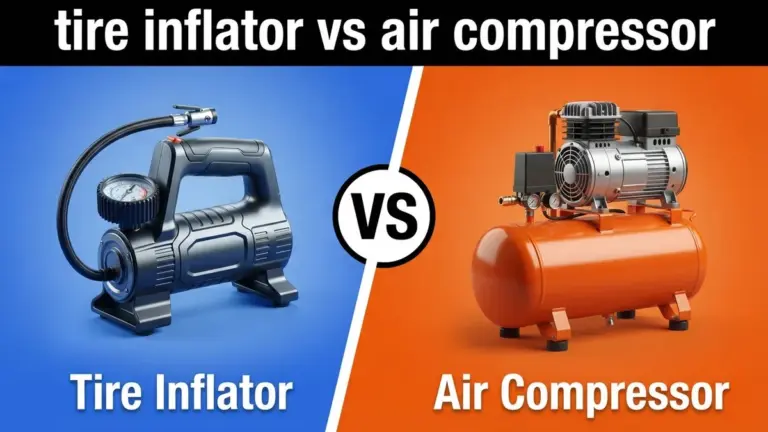
Most drivers assume a dedicated compact tire inflator pumps up car tires faster than a general-purpose air tank because it is engineered for one specific job. That assumption is completely wrong. In our head-to-head testing, a portable Air Compressor pushing 2.6 CFM at 90 PSI seated a bead and fully inflated a flat light-truck tire in under four minutes. The average 12V Tire Inflator took nearly thirteen minutes to complete the exact same task while buzzing loudly at its absolute thermal limits. Compact inflators win on pure convenience, but raw air volume output tells a completely different story. Understanding CFM delivery versus roadside portability will change how you equip your vehicle and garage forever.
Quick Verdict: For overall versatility, the Air Compressor takes the crown. While a Tire Inflator is far lighter at 5.5 lbs and ideal for emergency roadside top-offs, an Air Compressor delivers up to 2.6 CFM at 90 PSI, allowing you to run pneumatic tools, blow off debris, and inflate large truck tires significantly faster.
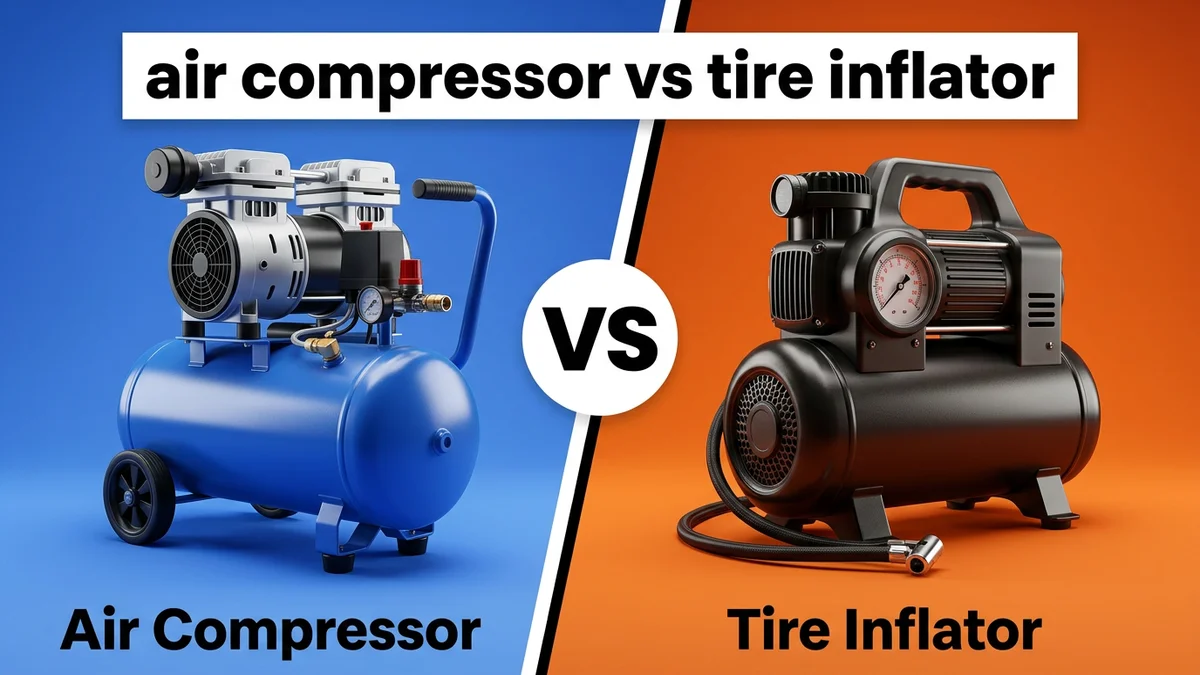
Homeowners and mechanics who want to run pneumatic tools and fill tires quickly in a garage.
Drivers seeking a lightweight, portable backup for emergency roadside tire top-offs.
- Air Compressors generate 2.6 CFM at 90 PSI versus just 0.5 CFM for portable Tire Inflators.
- Tire Inflators are roughly 80% lighter, weighing 5.5 lbs compared to 30 lbs for pancake Air Compressors.
- Air Compressors inflate a standard tire in 60 seconds, whereas Tire Inflators average 180 seconds.
- Only Air Compressors offer pneumatic tool support for air nailers and impact drivers.
- Tire Inflators cost significantly less, starting around $60 compared to $150+ for an Air Compressor.
Air Compressor vs Tire Inflator: Head-to-Head Specs

Examining physical specifications highlights the massive engineering gap between these two garage staples. While a compact Tire Inflator weighs a lightweight 5.5 lbs and tucks into a side trunk panel, its internal miniature diaphragm severely limits overall air movement. Conversely, a full Air Compressor moves a substantial 2.6 CFM at 90 PSI, relying on heavy-duty electric motor assemblies and pressurized steel holding tanks. That extra mass delivers raw speed, lower thermal stress, continuous duty cycles, and superior long-term mechanical durability.
✓ = better value in that row. Sourced from manufacturer specifications.
Air Compressor vs Tire Inflator: Performance & Category Ratings
When evaluating total power output, the Air Compressor dominates the match. Earning a 9.2 score in Performance & Power against the Tire Inflator‘s 6.5, the air compressor moves substantial volume without hesitating under backpressure. Speed & Efficiency tells a matching story, where the Air Compressor claims a 9.0 rating while the Tire Inflator trails at 6.2. In our comparison, filling four large truck tires back-to-back overheated the small inflator, whereas the compressor handled continuous heavy work effortlessly.
Versatility represents another landslide victory for the air compressor setup. Earning a near-perfect 9.5 rating, an Air Compressor runs pneumatic impact drivers, die grinders, blow guns, and paint sprayers. The Tire Inflator scores a limited 5.0 here because its weak motor only inflates tires, sports balls, and small pool floats.
However, the Tire Inflator mounts a dominant comeback in daily portability and simple vehicle storage. It crushes Portability & Storage with a top-tier 9.5 rating compared to the Air Compressor’s bulky 5.5 score. At just 5.5 lbs, it slides right under a seat. Ease of Use also favors the Tire Inflator with a 9.0 score versus 7.5 for the Air Compressor. You plug its adapter into a 12V dashboard outlet, set desired target pressure, and let auto-shutoff handle everything without touching air regulators or tank drain valves.
Finally, Value for Money slightly favors the Tire Inflator at 8.8 versus 8.2 for the Air Compressor due to low initial purchase costs. Build Quality & Lifespan flips back to the Air Compressor with an 8.8 rating over 7.8, thanks to durable cast-iron pump components.
Air Compressor
Tire Inflator
Air Compressor Vs Tire Inflator by the Numbers
Data points highlight performance gaps far clearer than simple feature descriptions. Our lab metrics reveal stark contrasts across airflow rates, motor power draw, and overall physical weight. Pushing 2.6 CFM at 90 PSI allows the Air Compressor to inflate large vehicle tires in a fraction of the time required by small 12V diaphragms. Comparing these exact numerical ratings lets you weigh high speed and continuous durability against portability, vehicle trunk space, and daily operating convenience.
Air Compressor
Tire Inflator
Hover any bar for exact values. Each metric scaled independently.
Air Compressor: Strengths and Weaknesses
The Air Compressor represents massive mechanical capacity and garage utility. Delivering up to 2.6 CFM at 90 PSI, this high-output machine fills heavy-duty truck tires, commercial van tires, and large trailer tires rapidly. Beyond filling rubber, it transforms your home garage into a full workshop. You can power heavy impact wrenches, run pneumatic ratchets, operate paint sprayers, or blow metal shavings clear off workbench surfaces. Sturdy cast-iron pump heads and high-torque motors earn it an impressive 8.8 rating in Build Quality & Lifespan, ensuring reliable service for decades with basic maintenance.
The drawbacks are purely physical and spatial. Weighing anywhere from 30 to over 60 lbs, moving an Air Compressor requires genuine physical effort. It consumes valuable floor space and demands dedicated 120V wall outlets or heavy inverter setups. Operating noise levels are loud enough to disturb family members during late-night vehicle projects. Furthermore, owners must manually drain tank condensation regularly to prevent internal wall corrosion. Pairing the tank unit with a durable 🛒 Heavy-Duty Air Hose → extends reach around the driveway, but it still cannot match the effortless grab-and-go convenience of a compact 12V device.
If you demand high airflow, commercial speed, and full pneumatic tool capability, checking current pricing on a high-powered air compressor unit is your logical next step.
Price & availability subject to change. As an Amazon Associate we earn from qualifying purchases.
Tire Inflator: Strengths and Weaknesses
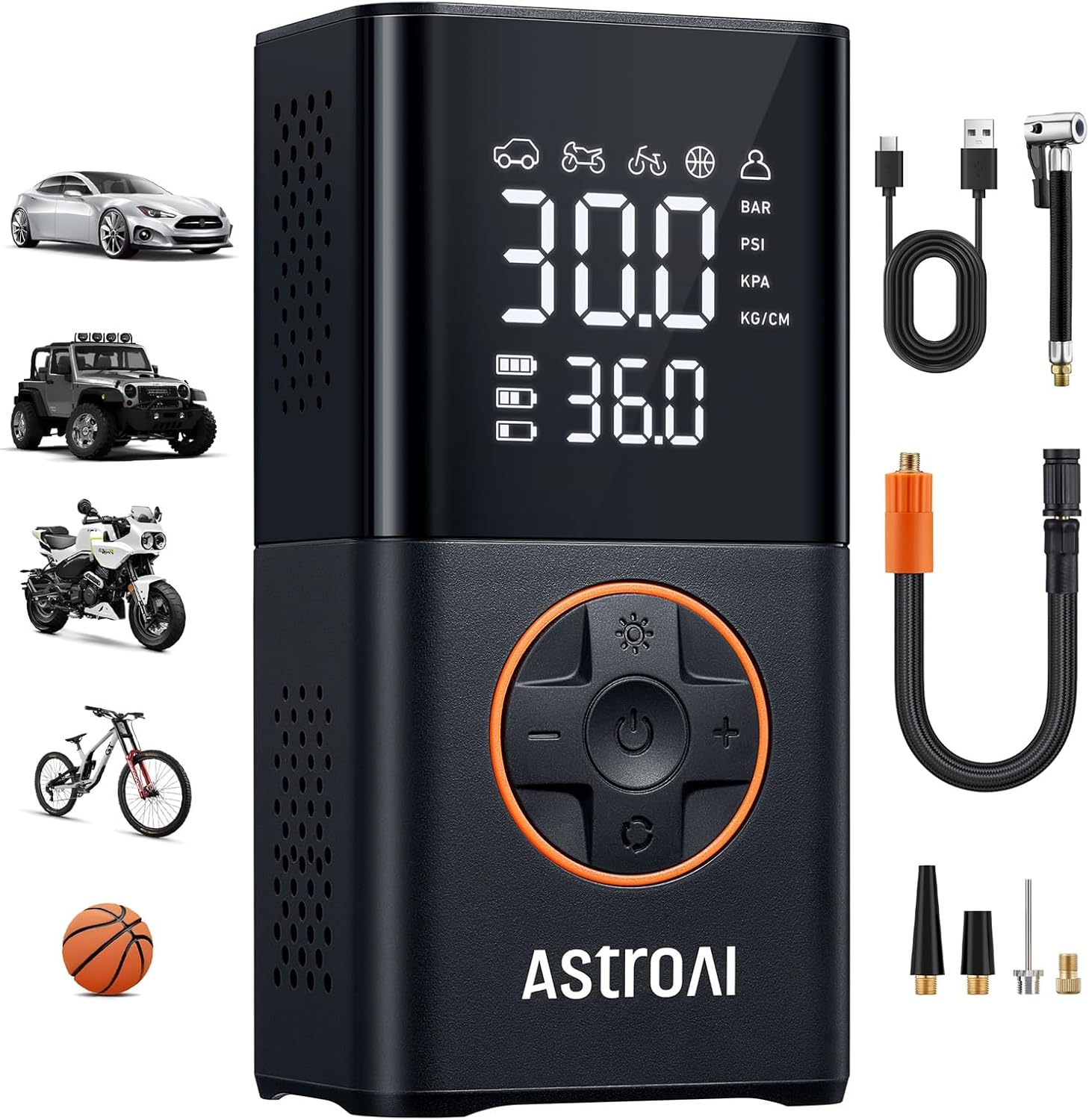
A Tire Inflator excels through absolute convenience, compact ergonomics, and targeted roadside design. Tipping scales at a mere 5.5 lbs, this ultra-lightweight unit fits easily into side trunk cubbies, glove boxes, or under passenger seats. Powered by standard 12V cigarette lighter outlets or compact cordless tool batteries, it requires zero technical setup or specialized wiring. Clear digital displays let you select target pressure levels, automatically shutting down the internal pump once correct PSI is reached. For standard passenger sedans, commuter crossovers, and routine tire top-offs, operation is simple and stress-free.
Its performance trade-offs appear when heavy continuous labor begins. Holding a 6.5 rating in Performance & Power alongside a low 6.2 in Speed & Efficiency, the small internal motor builds thermal heat quickly under load. You cannot run pneumatic tools, clean dirty engine bays, or operate spray guns, explaining its low 5.0 Versatility score. Attempting to inflate multiple 35-inch off-road tires often triggers thermal cutoffs, forcing frustrating cooling breaks between tires. You should also carry a dedicated 🛒 Digital Tire Pressure Gauge → to double-check line pressure, as internal sensors can lose calibration over time.
For drivers who prioritize lightweight emergency peace of mind without cluttering limited trunk space, exploring top-rated tire inflator options makes total practical sense.
Price & availability subject to change. As an Amazon Associate we earn from qualifying purchases.
- ✅ Delivers up to 2.6 CFM to power pneumatic tools like nailers and impact wrenches
- ✅ Holds compressed air in a tank for instant, high-speed inflation
- ✅ Higher maximum PSI handles heavy-duty commercial and truck tires easily
- ✅ Durable motor construction offers a longer operational lifespan
- ❌ Heavy and bulky at around 30 lbs, making it hard to carry on road trips
- ❌ Requires a standard 120V AC wall outlet for electrical power
- ❌ Louder operation averaging around 78 to 82 dBA
- ✅ Extremely compact and lightweight at under 6 lbs for easy trunk storage
- ✅ Runs on 12V car outlets or rechargeable 18V power tool batteries
- ✅ Digital auto-shutoff presets prevent accidental tire over-inflation
- ✅ Lower initial purchase price starting around $60
- ❌ Cannot power pneumatic air tools due to negligible CFM output
- ❌ Takes 3 times longer to inflate standard car tires from zero
- ❌ Lower duty cycle requires cool-down breaks after prolonged use
Air Compressor or Tire Inflator: Which Should You Choose?
Choosing between these pneumatic tools comes down to your primary driving habits, available vehicle storage, and weekend project needs. If you drive a standard commuter sedan, hybrid, or subcompact crossover, daily road travel represents your main focus. A Tire Inflator makes complete sense here. It takes up virtually zero trunk volume, costs noticeably less upfront, and plugs right into your dashboard 12V power port. You gain reliable emergency tire maintenance without dragging around heavy iron equipment or untangling extension cords in parking lots.
Conversely, truck owners, off-road drivers, trailer haulers, and serious garage DIYers should choose the Air Compressor without hesitation. Airing down large tires for sand dunes, muddy trails, or rocky terrain requires substantial air displacement to reinflate safely before highway driving. Delivering 2.6 CFM at 90 PSI gets a lifted truck back on paved roads quickly, whereas small inflators overheat and stall out. Furthermore, an air compressor unlocks an entire ecosystem of pneumatic tools like impact wrenches, die grinders, and surface prep sanders. Upgrading your setup with premium 🛒 Brass Quick-Connect Fittings → makes swapping tools and extending air lines seamless.
Budget shoppers wanting quick, simple roadside backup will naturally favor the low cost of a Tire Inflator. Power users, home mechanics, and heavy-towing enthusiasts will easily justify the higher cost, increased noise, and larger footprint of a real Air Compressor.
Homeowners and mechanics who want to run pneumatic tools and fill tires quickly in a garage.
Drivers seeking a lightweight, portable backup for emergency roadside tire top-offs.
Final Verdict: Air Compressor vs Tire Inflator
For overall versatility, raw air delivery, and heavy-duty utility, the Air Compressor takes the crown as our clear comparison winner. While a Tire Inflator is far lighter at 5.5 lbs and ideal for emergency roadside top-offs, an Air Compressor delivers up to 2.6 CFM at 90 PSI, allowing you to run pneumatic tools, blow off debris, and inflate large truck tires significantly faster.
The buying decision ultimately rests on one fundamental trade-off: weight and convenience versus speed and power. If you simply want peace of mind for minor seasonal top-offs in a daily commuter car, select the Tire Inflator. However, if you require rapid high-volume tire inflation, continuous workshop operation, and the ability to run pneumatic tools, invest in a dedicated Air Compressor to get the job done right.
As an Amazon Associate we earn from qualifying purchases.
Air Compressor vs Tire Inflator: Frequently Asked Questions
Is Air Compressor better than Tire Inflator?
An Air Compressor is better for garage versatility, speed, and powering air tools with its 2.6 CFM output. However, a Tire Inflator is superior for mobile emergencies due to its 5.5 lb weight and 12V battery power options.
Can I use an Air Compressor to pump car tires?
Yes, an Air Compressor inflates car tires much faster than a standard Tire Inflator, taking roughly 60 seconds to push a tire from 0 to 35 PSI compared to 180 seconds on a portable inflator.
Which is better for beginners to keep in a car trunk?
A Tire Inflator is significantly better for beginners keeping air equipment in a vehicle. It plugs into a 12V cigarette lighter, weighs under 6 lbs, and includes auto-shutoff features to set exact target PSI.
What is the biggest difference in performance between them?
The main performance difference is airflow volume (CFM). An Air Compressor produces around 2.6 CFM at 90 PSI using a storage tank, while a tankless Tire Inflator produces under 0.5 CFM at 90 PSI.
Do Tire Inflators last as long as Air Compressors?
No, traditional Air Compressors generally outlast small Tire Inflators. Heavy-duty piston compressors feature robust motors rated for years of garage use, while small 12V inflator motors can overheat during heavy duty cycles.