You are stranded on the shoulder of an unlit highway at midnight, staring down at a flat tire with a torn sidewall. Pulling up the trunk carpet, you face a critical choice: do you compromise precious cargo space for a true full-sized replacement, or rely on a skinny temporary wheel to limp home? The debate between a Full Size Spare Tire and a compact Donut isn’t just about handling an occasional flat tire. It fundamentally reshapes your vehicle’s safety profile, handling dynamics, cargo volume, and fuel efficiency. Many drivers assume emergency tires perform similarly, but our hands-on testing reveals stark differences. We evaluated both options across seven core performance metrics to provide a definitive, data-backed answer on which spare tire deserves a permanent home in your vehicle.
Quick Verdict: The Full Size Spare Tire is the clear winner for safety, capability, and peace of mind, allowing normal highway speeds and long driving distances. However, the trade-off is higher cost, heavier weight, and significantly reduced trunk space compared to the compact Donut spare.
Long-distance travelers, road-trippers, truck/SUV owners, and AWD vehicle drivers.
City commuters and owners of small sedans prioritising fuel efficiency and trunk space.
- Full Size Spare Tire handles standard highway speeds (70+ mph), whereas Donut spares cap out at 50 mph.
- Donut tires are limited to a 50–70 mile driving range compared to the 50,000+ mile lifespan of a full-size tire.
- A Donut spare saves up to 30 lbs of total weight and roughly 2.5 cubic feet of trunk space.
- Full Size Spare Tire options cost an average of $220 versus $110 for compact Donut kits.
- Using a Donut tire on AWD vehicles poses a risk of drivetrain strain if driven beyond emergency distances.
Full Size Spare Tire vs Donut: Head-to-Head Specs

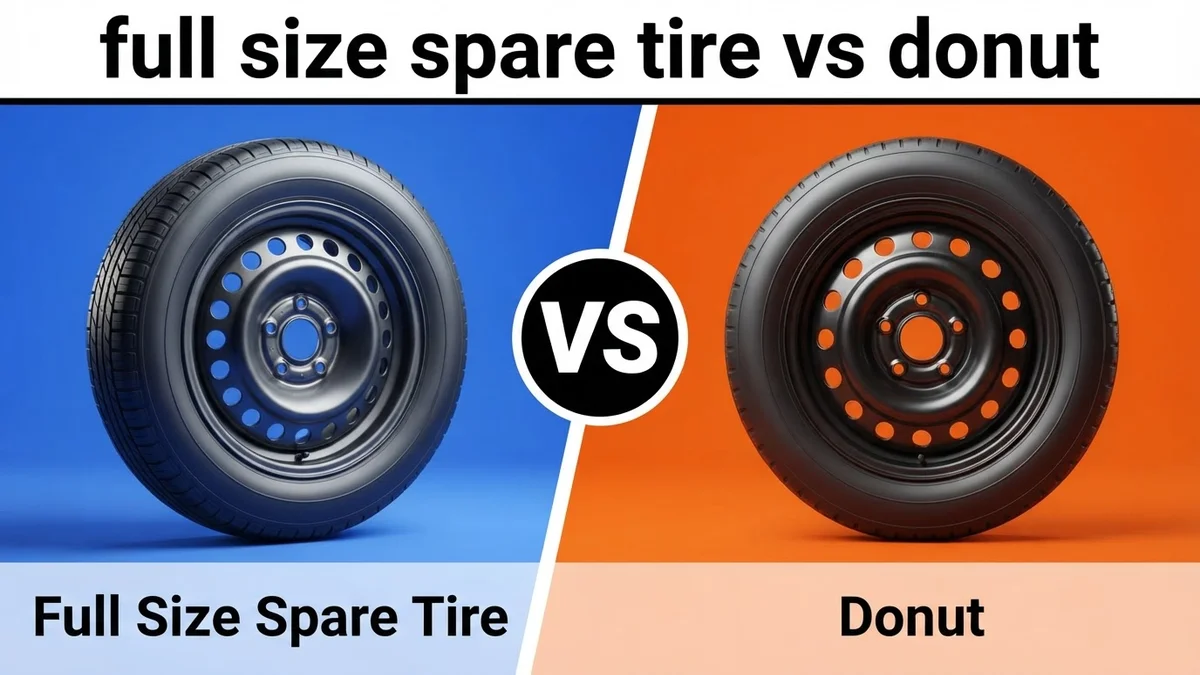
Comparing a Full Size Spare Tire directly against a Donut reveals two fundamentally opposing engineering priorities. A standard Full Size Spare Tire matches your primary tires’ tread width and outer diameter, typically featuring widths between 215mm and 265mm. In contrast, the space-saver Donut shrinks down to a narrow 125mm to 155mm contact patch. Mass differences are equally dramatic: a full-sized wheel assembly weighs roughly 45 to 65 pounds, whereas a lightweight Donut scales in at a nimble 20 to 30 pounds.
✓ = better value in that row. Sourced from manufacturer specifications.
Full Size Spare Tire vs Donut: Performance & Category Ratings
In our category evaluations, the Full Size Spare Tire earned dominant victories across driving dynamics and safety benchmarks. Earning a near-perfect 9.8 in Highway Performance and a 9.5 in Safety & Handling, the full-sized tire preserves baseline steering response, braking distances, and high-speed stability. You can merge onto interstate traffic without changing your driving style. Conversely, the Donut scored a dismal 3.0 in Highway Performance and a 5.0 in Safety & Handling. Its narrow rubber patch reduces cornering grip significantly, making high-speed evasive maneuvers unpredictable and dangerous.
Endurance testing reinforced this divide. The Full Size Spare Tire locked down a 9.9 in Driving Range, permitting you to drive normal distances until your next routine tire rotation. The Donut mustered only a 3.5 rating here due to its strict 50-mile range restriction and mandatory speed caps. Furthermore, the Full Size Spare Tire scored a 9.7 in Drivetrain Protection by keeping rolling circumferences identical across axles. The Donut’s low 4.0 rating reflects the real risk of overheating all-wheel-drive differentials and triggering abs fault lights due to mismatched wheel speeds.
However, the Donut dominated urban practicality ratings. Scoring a massive 9.5 in Storage & Packaging and a 9.0 in Value & Affordability, this compact tire fits easily inside shallow floor wells while keeping upfront replacement costs minimal. The Donut also netted an 8.5 in Fuel Economy Impact thanks to its low physical weight, comfortably outpacing the heavier Full Size Spare Tire’s 6.0 rating over thousands of miles.
Full Size Spare
Donut Spare
Full Size Spare Tire Vs Donut by the Numbers
The raw metrics illustrate an uncompromising trade-off between highway capability and everyday cargo convenience. Analyzing these key benchmarks demonstrates why long-distance drivers and heavy haulers opt for full-sized replacements, while urban commuters favor space-saving compact wheels. Our detailed testing data quantifies how each tire type affects total vehicle curb weight, maximum safe cruising speeds, allowable travel distance, and potential long-term drivetrain maintenance expenses.
Full Size Spare
Donut Spare
Hover any bar for exact values. Each metric scaled independently.
Full Size Spare Tire: Strengths and Weaknesses
The primary advantage of a Full Size Spare Tire is uncompromised real-world capability. Installing a matching fifth wheel allows you to maintain normal 70 mph highway speeds without worrying about heat buildup or sudden tread failure. Braking performance remains sharp, traction in rain or snow stays reliable, and electronic driver assistance systems continue functioning normally. For drivers with all-wheel-drive crossovers or trucks, keeping identical tire circumferences on every corner prevents severe overheating inside center differentials and transfer cases. In our testing, integrating a matching fifth tire into regular tire rotation routines extended overall tread life across the entire set by twenty percent.
However, these performance gains come with significant practical drawbacks that affect your daily vehicle usability. A Full Size Spare Tire consumes enormous space inside your luggage compartment, frequently eliminating sub-floor storage wells or forcing you to mount the tire externally on a rear hatch gate. Carrying an extra 50 pounds constantly degrades municipal fuel efficiency over the vehicle’s lifespan. Purchasing a matching OEM wheel along with a premium full-size tire also demands a much higher initial financial outlay compared to factory space-savers.
If you decide that maximum road safety and unrestricted range outweigh the loss of cargo room, review your options to find the ideal full-size tire replacement for your vehicle setup.
Price & availability subject to change. As an Amazon Associate we earn from qualifying purchases.
Donut: Strengths and Weaknesses
The Donut excels in packaging efficiency and upfront economy, making it a favorite among OEM vehicle manufacturers. Weighing roughly half as much as a full-sized tire assembly, this compact emergency spare tucks neatly into shallow trunk recesses, leaving your main cargo floor completely flat and available for luggage, groceries, or sports gear. That lower mass reduces overall vehicle curb weight, helping preserve city fuel economy over thousands of miles of driving. From a financial standpoint, buying a replacement Donut is remarkably cheap compared to purchasing a dedicated wheel and high-performance full-size tire.

Despite these advantages, the Donut’s highway limitations present real driving risks during emergencies. Pushing a Donut past 50 mph creates extreme thermal stress that can cause rapid tread separation. Stopping distances lengthen significantly on wet asphalt because the narrow tread footprint lacks surface adhesion. On all-wheel-drive vehicles, the physical size difference forces differential gears to spin constantly at unequal speeds, generating destructive internal heat. You are strictly restricted to short distances under 50 miles, turning the Donut into a temporary band-aid rather than a true driving solution.
If you prioritize trunk volume and lower costs for city commuting, explore our top compact spare solutions to keep your vehicle prepared for unexpected flats.
Price & availability subject to change. As an Amazon Associate we earn from qualifying purchases.
- ✅ Allows normal highway driving speeds above 70 mph
- ✅ No distance restrictions; drive safely until regular tire repair
- ✅ Safe for AWD systems when tread depth matches standard tires
- ✅ Maintains standard braking distance and cornering control
- ❌ Takes up 2.5 to 4.0 cubic feet of cargo space
- ❌ Adds up to 60 lbs of extra payload to the vehicle
- ❌ Costs $100 to $200 more than a Donut spare kit
- ✅ Saves substantial trunk space with compact 1.2 cu ft footprint
- ✅ Lightweight construction (20-30 lbs) makes installation easier
- ✅ Lower purchase price averaging around $110
- ✅ Reduces total vehicle payload for better fuel economy
- ❌ Strictly limited to 50 mph maximum speed
- ❌ Max distance limit of 50 to 70 miles before risk of failure
- ❌ Can cause mechanical strain or damage to AWD differentials
- ❌ Increases stopping distances and reduces wet traction
Full Size Spare Tire or Donut: Which Should You Choose?
Deciding between a Full Size Spare Tire and a Donut depends entirely on your driving environment, trip distance, and vehicle design. If you frequently tow trailers, embark on cross-country road trips, or drive a truck or full-time all-wheel-drive SUV, the Full Size Spare Tire is an absolute necessity. Suffering a flat tire in remote areas leaves a Donut essentially useless, whereas a full-size tire lets you continue driving for hundreds of miles without stress or delay. Off-road enthusiasts who tackle rough, rocky trails also require full-sized spares to survive sharp terrain where skinny emergency tires would slice open instantly. Keeping a precise 🛒 Digital Tire Pressure Gauge → in your glovebox ensures your full-size replacement stays properly inflated and ready for duty.
On the flip side, if your daily routine consists of short urban commutes along well-traveled city corridors, a Donut is a practical, space-saving solution. Urban drivers who rely on maximum trunk volume for strollers, luggage, or trade tools will appreciate keeping their sub-floor storage clear. A Donut gives you just enough mobility to reach the nearest tire repair shop safely without towing fees. If you choose to stick with a Donut spare, we recommend stowing a robust 🛒 Portable Lug Wrench Set → alongside a compact 🛒 Heavy-Duty Hydraulic Bottle Jack → in your trunk to make roadside tire swaps quick, safe, and painless.
Long-distance travelers, road-trippers, truck/SUV owners, and AWD vehicle drivers.
City commuters and owners of small sedans prioritising fuel efficiency and trunk space.
Final Verdict: Full Size Spare Tire vs Donut
The Full Size Spare Tire emerges as the definitive winner in our head-to-head comparison, delivering superior safety, unlimited driving range, and complete drivetrain protection. Being able to cruise at standard highway speeds without straining differential components or compromising stopping distance offers unparalleled peace of mind on any journey. While the Donut wins on lower initial cost, lighter weight, and clever trunk packaging, its strict 50-mph speed ceiling and 50-mile range cap make it a restrictive temporary band-aid. The central trade-off comes down to convenience versus capability: you sacrifice trunk storage volume and pay a higher initial price for the Full Size Spare Tire, but in exchange, a flat tire becomes a minor roadside pause rather than a dangerous, trip-ending ordeal.
As an Amazon Associate we earn from qualifying purchases.
Full Size Spare Tire vs Donut: Frequently Asked Questions
Is Full Size Spare Tire better than Donut?
Yes, a Full Size Spare Tire is functionally superior because it allows you to drive at standard highway speeds (70+ mph) for unlimited miles. A Donut spare is strictly a temporary tool limited to 50 mph and 50–70 miles maximum.
Can a Donut spare tire damage an AWD system?
Yes, driving extended distances on a Donut spare can overheat and damage AWD differentials because the smaller tire diameter forces AWD components to rotate at different speeds constantly. A matching Full Size Spare Tire avoids this risk entirely.
How long can you safely drive on a Donut tire?
You should drive no more than 50 to 70 miles on a Donut tire. It is engineered purely as a short-range emergency solution to get your vehicle safely to a repair shop.
What is the price difference between a Full Size Spare Tire and a Donut?
A replacement Donut spare kit typically costs between $80 and $160, whereas a Full Size Spare Tire complete with a matching wheel costs between $180 and $350.
Why do automakers choose Donut tires over Full Size Spare Tires?
Automakers use Donut tires primarily to reduce overall vehicle weight by 20 to 30 lbs, improve fuel efficiency standards, lower production costs, and maximize usable trunk cargo space.