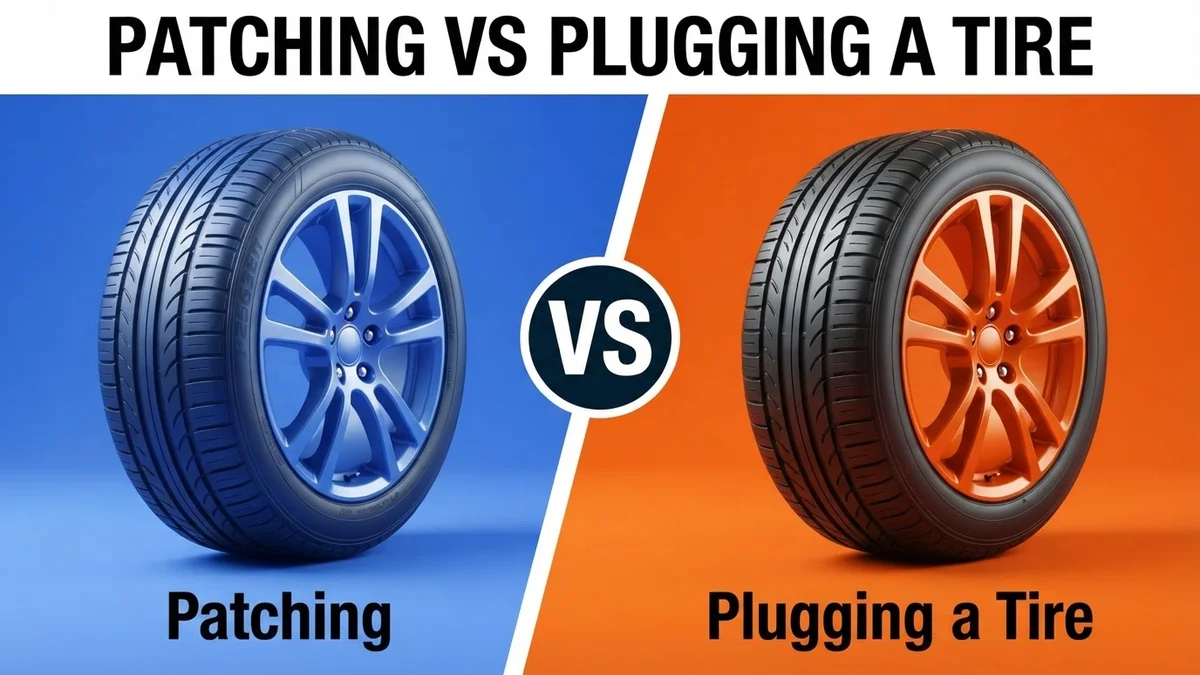
Demounting a wheel rim and installing a vulcanized patch takes roughly 30 minutes, whereas inserting a sticky rubber strip into a puncture takes less than 5 minutes on the side of the road. That 25-minute gap defines the structural divide between Patching and Plugging a Tire. Patching repairs damage internally by chemically bonding a thick rubber patch across the inner liner. Plugging a Tire works externally, shoving a sticky cord into the puncture channel to jam the leak from the outside. While Plugging a Tire offers rapid emergency relief when you are stranded, Patching remains the only method recognized by tire manufacturers as a safe, permanent repair for passenger road vehicles.
Quick Verdict: Patching is the clear overall winner for long-term safety, durability, and standard compliance. It seals the tire inner liner and preserves speed ratings, whereas Plugging a Tire is a faster, cheaper emergency fix that should ideally be followed by a permanent internal repair.
Drivers who want a permanent, safety-compliant repair that maintains speed ratings.
Commuters and off-roaders needing a fast, low-cost emergency fix on the roadside.
- Patching creates a permanent bond lasting up to 50,000 miles across full tread lifespan.
- Plugging a Tire takes under 10 minutes without removing the wheel from the vehicle.
- Professional Patching costs $30 to $45 but maintains USTMA safety compliance.
- Plugging a Tire DIY kits cost around $8 and fix 5 to 10 flat tires.
- Patching inspects internal belts, preventing $200 structural tire blowout risks.
Patching vs Plugging a Tire: Head-to-Head Specs
The critical technical split centers on wheel dismounting requirements and speed rating retention. Patching requires unseating the tire bead from the wheel rim, enabling a full internal inspection of steel belts before applying a 9.5-rated air seal. Plugging a Tire works entirely from the outside without removing the rubber from the rim. However, Plugging a Tire instantly voids a tire’s manufacturer speed rating, whereas a proper internal patch preserves factory speed ratings and maintains structural integrity across thousands of high-speed highway miles.

✓ = better value in that row. Sourced from manufacturer specifications.
Patching vs Plugging a Tire: Performance & Category Ratings
In our category breakdown, Patching dominates the structural and safety metrics, while Plugging a Tire steals the convenience and budget categories. For Safety & Compliance, Patching scores a near-perfect 9.5 compared to a weak 6.0 for Plugging a Tire. Major tire industry organizations strictly prohibit external plugs as standalone repairs because they fail to inspect hidden internal belt separation or severe internal rubber scorching.

Patching also leads in Lifespan & Durability with a 9.5 rating versus 7.0 for Plugging a Tire. A vulcanized patch chemically fuses with the tire wall, lasting the full remaining tread life of the tire. Conversely, a plug can degrade, harden, or slow-leak after extended exposure to thermal cycles and heavy road flex. Air Seal Integrity follows this exact pattern, where Patching earns a 9.5 by sealing the airtight inner liner, while Plugging a Tire achieves an 8.0 by packing the tread channel.
Where Plugging a Tire dominates is immediate practical utility. It scores 9.5 in Convenience and 9.0 in Ease of DIY Implementation, obliterating Patching’s dismal 5.5 and 5.0 in those same categories. You can plug a tire on a gravel shoulder with simple hand tools in minutes. Patching requires heavy mechanical tire changers or manual bead-breaking equipment to pull the tire off the wheel. Value for Money slightly favors Plugging a Tire at 9.0 versus 8.0 for Patching, as a ten-dollar plug kit handles multiple flats, whereas professional shop patching costs upwards of forty dollars per visit.
Tire Patching
Tire Plugging
Patching Vs Plugging A Tire by the Numbers
Evaluating raw performance metrics reveals the sharp trade-off between repair speed and long-term mechanical reliability. Internal Patching achieves a top-tier 9.5 air seal integrity score because it completely seals the inner liner’s damage footprint. On the flip side, Plugging a Tire earns its highest mark of 9.5 in convenience because it skips wheel demounting entirely. These empirical ratings demonstrate why external plugs suit urgent roadside emergencies while internal patches belong in professional garages for permanent safety.
Tire Patching
Tire Plugging
Hover any bar for exact values. Each metric scaled independently.
Patching: Strengths and Weaknesses
Patching stands as the gold standard for tire repair due to its uncompromising structural integrity. By removing the tire from the wheel rim, a technician performs a thorough visual inspection of the inner liner, sidewalls, and internal steel belts. This crucial step catches dangerous hidden damage that external checks miss completely. The chemical vulcanization process permanently bonds the patch to the internal rubber wall, creating an impenetrable barrier against high-pressure air loss. It maintains factory speed ratings, handles high thermal stress during fast highway driving, and comfortably lasts for the remaining life of the tread.
The drawbacks of Patching center on mechanical friction, specialized tools, and heavy labor effort. You cannot patch a tire on the side of the highway with basic pocket tools. It demands a bead breaker tool, tire levers, surface buffing tools, and specialized chemical cement. If you take the wheel to a repair shop, you face labor costs ranging from $35 to $60 alongside waiting room downtime. Furthermore, Patching cannot fix shoulder damage, sidewall punctures, or severe holes exceeding a quarter-inch in diameter.
Despite these high labor demands, internal vulcanization remains the safest route for keeping your passenger vehicle stable at high highway speeds. If you intend to dismount wheels in your garage, picking up a heavy-duty 🛒 Bead Breaker Tool → makes separating the tight rubber bead from the rim significantly easier.

Price & availability subject to change. As an Amazon Associate we earn from qualifying purchases.
Plugging a Tire: Strengths and Weaknesses
Plugging a Tire delivers exceptional practical value when an unexpected flat tire threatens to leave you stranded far from home. The primary strength of Plugging a Tire is rapid installation: you pull the nail, ream the hole, insert the sticky rubberized strip, and reinflate the tire without removing the wheel from the hub. At under fifteen dollars for a complete kit that handles multiple repairs, the value proposition for budget-minded drivers and off-roaders is undeniable. It gets your vehicle rolling again in under ten minutes.
However, the trade-offs in structural safety are significant. Because the tire remains mounted on the rim, you have zero visibility into internal cord damage or rubber scorching caused by driving on low air pressure. Over thousands of miles, road friction and harsh weather changes cause sticky plug strips to harden, shrink, or develop persistent slow leaks. Plugging a Tire also voids original manufacturer speed ratings, making it unsuitable for aggressive driving, heavy towing, or high-speed transit.
While an external plug should rarely serve as a permanent fix for daily commuter cars, carrying a kit provides tremendous relief during long road trips. For emergency trunk storage, pairing your plug kit with a compact 🛒 12V Air Compressor → ensures you can reinflate the tire immediately after sealing the leak.

Price & availability subject to change. As an Amazon Associate we earn from qualifying purchases.
- ✅ Restores manufacturer speed rating when installed with a stem plug
- ✅ Chemical vulcanization forms a permanent bond with the inner liner
- ✅ Lasts the full 50,000 mile lifespan of typical tire tread
- ✅ Allows full internal inspection for hidden structural damage
- ✅ Fully compliant with USTMA and DOT tire repair standards
- ❌ Requires removing wheel and dismounting tire from rim
- ❌ Higher professional installation cost of $30 to $45
- ❌ Takes 30 to 45 minutes to install properly
- ✅ Can be completed roadside in under 10 minutes
- ✅ Does not require removing wheel or dismounting tire
- ✅ Affordable kit pricing starting under $8
- ✅ Compact tools fit easily in any glove compartment
- ✅ Ideal emergency fix for remote off-road situations
- ❌ Voids official tire manufacturer warranties and speed ratings
- ❌ May allow water to corrode internal steel belts over time
- ❌ Higher risk of developing slow pressure leaks over miles
Patching or Plugging a Tire: Which Should You Choose?
Selecting between Patching and Plugging a Tire comes down to your driving environment, vehicle loads, and long-term safety priorities.
If you are a daily highway commuter, drive a performance vehicle, haul heavy trailers, or frequently transport family members, Patching is the mandatory choice. Highway travel subjects tires to extreme rotational force and severe internal heat. A proper internal patch ensures structural steel belts remain protected against moisture intrusion while maintaining full air retention at 70 mph. Skipping a proper patch to save thirty dollars is a risky trade-off when high-speed blowouts are on the line.
Conversely, Plugging a Tire shines during urgent emergencies and remote off-road excursions. If you catch a nail on an isolated trail, rural dirt road, or during a late-night commute, Plugging a Tire gets you back on the road without waiting hours for expensive towing services. Off-road enthusiasts who air down tires on rocky terrain rely heavily on plugs for quick trailside fixes where shop access is non-existent.
A smart strategy used by seasoned motorists is the two-step hybrid approach: insert an external plug on the roadside to escape danger, then visit a tire shop within 48 hours for a permanent internal patch. To monitor repair stability over time, use a digital 🛒 Tire Pressure Gauge → to verify consistent air pressure, and check remaining rubber depth with a precision 🛒 Tire Tread Depth Gauge → before taking off on long interstate trips.
Drivers who want a permanent, safety-compliant repair that maintains speed ratings.
Commuters and off-roaders needing a fast, low-cost emergency fix on the roadside.
Final Verdict: Patching vs Plugging a Tire
Patching emerges as the definitive winner in our head-to-head comparison. While Plugging a Tire offers top-tier convenience with a 9.5 rating and minimal cost, it sacrifices structural safety, carrying a low 6.0 rating in Safety & Compliance and voiding speed ratings. Patching takes top honors across Safety & Compliance (9.5), Lifespan & Durability (9.5), and Air Seal Integrity (9.5) by chemically bonding directly to the tire’s airtight inner liner.
The core trade-off centers on fast emergency mobility versus long-term structural integrity. Plugging a Tire serves as an essential emergency tool to escape roadside hazards quickly. However, for everyday highway travel, heavy payloads, and long-term peace of mind, Patching remains the superior, industry-approved method for maintaining your tires safely.
As an Amazon Associate we earn from qualifying purchases.
Patching vs Plugging a Tire: Frequently Asked Questions
Is Patching better than Plugging a Tire?
Yes, Patching is superior for long-term safety. While Plugging a Tire costs under $10 and takes 8 minutes, Patching seals the inner liner from inside, maintaining the tire's speed rating and lasting 50,000 miles. Industry guidelines require an internal patch for a permanent, safe repair.
Can you plug and patch the same tire hole?
Yes, the tire industry standard recommended by USTMA is a combination patch-plug repair. A stem fills the 0.25-inch puncture channel to block moisture, while an internal patch seals the inner liner. Professional combination repairs cost $30 to $45 and deliver maximum safety.
Does plugging a tire void its warranty?
Yes, most major tire manufacturers void tread and hazard warranties if a tire is repaired with an external plug alone. Proper Patching from the inside according to USTMA guidelines preserves tire warranty coverage and maintains original speed ratings up to 149 mph without compromising safety.
How long does a tire plug last compared to a patch?
A proper Patching repair lasts the full lifespan of the tire, up to 50,000 miles or more. A tire plug typically lasts 20,000 miles or less and is prone to slow leaks due to temperature cycles, making it best suited for temporary emergency situations.
Which repair method is easier for beginners stranded on the highway?
Plugging a Tire is significantly easier for beginners stranded on the roadside. It requires no wheel removal or heavy tools and takes under 10 minutes using a $10 kit. Patching requires dismounting the tire from the rim, which is impossible without specialized shop equipment.