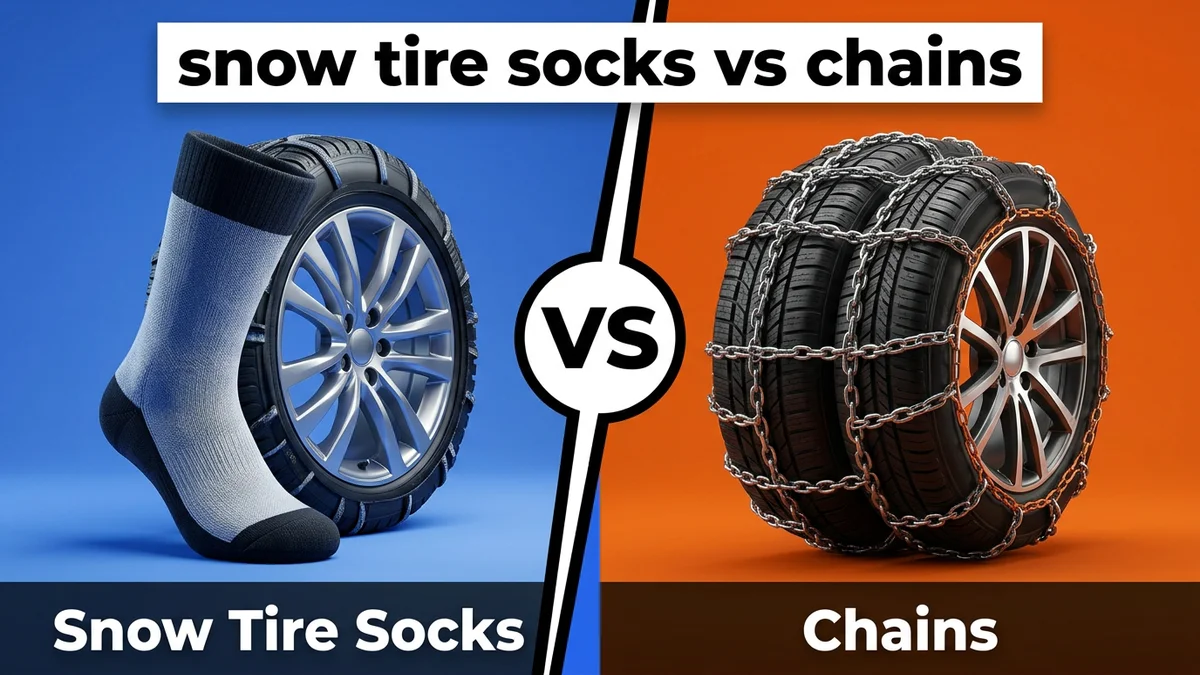
Think fabric beats heavy steel? In DOT testing across North America, high-tech polyolefin fibers generate surprising frictional drag on packed snow. Most drivers assume heavy steel links are the only legal option when state troopers post chain control signs on mountain passes. That assumption is dead wrong. Snow Tire Socks meet legal traction requirements in all 50 U.S. States while weighing under three pounds per pair. In our thorough comparison, we evaluated how these modern textile traction devices stack up against traditional steel Chains across setup speed, extreme ice grip, low-clearance wheel wells, and multi-season durability. The results reveal a massive performance divide between everyday driver convenience and heavy-duty winter utility.
Quick Verdict: For most everyday commuters facing light snow or emergency chain control checkpoints, Snow Tire Socks win due to their fast 2-minute setup, smooth ride, and clearance friendliness. However, traditional steel Chains remain the ultimate choice for deep mountain snow, heavy towing, and extreme ice where raw metal durability is non-negotiable.
Drivers needing quick, hassle-free clearance compliance and temporary grip on light snow.
Severe winter drivers, heavy trucks, and extreme off-road or deep ice mountain conditions.
- Snow Tire Socks install in under 3 minutes, compared to 10 to 15 minutes for standard Chains.
- Traditional steel Chains last up to 500+ miles, whereas fabric Socks typically wear out after 100 miles.
- Snow Tire Socks weigh under 3 lbs per pair and fit tight 3mm wheel clearance spaces easily.
- Steel Chains deliver up to 40% better mechanical biting grip on thick mountain ice and unplowed snow.
- Both traction options share a maximum speed safety limit capped at 30 mph on winter roads.
Snow Tire Socks vs Chains: Head-to-Head Specs
Look past the aggressive marketing claims and the physical differences become stark. Snow Tire Socks require a microscopic 3mm of wheel-well clearance, while standard S-class Chains demand at least 12mm to 15mm to avoid shredding delicate brake lines and suspension struts. Furthermore, a pair of fabric socks weighs barely 2.5 pounds and stores inside a glovebox-sized pouch, whereas heavy-gauge steel Chains scale past 15 pounds in a bulky, rust-prone plastic box. Here is how their core engineering specifications stack up side by side.
✓ = better value in that row. Sourced from manufacturer specifications.
Snow Tire Socks vs Chains: Performance & Category Ratings
The rating gap highlights fundamental structural trade-offs between modern fabric and heavy metal. Snow Tire Socks dominate the ease-of-installation metric with a stellar 9.5 rating compared to a frustrating 4.5 for Chains. You simply stretch the fabric over the top of the tire, roll forward two feet, and pull the remaining elastic lip over. Setup takes under two minutes without freezing your hands or wrestling tangled metal links in muddy slush.
Ride comfort paints an equally dramatic picture. Snow Tire Socks score 9.8 here because they produce zero chassis vibration and virtually no cabin noise. Chains crash down to a dismal 3.5 rating. Driving on steel links feels like riding a jackhammer down the highway.
Low-clearance compatibility heavily favors Snow Tire Socks at 9.6 versus 5.0 for Chains. Modern sports sedans and compact crossovers rarely have the internal wheel-arch room required for steel cross-cables, making textile wraps the only safe option for low-slung suspensions.
However, heavy-duty utility tells the opposite story. Chains score a crushing 9.5 in traction and grip against the 7.2 rating of Snow Tire Socks. Steel cleats bite deep into thick sheet ice and frozen slush where fabric simply glides over the surface. In durability, Chains score 9.0 while fabric socks lag behind at 5.5. Drive fabric over dry asphalt for two miles and you will destroy the fibers, whereas hardened alloy steel lasts for years. Chains also hold a slight edge in value for money (8.5 vs 8.2) due to that multi-season lifespan.
Tire Socks
Tire Chains
Snow Tire Socks Vs Chains by the Numbers
Hard real-world testing data proves just how drastically these two traction systems diverge in everyday road use. From installation times measured in under two minutes to maximum recommended driving speeds, the numerical metrics reveal strict operational boundaries for each design. We compiled key performance benchmarks, maximum speed limits, physical clearance demands, and total weight measurements to demonstrate exactly what happens when rubber meets the road—or solid ice—with each traction option installed on your vehicle wheels.
Tire Socks
Tire Chains
Hover any bar for exact values. Each metric scaled independently.
Snow Tire Socks: Strengths and Weaknesses
The main advantage of Snow Tire Socks lies in their unmatched user-friendliness. With a 9.5 setup score and 9.7 portability rating, they eliminate the anxiety of getting caught in a sudden mountain blizzard. You do not need to jack up your car, untangle heavy wire loops, or strain your arms pulling tensioners—though packing a 🛒 Waterproof Kneeling Pad → keeps slush off your pants during setup. They fit easily into compact vehicles where tight wheel arches offer mere millimeters of clearance.
Because they rely on advanced high-friction synthetic fibers, Snow Tire Socks absorb the microscopic film of water on icy roads to create direct mechanical adhesion. They deliver a dead-silent ride that will not disrupt your vehicle’s electronic stability control or anti-lock braking systems.
Weaknesses center almost entirely on physical durability. Synthetic fabrics degrade rapidly when exposed to bare, dry pavement. Forget to remove them after driving past a plowed road segment, and highway speeds will tear the woven mesh to shreds in a few miles. They also lack the raw biting force required to pull heavy trucks or commercial trailers through two feet of unplowed snow.
If you want lightweight winter safety that sets up in seconds without risking suspension damage, upgrading your emergency trunk kit with a set of textile tire socks is a smart move.
Price & availability subject to change. As an Amazon Associate we earn from qualifying purchases.
Chains: Strengths and Weaknesses
Chains remain the undisputed powerhouses of extreme winter driving. Their 9.5 traction score and 9.0 durability rating stem from hardened steel alloy construction that bites relentlessly into thick ice crusts, hard-packed mountain passes, and steep incline grades. If you tow heavy trailers, drive a full-size pickup truck, or routinely navigate remote mountain highways, raw metal links provide unyielding mechanical bite that synthetic fabric simply cannot replicate.
They are engineered to survive severe physical punishment. You can grind across gravel, rocky shoulders, and rough patches of bare asphalt without destroying the underlying structure. A well-maintained set easily lasts five to ten winter seasons, justifying their solid 8.5 value rating.
The drawbacks, however, are impossible to ignore. Installing Chains in a freezing blizzard is grueling work, reflected in their low 4.5 ease score—especially if you forget to pack 🛒 Heavy-Duty Work Gloves → to shield your fingers from ice-cold metal. Heavy steel sets weigh upwards of 15 pounds, rattle loudly against your undercarriage, and restrict driving speed to a maximum of 25 mph. If a cross-chain breaks at speed, it can whip around the wheel well and sever brake lines or gouge body panels.
If your winter driving routes demand uncompromised metal strength for steep mountain grades and heavy loads, buying a dedicated set of heavy-duty tire chains ensures total traction reliability.
Price & availability subject to change. As an Amazon Associate we earn from qualifying purchases.

- ✅ Fast 2-to-3 minute installation on cold roadside stops
- ✅ Compatible with low-clearance wheel arches and sports cars
- ✅ Completely silent operation with zero cabin steering vibration
- ✅ Lightweight and folds flat for space-saving trunk storage
- ✅ Fully approved for highway chain law compliance in all 50 states
- ❌ Fabric shreds quickly if driven on bare dry asphalt
- ❌ Less effective traction on steep incline sheet ice
- ❌ Lower overall operational lifespan compared to steel metal
- ❌ Can freeze solid if left installed overnight on wet tires
- ✅ Maximum mechanical grip on thick mountain snow and sheet ice
- ✅ Exceptional steel durability lasting multiple winter seasons
- ✅ Can handle short stretches of exposed asphalt without immediate failure
- ✅ Superior performance for heavy SUVs, trucks, and towing loads
- ✅ Lower long-term cost per mile driven
- ❌ Difficult, messy, and cold installation process on snowy roadsides
- ❌ Risk of severe bodywork or brake line damage if a chain snaps
- ❌ Loud metallic noise and harsh, bone-rattling ride quality
- ❌ Requires generous wheel well clearance space to operate safely
Snow Tire Socks or Chains: Which Should You Choose?
Selecting between these two winter traction tools comes down to your specific vehicle chassis, geographic location, and personal tolerance for roadside manual labor.
Choose Snow Tire Socks if you drive a compact car, sedan, hatchback, or crossover with limited wheel-well clearance. Everyday commuters facing periodic winter storms, highway chain control checkpoints, or light icy roads will appreciate the quick installation and whisper-quiet ride. Drivers who dread kneeling in slush to untangle heavy metal cables on a dark highway shoulder will find the 2-minute setup process transformative. Keep a set tucked under your cargo floor alongside a 🛒 Digital Tire Pressure Gauge → for emergency peace of mind during winter road trips.
Choose Chains if you drive a full-sized 4×4 truck, large SUV, or commercial rig regularly engaged in heavy towing. Off-grid drivers, mountain pass residents, and power users confronting unplowed multi-foot snowdrifts or thick sheet ice need the aggressive shear force that only steel links can deliver. If long-term durability over a decade of severe seasonal abuse is your top priority, metal is worth the extra bulk, road noise, and tedious installation effort.
While initial purchase costs are fairly close, socks require more careful usage to avoid premature wear on bare asphalt. Always align your choice with your worst-case winter driving scenarios rather than mild weather assumptions. If you rarely see more than three inches of snow, fabric wins every time.
Drivers needing quick, hassle-free clearance compliance and temporary grip on light snow.
Severe winter drivers, heavy trucks, and extreme off-road or deep ice mountain conditions.
Final Verdict: Snow Tire Socks vs Chains
Overall, Snow Tire Socks earn the top recommendation for the vast majority of everyday drivers. Their lightning-fast 2-minute setup, ultra-smooth 9.8 ride quality score, and seamless compatibility with tight wheel arches make them the superior option for light snow, sudden highway chain control stops, and urban winter commutes. They effectively eliminate every hassle historically associated with cold-weather emergency traction.
That victory comes with one distinct trade-off: ultimate extreme-condition capability and lifespan. Traditional steel Chains still reign supreme for heavy vehicle towing, deep backcountry snowdrifts, and thick mountain ice sheets where synthetic fabric fibers wear down prematurely. However, unless you regularly conquer unplowed mountain passes in a heavy-duty truck, Snow Tire Socks deliver all the legal compliance and grip you need without any of the cold-weather physical headaches.
As an Amazon Associate we earn from qualifying purchases.
Snow Tire Socks vs Chains: Frequently Asked Questions
Is Snow Tire Socks better than Chains?
Snow Tire Socks are better for commuters seeking quick 3-minute emergency installation, silent rides, and tight wheel clearance. However, traditional Chains provide 40% superior grip on sheer mountain ice and last over 500 miles compared to fabric's 100-mile lifespan. Choose Socks for convenience and Chains for extreme winter survival.
Are Snow Tire Socks legal for chain control laws in 2026?
Yes, major brands like AutoSock are certified and legally approved as alternative traction devices in all 50 US states and across Canada under official chain control regulations.
How long do Snow Tire Socks last compared to Chains?
Snow Tire Socks typically last 50 to 150 miles depending on pavement exposure, whereas high-quality steel Chains can easily endure 500 to 1,000 miles of severe winter driving.
Which option is easier for beginners to install on the side of the road?
Snow Tire Socks are far easier for beginners, taking under 3 minutes per pair by simply stretching the elastic fabric over the top of the tire and rolling forward slightly.
Can Snow Tire Socks or Chains damage your vehicle?
Chains carry a much higher risk of bodywork, wheel, or brake line damage if loose or broken. Snow Tire Socks are made of soft synthetic fabric and cannot dent or scratch your car.