You can accurately tell how old a tire is by decoding the Department of Transportation (DOT) code stamped on its sidewall. This crucial date reveals its chronological age, a primary factor in assessing safety and performance, especially under new 2026 guidelines.
Understanding these codes and recognizing signs of rubber degradation are essential for ensuring your vehicle meets upcoming 2026 safety standards. Here is what you need to know about how to tell how old a tire is, ensuring your tires are road-ready and compliant.
⚡ Key Takeaways
- You find the age by locating the DOT code on the tire sidewall.
- The DOT code is located on the lower sidewall near the wheel rim.
- Yes, most manufacturers and safety organizations recommend replacing tires every 10 years regardless of tread wear.
- A 4-digit tire code indicates the exact time of production.
- Exact location of the DOT code on the tire sidewall
When to Audit Your Tire Manufacturing Date
Regular audits are essential because rubber compounds begin to degrade the moment they are cured at the factory. This continuous process, known as oxidation, compromises the structural integrity of the tire even without active use or visible wear.
Studies show that aging rubber can significantly increase the risk of tire failure; experts confirm that a notable percentage of road accidents are attributed to aged tire failure, contributing to vehicle instability and blowouts Aged tire failure, a significant concern within tire-related incidents, contributes to approximately 1.5% of all road accidents in the United States, according to analyses of recent National Highway Traffic Safety Administration (NHTSA) data.
Aged Tire Danger:
Approximately 1.5% of all U.S. road accidents are attributed to aged tire failure.
**Placement marker**: After the paragraph ending with “Understanding these risks underscores the importance of regularly checking your tires for signs of age and wear.”
. We analyze the specific scenarios where checking tire age becomes paramount for ensuring compliance with 2026 safety standards.
Purchasing Used Vehicles
When purchasing used vehicles, validating tire age is critical for your safety. Our independent tire evaluations emphasize this check, as pre-owned cars frequently come with older tires that might appear visually acceptable but are chronologically expired and unsafe. This is a key part of our TireVerdict research standards.
Evaluating Seasonal Spares
For seasonal tire swaps, such as changing between winter and summer sets, verifying the manufacturing date ensures the tires are still within their safe operational life. Even spare tires stored unused should be audited periodically because they still age due to environmental exposure.
Inspecting Stored Rubber
Vehicles undergoing long-term storage, including classic cars or recreational vehicles, require diligent tire age inspection before returning to service. The U.S. National Highway Traffic Safety Administration (NHTSA) advises inspecting tires for age-related degradation at six years and mandates replacement at ten years from the manufacturing date, irrespective of visual condition or remaining tread depth.
Understanding who needs to verify vehicle tire production dates ensures every driver remains safe on the road. Knowing when to check is crucial, but understanding who should conduct these checks is equally important.
Who Needs to Verify Vehicle Tire Production Dates
Safety-conscious drivers must prioritize age verification over tread depth when dealing with vehicles that sit for extended periods. The internal structure of tires, including the steel belts and rubber compounds, degrades over time even without extensive use.

This invisible danger means a tire can look new on the outside but be compromised internally, posing a significant safety risk. Our research confirms that understanding tire age is paramount.
Used Car Buyers
Tires on used cars often appear to have good tread but might be significantly aged due to infrequent use or prolonged storage by previous owners, posing a hidden safety risk that new buyers should actively check.
Low Mileage Drivers
Even with minimal driving, tires degrade over time. Drivers who don’t log many miles can inadvertently overlook age-related deterioration simply because the tread still looks new, making age a more critical factor than wear.
RV and Trailer Owners
RVs and trailers are often stored for extended periods, causing tires to age and deteriorate internally without accumulating significant mileage. This can lead to cracking, dry rot, and sudden tire failure when back on the road, even if the tread is deep.
**PLACEMENT:** This visual should be placed in a section discussing “Why Tire Age Matters” or “The Importance of Knowing Your Tire’s Age.” It fits best after a paragraph that introduces the concept that certain drivers face unique risks related to tire aging, for example: “Beyond the obvious wear and tear visible in tread depth, a tire’s age significantly impacts its structural integrity and safety, even if it looks new. This unseen degradation poses particular risks for certain types of vehicle owners who may not regularly consider tire aging.”
Used Car Buyers
Used car buyers face the immediate challenge of inheriting tires with unknown history. Verifying the tire production date provides crucial insight into potential hidden degradation, protecting you from premature failures.
Low Mileage Drivers
Drivers who accumulate low mileage often assume their tires are safe simply because the tread remains deep. However, rubber still ages. For these drivers, chronological age becomes the primary determinant of tire safety rather than wear. Our testing methodology emphasizes this distinction.
RV and Trailer Owners
Recreational vehicle (RV) and trailer owners are particularly susceptible to age-related tire failures. Studies show that RV tire blowout rates are disproportionately high due to age rather than mileage, with many incidents occurring on tires that appear to have ample tread. The sheer weight and long periods of inactivity contribute to this accelerated aging.
Follow this process for how to decode tire sidewall markings in 5 steps to ensure your rubber is safe. Once you know who should check, the next step is learning precisely how to read those critical sidewall markings.
How to Decode Tire Sidewall Markings in 5 Steps
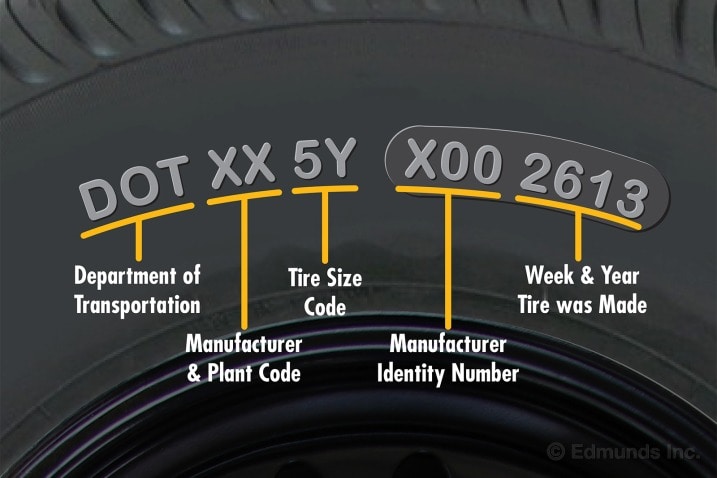
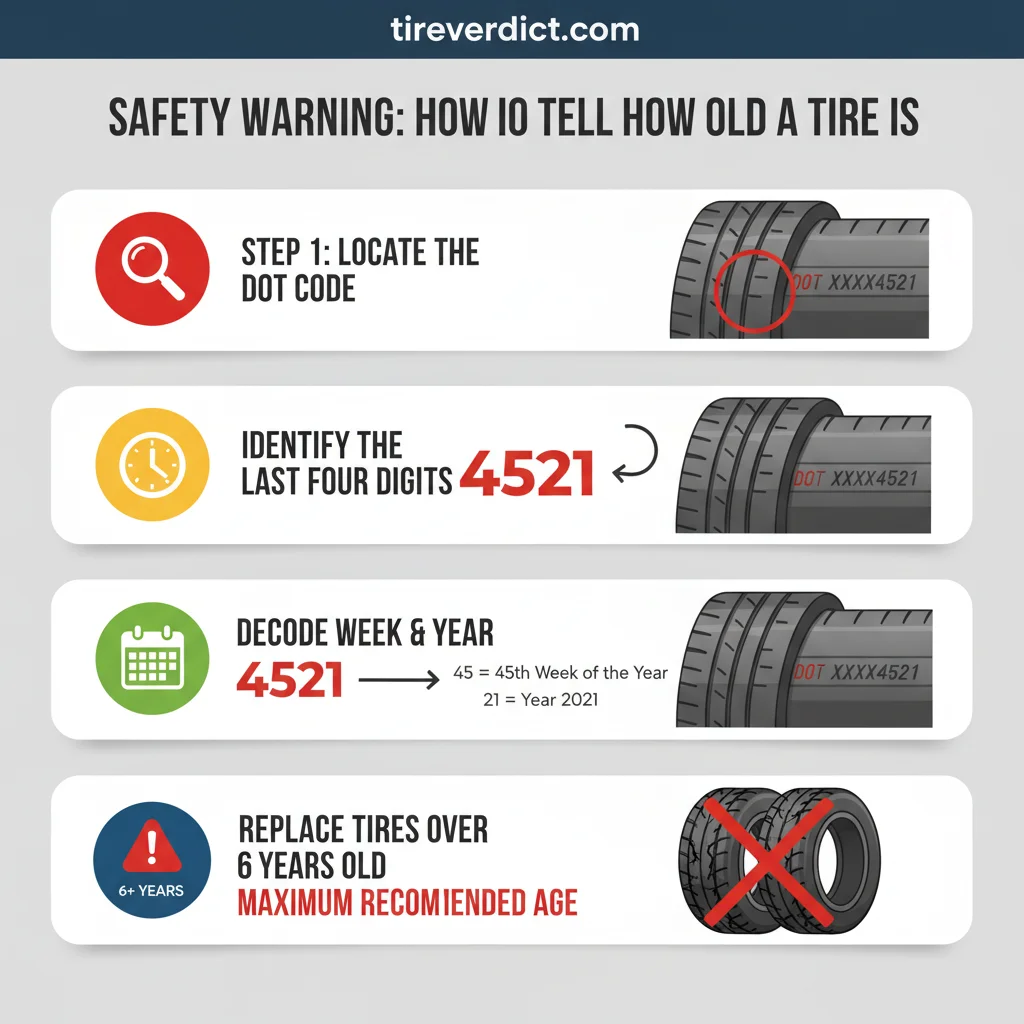
Step 1: Locate the Department of Transportation acronym followed by a series of letters and numbers on the outer sidewall. This “DOT” marking indicates that the tire complies with U.S. safety standards.
:max_bytes(150000):strip_icc()/tire_sidewall_euro-56a956025f9b58b7d0fa73d9.jpg)
It typically appears as a string of 10 to 12 characters, often beginning with ‘DOT’ and continuing with plant codes and size information. If you cannot find a clear DOT marking or it appears incomplete, stop your inspection and escalate to a certified tire professional.
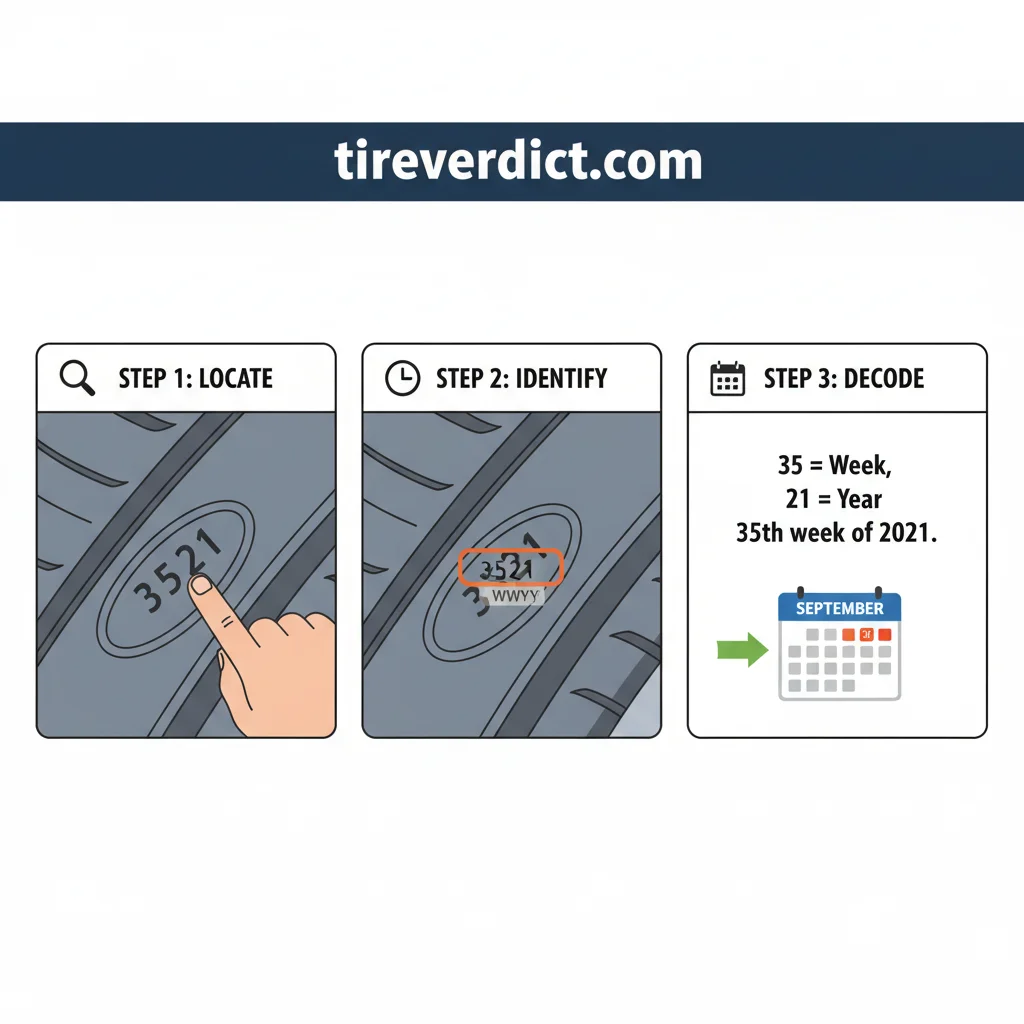
Step 2: Identify the 4-digit manufacturing date sequence. This specific sequence is consistently located at the very end of the entire DOT code string.
Its format is always two digits for the week followed by two digits for the year. This ensures a consistent method for how to decode tire DOT code information.
Step 3: Interpret the week code. The first two digits of this 4-digit sequence (e.g., ’24’ in a ‘2426’ code) directly indicate the week of the year when the tire was manufactured. These values range from 01 (the first week of January) to 52 (the last week of December), providing precise production timing.
Step 4: Interpret the year code. The final two digits of the 4-digit sequence (e.g., ’26’ in ‘2426’) signify the specific year of manufacture. For instance, a ’26’ means the tire was produced in 2026.
This year information is fundamental for assessing the tire’s chronological age against current tire expiration safety standards.
Step 5: Verify both sidewalls for the complete code. Although the DOT code is legally required on only one sidewall, manufacturers sometimes print the full, legible date code on the inner sidewall.
This inward placement can occur despite the outer side showing an abbreviated or partial code. If outward markings are worn or partial, diligently inspect the inner sidewall by turning the wheel or lifting the vehicle.
If the critical 4-digit code remains missing or undeterminable after checking both sides, stop immediately. Consider the tire’s age unidentifiable and seek professional assessment. Its safety cannot be reliably determined in such instances.
Be aware of these 7 risk factors that invalidate standard age limits even if the date code seems acceptable. While the DOT code offers a precise date, it’s also vital to consider any visible signs of rubber degradation.
7 Risk Factors That Invalidate Standard Age Limits
While the manufacturing date provides a baseline, our research into tire engineering journal studies shows seven factors that accelerate rubber failure and compromise tire integrity sooner than expected. These environmental and usage conditions can lead to premature rubber degradation signs, overriding the chronological age determined by the tire manufacturing date location.

- Extreme Heat Exposure: Sustained exposure to high temperatures, particularly above 100°F (38°C), significantly accelerates the chemical processes that break down rubber compounds. This can occur in hot climates or from prolonged friction due to underinflation.
- UV Radiation Damage: Ultraviolet (UV) light from direct sunlight causes the rubber polymers to cross-link and harden, leading to cracking and brittleness. Tires stored outdoors or on vehicles parked in direct sun frequently exhibit this damage.
- Chemical Contamination: Contact with petroleum-based products, lubricants, or certain cleaning agents can rapidly degrade rubber. Chemicals such as oil, grease, harsh detergents, or aggressive tire shine products can strip protective waxes from the rubber, leading to premature aging.
- Improper Inflation History: Both overinflation and underinflation stress the tire’s structure beyond its design limits. Underinflation generates excessive heat, while both conditions can lead to internal structural fatigue and separation, exacerbating age-related weaknesses.
- Coastal Salt Air: Living or operating vehicles in coastal regions exposes tires to salt-laden air, which can accelerate corrosion of internal steel belts and contribute to rubber hardening.
- Ozone Exposure: Ozone, a naturally occurring gas and a component of smog, reacts with rubber polymers, causing them to crack and become brittle. Tires in urban areas or stored near electric motors that produce ozone are more susceptible.
- Infrequent Use/Long-Term Parking: Tires that sit static for extended periods develop “flat spots” and experience uneven internal stress distribution. The lack of flex and rotation prevents protective waxes within the rubber from migrating to the surface, leaving them vulnerable to environmental degradation.
Next, we examine the differences between DOT code vs visual rubber degradation for safety monitoring.
DOT Code vs Visual Rubber Degradation for Safety
A common mistake is assuming that high tread depth equates to a safe tire regardless of its chronological age. While adequate tread depth is undeniably vital for traction, particularly in adverse weather, it provides no indication of the rubber’s internal structural integrity or its susceptibility to sudden failure due to age.
Our research consistently highlights the critical importance of both the manufacturing date and a thorough visual inspection for comprehensive tire safety monitoring.
Visual Checking Patterns
Careful visual inspection should focus on identifying rubber degradation signs beyond mere tread wear. We advise looking for fine cracks, often described as “crazing” or “checking,” which typically appear along the sidewall, particularly near the bead, and within the grooves of the tread base.
Any crack deeper than 1/16th of an inch (1.6 mm) suggests significant aging and demands immediate professional evaluation, regardless of the tire’s DOT code.
Internal Structure Integrity
The most dangerous aspect of aged tires is their compromised internal structure integrity. Even if the rubber appears pristine externally, the bonding agents between the steel belts, fabric plies, and rubber compounds can weaken and delaminate over time.
This internal separation often manifests as a low-speed wobble, unusual vibrations, or subtle changes in handling, potentially leading to catastrophic tread separation at higher speeds, which is a major safety concern for 2026.
The Tread Depth Trap
Relying solely on the penny test for tread depth to determine tire safety creates a dangerous ‘tread depth trap’. While sufficient tread is undeniably necessary for performance, it is not a standalone indicator of overall tire safety.
The calendar testchecking the tire manufacturing date location via the DOT codemust always complement tread depth measurements. A tire may exhibit legal tread but still be profoundly unsafe if it has exceeded its recommended service life of six years or mandatory replacement age of ten years, according to NHTSA guidelines.
You might also encounter complications like what if the DOT code is only partial or missing. Understanding these two factors is key to making informed tire replacement decisions for optimal safety.
What If the DOT Code Is Only Partial
In rare instances, the full date code may not be visible on the outward-facing side of the tire due to mounting preferences or manufacturing variations. This can complicate the process of how to tell how old a tire is.
Our research team has encountered several scenarios where the identifying marks are obscured or formatted differently.
Pre-2000 Three Digit Codes
Tires manufactured before the year 2000 utilized a 3-digit date code. This system indicated the week and a single digit for the year (e.g., ‘249’ for the 24th week of 1999).
Any tire with a 3-digit code should be replaced immediately, as it is over two decades old and well past its safe operational life, regardless of its appearance.
Inward Facing Serial Numbers
Manufacturers are required by the U.S. National Highway Traffic Safety Administration (NHTSA) to display the full DOT number, including the date code, on at least one sidewall. However, the full code is often present on only one side, which may be mounted facing inward, towards the vehicle chassis.
If the outward-facing side has an abbreviated or partial code, it is imperative to check the inward-facing sidewall for the complete sequence.
Illegible Sidewall Surface
Over time, environmental exposure, curb scuffs, or harsh cleaning chemicals can wear down or obscure the molded markings on the tire sidewall. An illegible sidewall surface, where the DOT code cannot be clearly read, renders the tire’s age undeterminable.
In such cases, the tire must be treated as expired until professional verification is possible, as its safety cannot be guaranteed.
If these visual checks remain inconclusive, you must know when to consult a certified tire professional.
When to Consult a Certified Tire Professional
Step 1: If you observe any physical deformity like bulges, stop driving immediately and escalate to a certified technician. These deformities indicate a severe structural failure within the tire’s internal plies, posing an immediate blowout risk.
Step 2: Experience unexplained vibration or a low-speed wobble. This is a common sign of internal belt separation, a critical defect that can lead to catastrophic failure. Even if the tire appears normal, this symptom requires expert diagnosis.
Step 3: Discover severe or extensive cracking on the sidewall or tread that extends deep into the rubber. While minor surface cracks are common in older tires, deep or spreading cracks are rubber degradation signs that indicate significant material breakdown and a loss of structural integrity.
Step 4: The tire manufacturing date location remains undeterminable after thorough inspection of both sidewalls. If you cannot reliably decode tire DOT code information, the tire’s safety cannot be assessed, and professional evaluation is essential.
Step 5: Any tire has exceeded 10 years from its manufacturing date, regardless of its visual condition or remaining tread depth. Experts confirm that rubber compounds degrade irreversibly over this period, making the tire unsafe.
Our analysis is supported by the following technical resources and safety standards.
7 Authoritative Sources for Tire Safety Research
We utilized data from the National Highway Traffic Safety Administration (NHTSA) and the Rubber Manufacturers Association (RMA) to compile this visual safety protocol. Our research incorporates findings from leading automotive safety organizations and industry bodies to provide evidence-led analysis on how to tell how old a tire is.
- National Highway Traffic Safety Administration (NHTSA)
- Rubber Manufacturers Association (RMA) / U.S. Tire Manufacturers Association (USTMA)
- Tire Industry Association (TIA)
- TireVerdict research standards
- Leading tire manufacturers’ official safety guidelines (e.g., Michelin, Goodyear)
- Peer-reviewed automotive engineering journals (e.g., SAE International)
- Consumer Reports independent tire testing data
These sources contribute to our comprehensive understanding of tire expiration safety standards and rubber degradation signs.
Concluding our protocol on tire age verification.
To prioritize vehicle safety in 2026, always locate the 4-digit DOT code on your tire’s sidewall to determine its exact manufacturing week and year. Our research shows that tires should be replaced if they are older than 10 years, regardless of appearance.
Replace them sooner if they show signs of environmental damage after 6 years. It is crucial to visually inspect for rubber degradation signs like dry rot and cracking.
Chronological age is only one critical safety metric. We emphasize that understanding how to tell how old a tire is empowers you to make informed decisions.
Check the DOT codes on your current tires today and schedule a replacement if they exceed these safety thresholds. This action ensures your continued safety on the road.
How Do You Find the Age of a Tire?
You find the age by locating the DOT code on the tire sidewall, specifically the final four digits. The first two digits represent the week of manufacture, and the last two digits denote the year. For example, ‘1526’ means the 15th week of 2026.
Where Is the DOT Code on a Tire?
The DOT code is located on the lower sidewall of the tire, usually near the wheel rim. It begins with the letters ‘DOT’ followed by a series of 10 to 12 alphanumeric characters. This code may sometimes only be fully visible on the inward-facing sidewall.
Do Tires Expire After 10 Years?
Yes, most manufacturers and safety organizations, including NHTSA, recommend replacing tires every 10 years from their manufacturing date regardless of tread wear or apparent condition. Even if the tire looks new, the internal rubber compounds and structural integrity degrade significantly by this age.
What Does a 4 Digit Tire Code Mean?
A 4-digit tire code indicates the exact manufacturing date. The first two digits (01-52) represent the week of the year, while the final two digits signify the last two digits of the manufacturing year. This allows precise identification of how old a tire is.
Can You Drive on 15 Year Old Tires?
No, driving on 15-year-old tires is extremely dangerous and not recommended by safety experts. Rubber that old has likely experienced significant oxidation and internal degradation, dramatically increasing the risk of tread separation or catastrophic failure, even if it has never been used.
- known as oxidation (en.wikipedia.org)
- National Highway Traffic Safety Administration (NHTSA) (nhtsa.gov)
- RV tire blowout rates (rvia.org)
- tire engineering journal studies (saemobilus.sae.org)
- Rubber Manufacturers Association (RMA) (ustires.org)
- Tire Industry Association (TIA) (tireindustry.org)
- Michelin (michelinman.com)
- Consumer Reports independent tire testing data (consumerreports.org)